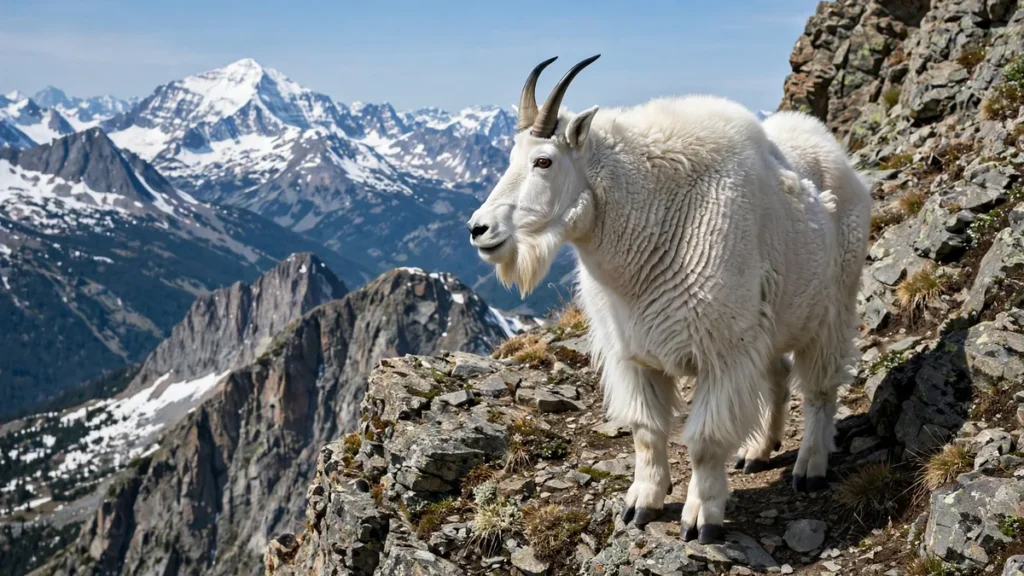
The mountain goat species is a single species, Oreamnos americanus, and despite its name it is not a true goat at all. If you are asking what kind of animal a mountain goat is, the answer is a goat-antelope, a white, shaggy, sure-footed climber of the high mountains of western North America, closer to the chamois and the serows than to any farmyard goat, and the only species in its genus.
Mountain goats live where almost nothing else can, on steep cliffs and rocky ridges high above the tree line, in Alaska, Canada and the Rockies. They are built for the cold and the heights: a thick double coat of white wool, a beard, short black horns, and cloven hooves with rough pads that grip bare rock like climbing shoes.
Key takeaways
- The mountain goat is a single species, Oreamnos americanus, and it is a goat-antelope, not a true goat — its closest relatives are the chamois and the serows.
- Mountain goats stand about 90 to 110 centimetres at the shoulder and weigh about 45 to 140 kilograms, males larger than females, and both sexes carry short black horns.
- Mountain goats live on steep cliffs and alpine ridges from Alaska to the Rockies, at heights of up to about 4,000 metres, and rarely leave the safety of the rocks.
- Mountain goats eat grasses, sedges, herbs, shrubs, mosses and lichens, and they travel to mineral licks to lick salt from the soil.
- The mountain goat is listed as Least Concern, with about 48,000 to 62,000 mature animals, and its numbers are stable, though disturbance and a warming climate threaten it.
What makes a mountain goat a mountain goat
A mountain goat is easy to recognise, though it is often confused with the wild sheep that share its mountains. It is covered in shaggy white fur, with a thick woolly undercoat and long guard hairs that shed in great mats in summer. It has a beard, a short black tail, and slender black horns that curve back slightly, about 21 to 30 centimetres long in males and a little shorter in females. Both sexes have horns and a beard, though the male’s beard is longer.
What really sets the mountain goat apart is its feet. Each hoof is split into two toes that can spread wide, with a hard outer rim and a rough, rubbery pad that grips rock, and sharp dewclaws that act like crampons on ice and snow. With those feet, powerful shoulders and a low centre of gravity, a mountain goat can climb slopes that look almost vertical and leap from ledge to ledge with ease. Like the bighorn sheep, another cliff-dwelling mountain animal, a mountain goat trusts its feet more than its speed, and it runs to the steepest rocks it can find when danger comes near.
The mountain goat species and its relatives
The mountain goat is the only species in the genus Oreamnos, in the bovid family Bovidae, which also holds the antelopes, sheep, goats and cattle. Its closest relatives are the chamois and the serows, also goat-antelopes, with stocky bodies, short horns and lives spent on steep ground. It is not a true goat: true goats belong to the genus Capra, and the mountain goat split from their line millions of years ago.
The scientific name, Oreamnos americanus, means the American mountain lamb, and it was first described from animals in the Rocky Mountains. No subspecies are recognised today, though goats from different mountains vary a little in size and coat. Like the eland, the largest of the antelopes, the mountain goat is a bovid, but it is built for cold cliffs rather than open plains.
| Type | Animal | Where it lives | Best-known food | Length or Weight |
|---|---|---|---|---|
| Genus | Mountain goat (genus Oreamnos) | High mountains of western North America | Grasses, herbs and shrubs | About 90 to 110 cm at the shoulder |
| Species | Mountain goat (Oreamnos americanus) | Alaska to the Rocky Mountains | Grasses, sedges and lichens | About 45 to 140 kg |
| Relative | Alpine chamois (Rupicapra rupicapra) | Mountains of Europe | Grasses, herbs and shrubs | About 25 to 50 kg |
| Relative | Japanese serow (Capricornis crispus) | Forested mountains of Japan | Leaves, shoots and acorns | About 30 to 45 kg |
| Relative | Bighorn sheep (Ovis canadensis) | Rocky Mountains | Grasses and shrubs | About 70 to 140 kg |
| Relative | Dall sheep (Ovis dalli) | Mountains of Alaska and Yukon | Grasses, sedges and lichens | About 50 to 110 kg |
| Relative | True goat (Capra species) | Mountains of Europe, Asia and Africa | Grasses, leaves and shrubs | About 30 to 120 kg |
How mountain goats live
Mountain goats are grazers and browsers, eating almost any plant they can reach on the high slopes. In summer they feed on grasses, sedges, herbs and shrub leaves, and in winter, when the high meadows are buried in snow, they move to steep, windswept ridges where the snow is thin and eat mosses, lichens and shrub twigs. They also need salt, travelling to mineral licks, and they famously seek the salt in human sweat at campsites.
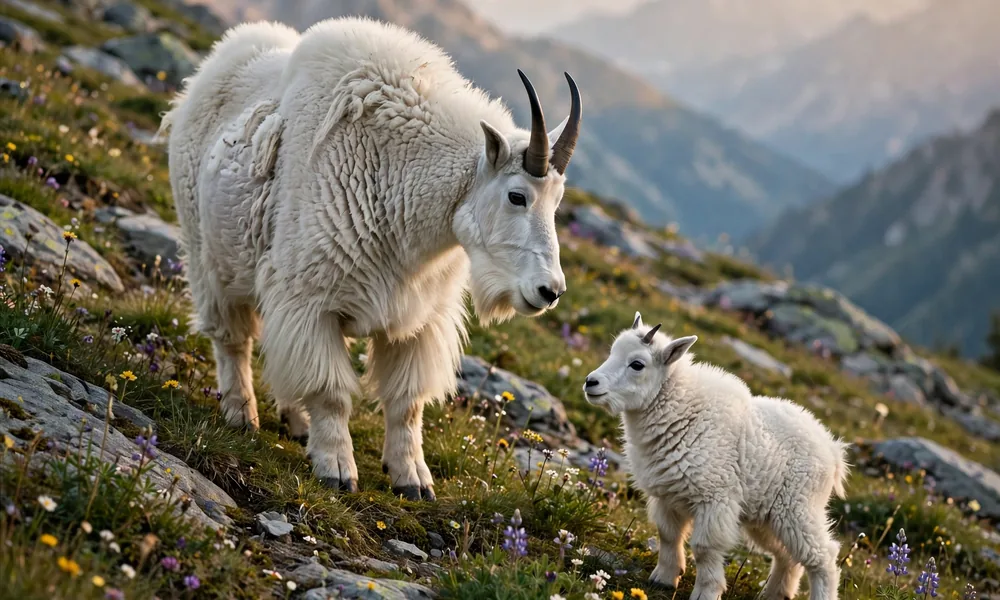
Mountain goats live in two kinds of group. Females, called nannies, spend most of the year in nursery herds with their young, called kids, and these groups usually hold up to about 20 animals, though they can be larger in summer. Males, called billies, usually live alone or with one or two other males, joining the females only in the breeding season, in November and December. A female gives birth to a single kid, rarely twins, in late May or June, after a pregnancy of about six months, and the kid can stand within hours and follow its mother across steep ground within days.
Mountain goats are active by day, feeding in the morning and evening and resting in the heat of the day, often on a cool ledge where they can see danger coming. They are not fast runners, and they do not need to be: when a predator such as a cougar, bear or wolf appears, a mountain goat climbs to the steepest rock it can find, where few predators can follow. Mountain goats live for about 12 to 15 years in the wild and up to 20 years in captivity.
Where mountain goats live
Mountain goats live in the high mountains of western North America, from Alaska and the Yukon through British Columbia and Alberta to Washington, Oregon, Idaho, Montana, Wyoming and Colorado. They live above the tree line, on cliffs, rocky ridges and alpine meadows, at heights of up to about 4,000 metres, coming down to lower slopes only in winter, when deep snow covers the high ground.
Each herd has its own mountain, and mountain goats rarely travel far. They know every ledge and escape route on their home cliffs, and they use the same mineral licks, bedding ledges and kidding grounds year after year. In summer they spread out across the alpine meadows to feed, and in winter they gather on steep, windswept ridges where the wind blows the snow away and the sun warms the rock. Goats have also been introduced to new ranges: six released in Utah in the late 1960s grew into a population of more than 2,000.
The mountain goat is listed as Least Concern, because it is widespread and its numbers are stable, with about 48,000 to 62,000 mature animals across North America. Most live in British Columbia and Alaska. Mountain goats are sensitive to disturbance, especially from helicopters and hikers near their kidding cliffs, and a warming climate is shrinking the alpine meadows they depend on, so their future depends on keeping their high mountain homes quiet and wild.
Best seasons for mountain goat watching
The best time to watch mountain goats is in summer, from June to September, when the snow has melted and the goats are out on the alpine meadows with their kids. Mornings and evenings are best, because the goats feed in the cool hours and rest on shady ledges in the heat of the day, and a long lens helps, because the goats are often far above the trail.
Staying safe around mountain goats
A mountain goat is not usually aggressive, but it is a large wild animal with sharp horns, and it should always be watched from a distance. Never approach one, especially a nanny with a kid, and never get between a goat and its escape route to the cliffs. Keep at least 50 metres away, never feed a goat, and be careful at campsites, where goats come looking for salt and can become bold.
Mountain goat watching checklist
A little preparation turns a mountain walk into a real chance of seeing a mountain goat.
- A summer morning or evening, when mountain goats feed on the alpine meadows.
- A high trail above the tree line, with cliffs and rocky ridges in view.
- Binoculars or a telescope, because mountain goats are often far above the trail.
- A camera with a zoom lens, for close views of white coats and black horns.
- A field guide to North American mammals, for telling a mountain goat from a Dall sheep.
- Warm layers, sun protection and plenty of water, because alpine weather changes fast.
- Sturdy boots and a steady pace, because the best goat cliffs are reached on steep paths.
Frequently asked questions
Is a mountain goat a true goat?
No. A mountain goat is a goat-antelope, not a true goat. Its scientific name is Oreamnos americanus, and its closest relatives are the chamois and the serows. True goats belong to the genus Capra, and the mountain goat is the only species in its own genus, Oreamnos.
How big is a mountain goat?
A mountain goat stands about 90 to 110 centimetres at the shoulder and weighs about 45 to 140 kilograms. Males weigh about 95 to 115 kilograms, females about 60 to 75 kilograms, and both sexes carry short black horns about 21 to 30 centimetres long.
Where do mountain goats live?
Mountain goats live in the high mountains of western North America, from Alaska and the Yukon through British Columbia and Alberta to Washington, Oregon, Idaho, Montana, Wyoming and Colorado, above the tree line, on cliffs, rocky ridges and alpine meadows, at heights of up to about 4,000 metres.
What does a mountain goat eat?
Mountain goats eat grasses, sedges, herbs, shrubs, mosses and lichens. In summer they graze the alpine meadows, and in winter they eat mosses, lichens and shrub twigs on steep, windswept ridges, and they visit mineral licks to lick salt from the soil.
How is this guide different from the marmoset species guide?
This guide covers the mountain goat, a single species of white goat-antelope that lives on the high cliffs of North America and eats grasses and lichens, while our marmoset species guide covers the marmoset, about 22 species of tiny tree-dwelling monkeys from South American forests that eat tree gum and insects. Mountain goats climb cliffs, and marmosets climb trees.
Are mountain goats endangered?
No. The mountain goat is listed as Least Concern, with about 48,000 to 62,000 mature animals across North America, and its numbers are stable. It is sensitive to disturbance near its kidding cliffs, and a warming climate is shrinking the alpine meadows it depends on.
Conclusion
The mountain goat species shows how one animal can master a world that looks uninhabitable: a single species, Oreamnos americanus, a white goat-antelope that is not a goat at all, living on cliffs and ridges where wind, cold and height keep almost everything else away.
If you go looking for one, go on a summer morning, and look up at the cliffs above the trail. Watch a white shape pick its way across a ledge that looks too narrow to stand on, and you will see why the mountain goat is the finest climber in North America.