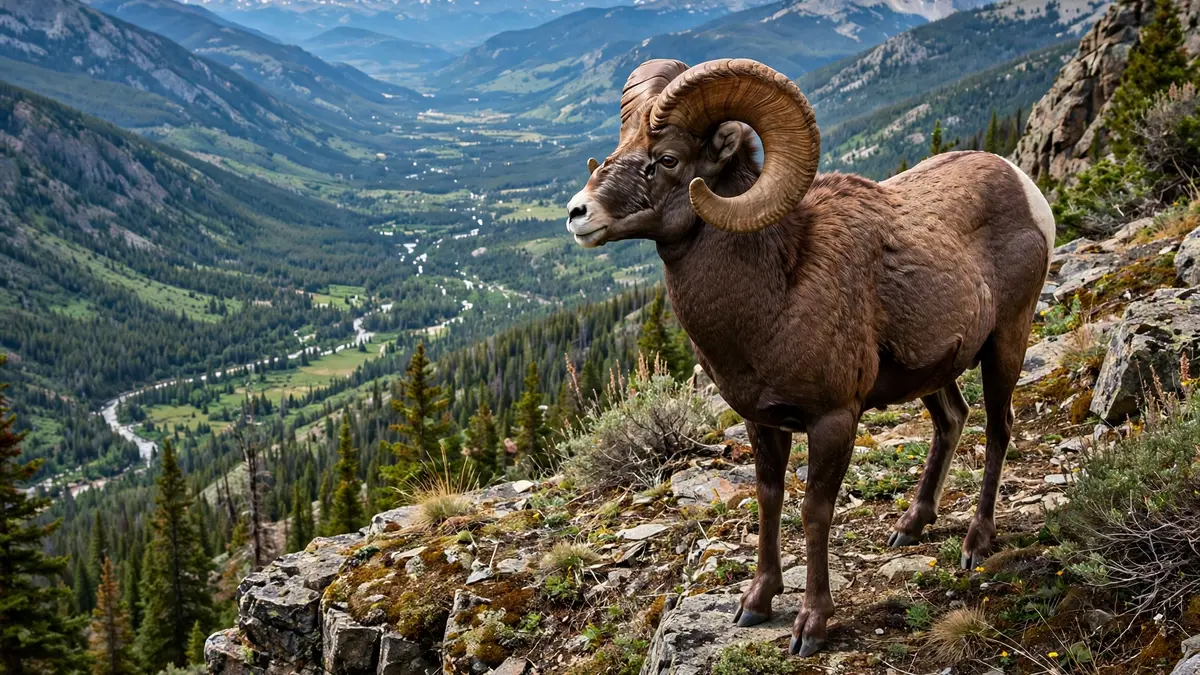
The bighorn sheep species number one, a single species called Ovis canadensis, and it is the curl-horned sheep of the Rocky Mountains, a climber of steep cliffs. If you are asking how many bighorn sheep species there are, the answer is one: there is one recognised bighorn sheep species in the world, and every bighorn sheep alive today belongs to it.
The bighorn sheep lives in the mountains and deserts of western North America, from southern Canada to Mexico, on steep rocky slopes where few other animals can go. Its massive curling horns, its sure feet, its chocolate-brown coat and its dramatic rut battles make it one of the most admired animals in the world.
Key takeaways
- There is one bighorn sheep species, Ovis canadensis, with three living subspecies.
- Bighorn sheep weigh 73 to 113 kilogrammes, with males up to 159 kilogrammes, and stand about 102 centimetres at the shoulder.
- A ram’s horns can weigh up to 14 kilogrammes, as much as all the other bones in its body.
- Bighorn sheep eat grasses, sedges and shrubs, and they climb steep cliffs to escape predators.
- Bighorn sheep are listed as Least Concern, though the Sierra Nevada subspecies is endangered.
What makes a bighorn sheep a bighorn sheep
A bighorn sheep is a stocky hoofed mammal with a chocolate-brown coat, a white rump patch, a white muzzle and belly, and, in the ram, massive horns that curl around the ears in a full spiral, and it measures about 160 to 180 centimetres long, stands about 90 to 102 centimetres at the shoulder, and usually weighs between 73 and 113 kilogrammes, though large males may weigh more than 159 kilogrammes. The ewe is smaller, with short horns that curve only slightly.
The horns define the bighorn sheep: a pair of ram’s horns can weigh up to 14 kilogrammes, as much as all the other bones in the male’s body, and they grow throughout life, with growth rings that show the ram’s age. Like other golden eagles, the bighorn sheep is an animal of the high mountains, but it is a sheep, not an eagle, and it climbs cliffs on split hooves, not on wings, and its horns are for fighting, not for hunting.
The bighorn sheep species and their relatives
There is one bighorn sheep species. It has three living subspecies: the Rocky Mountain bighorn sheep, the Sierra Nevada bighorn sheep and the desert bighorn sheep, and they differ in size, horn shape and range. The Rocky Mountain bighorn is the largest, living in the high Rockies from Canada to Colorado, while the desert bighorn is the smallest, living in the deserts of the south-western United States and Mexico.
The Dall sheep is the bighorn sheep’s closest relative, a white sheep of the mountains of Alaska and north-western Canada, while the Stone sheep is a dark sheep of northern British Columbia and the Yukon. The mountain goat is a white goat of the high peaks that is not a true goat, the ibex is a wild goat of the mountains of Europe and Asia, and the mouflon is the wild ancestor of the domestic sheep.

| Type | Animal | Where it lives | Best-known food | Length or Weight |
|---|---|---|---|---|
| Species | Bighorn sheep (Ovis canadensis) | Mountains and deserts of western North America | Grasses, sedges and shrubs | 73 to 113 kg, up to 159 kg |
| Close relative | Dall sheep | Mountains of Alaska and north-western Canada | Grasses, sedges and shrubs | 73 to 113 kg, up to 140 kg |
| Close relative | Stone sheep | Mountains of British Columbia and Yukon | Grasses, sedges and shrubs | 80 to 110 kg, up to 140 kg |
| Close relative | Mountain goat | High peaks of western North America | Grasses, mosses and lichens | 45 to 140 kg, up to 140 kg |
| Close relative | Alpine ibex | Alps of Europe | Grasses, herbs and shrubs | 65 to 120 kg, up to 120 kg |
| Close relative | Mouflon | Mountains of the Mediterranean | Grasses, herbs and shrubs | 25 to 55 kg, up to 55 kg |
| Close relative | Domestic sheep | Farms worldwide | Grass and hay | 45 to 160 kg, up to 160 kg |
How bighorn sheep live
Bighorn sheep are creatures of the steep cliff. A bighorn sheep lives in single-sex groups of two to twelve animals, with rams in bachelor flocks and ewes with their lambs, and it moves between high summer pastures and sheltered winter valleys, travelling up to 32 kilometres between seasons. Like other coyotes, the bighorn sheep is an animal of the open west, but it is a sheep, not a coyote, and it climbs cliffs to escape predators, not to hunt them.
Grasses make up most of the diet in summer, along with sedges, clover and herbs, and woody plants like willow and sage in winter, and a bighorn sheep eats by grazing quickly in the open, then retreating to a cliff ledge to chew its cud in safety. It feeds mostly in the morning and evening, when the grass is cool and the predators are resting, and in desert areas it eats cacti and holly for water, going for long periods without drinking.
Breeding is an autumn affair, and the rams clash in dramatic battles for the ewes, charging at each other from several metres away and crashing their horns together with a crack that can be heard a kilometre away. The shock is absorbed by a double layer of bone in the skull, and the winner mates with the ewes. The ewe has her first lamb at three or four years old, after a pregnancy of nearly six months, and the single lamb weighs 3 to 5 kilogrammes and can stand within hours. Bighorn sheep live for about 10 to 20 years in the wild.
Where bighorn sheep live
The bighorn sheep lives in the western mountains of North America, from southern Canada to Mexico, and in the Rocky Mountains, the Sierra Nevada and the deserts of the south-west, and it is most common where there are steep rocky slopes close to grassy meadows. It is a symbol of the American west, and it is the state mammal of Colorado and Nevada.
Steep rocky ground is the key requirement. A bighorn sheep needs cliffs and ledges where it can escape from coyotes, mountain lions and eagles, with grassy meadows nearby for feeding, so it returns to the same ranges year after year, generation after generation, and when the cliffs are lost to roads and mines the sheep disappear, because they cannot live on flat ground.
Bighorn sheep are listed as Least Concern, and their numbers have recovered well from hunting, though the Sierra Nevada subspecies is endangered, with only a few hundred animals left. The main pressures are disease from domestic sheep, the loss of habitat, and collisions with cars, though bighorn sheep are protected by law and many herds have been brought back by moving animals to empty mountains.
Best seasons for bighorn sheep watching
There is no closed season, because bighorn sheep are active all year, but the best time to look for them depends on where you go. In the Rockies the best months are often June to September, when the sheep are on the high summer pastures and the mountain roads are open. In the deserts the best months are often October to April, when the sheep are in the low valleys and the heat is bearable.
Staying safe around bighorn sheep
A bighorn sheep is a wild animal with massive horns and great strength, and a ram can injure a person who comes too close during the rut, though bighorn sheep almost never attack people. Keep your distance, never touch a lamb, and never feed a sheep, because a sheep that is fed by people may lose its fear and become a danger. If you see bighorn sheep while walking in the mountains, stay calm, stay still, and let them come to you, because sheep that are chased may fall from the cliffs.
Bighorn sheep watching checklist
A little preparation turns a mountain visit into a real chance of seeing a bighorn sheep, so pack for cold, wind and long quiet hours.
- Binoculars, because the sheep are high on the cliffs and best watched from a distance.
- A camera with a zoom lens, for the curling horns and the white rump patch without getting close.
- A telescope, for the cliff ledges, because the sheep rest on ledges far above the valley.
- A booked mountain park with a ranger who knows the bighorn sheep ranges and the safe routes.
- A plan to be out in the morning, when the sheep are most active and grazing.
- Patience and silence, because sheep are shy animals and a noisy group will send them away.
- A field guide to wild sheep, for telling a bighorn from a Dall sheep at a glance.
Frequently asked questions
How many bighorn sheep species are there?
There is one bighorn sheep species, Ovis canadensis. It has three living subspecies, the Rocky Mountain, Sierra Nevada and desert bighorns, but scientists now recognise it as a single species, and the old seven-subspecies split has been shown by DNA to be largely illusory.
How heavy are a ram’s horns?
A ram’s horns can weigh up to 14 kilogrammes, as much as all the other bones in the male’s body put together. The horns grow throughout life, with growth rings that show the ram’s age, and the oldest rams have horns more than a metre long.
What do bighorn sheep eat?
Bighorn sheep eat grasses, sedges, clover and herbs in summer, and woody plants like willow and sage in winter. In desert areas they eat cacti and holly for water, and they can go for long periods without drinking.
Do bighorn sheep really clash horns?
Yes. During the rut, rams charge at each other from several metres away and crash their horns together, and the sound can be heard a kilometre away. A double layer of bone in the skull absorbs the shock, and the winner mates with the ewes.
How is this guide different from the American goldfinch species guide?
This guide covers the single bighorn sheep species, a curl-horned sheep of the Rocky Mountains that eats grass, while our American goldfinch species guide covers the single American goldfinch species, a bright yellow finch that eats seeds in thistle fields. The bighorn sheep weighs 73 to 113 kilogrammes and climbs cliffs, and the American goldfinch measures 11 to 14 centimetres and hangs from thistles.
Are bighorn sheep endangered?
Not as a species. Bighorn sheep are listed as Least Concern, though the Sierra Nevada subspecies is endangered, with only a few hundred animals left. Disease from domestic sheep and the loss of habitat are the main threats to watch.
Conclusion
The bighorn sheep species shows how much strength one mountain animal can hold: a single species of curl-horned sheep, with horns like stone, feet like iron, and a life spent between the high pasture and the steep cliff.
If you go looking for one, go in the summer to the Rockies, go quietly, and go with patience. Watch a bighorn ram stand on a ledge no wider than your hand and you will understand why it has earned its place as the symbol of the American mountains, and why keeping its cliffs wild matters most.