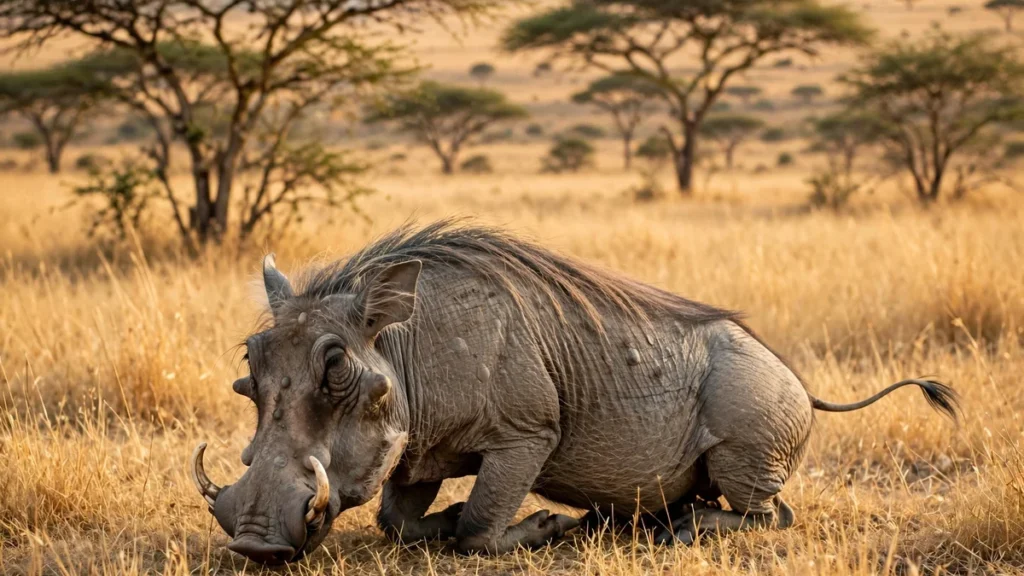
The warthog species number two, common and desert warthogs, kneeling grazers of the African savanna, and they are the most common wild pigs in Africa. If you are asking how many warthog species there are, the answer is two: there are two recognised warthog species in the world, the common warthog and the desert warthog, and every warthog alive today belongs to one of them.
The warthog belongs to the family Suidae, the pigs, and it lives on the savannas and dry plains of sub-Saharan Africa, from Senegal to South Africa. Its grey skin, its warty face, its curved tusks and its habit of running with its tail held high make it one of the most recognisable animals of the African plains.
Key takeaways
- There are two warthog species, the common warthog and the desert warthog, both in the genus Phacochoerus.
- Warthogs graze on their knees, with callused pads on their front legs, and they can run at up to 48 kilometres per hour.
- Warthogs live in burrows, often old aardvark burrows, and they back into the burrow so their tusks face out.
- Male warthogs have large warts on their faces and curved tusks of up to 60 centimetres.
- Both warthog species are listed as Least Concern, and they are common across sub-Saharan Africa.
What makes a warthog a warthog
A warthog is a grey pig with a large head, a mane of dark hair along its neck and back, warty bumps on its face, curved tusks and a thin tail with a tuft at the end, and it measures roughly 0.9 to 1.5 metres long and usually weighs between 50 and 150 kilogrammes, with males larger than females. The common warthog is the larger of the two, at up to 150 kilogrammes, while the desert warthog is smaller, at up to 75 kilogrammes, with a flatter face and smaller ears.
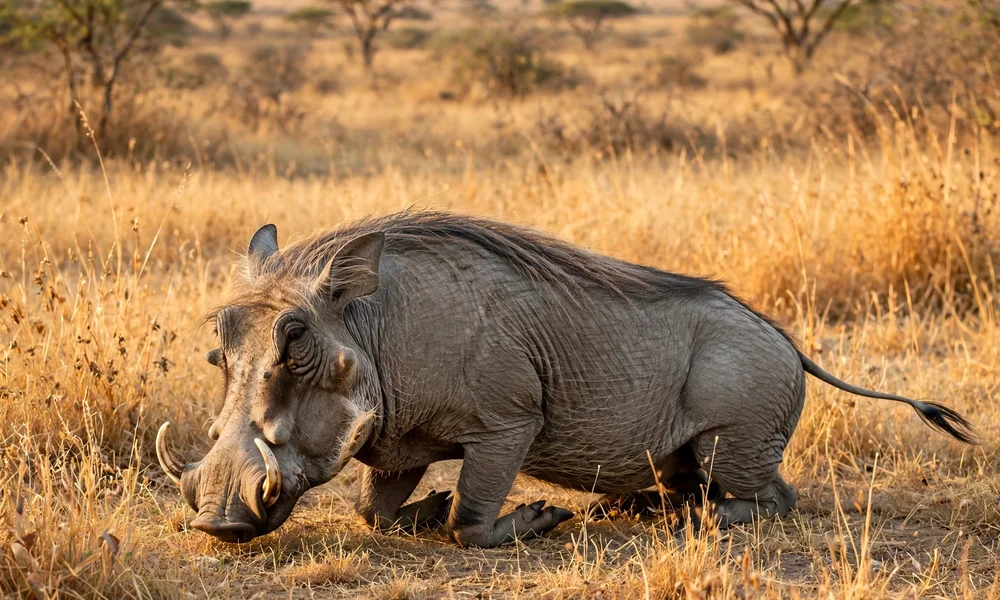
The knees define the warthog: thick callused pads on its front legs that let it kneel to graze on short grass, and the warthog spends hours on its knees, digging for roots and bulbs with its snout. The tail defines it too, and a warthog runs with its tail held straight up like a flag, warning the rest of the group. Like other wild boars, the warthog is a tough wild pig, but it lives in the open savanna, while the wild boar lives in forests and woodlands.
The warthog species and their relatives
There are two warthog species. The common warthog lives across sub-Saharan Africa, from Senegal to South Africa, and it is the warthog most people see on safari. The desert warthog lives in the dry Horn of Africa, in Ethiopia, Somalia and northern Kenya, and it was once thought to be the same species, but scientists split them in the 1990s.
The wild boar is the warthog’s most famous relative, a pig of the forests of Europe and Asia, while the bushpig is a reddish pig of the forests of Africa. The giant forest hog is the largest wild pig in the world, living in the forests of Central Africa, and the red river hog is a bright orange pig of the rainforests of West Africa. The domestic pig descends from the wild boar, and it is kept on farms worldwide.
| Type | Animal | Where it lives | Best-known food | Length or Weight |
|---|---|---|---|---|
| Species | Common warthog (Phacochoerus africanus) | Savanna of sub-Saharan Africa | Grass, roots and bulbs | 0.9 to 1.5 m, 50 to 150 kg |
| Close relative | Desert warthog | Horn of Africa | Grass, roots and bulbs | 0.9 to 1.4 m, 45 to 75 kg |
| Close relative | Wild boar | Forests of Europe and Asia | Roots, acorns and worms | 0.9 to 1.8 m, 60 to 300 kg |
| Close relative | Bushpig | Forests of sub-Saharan Africa | Roots, fruit and insects | 0.9 to 1.5 m, 54 to 115 kg |
| Close relative | Giant forest hog | Forests of Central Africa | Grass, leaves and fruit | 1.3 to 2.1 m, 100 to 275 kg |
| Close relative | Red river hog | Rainforests of West Africa | Roots, fruit and insects | 1 to 1.4 m, 45 to 115 kg |
| Close relative | Domestic pig | Farms worldwide | Grain, vegetables and scraps | 0.9 to 1.8 m, 50 to 350 kg |
How warthogs live
Warthogs are creatures of the open savanna. A warthog lives in a small group, a mother with her piglets, or a lone male, and the groups share burrows and feeding grounds, though they are not as social as other pigs. Like other African buffalo, the warthog is a grazer of the savanna, but it is small and fast, and it runs from danger instead of standing its ground.
Grass, roots and bulbs make up most of the diet, along with fruit, insects and the occasional carrion, and a warthog eats by kneeling on its front knees and digging with its snout, tearing up roots and bulbs from the dry ground. It feeds mostly in the morning and late afternoon, when the sun is low, and it drinks water when it can find it, though it can go for days without drinking in the dry season.
Breeding happens in the dry season, and the female gives birth in her burrow after a pregnancy of about six months, and she has between one and eight piglets, usually two to four. The piglets stay in the burrow for the first weeks, then follow their mother out to graze, and they grow fast, leaving their mother after about a year. Warthogs live for around 7 to 11 years in the wild, and up to 18 years in captivity.
Where warthogs live
The warthog lives on the savannas and dry plains of sub-Saharan Africa, from Senegal in the west to Ethiopia in the east and South Africa in the south, and it is most common in the savannas of Kenya, Tanzania and South Africa, where grass and burrows are plentiful. It is seen regularly in the Serengeti, the Kruger National Park and the Okavango Delta, where warthogs graze the plains.
Grass and burrows are the key requirements. A warthog needs open grassland to graze in, and burrows to sleep in and hide from predators, so it follows the rains as they move across the savanna, and when the dry season comes the warthogs gather around the remaining waterholes. It depends on the grass staying plentiful, and it grazes the same plains year after year, returning to the same burrows.
Both warthog species are listed as Least Concern, and their numbers are stable across most of their range. Warthogs are common across Africa, and the species is one of the most numerous wild pigs on the continent. The main pressures are the loss of grassland to farming, hunting, and disease, though the warthog’s speed and wariness keep most dangers at bay.
Best seasons for warthog watching
There is no closed season, because warthogs are active all year, but the best time to look for them depends on where you go. In the Serengeti the best months are often June to October, the dry season, when the warthogs gather around the waterholes. In Kruger the best months are often May to September, when the warthogs graze the open plains.
Staying safe around warthogs
A warthog is a wild animal with sharp tusks and great speed, and it can injure a person with a slash of its tusks, though warthogs almost never attack people. Keep your distance, never approach a warthog burrow, and never try to touch or feed a warthog, because a warthog that feels cornered will charge without warning. If you see warthogs, stay in your vehicle or behind a guide, and watch with binoculars, because warthogs that are disturbed may bolt and the piglets may be lost.
Warthog watching checklist
A little preparation turns a safari visit into a real chance of seeing a warthog, so pack for sun, dust and long quiet hours.
- Binoculars with good low-light performance, for picking a grey warthog out of the grass.
- A camera with a zoom lens, because warthogs should always be watched from a distance.
- Sun cream and a hat, because the best watching is in the bright midday sun.
- A booked safari with a guide who knows the warthog burrows and the safe routes.
- A plan to be out in the morning, when the warthogs are most active and grazing.
- Patience and silence, because warthogs are wary animals and a noisy group will send them away.
- A field guide to African mammals, for telling a common warthog from a desert warthog at a glance.
Frequently asked questions
How many warthog species are there?
There are two warthog species, the common warthog and the desert warthog. They were once thought to be one species, but scientists split them in the 1990s, and the desert warthog lives only in the Horn of Africa.
Why do warthogs graze on their knees?
Warthogs graze on their knees because their necks are short and their legs are long, so kneeling lets them reach the short grass. They have thick callused pads on their front knees that protect them, and they spend hours each day kneeling to eat.
Why do warthogs run with their tails up?
Warthogs run with their tails held straight up like a flag, and the raised tail warns the rest of the group that danger is near. The piglets follow their mother’s tail through the tall grass, and the tail is one of the easiest ways to spot a warthog at a distance.
Can you keep a warthog as a pet?
No. A warthog is a wild animal that needs the savanna, eats grass and roots, and is fully protected by law in most of the countries where it lives. Warthogs in zoos need huge enclosures with grassland and burrows, and they are not pets.
How is this guide different from the wildebeest species guide?
This guide covers two warthog species, kneeling grazers that live in burrows and run with their tails held high, while our wildebeest species guide covers two wildebeest species, migrating grazers that travel in herds of more than a million across the African savanna. The common warthog weighs up to 150 kilogrammes and runs at 48 kilometres per hour, and the blue wildebeest weighs up to 250 kilogrammes and runs at 80 kilometres per hour.
Are warthogs endangered?
Both warthog species are listed as Least Concern, so they are not classed as endangered. Warthogs are common across sub-Saharan Africa, though the loss of grassland to farming is the main threat.
Conclusion
The warthog species show how much character one pig can hold: two species of kneeling grazer, with warty faces, curved tusks, tails held high, and lives spent on the savannas of Africa.
If you go looking for one, go in the dry season to the Serengeti or Kruger, go quietly, and go with patience. Watch a warthog graze on its knees in the golden grass and you will understand why it has earned its place as the most loved pig of Africa, and why keeping its grassland matters most.