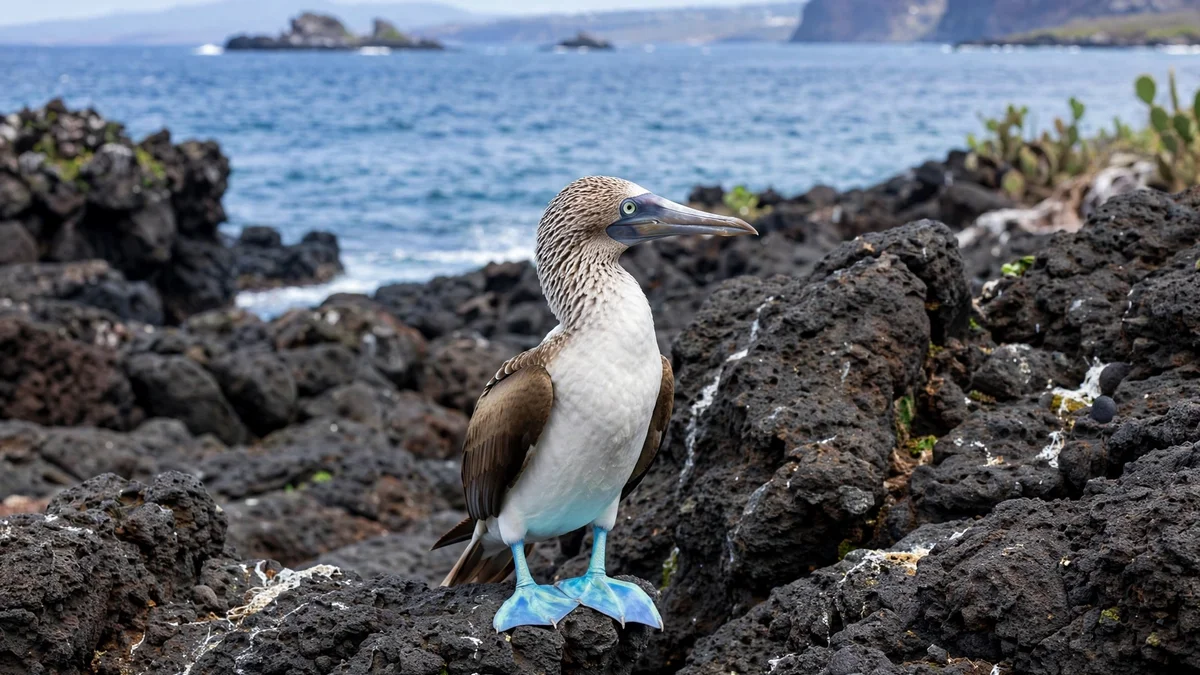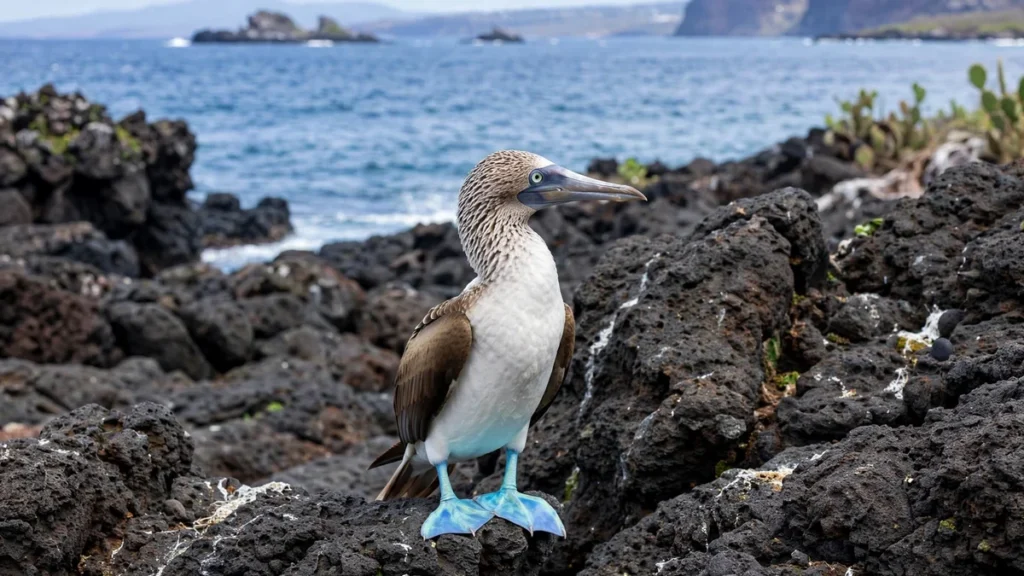
The blue-footed booby species number one, a single species called Sula nebouxii, and it is the seabird with the brightest feet in the world, a big brown and white diver of the tropical eastern Pacific. If you are asking how many blue-footed booby species there are, the answer is one: there is one recognised blue-footed booby species in the world, and every blue-footed booby alive today belongs to it.
The blue-footed booby lives along the Pacific coast of the Americas, from the Gulf of California in Mexico south to Peru, and on the Galapagos Islands, where about half of all breeding pairs make their home. Its turquoise blue feet, its plunge dives and its comical courtship dance have made it one of the most famous birds of the Galapagos.
Key takeaways
- There is one blue-footed booby species, Sula nebouxii, a member of the gannet and booby family.
- Blue-footed boobies measure 81 to 86 centimetres long, with a wingspan of about 1.5 metres and a weight of 1.3 to 1.8 kilogrammes.
- The bright blue feet get their colour from carotenoids in the diet, and bluer feet signal a healthier bird.
- Blue-footed boobies plunge-dive for anchovies and sardines, folding their wings and dropping from as high as 24 metres.
- Blue-footed boobies are listed as Least Concern, though the Galapagos population has fallen sharply since the 1960s.
What makes a blue-footed booby a blue-footed booby
A blue-footed booby is a large seabird with a long pointed bill, a brown-streaked head and neck, a white chest and belly, dark brown wings and a long tapered tail, and it measures 81 to 86 centimetres from bill to tail, with a wingspan of nearly 1.5 metres and a weight of 1.3 to 1.8 kilogrammes. Females are slightly larger and heavier than males.
The feet are the feature that gives the bird its name. A blue-footed booby has large webbed feet of a vivid turquoise blue, and the colour comes from carotenoids, pigments the bird gets from the fish it eats. The bluer the feet, the healthier the bird, and females choose mates with the brightest feet, because a bright blue foot is an honest signal that the male is well fed and free of disease.
The booby is built for diving. Its nostrils are sealed shut, so it breathes through the corners of its mouth, and air sacs in its skull and chest cushion the shock of hitting the water. Its eyes face forward, giving it binocular vision for judging distance as it drops towards the sea.
The blue-footed booby species and their relatives
There is one blue-footed booby species. It belongs to the genus Sula, the boobies, and it shares that genus with the masked booby, the brown booby, the red-footed booby, the Nazca booby and the Peruvian booby. Two subspecies are recognised: the mainland form along the Pacific coast from Mexico to Peru, and the larger, paler Galapagos form.
The masked booby is the blue-footed booby’s closest lookalike, a larger bird with a black face mask that lives across the tropical oceans, while the brown booby is a smaller chocolate-brown booby of tropical seas, and the red-footed booby is the smallest booby, with bright red feet. The Nazca booby is another Galapagos breeder with an orange bill, and the northern gannet is the booby’s northern cousin of the North Atlantic.
| Type | Animal | Where it lives | Best-known food | Length or Weight |
|---|---|---|---|---|
| Species | Blue-footed booby (Sula nebouxii) | Eastern Pacific, Galapagos, Mexico to Peru | Anchovies, sardines and squid | 81 to 86 cm, 1.3 to 1.8 kg |
| Close relative | Masked booby | Tropical oceans worldwide | Flying fish and squid | 81 to 92 cm, 1.2 to 2.2 kg |
| Close relative | Brown booby | Tropical Atlantic, Pacific and Indian Oceans | Flying fish and squid | 64 to 85 cm, 0.9 to 1.5 kg |
| Close relative | Red-footed booby | Tropical oceans worldwide | Flying fish and squid | 69 to 71 cm, 0.9 to 1.1 kg |
| Close relative | Nazca booby | Eastern Pacific and Galapagos | Sardines and flying fish | 80 to 90 cm, about 1.5 kg |
| Close relative | Peruvian booby | Humboldt Current, Peru and Chile | Anchovies and sardines | 71 to 76 cm, 1.3 to 1.6 kg |
| Close relative | Northern gannet | North Atlantic coasts | Mackerel, herring and squid | 87 to 100 cm, 2.3 to 3.6 kg |
How blue-footed boobies live
Blue-footed boobies are birds of the open sea and the rocky shore. A booby spends much of its life flying over the ocean, soaring on long wings and watching the water below for the flash of a school of fish, and when it spots prey it folds its wings back and plunge-dives, dropping from as high as 24 metres and hitting the water at speeds of up to 97 kilometres an hour. Boobies often hunt in groups, and a whole flock may dive together like arrows.
Anchovies and sardines make up most of the diet, along with mackerel, flying fish and squid, and a booby catches its prey with its long serrated bill and swallows it whole before it surfaces. Males and females hunt slightly differently, because the smaller male is a shallow diver that stays closer to shore, while the heavier female dives deeper and further out to sea.
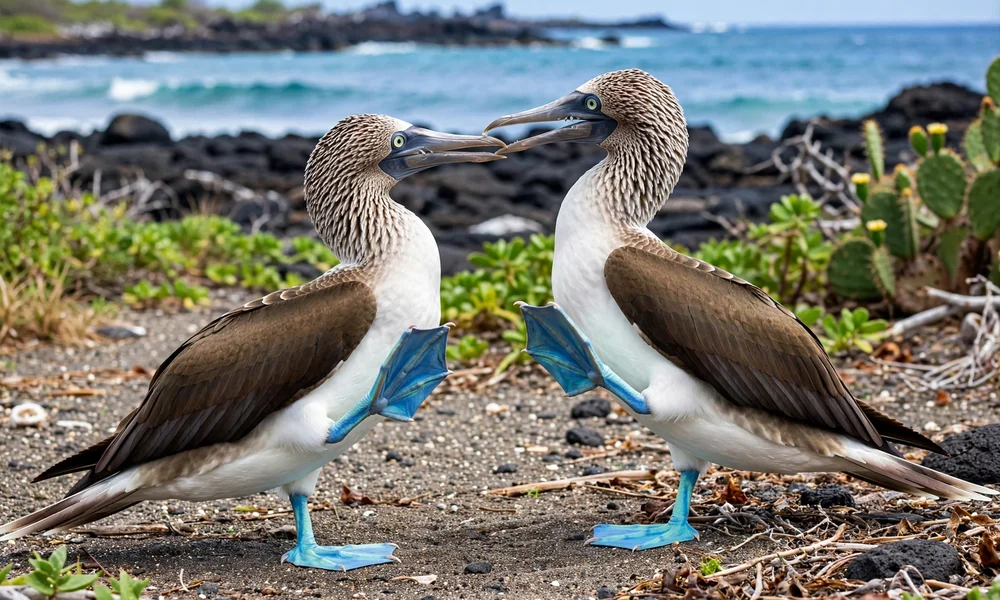
The courtship dance is the blue-footed booby’s most famous behaviour, and it is a slow comical display in which the male lifts one bright blue foot high, then the other, strutting in front of the female and pointing his bill and tail to the sky, whistling as he goes. The female answers with honks, and the pair may dance for hours before they mate, and the dance lets the female judge the blueness of the male’s feet, which tells her how healthy he is.
Breeding takes place on the ground, and the booby makes no real nest, laying its eggs in a shallow scrape on rock, sand or bare ground. The female usually lays two eggs, and both parents take turns sitting on them for about 41 days, keeping the eggs warm with their big blue feet. The older chick often pushes its smaller sibling from the nest, and only the strongest chick usually survives to fledge, after about three months of feeding.
Where blue-footed boobies live
The blue-footed booby lives along the tropical eastern Pacific, from the Gulf of California in Mexico south along the coasts of Central America, Ecuador and Peru, and on the Galapagos Islands, where about half of all breeding pairs in the world make their home. It is a bird of warm coastal waters and offshore islands.
The Galapagos colonies are the most famous, and the best islands for seeing boobies are North Seymour and Espanola, where the birds nest in the open and dance in full view of visitors, but the booby also breeds on islands off Mexico, Ecuador and Peru, and it wanders widely over the open ocean outside the breeding season. Like flamingos, blue-footed boobies are birds of warm shallow waters.
Best seasons for blue-footed booby watching
There is no closed season, because blue-footed boobies are active all year, but the best time to look for them depends on where you go. On the Galapagos the birds breed all year, and the courtship dance is easiest to see in the dry season, from June to December, when the birds gather at their colonies and the males are at their showiest. On the mainland coast the best months are often the cooler months, when anchovy schools come close to shore.
Staying safe around blue-footed boobies
A blue-footed booby is a wild seabird with a long sharp bill, and it can give a painful peck to a person who comes too close, though boobies almost never attack people. Keep your distance, never touch a booby or its eggs, and never walk through a colony, because a booby that is disturbed may leave its nest and its eggs may chill or be taken by a predator. If you see boobies while visiting the Galapagos, stay on the marked paths, stay calm, and let them come to you. Like the emperor penguin, the blue-footed booby puts up with people only when they keep their distance.
Blue-footed booby watching checklist
A little preparation turns a Galapagos shore walk into a real chance of seeing a blue-footed booby dance, so pack for sun, salt and long quiet hours.
- Binoculars, because the colonies are spread out and the blue feet show best from a distance.
- A camera with a zoom lens, for the blue feet and the courtship dance without getting close.
- Sun protection, a hat and plenty of water, for standing on a hot rocky shore.
- A booked Galapagos cruise or day trip with a guide who knows the booby colonies.
- A plan to be out in the morning, when the boobies are most active and dancing.
- Patience and silence, because boobies are shy birds and a noisy group will send them away.
- A field guide to Galapagos birds, for telling a blue-footed booby from a masked or Nazca booby.
Frequently asked questions
How many blue-footed booby species are there?
There is one blue-footed booby species, Sula nebouxii. Two subspecies are recognised, the mainland form and the Galapagos form, but both belong to the same single species.
Why are the feet of a blue-footed booby blue?
The feet are blue because of carotenoids, pigments the bird gets from the fish it eats, which are deposited in the skin of the feet. The colour is a signal of health, because only a well-fed bird can afford to put so much pigment into its feet, and a bird that is sick or hungry quickly loses its bright blue colour.
What do blue-footed boobies eat?
Blue-footed boobies eat small schooling fish, mainly anchovies and sardines, along with mackerel, flying fish and squid. They catch their food by plunge-diving from the air, folding their wings and dropping headfirst into the sea, and they can dive from as high as 24 metres.
Can blue-footed boobies fly?
Yes. Blue-footed boobies are strong fliers, and they soar over the ocean on long wings for hours at a time, covering great distances in search of fish. They are clumsy on land, waddling on their big webbed feet, but in the air and in the water they are fast and graceful.
How is this guide different from the blue jay species guide?
This guide covers the single blue-footed booby species, a large tropical seabird that lives on the Galapagos Islands and the eastern Pacific and eats anchovies and sardines, while our blue jay species guide covers the single blue jay species, a small woodland songbird that lives in eastern North America and eats acorns and insects. The blue-footed booby measures 81 to 86 centimetres and plunge-dives into the sea, and the blue jay measures 22 to 30 centimetres and flies through oak woodlands.
Are blue-footed boobies endangered?
No. Blue-footed boobies are listed as Least Concern, though the Galapagos population has fallen sharply since the 1960s, with only about 6,400 adults counted in 2012. The loss of sardines and anchovies is the main threat to watch.
Conclusion
The blue-footed booby species shows how much charm one seabird can hold: a single species of plunge-diving booby, with bright blue feet, a courtship dance, and a life spent between the rocky Galapagos shore and the open Pacific.
If you go looking for one, go to North Seymour or Espanola in the Galapagos dry season, go quietly, and go with patience. Watch a blue-footed booby lift its blue feet in the dance, or fold its wings and drop like an arrow into the sea, and you will understand why it has earned its place as the most loved seabird of the Galapagos, and why keeping its fish-rich seas healthy matters most.