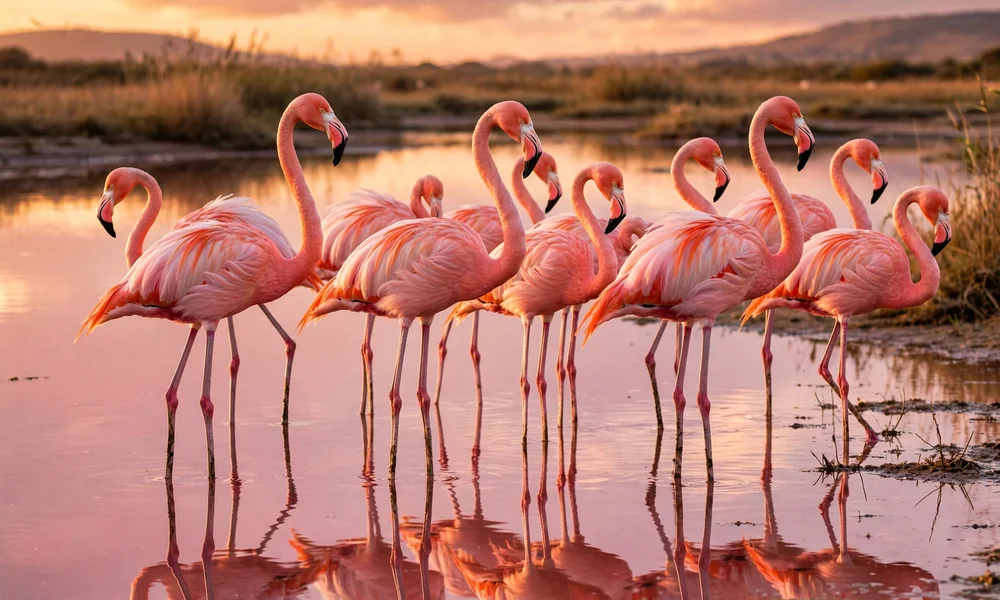
The flamingo species number six, pink wading birds of salty lagoons and soda lakes, and they are the only birds that feed with their heads upside down, filtering tiny food from the water with a bill built like a sieve. If you are asking how many flamingo species there are, the answer is six: the greater, American, Chilean, Andean, James’s and lesser flamingos, and every flamingo alive today belongs to one of them.
The flamingo belongs to the family Phoenicopteridae, and it lives in the shallow salty waters of Africa, Europe, Asia and the Americas, where algae and tiny crustaceans bloom in the sun. Its long pink legs, its curved bill and its pale pink feathers make it one of the most recognisable birds on Earth.
Key takeaways
- There are six flamingo species, and the greater flamingo is the largest and most widespread of them all.
- Flamingos are pink because of carotenoids in their food, and chicks are born grey or white, turning pink as they feed.
- Flamingos feed with their bills upside down, filtering algae and tiny crustaceans from the water.
- Flamingos stand on one leg to keep warm, tucking the other leg into their feathers to save body heat.
- Most flamingos are listed as Least Concern, but the Andean flamingo is listed as Vulnerable.
What makes a flamingo a flamingo
A flamingo is a tall wading bird with very long pink legs, a long curved neck, a bent bill and pale pink feathers, and it measures roughly 80 to 150 centimetres tall and usually weighs between 2 and 4 kilogrammes, depending on the species. The greater flamingo is the largest, at 110 to 150 centimetres, while the lesser flamingo is the smallest, at 80 to 90 centimetres.
The bill defines the flamingo: a deep bill that bends sharply downwards in the middle, lined with tiny plates that act as a sieve, and the bird feeds with its head upside down, sweeping its bill through the water and filtering out algae, diatoms and tiny crustaceans. Its pink colour comes from carotenoids in its food, and a flamingo that stops eating carotenoids turns white, while its chicks are born grey and turn pink as they feed. Like other African animals, it lives in the open, and it can fly at up to 60 kilometres per hour, travelling hundreds of kilometres between lakes in a single night.
The flamingo species and their relatives
There are six flamingo species. The greater flamingo lives in Africa, southern Europe, the Middle East and South Asia, and it is the largest and most widespread of the six. The American flamingo lives in the Caribbean and the Galápagos Islands, the Chilean flamingo lives in the wetlands of South America, the Andean flamingo lives in the high salt lakes of the Andes, the James’s flamingo lives in the same high lakes, and the lesser flamingo lives in Africa and India.
The Andean flamingo is the rarest of the six, living only in the high Andes above 3,500 metres, while the lesser flamingo gathers in the largest flocks, with more than a million birds at Lake Nakuru in Kenya. The roseate spoonbill is the flamingo’s most colourful relative in the Americas, a pink wading bird with a flat spoon-shaped bill, and the great white heron is a tall wader that shares the flamingo’s lagoons. The sacred ibis is another long-legged wader of African wetlands, and the grey heron is a familiar wader of European lakes and rivers.
| Type | Animal | Where it lives | Best-known food | Length or Weight |
|---|---|---|---|---|
| Species | Greater flamingo (Phoenicopterus roseus) | Africa, Europe, Middle East and Asia | Algae and tiny crustaceans | 110 to 150 cm, 2 to 4 kg |
| Close relative | American flamingo | Caribbean and Galápagos Islands | Algae and small crustaceans | 120 to 145 cm, 2 to 4 kg |
| Close relative | Chilean flamingo | South American wetlands | Algae and small invertebrates | 100 to 120 cm, 2 to 3 kg |
| Close relative | Andean flamingo | High salt lakes of the Andes | Diatoms and algae | 100 to 110 cm, 2 to 3 kg |
| Close relative | James’s flamingo | High salt lakes of the Andes | Diatoms and algae | 90 to 100 cm, 2 kg |
| Close relative | Lesser flamingo | Africa and India | Blue-green algae | 80 to 90 cm, 1.5 to 2 kg |
| Close relative | Roseate spoonbill | Americas, coastal wetlands | Small fish and crustaceans | 71 to 86 cm, 1.2 to 1.8 kg |
How flamingos live
Flamingos are creatures of shallow salty water. A flamingo lives in huge flocks, sometimes numbering hundreds of thousands, standing in lagoons and soda lakes by day and flying to new feeding grounds by night. Like other South American animals, it follows the seasons, moving between lakes as the water rises and falls with the rains.
Algae make up most of the diet, along with diatoms, tiny crustaceans, small molluscs and insect larvae, and a flamingo feeds by sweeping its bill through the water with its head upside down, pumping water in and out and trapping food on the fine plates inside its bill. It eats for hours at a time, often with its whole head underwater, and it can filter thousands of tiny organisms in a single day.
Breeding happens in the dry season, when the water is low and mudflats are exposed, and the pair builds a nest of mud, a small cone about 30 centimetres high, on which the female lays a single egg. Both parents incubate the egg for about 30 days, and the chick is born grey and downy, fed on crop milk, a rich red liquid made in the parents’ throats. The chicks gather in crèches, guarded by a few adults, and they fledge after about 70 days. Flamingos live for around 20 to 30 years in the wild, and up to 50 years in captivity.
Where flamingos live
The greater flamingo lives across Africa, southern Europe, the Middle East and South Asia, from the Camargue in France to the salt lakes of India, and it is most common in the shallow lagoons and salt pans of the Mediterranean and East Africa. The American flamingo lives in the Caribbean, from the Bahamas to the Yucatán, and in the Galápagos Islands, while the Chilean, Andean and James’s flamingos live in the wetlands and high salt lakes of South America.
Salty water is the key requirement. A flamingo needs shallow water, usually less than a metre deep, where algae and tiny crustaceans bloom in the sun, so it follows the salt lakes as they fill and dry with the seasons, and when a lake dries out the flamingos fly hundreds of kilometres to the next one.
Most flamingo species are listed as Least Concern, but the Andean flamingo is listed as Vulnerable, and the Chilean, James’s and lesser flamingos are listed as Near Threatened. The main pressures are the draining of wetlands for farming and salt, disturbance at breeding colonies, and pollution, which kills the algae the flamingos feed on. In Kenya the lesser flamingo gathers in flocks of more than a million birds at Lake Nakuru, one of the great wildlife sights of Africa.
Best seasons for flamingo watching
There is no closed season, because flamingos are active all year, but the best time to look for them depends on where you go. In the Camargue in France the best months are often April to September, when the birds are breeding in the salt pans. In Kenya the best months are often the dry season, when the flamingos gather in huge numbers at Lake Nakuru and Lake Bogoria.
Staying safe around flamingos
A flamingo is a wild bird with a sharp bill and strong legs, and it can hurt a person, though flamingos are shy and almost never aggressive. Keep your distance, never approach a flamingo colony, and never wade into a lagoon where flamingos are feeding, because a frightened flock may abandon its nests and the chicks may die. If you see flamingos, stay on the path or in a hide and watch with binoculars, because flamingos that are disturbed may leave their breeding grounds for good.
Flamingo watching checklist
A little preparation turns a lagoon visit into a real chance of seeing a flamingo, so pack for sun, shallow water and long quiet hours.
- Binoculars with good low-light performance, for picking a pink bird out of the lagoon at dawn.
- A camera with a long lens, because flamingos should always be watched from a distance.
- Sun cream and a hat, because the best watching is in the bright midday sun.
- Water and snacks for long days, because the best sightings come after hours of waiting.
- A field guide to wading birds, for telling a greater flamingo from a lesser at a glance.
- A plan to be out in the dry season, when the flamingos gather in huge flocks.
- Patience and silence, because flamingos are shy birds and a noisy group will send them away.
Frequently asked questions
How many flamingo species are there?
There are six flamingo species: the greater, American, Chilean, Andean, James’s and lesser flamingos. The greater flamingo is the largest and most widespread, and the Andean flamingo is the rarest, living only in the high salt lakes of the Andes.
Why are flamingos pink?
Flamingos are pink because of carotenoids, the same pigments that colour carrots, in the algae and tiny crustaceans they eat. Chicks are born grey or white and turn pink as they feed, and a flamingo that stops eating carotenoids slowly turns white again.
Why do flamingos stand on one leg?
Flamingos stand on one leg to keep warm, tucking the other leg into their belly feathers to save body heat. Standing on one leg also lets the bird rest the other, and flamingos can sleep standing up, with their necks folded back and their heads resting on their backs.
Can you keep a flamingo as a pet?
No. A flamingo is a wild bird that needs shallow salty water, eats algae by the kilogramme, and is fully protected by law in every country where it lives. Flamingos in zoos need huge lagoons with filtered salt water, and they are not pets.
How is this guide different from the ostrich species guide?
This guide covers six flamingo species, pink wading birds that filter algae from salty lagoons with their heads upside down, while our ostrich species guide covers two ostrich species, the largest birds on Earth, which run across the African savanna at 70 kilometres per hour. The flamingo stands in shallow water and eats algae, and the ostrich runs on dry land and eats seeds.
Are flamingos endangered?
Most flamingos are listed as Least Concern, but the Andean flamingo is listed as Vulnerable, and the Chilean, James’s and lesser flamingos are listed as Near Threatened. The draining of wetlands and disturbance at breeding colonies are the main threats.
Conclusion
The flamingo species show how much colour one bird can hold: six species of pink wader, with bills like sieves, legs like stilts, and lives spent standing on one leg in salty lagoons. They are the most recognisable wading birds on Earth, and they have lived in the shallow waters of four continents for millions of years.
If you go looking for one, go in the dry season to the Camargue or Lake Nakuru, go quietly, and go with patience. Watch a flock of flamingos feeding with their heads upside down and you will understand why it has earned its place as the pink bird of the lagoons, and why keeping its salty water matters most.