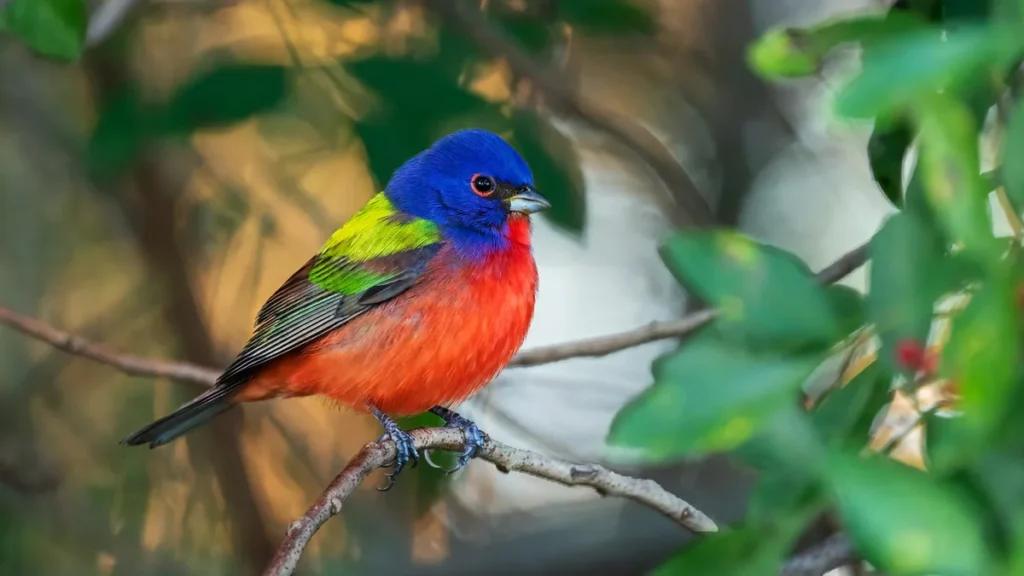
The painted bunting species is a single species, Passerina ciris, a small songbird of the cardinal family whose adult male is often called the most beautiful bird in North America. If you are asking how many painted bunting species there are, the answer is one, and its male wears a dark blue head, a green back and red underparts and rump all at once.
The French called this bird the nonpareil, meaning without equal, and the name has stuck. Yet for all its colour it is a shy bird that spends much of its life hidden in thick foliage, singing from a perch you can hear long before you can see. It breeds in two widely separated parts of the southern United States, winters in Mexico and Central America, and lives mostly on seeds.
Key takeaways
- The painted bunting species is Passerina ciris, a single species with eastern and western subspecies in the cardinal family.
- Adult males have a dark blue head, green back and red underparts, while females and young birds are plain green.
- Painted buntings are 12 to 14 centimetres long, with a wingspan of 21 to 23 centimetres and a weight of 13 to 19 grams.
- They live in scrub and woodland edges, breed in the southern United States and winter in Mexico and Central America.
- The species is listed as Least Concern, but numbers fell by about a third between 1966 and 2019, and the eastern population is of most concern.
What makes a painted bunting a painted bunting
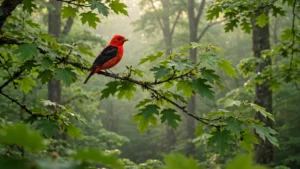
A painted bunting is a small, stocky songbird with a short, stout, conical bill made for cracking seeds. The adult male is unmistakable: a dark blue head, a bright green back, red underparts and a red rump, darker wings and tail and a thin red eye ring. No other North American bird combines a red breast with a blue head.
The female looks like a different bird altogether. She is bright green above and paler yellow-green below, with no wing bars and a pale eye ring, and her colouring is camouflage, letting her vanish into the leaves around the nest. Young birds look like females, and young males gain the adult colours only in their second autumn. Only males are reported to sing, so a green bird singing in the breeding season is almost certainly a young male.
The painted bunting species and their relatives
The painted bunting belongs to Passerina, a small genus of North American buntings in the cardinal family, Cardinalidae, and it is a single species with two recognised subspecies. The eastern race, P. c. ciris, breeds along the Atlantic coast and is the darker, larger bird, while the western race, P. c. pallidior, breeds across the south-central United States and northern Mexico and is paler and slightly smaller. The two populations are separated by a wide gap, and genetic work suggests they have barely mixed for thousands of years.
Its closest relatives are the other buntings of Passerina, above all the indigo bunting and the lazuli bunting, both blue birds of open country, and the varied bunting of the south-western deserts. The painted bunting is the most colourful of the group, and the only one whose male wears three bold colours at once. Like its relatives it is a seed eater, but it is shyer and far more tied to dense cover.

| Type | Animal | Where it lives | Best-known food | Length or Weight |
|---|---|---|---|---|
| Genus | Buntings of genus Passerina | Open country of North and Central America | Seeds and insects | About 12 to 15 cm long |
| Species | Painted bunting (Passerina ciris) | Southern United States, Mexico, Central America | Seeds, grasshoppers and caterpillars | 12 to 14 cm, 13 to 19 g |
| Species | Indigo bunting (Passerina cyanea) | Eastern and central North America | Seeds and insects | About 13 cm, 12 to 18 g |
| Species | Lazuli bunting (Passerina amoena) | Western North America | Seeds and insects | About 14 cm, 13 to 18 g |
| Species | Varied bunting (Passerina versicolor) | South-western United States, Mexico | Seeds and insects | About 14 cm, 11 to 13 g |
| Species | Rose-bellied bunting (Passerina rositae) | Southern Mexico | Seeds and insects | About 13 cm, 12 to 15 g |
How painted buntings live
Painted buntings feed mostly on the ground and low in shrubs, hopping through cover and picking up seeds with their stout bills. Grass seeds are the staple, along with seeds of weeds and wildflowers, and in the breeding season they add insects, above all grasshoppers, caterpillars and beetles. The insects matter most when there are chicks to feed.
Breeding runs from late April to early August, peaking from mid-May to mid-July. The male arrives about a week before the female and sets up a small territory, singing from a high perch, often half hidden in the leaves. Males defend their ground fiercely, fighting rivals in the air, and these fights are sometimes bloody and even fatal. Painted buntings are mostly monogamous.
The female builds the nest alone, a neat cup woven into low, dense vegetation, usually one to two metres from the ground. She lays three or four pale, grey-white eggs speckled with brown, and incubates them alone for about ten days. The chicks hatch naked and helpless and leave the nest after twelve to fourteen days. About thirty days after the first eggs hatch she usually starts a second brood, and some pairs manage three in a season.
Where painted buntings live
Painted buntings live in scrub, woodland edges, overgrown fields and coastal thickets, always where dense low cover meets open ground. They avoid deep forest and wide-open prairie alike, and they need the thickets for nesting and hiding, since wary birds drop into cover at the first alarm. The western birds breed from the lower Mississippi valley through the south-central states to north-east Mexico, while the eastern birds live along the Atlantic coast from central North Carolina to Florida, and inland in parts of South Carolina and Georgia.
When summer ends the buntings move south, travelling at night like most songbird migrants. Western birds winter in Mexico and Central America, while eastern birds winter in southern Florida, Cuba, the Bahamas and the Yucatan, and the two populations stay apart all year. On the wintering grounds they use the shrubby edges of tropical forest and densely vegetated savanna, and may join small flocks with other seed-eating birds, unlike their solitary summer life.
The painted bunting is listed as Least Concern on the IUCN Red List, in an assessment from 2018. Partners in Flight estimates about 15 million breeding birds, with about 13 million of them in the United States and Canada, but other published estimates are much lower, so the true total is uncertain. Breeding bird surveys show numbers fell by about a third between 1966 and 2019, with the steepest losses in the east, though the decline has slowed in recent years. The eastern population is small, holding only about four per cent of the breeding birds, and it is the one conservationists worry about most. Habitat loss to housing and farming, and trapping for the cage-bird trade, are the main threats. Capture has been illegal in the United States since the Migratory Bird Treaty Act of 1918, but trapping for overseas sale still occurs in parts of Central America.
Best seasons for painted bunting watching
The best time to look for painted buntings is the breeding season, from late April to early August, when the males sing from exposed perches. In the east, the coastal thickets of South Carolina and Georgia are the stronghold, and the birds are easiest in May and June. In the west, the scrub and riverside thickets of Texas and Oklahoma are reliable from May through July. In winter, southern Florida is the best place to find eastern birds.
Staying safe around painted buntings
A painted bunting is a harmless songbird with no defence beyond its camouflage and its habit of vanishing into thick cover, so the main risk is to the bird rather than to you. Keep your distance from a singing male and never push into the shrubs around a nest, since a disturbed female may abandon her eggs. Watch from a path or a feeder with binoculars.
Never trap, catch or keep a painted bunting, which is protected by law in the United States, and never buy a wild-caught songbird, since the cage trade is one of the pressures on the species. If you feed them, offer white millet near cover, keep the feeder clean, and keep cats indoors. Like the eastern bluebird, the painted bunting rewards a quiet watcher far more than a chasing one.
Painted bunting watching checklist
A little preparation turns a walk through southern scrub into a real chance of seeing North America’s most colourful songbird.
- A breeding-season visit, from late April to early August, to coastal thickets in South Carolina or Georgia, or scrub in Texas or Oklahoma.
- An early morning start, when males sing from exposed perches.
- Binoculars, since a painted bunting often sings half hidden in leaves.
- An ear tuned to the male’s warbling song, which often gives the bird away.
- A feeder with white millet near dense cover, which can bring the birds into the open.
- Patience and a slow pace, because the birds drop into cover at the first alarm.
- Respect for nests and thickets, keeping cats indoors and never approaching a nest.
Frequently asked questions
How many painted bunting species are there?
There is one painted bunting species, Passerina ciris, with two subspecies: the eastern P. c. ciris of the Atlantic coast and the western P. c. pallidior of the south-central United States and northern Mexico. They barely mix, but they are one species.
Why is the male so colourful while the female is green?
The male’s blue, green and red plumage is a display, shaped by female choice, and it advertises his health and quality as a mate. The female’s plain green plumage is camouflage, hiding her on the nest.
What does a painted bunting eat?
A painted bunting eats mostly seeds, above all grass seeds and the seeds of weeds and wildflowers, picked up on the ground. In the breeding season it adds grasshoppers, caterpillars and beetles, which are the main food of the chicks.
Where do painted buntings go in winter?
Painted buntings migrate south at night when summer ends. Western birds winter in Mexico and Central America, while eastern birds winter in southern Florida, Cuba, the Bahamas and the Yucatan.
Are painted buntings endangered?
Not officially. The painted bunting is listed as Least Concern on the IUCN Red List, but its numbers fell by about a third between 1966 and 2019, and the small eastern population is of real concern. Habitat loss and trapping for the cage-bird trade are the main threats.
How is this guide different from the osprey guide?
This guide covers the painted bunting, a tiny, seed-eating songbird of scrub and woodland edge that weighs less than 20 grams, while our osprey species guide covers the osprey, a large fish-eating bird of prey that dives feet-first into water. One is a jewel of the thickets; the other is a hunter of the open water.
Conclusion
The painted bunting species needs no introduction once you have seen it: one species, Passerina ciris, whose male wears blue, green and red at once, and whose female hides in plain green camouflage.
If you go looking for one, go in the breeding season, go early, and listen before you look, since the song gives the bird away long before the colour does. Find a painted bunting singing from a bush in the morning light, and you will see why the French called it the nonpareil, without equal.