The superb lyrebird species is a single species, Menura novaehollandiae, a large ground-dwelling songbird of the wet forests of south-eastern Australia. If you are asking how many superb lyrebird species there are, the answer is one, and it is famous above all for the male’s lyre-shaped tail and for a song that copies other birds, and even chainsaws, with uncanny accuracy.
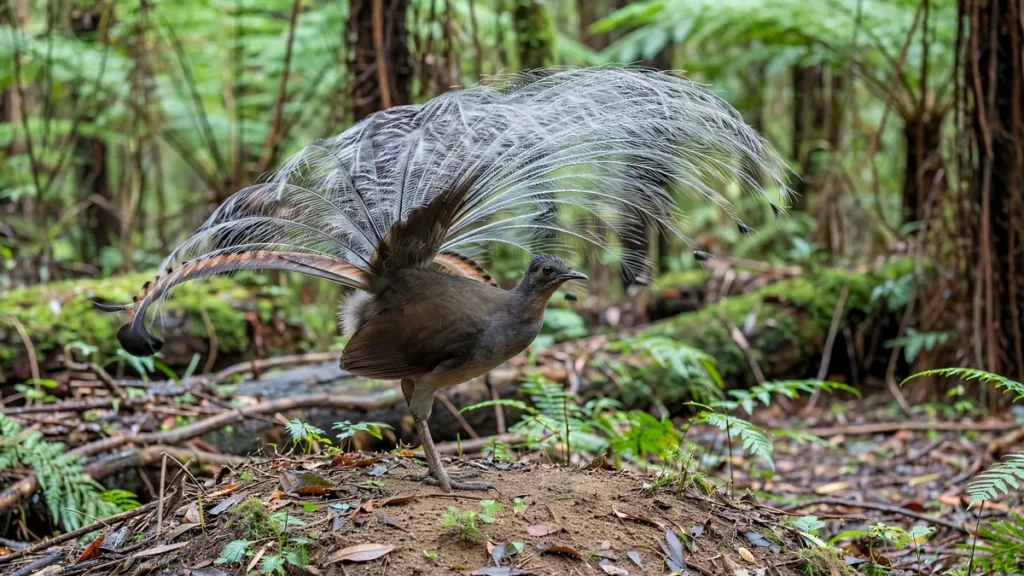
For all its fame the superb lyrebird is a plain brown bird, easy to overlook as it scratches through the leaf litter. It spends almost its whole life on the forest floor and vanishes into the ferns at the first sign of trouble. Yet when a male steps onto his display mound in winter and throws his tail forward over his head, he becomes one of the most spectacular sights in Australian nature.
Key takeaways
- The superb lyrebird species is Menura novaehollandiae, a single species in the genus Menura, which holds just two species in total.
- Adult males reach up to 100 centimetres long including the tail and weigh about 1.1 kilograms, making the superb lyrebird one of the largest songbirds in the world.
- Males display on cleared earth mounds in winter, fanning a lyre-shaped tail of sixteen feathers while singing songs built largely from mimicry.
- Superb lyrebirds live on the forest floor of wet forests in south-eastern Australia, with an introduced population thriving in Tasmania.
- The species is listed as Least Concern, but no precise global population figure exists, and bushfires, logging and introduced predators press on local numbers.
What makes a superb lyrebird a superb lyrebird
A superb lyrebird is a pheasant-sized songbird with plain, rich brown plumage, a grey-brown breast, strong legs and long, hooked claws made for digging. The male reaches 86 to 100 centimetres in length including his tail, while the female is about 86 centimetres long. Males weigh around 1.1 kilograms and females around 0.9 kilograms, and among perching birds only the two largest ravens grow bigger.
The male’s tail is what gives the bird its name. It holds sixteen feathers, including two long outer plumes that curve outwards like the arms of a lyre and fine, silvery, filamentary feathers in the centre, and it can reach 70 centimetres long. Females and young birds carry plainer tails, and young males take several years of moults to grow the full display. The bird walks with a strong, upright stride and is a poor flier that escapes danger by running or gliding downhill.
The superb lyrebird species and their relatives
The superb lyrebird belongs to Menura, a genus in the family Menuridae that holds just two living species. The superb lyrebird is the widespread one, ranging through the wet forests of south-eastern Australia, while Albert’s lyrebird, Menura alberti, is confined to a small pocket of rainforest on the New South Wales–Queensland border, an area of only about 1,500 square kilometres. Albert’s lyrebird is the rarer of the pair and is listed as Near Threatened, while the superb lyrebird is listed as Least Concern.

Lyrebirds are an ancient lineage, and their closest living relatives are the scrub-birds, two shy Australian species heard far more often than seen. The superb lyrebird shares its forests with other celebrated Australian birds, among them the kookaburra, but no other bird combines its size, its tail and its gift for mimicry.
| Type | Animal | Where it lives | Best-known food | Length or Weight |
|---|---|---|---|---|
| Genus | Lyrebirds of genus Menura | Wet forests of eastern Australia | Invertebrates in leaf litter | About 86 to 100 cm long |
| Species | Superb lyrebird (Menura novaehollandiae) | South-eastern Australia and Tasmania | Earthworms, insects and fungi | 86 to 100 cm, 0.9 to 1.1 kg |
| Species | Albert’s lyrebird (Menura alberti) | Rainforest on the New South Wales–Queensland border | Invertebrates in leaf litter | Slightly smaller than the superb lyrebird |
How superb lyrebirds live
Superb lyrebirds feed on the forest floor, raking through leaf litter, rotting logs and loose soil with their strong feet to expose the small animals hidden beneath. The diet is built on invertebrates, above all earthworms and insects with their larvae, along with spiders, ants and beetle grubs, and the birds also eat fungi and occasionally take a frog or a lizard. A single bird works over a large area of ground in a year, and its steady digging turns the soil.
The lyrebird’s fame rests on its voice. A male sings all year, but the peak comes in the Australian winter, from June to August, when he may sing for four hours a day. His song mixes his own whistles with mimicry of other birds, and he also copies possums, koalas and dingoes, along with chainsaws, car alarms and camera shutters. A single performance can run for twenty minutes, and the borrowed sounds are learned, not inborn. Males sing from cleared mounds of bare earth, tending as many as fifteen display platforms, and on the mound the male sweeps his tail forward over his back while stepping and shivering in rhythm. The species is polygynous, so one male mates with several females and takes no part in raising the young.
Breeding takes place in the depths of winter, roughly May to August. After mating, the female handles every remaining task alone. She builds a bulky domed nest of sticks lined with moss and ferns, tucked against a rock or a stream bank, and lays a single egg. She incubates it alone for about fifty days, one of the longest incubation periods of any songbird, and she alone feeds the chick, which depends on her for months after fledging. Lyrebirds mature slowly, with females ready to breed at about five to seven years of age and males at about six to nine, with published accounts giving slightly different ages, and they are notably long-lived, with wild birds often surviving twenty to thirty years.
Where superb lyrebirds live
Superb lyrebirds live nowhere in the world outside Australia. They occupy a broad band of wet forest along the south-east, from southern Victoria north through New South Wales into the extreme south-east of Queensland, largely following the Great Dividing Range, from near sea level up into high mountain country. Their preferred home is wet forest and rainforest with an open ground layer of moist leaf litter shaded by vegetation, though they also use wet and dry sclerophyll forest.
In 1934 a population was deliberately introduced to Tasmania, and it is now thriving and expanding. Outside the breeding season adults live singly in territories, though young birds may gather in small groups. They roost in trees at night and spend the day on the ground, rarely straying far from dense cover.
The superb lyrebird is listed as Least Concern on the IUCN Red List, in an assessment from 2018, and it remains common across its wide range. No precise global population figure exists: numbers are generally thought to exceed ten thousand mature birds, while the overall trend is suspected to be slowly declining. The main threats are habitat loss through logging and urban expansion, predation by introduced red foxes and cats, and severe bushfires, which can strip the litter layer the birds need.
Best seasons for superb lyrebird watching
The best time to look for superb lyrebirds is the Australian winter, from June to August, when the males display and sing with the greatest intensity. Go at dawn, when a male may sing for hours from a single mound, and listen first, since the bird is heard long before it is seen. The Dandenong Ranges and Sherbrooke Forest near Melbourne, the Blue Mountains west of Sydney and the Royal National Park south of the city are among the most reliable places.
Staying safe around superb lyrebirds
A superb lyrebird is a harmless, shy bird whose only defence is to run or glide away through the ferns, so the main risk is to the bird rather than to you. Keep your distance from a displaying male and never step onto a display mound or push through the ferns around a nest. Watch from a track with binoculars, move slowly, and keep dogs on a lead, since dogs and cats are among the pressures on ground-nesting birds.
Do not play recorded lyrebird calls to lure a bird into view, and never feed lyrebirds, which find everything they need in the litter. Like the eastern bluebird, the superb lyrebird rewards a quiet watcher far more than a chasing one.
Superb lyrebird watching checklist
A little preparation turns a winter walk through wet forest into a real chance of hearing one of the world’s great vocal mimics.
- A winter visit, from June to August, when males display and sing at dawn.
- An early morning start, when the song is strongest.
- Binoculars, for a bird that sings half hidden in ferns.
- An ear tuned to mimicry, since the calls of other birds may be the lyrebird itself.
- Waterproof boots and warm clothing for damp tracks and cold mornings.
- Patience and a slow pace, because the birds slip away at the first alarm.
- Respect for mounds and nests, keeping dogs away and never playing recorded calls.
Frequently asked questions
How many superb lyrebird species are there?
There is one superb lyrebird species, Menura novaehollandiae. The genus Menura holds just two species: the superb lyrebird and Albert’s lyrebird, Menura alberti, a rarer bird confined to a small pocket of rainforest on the New South Wales–Queensland border.
Why does the male have a lyre-shaped tail?
The male’s tail is a display, shaped by female choice. On his cleared mound he sweeps the sixteen feathers forward into a silvery canopy over his back while he sings and dances, and the tail advertises his health and quality as a mate.
What sounds can a superb lyrebird copy?
A superb lyrebird can copy the songs of many other birds with great fidelity, along with possums, koalas and dingoes and human-made noises such as chainsaws, car alarms and camera shutters. The mimicry is learned rather than inborn, and local birds hand their borrowed sounds down through generations.
What does a superb lyrebird eat?
A superb lyrebird eats mostly invertebrates from the forest floor, above all earthworms and insects with their larvae, along with spiders, ants and beetle grubs. It also eats fungi and occasionally takes a frog or a lizard, finding its food by raking through leaf litter.
Are superb lyrebirds endangered?
Not officially. The superb lyrebird is listed as Least Concern on the IUCN Red List, and it remains common across its wide range, with a thriving introduced population in Tasmania. No precise global population figure exists, numbers are thought to exceed ten thousand mature birds, and the trend is suspected to be slowly declining.
How is this guide different from the Steller’s sea eagle guide?
This guide covers the superb lyrebird, a plain brown, ground-dwelling songbird of Australian rainforest that weighs about a kilogram and is famous for mimicry, while our Steller’s sea eagle species guide covers Steller’s sea eagle, a huge fish-eating bird of prey of the far north Pacific. One is a shy singer of the forest floor; the other is a hunter of cold northern coasts.
Conclusion
The superb lyrebird species needs no introduction once you have heard it: one species, Menura novaehollandiae, a large brown bird of the forest floor whose male fans a lyre-shaped tail over his back and sings the songs of other birds, a chainsaw and a camera shutter in a single performance.
If you go looking for one, go in winter, go at dawn, and listen before you look, since the song gives the bird away long before the tail does. Find a lyrebird singing from his mound in a fern gully, and you will understand why this plain brown bird is one of Australia’s best-known birds.