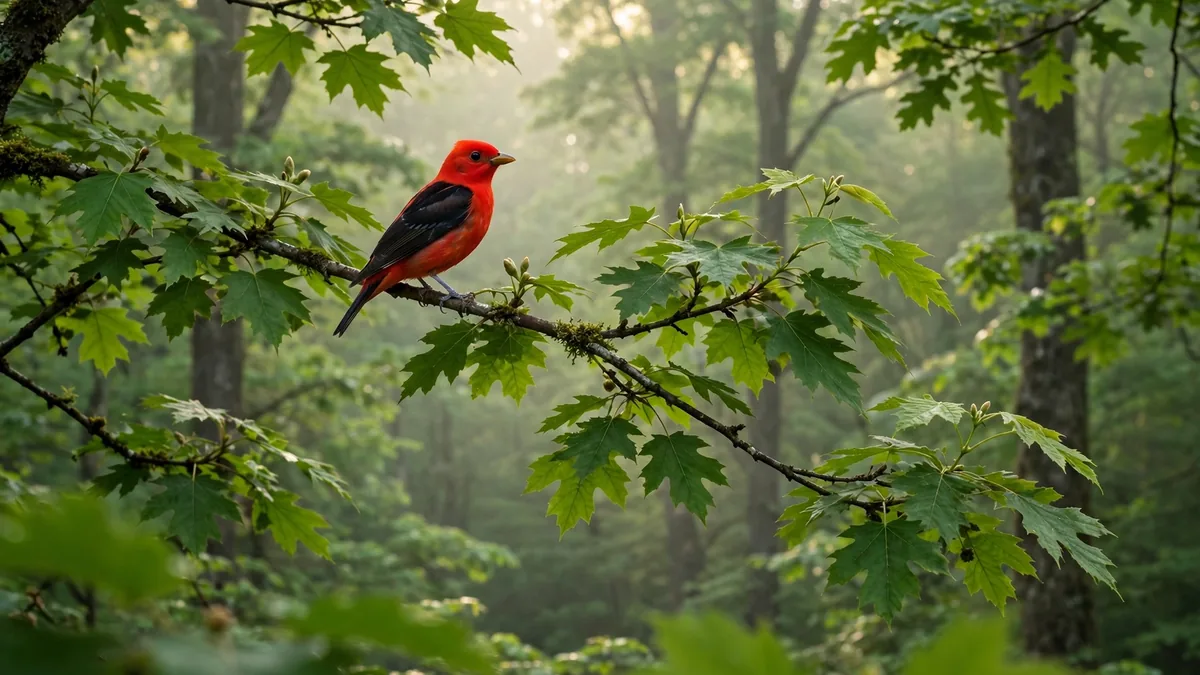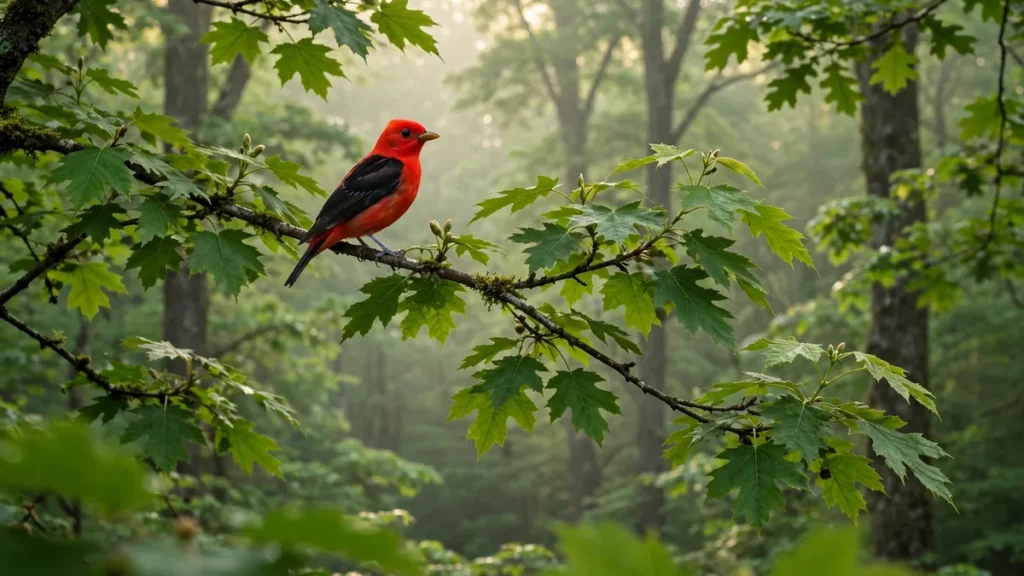
The scarlet tanager species is a single species, Piranga olivacea, a medium-sized songbird of the cardinal family whose breeding male is one of the most startling sights in an eastern North American forest: scarlet red all over, with jet-black wings and tail. If you are asking how many scarlet tanager species there are, the answer is one, and it is a monotypic species, with no recognised subspecies.
For all its colour, the scarlet tanager is a hard bird to spot. It feeds high in the canopy and often sits still for long stretches, so birdwatchers usually hear its raspy, robin-like song long before they see the flash of red among the leaves. It breeds in large deciduous forests in eastern North America, then flies thousands of kilometres south to winter in the foothills of the Andes.
Key takeaways
- The scarlet tanager species is Piranga olivacea, a single monotypic species in the cardinal family, with no recognised subspecies.
- Breeding males are brilliant scarlet red with black wings and tail, while females and winter males are olive-yellow with darker wings.
- Scarlet tanagers are 16 to 19 centimetres long, with a wingspan of 25 to 30 centimetres and a weight of 23.5 to 38 grams.
- They breed in large deciduous forests in eastern North America and winter in the Andean foothills of north-western South America.
- The species is listed as Least Concern, but forest fragmentation raises nest predation and cowbird parasitism, and the population trend is disputed.
What makes a scarlet tanager a scarlet tanager
A scarlet tanager is a stocky, medium-sized songbird with a large head, a short, broad tail and a pale, fairly stout bill. The breeding male is unmistakable: brilliant red all over, with black wings and tail and a pale horn-coloured bill. No other bird in its range combines a wholly red body with black wings.
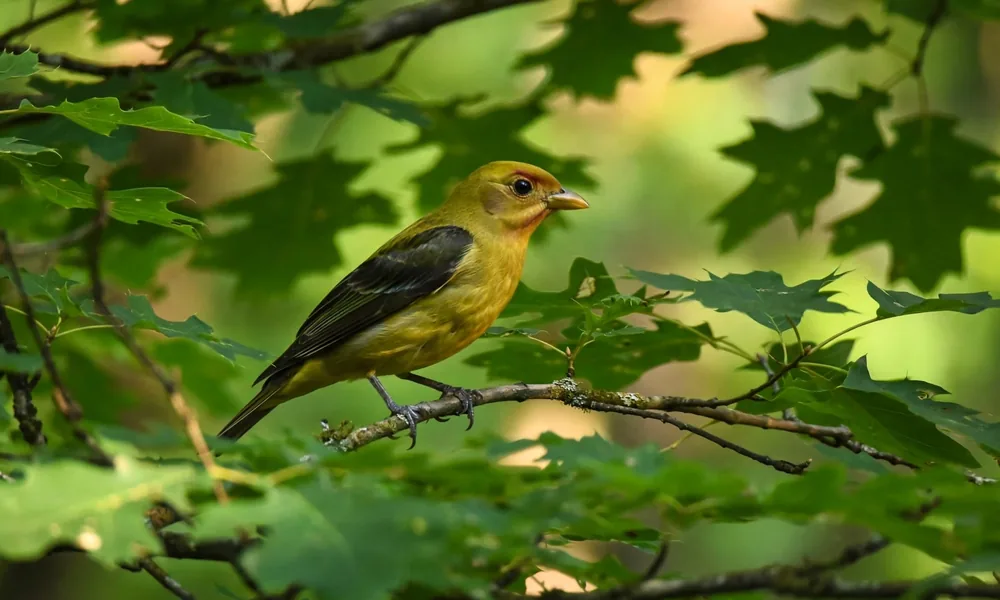
The female looks like a different bird altogether. She is olive-yellow above and straw-yellow below, with darker wings and tail and a thin eye ring. Young males resemble females, though brighter yellow with black on the shoulders and wing coverts. In late summer the male moults out of his red plumage into an olive-yellow winter dress, keeping his black wings and tail, so autumn birds can look blotchy red and yellow.
The scarlet tanager species and their relatives
The scarlet tanager belongs to Piranga, a genus of tanagers in the cardinal family, Cardinalidae, and it is a single, monotypic species, which means it has no recognised subspecies. It is marginally the smallest of the four Piranga species that breed north of the Mexican border. Its scientific name, Piranga olivacea, recalls its olive winter plumage.
Its closest relatives are the other North American tanagers of Piranga: the summer tanager, which is red all over with no black wings, the western tanager, with its yellow body and red head, and the hepatic tanager of the south-west. All four forage slowly high in trees, eat insects and fruit, and migrate far to Central and South America. The scarlet tanager is the only one of the four that is a bird of the eastern deciduous forest.
| Type | Animal | Where it lives | Best-known food | Length or Weight |
|---|---|---|---|---|
| Genus | Tanagers of genus Piranga | Forests of the Americas | Insects and fruit | About 16 to 20 cm long |
| Species | Scarlet tanager (Piranga olivacea) | Eastern North America, Andean foothills | Insects, fruit and berries | 16 to 19 cm, 23.5 to 38 g |
| Species | Summer tanager (Piranga rubra) | Southern United States, Mexico, South America | Bees, wasps and fruit | About 17 cm, about 28 g |
| Species | Western tanager (Piranga ludoviciana) | Western North America | Insects and fruit | 16 to 19 cm, about 28 g |
| Species | Hepatic tanager (Piranga flava) | South-western United States to South America | Insects and fruit | About 18 to 20 cm |
| Species | Flame-coloured tanager (Piranga bidentata) | Mexico and Central America | Insects and fruit | About 18 to 19 cm |
How scarlet tanagers live
Scarlet tanagers feed mainly on insects, gleaning them from leaves and twigs high in the canopy and sometimes flying out to catch prey in the air before returning to the same perch. They take bees, wasps and ants, moths and butterflies, beetles, flies, cicadas, grasshoppers and dragonflies, along with spiders and snails. When insects are scarce they eat fruit, including mulberries, elderberries and blackberries.
Breeding runs from late spring into summer, and the birds are serially monogamous, forming pairs that stay together for one breeding season. The male arrives about a week before the female and sings from a high perch, a robin-like song that is noticeably raspier, often described as a robin with a sore throat. The female builds the nest alone, a shallow saucer of twigs and rootlets set in a fork of a deciduous tree, often well above the ground. She lays four or five pale blue-green eggs and incubates them alone for thirteen to fourteen days, while the male brings her food.
The chicks hatch naked and helpless and leave the nest after about nine to eleven days, still unable to fly well, and the parents feed them for some weeks after that. The oldest scarlet tanager known from banding records lived at least eleven years and eleven months. Like the painted bunting, a fellow member of the cardinal family, the scarlet tanager puts most of its energy into a single summer of nesting before the long flight south.
Where scarlet tanagers live
Scarlet tanagers live in large stretches of deciduous forest, especially where oaks grow, across eastern North America, from southern Canada through the eastern United States. They need big, unbroken tracts of woodland: a viable breeding population needs at least 10 to 12 hectares of forest, and the birds do poorly in small, fragmented woodlots. Deep, mature forest is their stronghold.
When summer ends the tanagers move south, migrating at night like most songbirds and crossing the Gulf of Mexico and Central America on the way. They spend the winter in the montane forests of the Andean foothills of north-western South America, in countries such as Colombia, Ecuador, Peru and Bolivia. They arrive back on the breeding grounds from late April to mid-May, and by early October they are all on their way south again.
The scarlet tanager is listed as Least Concern on the IUCN Red List. Estimates of its numbers differ: Partners in Flight puts the global population at about 12 million mature individuals, while the North American breeding population is estimated at around 2.6 million birds. The population trend is disputed, with National Geographic listing it as stable and other authorities reporting a slightly negative trend. The main threat is habitat fragmentation, which opens the forest to nest predators and to brown-headed cowbirds, which lay their eggs in tanager nests.
Best seasons for scarlet tanager watching
The best time to look for scarlet tanagers is the breeding season, from May to July, when the males sing from high perches in deciduous forest. The forests of the north-eastern United States and southern Canada are the stronghold, and the birds are easiest in May, just after they arrive. In migration they may turn up in parks and gardens along the Gulf coast, and in winter they join mixed flocks in the Andean foothills.
Staying safe around scarlet tanagers
A scarlet tanager is a harmless songbird with no defence beyond its camouflage and its habit of sitting still high in the canopy, so the main risk is to the bird rather than to you. Keep your distance from a singing male and never push into the trees around a nest, since a disturbed female may abandon her eggs. Watch from a path with binoculars, and let the song lead you to the bird.
Never trap, catch or keep a scarlet tanager, which is protected by law in the United States and Canada, and never play recorded song at a singing male for long, since it can draw him away from his territory and his nest. Like the eastern bluebird, the scarlet tanager rewards a quiet watcher far more than a chasing one.
Scarlet tanager watching checklist
A little preparation turns a walk through eastern deciduous forest into a real chance of seeing this startling songbird.
- A breeding-season visit, from May to July, to mature deciduous forest in the north-eastern United States or southern Canada.
- An early morning start, when males sing from high perches in the canopy.
- Binoculars, since a scarlet tanager often sits still and half hidden among the leaves.
- An ear tuned to the male’s raspy, robin-like song, which often gives the bird away.
- A look high in the trees, not at eye level, where the birds do most of their feeding.
- Patience and a slow pace, because the birds sit still for long stretches.
- Respect for nests and forest, keeping to paths and never approaching a nest.
Frequently asked questions
How many scarlet tanager species are there?
There is one scarlet tanager species, Piranga olivacea, and it is monotypic, with no recognised subspecies. The red breeding male and the olive-yellow winter male are the same bird in different plumages.
Why is the male red in summer and olive in winter?
The male’s brilliant red breeding plumage is a display, shaped by female choice, and it advertises his health and quality as a mate. After breeding he moults into an olive-yellow winter dress, which is better camouflage in the South American forest, and he regains the red plumage before the next breeding season.
What does a scarlet tanager eat?
A scarlet tanager eats mainly insects, including bees, wasps, ants, moths, beetles, flies, cicadas and grasshoppers, along with spiders and snails. When insects are scarce it eats fruit, such as mulberries, elderberries and blackberries.
Where do scarlet tanagers go in winter?
Scarlet tanagers migrate south at night when summer ends, crossing the Gulf of Mexico and Central America. They spend the winter in the montane forests of the Andean foothills of north-western South America, in countries such as Colombia, Ecuador, Peru and Bolivia, and return north in late April and May.
Are scarlet tanagers endangered?
Not officially. The scarlet tanager is listed as Least Concern on the IUCN Red List, and Partners in Flight estimates about 12 million mature individuals worldwide. Forest fragmentation nevertheless pressures it, raising nest predation and cowbird parasitism, and the trend is disputed between stable and slightly declining.
How is this guide different from the scarlet ibis guide?
This guide covers the scarlet tanager, a small, insect-eating songbird of eastern North American forests that weighs less than 40 grams, while our scarlet ibis species guide covers the scarlet ibis, a long-legged wading bird of South American wetlands that feeds on crustaceans in shallow water. Both birds are scarlet, but one sings from the canopy and the other wades in the mud.
Conclusion
The scarlet tanager species needs no introduction once you have seen it: one species, Piranga olivacea, whose breeding male is scarlet red with black wings, and whose female and winter male hide in plain olive-yellow camouflage.
If you go looking for one, go in the breeding season, go early, and listen before you look, since the raspy song gives the bird away long before the colour does. Find a scarlet tanager singing from the top of an oak on a May morning, and you will understand its fame.