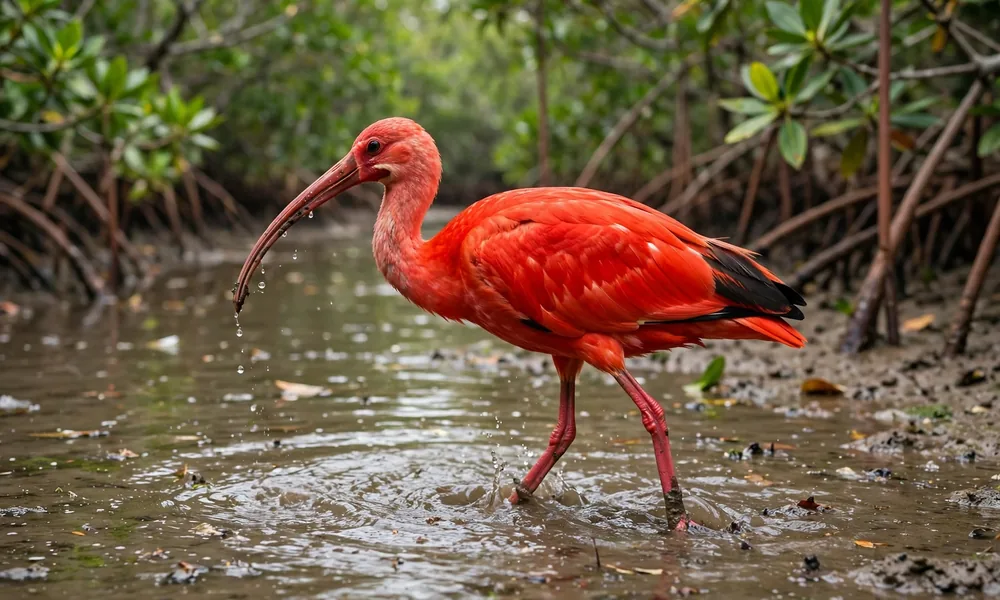
The scarlet ibis species is a single species, Eudocimus ruber, a brilliantly red wading bird of the mangroves and coastal wetlands of northern South America and the Caribbean. If you are asking how many scarlet ibis species there are, the answer is one, and its colour comes entirely from its food: the crabs and shrimp it eats are rich in red pigments that settle into every new feather it grows.
It is one of the most vividly coloured birds in the world, a flash of scarlet against the green of a mangrove forest, and it is the national bird of Trinidad and Tobago, where thousands of ibises return to roost in the Caroni Swamp every evening. No scarlet ibis is born red: the chicks hatch grey-brown and white.
Key takeaways
- The scarlet ibis species is Eudocimus ruber, a single species of ibis with no recognised subspecies.
- Adults are 55 to 63 centimetres long and weigh roughly 0.6 to 1.4 kilogrammes, with males slightly larger than females.
- The scarlet plumage comes from carotenoid pigments in crabs, shrimp and other crustaceans, and juveniles take about two years to turn fully red.
- They live in mangrove swamps, tidal mudflats and flooded grasslands along the northern coast of South America, from Colombia to Brazil, and in Trinidad and Tobago.
- The species is listed as Least Concern, with a global population estimated in the low hundreds of thousands, though local numbers are falling in places.
What makes a scarlet ibis a scarlet ibis
A scarlet ibis is a medium-sized wading bird, almost entirely covered in deep, saturated red feathers, standing on long red legs with a long, slender, down-curved bill. The only black on the body sits at the tips of the four outermost wing feathers, and it shows mainly in flight. The bill darkens to reddish-black in breeding adults. Males are a little larger than females, with longer bills, but the sexes look alike in colour.
Young birds look nothing like their parents. They hatch with grey-brown upperparts and a white belly, then pass through a mottled pink and orange stage over about two years before the adult plumage turns uniform scarlet. The change is gradual because the colour is not made by the bird at all: the ibis cannot produce red pigment itself, and must absorb carotenoids, above all astaxanthin and canthaxanthin, from the crustaceans it eats. The more crabs and shrimp in the diet, the deeper the red.
The scarlet ibis species and their relatives
The scarlet ibis belongs to the ibis and spoonbill family, Threskiornithidae, and it is a single species with no recognised subspecies. It sits in the genus Eudocimus alongside its near twin, the American white ibis, and the two meet and interbreed freely along the coasts of Venezuela and Colombia, producing pink intermediate birds. Some ornithologists have argued that the two should be treated as one species, though most authorities keep them separate.
Its wider relatives are the other ibises and spoonbills of the family, about thirty species in all, including the glossy ibis, which wanders across several continents, and the roseate spoonbill of the Americas, which shares the scarlet ibis’s mangrove and mudflat world and often feeds beside it. No other ibis wears its colour.
| Type | Animal | Where it lives | Best-known food | Length or Weight |
|---|---|---|---|---|
| Family | Ibises of family Threskiornithidae | Wetlands worldwide | Crustaceans, insects and small fish | About 55 to 75 cm long |
| Species | Scarlet ibis (Eudocimus ruber) | Northern South America, Trinidad | Fiddler crabs and shrimp | 55 to 63 cm, 0.6 to 1.4 kg |
| Species | American white ibis (Eudocimus albus) | Southern United States to South America | Crabs, crayfish and insects | About 60 cm, 0.8 to 1 kg |
| Species | Glossy ibis (Plegadis falcinellus) | Europe, Africa, Asia, Australia, Americas | Insects, worms and small fish | About 60 cm, 0.5 to 0.7 kg |
| Species | Australian white ibis (Threskiornis molucca) | Australia and New Guinea | Insects, frogs and scraps | About 70 cm, 1.4 to 2.5 kg |
| Species | Sacred ibis (Threskiornis aethiopicus) | Sub-Saharan Africa | Insects, frogs and small fish | About 75 cm, 1.3 to 1.5 kg |
How scarlet ibises live
Scarlet ibises are social and gregarious birds that live, feed, fly and roost in flocks, sometimes of thirty birds, sometimes of thousands. They feed by day, walking slowly through shallow water and soft mud, probing with the tip of the long bill, which is highly sensitive and can feel prey hidden below the surface. Fiddler crabs are the favourite food, along with other small crabs, shrimp, crayfish, molluscs, aquatic insects and the occasional small fish or frog.
Breeding follows the rains, roughly from April to September in Trinidad and northern South America, though the timing shifts with the weather from year to year. The birds nest colonially in mangrove trees standing over water, often in mixed colonies with herons and egrets, building a platform of sticks. The female usually lays two or three eggs, though clutches of one to six have been recorded, and both parents share the incubation of twenty-one to twenty-four days. The chicks stay on the nest for about three weeks. Wild birds live around fifteen to twenty years, and the oldest known bird in captivity reached thirty-three.
At dusk the flocks fly in long lines and loose V formations back to their roosting trees, a flight that has become one of the great wildlife spectacles of the Caribbean. In the Caroni Swamp in Trinidad, thousands of scarlet ibises settle into the same mangrove islands every evening, turning the green canopy red as the sun goes down.
Where scarlet ibises live
Scarlet ibises live where salt water and fresh water meet: mangrove swamps, tidal mudflats, estuaries, shallow lagoons and river deltas, with flooded grasslands and rice paddies used inland. They are most abundant along the northern coast of South America, from Colombia and Venezuela through the Guianas into northern Brazil, with strong populations in Trinidad and Tobago and on the flooded llanos of Venezuela and Colombia. A population has also returned to the coast of southern Brazil around Sao Paulo and Santa Catarina in recent decades.
They depend on undisturbed shorelines with mature mangroves, which provide shelter for roosting and nesting and rich feeding grounds at low tide. Mangrove loss, hunting and the collecting of eggs are the main pressures, and the species is protected across most of its range, with the Caroni Swamp declared a wildlife sanctuary in 1953. In Trinidad itself the birds have stopped breeding in recent decades according to some reports, though the roosting flocks still return each evening.
The scarlet ibis is listed as Least Concern on the IUCN Red List, in an assessment from 2016, and the global population is estimated in the low hundreds of thousands, with one published figure putting it at 100,000 to 150,000 birds. Authorities differ on the exact total, and the trend is believed to be decreasing. The species is numerous where its habitat survives, but it is concentrated in a narrow band of coast.
Best seasons for scarlet ibis watching
The best time to watch scarlet ibises is the dry season in Trinidad, roughly from mid-October to March, when the largest numbers are present in the Caroni Swamp and the evening roost flight is at its most spectacular. Boat trips into the swamp in the late afternoon put you in position as the flocks stream in, and the birds are visible all year round. In the breeding season, from April to September, the birds spread deeper into the swamp to nest, and the roosting flocks are smaller. The same mangrove channels also attract the roseate spoonbill.
Staying safe around scarlet ibises
A scarlet ibis is a harmless wading bird with no defence beyond flight and the safety of the flock, so the main risk is to the bird rather than to you. Keep your distance from nesting colonies in the mangroves, since disturbed birds may abandon their eggs, and never push a boat into a roosting area at dusk, when thousands of birds are settling for the night. Watch from the marked channels and viewing points, and let the birds come to you.
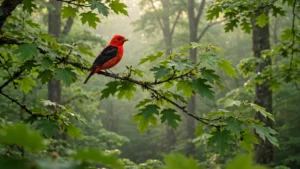
Never buy a wild-caught ibis or collect eggs, which is illegal across much of the range, and never feed the birds, since human food disrupts the diet that gives them their colour. Like the eastern bluebird, the scarlet ibis rewards a quiet watcher far more than a chasing one.
Scarlet ibis watching checklist
A little preparation turns an evening boat trip in the Caroni Swamp into one of the great wildlife experiences of the Caribbean.
- A visit to the Caroni Swamp in Trinidad between mid-October and March, when the roosting flocks are largest.
- A late-afternoon boat trip, timed so you are in the swamp as the flocks fly in to roost.
- Binoculars, since the birds often roost on mangrove islands at a distance.
- A camera with a fast shutter, because the flocks move quickly across the evening sky.
- Light, long-sleeved clothing and insect repellent for the mangrove channels at dusk.
- Patience at the roost, since the birds arrive in waves over an hour or more.
- Respect for the sanctuary rules, keeping boats in the channels and never approaching a nest.
Frequently asked questions
How many scarlet ibis species are there?
There is one scarlet ibis species, Eudocimus ruber, with no recognised subspecies. Its closest relative is the American white ibis, and the two interbreed where their ranges meet in Venezuela and Colombia, though some ornithologists argue they should be treated as one species.
Why is the scarlet ibis red?
The scarlet ibis is red because of its food. Crabs, shrimp and other crustaceans are rich in carotenoid pigments, above all astaxanthin and canthaxanthin, and the ibis stores those pigments in its growing feathers. Chicks hatch grey-brown and white, and take about two years of eating crustaceans to reach full scarlet.
What does a scarlet ibis eat?
A scarlet ibis eats mainly small crabs, above all fiddler crabs, along with shrimp, crayfish, molluscs, aquatic insects and the occasional small fish or frog. It probes soft mud and shallow water with the sensitive tip of its long, down-curved bill.
Where is the best place to see scarlet ibises?
The Caroni Swamp in Trinidad is the best place, where thousands of scarlet ibises return to roost in the mangroves every evening, with the largest numbers from mid-October to March. The flooded llanos of Venezuela and the mangrove coasts of the Guianas and northern Brazil hold large numbers too.
Are scarlet ibises endangered?
Not officially. The scarlet ibis is listed as Least Concern on the IUCN Red List, with a global population estimated in the low hundreds of thousands and the trend believed to be decreasing. Hunting, egg collecting and mangrove loss are the main threats.
How is this guide different from the sandhill crane guide?
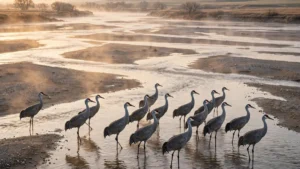
This guide covers the scarlet ibis, a red wading bird of tropical mangroves whose colour comes from the crabs it eats, while our sandhill crane species guide covers the sandhill crane, a tall grey bird of northern prairies and river valleys that bugles, dances and soars on thermals. One is a scarlet jewel of the mangrove coast; the other is a grey giant of the open plains.
Conclusion
The scarlet ibis species needs no introduction once you have seen it: one species, Eudocimus ruber, whose scarlet plumage is built entirely from the crabs and shrimp of the mangrove mud, and whose evening flight into the Caroni Swamp is one of the great wildlife spectacles of the Caribbean.
If you go looking for one, go in the dry season, go late in the afternoon, and wait in silence as the flocks stream in.