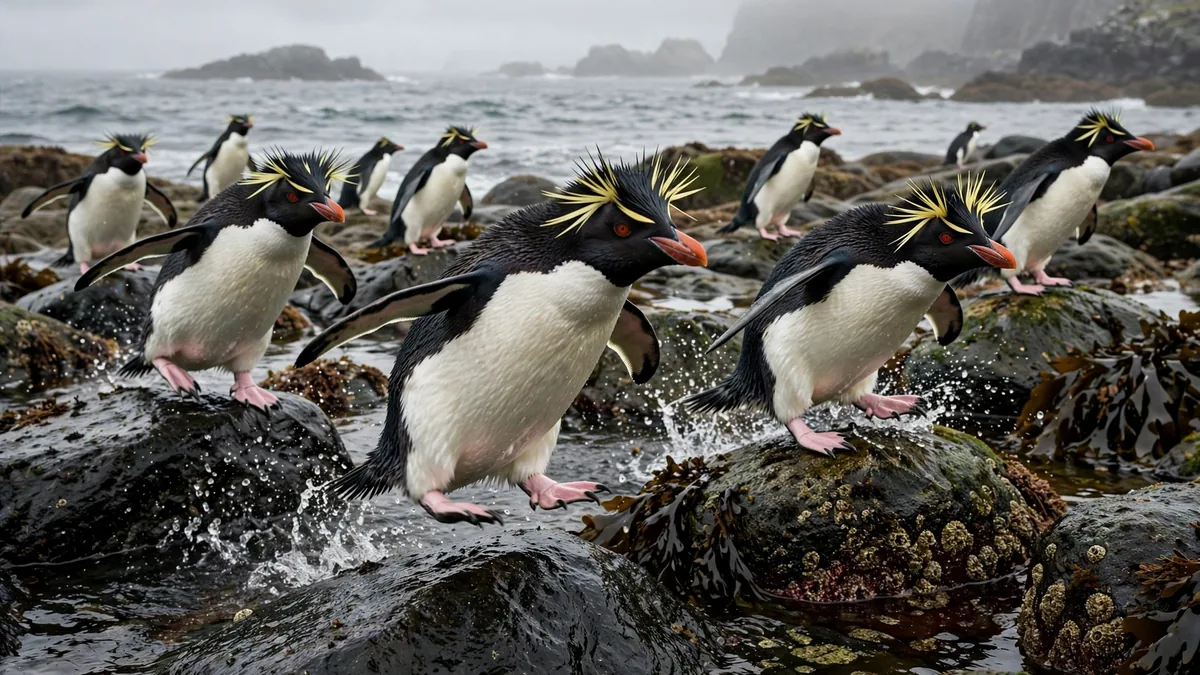
The rockhopper penguin species is not one bird but a group of small crested penguins from the Southern Ocean, and if you are asking how many rockhopper penguin species there are, the answer most authorities now give is two: the southern rockhopper penguin and the northern rockhopper penguin. A third form, the eastern rockhopper, is a full species to some authorities and a subspecies of the southern rockhopper to others, so the honest count is two, with a third under debate.
Rockhoppers are the smallest crested penguins, 45 to 58 centimetres tall and 2 to 3.8 kilograms, instantly recognisable by the spiky yellow crest feathers sweeping back from above each red eye. They get their name from how they move on land: instead of waddling across flat ice like the emperor penguin of Antarctica, they hop from rock to rock with both feet together, climbing steep cliffs to reach their colonies.
Key takeaways
- The rockhopper penguin species group is generally treated as two species, the southern rockhopper Eudyptes chrysocome and the northern rockhopper Eudyptes moseleyi.
- The eastern rockhopper Eudyptes filholi is a full species under the New Zealand checklist, but a subspecies of the southern rockhopper under BirdLife International.
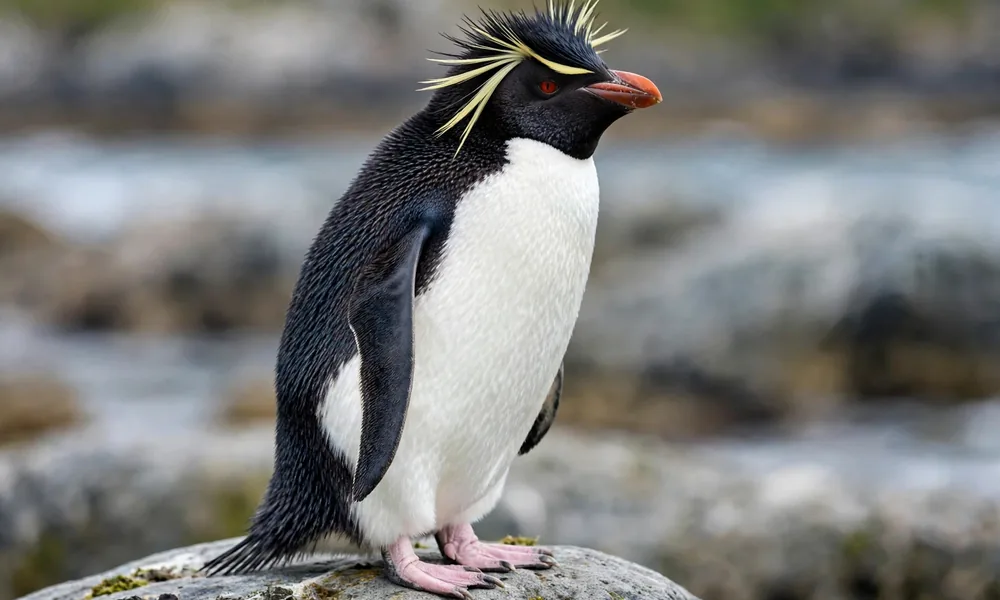
- Rockhoppers are 45 to 58 centimetres tall, weigh 2 to 3.8 kilograms, and are recognised by spiky yellow crests, red eyes and a reddish-orange bill.
- They eat krill and other small crustaceans, squid and small fish, diving to depths of up to 100 metres.
- The northern rockhopper is listed as Endangered and the southern rockhopper as Vulnerable on the IUCN Red List, with both in decline.
What makes a rockhopper penguin a rockhopper penguin
A rockhopper penguin is a small, stocky penguin with a black back, a white front and a head that looks dressed up for a party. Stiff yellow plumes sweep back from above each eye, and the red eyes and short reddish-orange bill stand out against the black face. Males and females look alike, though males are slightly larger, and chicks are covered in grey-brown down with no crest until their first moult.
What truly sets a rockhopper apart is how it climbs. Strong legs, sharp claws and a stiff tail let it bounce up near-vertical rock faces to colonies more than 100 metres above the sea. At sea it uses its narrow flippers as wings, swimming at up to 40 kilometres per hour.
The rockhopper penguin species and their relatives
The rockhoppers belong to Eudyptes, the genus of crested penguins, and all were once treated as a single species, Eudyptes chrysocome. The split rested on clear differences in shape, voice and genetics, and the northern form was formally recognised in 2006.
The eastern form is the remaining puzzle. A 2021 molecular study found the eastern birds form a distinct lineage, and the New Zealand checklist now treats them as a full species, Eudyptes filholi, while BirdLife International and the IUCN still list them as a subspecies of the southern rockhopper. No single global total exists for the whole group, because the three forms are counted separately, in different years and by different methods.
| Type | Animal | Where it lives | Best-known food | Length or Weight |
|---|---|---|---|---|
| Genus | Crested penguins of genus Eudyptes | Subantarctic and cool-temperate islands | Krill, squid and small fish | About 45 to 68 cm long |
| Species | Southern rockhopper penguin (Eudyptes chrysocome) | Falkland Islands and southern South America | Krill, squid and small fish | About 48 to 55 cm, 2 to 3.8 kg |
| Species | Northern rockhopper penguin (Eudyptes moseleyi) | Tristan da Cunha, Gough, Amsterdam and St Paul | Krill, squid and small fish | About 55 to 65 cm, 2 to 4 kg |
| Species | Eastern rockhopper penguin (Eudyptes filholi) | Subantarctic islands south of New Zealand | Small fish, squid and krill | About 45 to 55 cm, 2 to 4 kg |
| Species | Macaroni penguin (Eudyptes chrysolophus) | Subantarctic islands of the Southern Ocean | Krill and small fish | About 70 cm, 5 to 6 kg |
| Species | Fiordland penguin (Eudyptes pachyrhynchus) | Fiordland and Stewart Island, New Zealand | Fish, squid and krill | About 55 to 60 cm, 3 to 4 kg |
How rockhopper penguins live
Rockhopper penguins spend most of their lives at sea, like all penguins, and come ashore only to breed, rest and moult. They feed in flocks, diving to 10 to 25 metres on most trips and to 100 metres when they must, catching krill, squid and small fish. Special glands above their eyes remove the salt from their food.
Breeding is a noisy, crowded affair. In the Falkland Islands the males arrive in early October and the females follow about a week later, with pairs often returning to the same nest site and partner. The female lays two eggs, four or five days apart, and the second egg is much larger than the first, so usually only the chick from the second egg survives. Both parents share the 33-day incubation, and the chicks gather in creches while both parents are at sea. The moult follows breeding and takes about five weeks, during which the birds cannot swim and must fast.
Where rockhopper penguins live
The southern rockhopper breeds on the Falkland Islands and on islands around the southern tip of South America, with further colonies on Prince Edward and Marion, Crozet and Kerguelen islands, and Macquarie and Campbell islands. The Falklands hold the largest share, with about 320,000 breeding pairs counted there in 2010, and the global southern population was estimated at just over 1.2 million breeding pairs in an older BirdLife assessment.
The northern rockhopper breeds much further north, on Tristan da Cunha and Gough Island in the South Atlantic, and on Amsterdam and St Paul islands in the southern Indian Ocean. About 90 per cent of the northern population breeds on Tristan da Cunha and Gough Island, and the IUCN assessment puts the total at about 413,700 mature individuals, while a 2026 genetic study suggested about 200,000 breeding pairs. The eastern form breeds on the subantarctic islands south of New Zealand, including Campbell, Antipodes and Auckland islands, plus Macquarie Island, and no single agreed global total exists for it.
All three forms are birds of rocky, windswept islands rather than of ice, and they are absent from Antarctica itself. The southern rockhopper is listed as Vulnerable on the IUCN Red List, and the northern rockhopper as Endangered since 2008, after falls of 96 per cent on Gough Island between 1962 and 2007 and 98 per cent on Tristan da Cunha since the 1880s. The causes are commercial fishing for the krill and fish the birds eat, oil spills, introduced predators such as rats and mice, and warming seas. The eastern form has no separate IUCN listing while it is treated as a subspecies, though BirdLife International has recommended Vulnerable status for it.
Best seasons for rockhopper penguin watching
The best time to watch rockhopper penguins is the southern spring, from October to December, when the colonies are full. In the Falkland Islands the males arrive in early October, the eggs are laid in early November, and the chicks hatch in December, so a November or December visit shows courting birds, sitting birds and the first small chicks together. In January the chicks gather in noisy creches while their parents commute to the sea.
By February and March most colonies are moulting, and the birds look scruffy and stay put on land. From April to September the birds are away at sea and the colonies are empty. The northern and eastern colonies are far harder to reach, since Tristan da Cunha and Gough Island have no regular tourist access and the New Zealand subantarctic islands are visited only on permit-only expedition cruises.
Staying safe around rockhopper penguins
A rockhopper penguin is a wild bird with a sharp bill and a short temper, and it can give a painful peck to a hand or camera that gets too close. Watch from the marked paths, keep at least five metres from the birds, and never step into a colony, because a frightened bird can knock an egg from its nest or trample a chick. Sit still and let the birds come to you.
Stay off the cliff edges and wet rocks, which are slippery and crumbling, and keep to the marked paths, since a fall on a rockhopper shore can be serious and help is a long way off. Never feed the penguins, never use a flash at close range, and keep dogs away, because one loose dog can scatter a whole colony.
Rockhopper penguin watching checklist
A little preparation turns a windy walk on a subantarctic shore into a real chance of seeing rockhoppers hop.
- A trip to the Falkland Islands between October and December, when the colonies are full.
- Warm, windproof clothing and sturdy boots with grip.
- Binoculars for the yellow crests, and a camera with a zoom lens.
- A guide who knows the colony paths.
- Patience and a willingness to sit still.
- A tide timetable and a weather check.
- Respect for the colony rules.
Frequently asked questions
How many rockhopper penguin species are there?
Most authorities now recognise two: the southern rockhopper Eudyptes chrysocome and the northern rockhopper Eudyptes moseleyi. A third form, the eastern rockhopper Eudyptes filholi, is a full species under the New Zealand checklist, but a subspecies of the southern rockhopper under BirdLife International and the IUCN, so the count is two, with a third under debate.
Why are they called rockhopper penguins?
They are called rockhoppers because of how they move on land, hopping from rock to rock with both feet together instead of waddling. Their colonies sit on steep slopes, and the birds bounce up the rocks to reach their nests.
What do rockhopper penguins eat?
Rockhopper penguins eat krill and other small crustaceans, squid and small fish, caught by pursuit diving, usually to 10 to 25 metres and sometimes to 100 metres. Southern birds in the Falklands feed mostly on crustaceans, while eastern birds take more small fish, including southern blue whiting, along with squid, octopus and krill.
Why do rockhopper penguins lay two eggs but raise one chick?
The female lays two eggs four or five days apart, and the second egg is much larger than the first, so its chick is bigger and stronger and usually the only one to survive. The first egg often fails or its chick is outcompeted.
Are rockhopper penguins endangered?
It depends on the form. The northern rockhopper is listed as Endangered, after falls of 96 per cent on Gough Island between 1962 and 2007 and 98 per cent on Tristan da Cunha since the 1880s, while the southern rockhopper is listed as Vulnerable. The eastern form has no separate IUCN listing while it is treated as a subspecies.
How is this guide different from the rock pigeon guide?
This guide covers the rockhopper penguin, a small flightless seabird of the Southern Ocean that hops up rocky cliffs, dives for krill and raises a single chick in a crowded island colony, while our rock pigeon species guide covers the rock pigeon, a familiar city bird that flies, nests on ledges and feeds on seeds and scraps in towns around the world.
Conclusion
The rockhopper penguin species group is a reminder that a familiar name can hide a real scientific debate: two species most authorities agree on, the southern and northern rockhoppers, and a third eastern form whose status is still argued over.
If you go looking for them, go to the Falkland Islands in the southern spring and sit quietly above a colony while the birds hop up the rocks with both feet together. Find a rockhopper bouncing between the boulders, and you will see why this little penguin earned a name of its own.