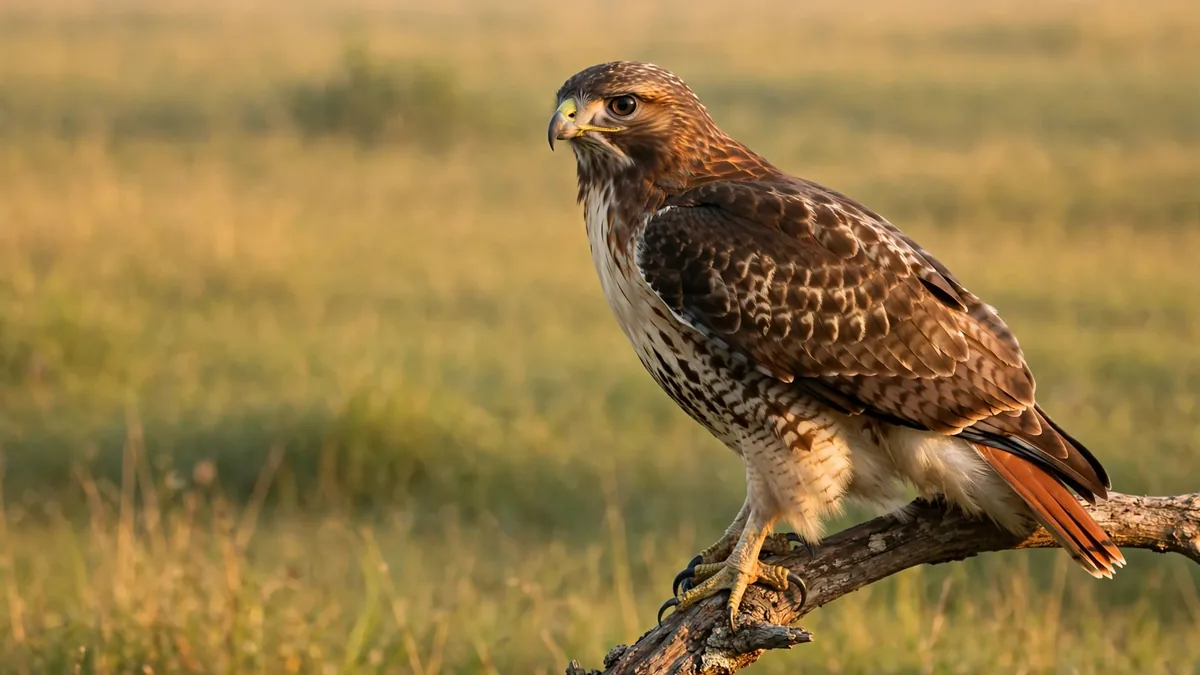
The red-tailed hawk species is a single species, Buteo jamaicensis, the most widespread and familiar large hawk in North America. If you are asking how many red-tailed hawk species there are, the answer is one, a broad-winged hunter of open country that soars over fields on slow wingbeats and shows a brick-red tail when it turns.
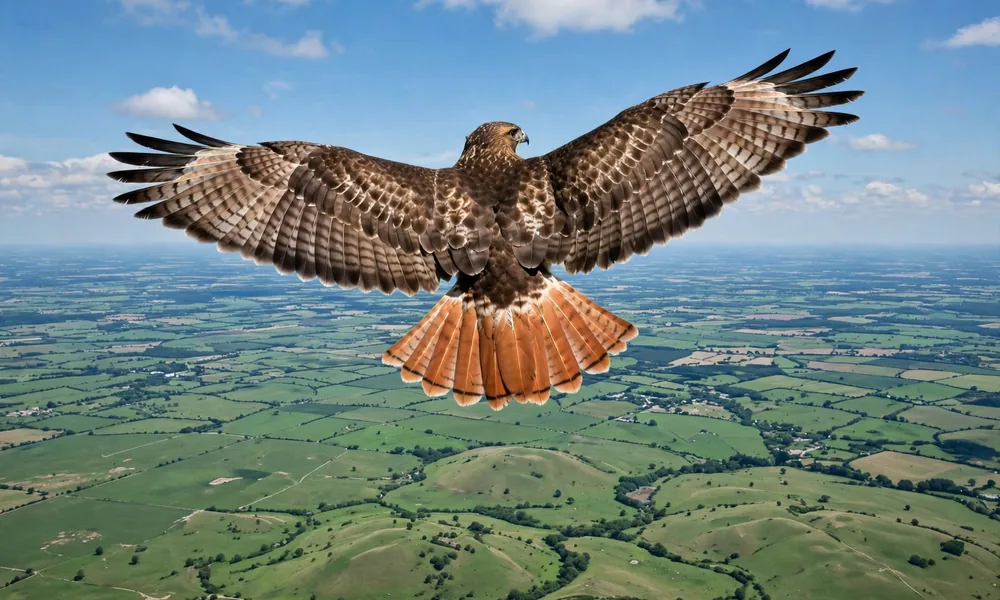
The red-tailed hawk takes its name from that tail, the rusty-red fan that marks the adult bird in flight. It is the hawk most people in North America see first, and its harsh scream is the sound film-makers use for any bird of prey on screen, even an eagle.
Key takeaways
- The red-tailed hawk species is Buteo jamaicensis, a single species with about fourteen recognised subspecies.
- Adults are 45 to 65 centimetres long, with a wingspan of 114 to 132 centimetres and a weight of 690 grams to 1.6 kilograms.
- Red-tailed hawks hunt in open country, eating mainly small rodents, with rabbits, squirrels, snakes and birds as well.
- Pairs are monogamous and often stay together for life, raising two or three young in a large stick nest.
- The species is listed as Least Concern, with a population of about three million birds and numbers still rising.
What makes a red-tailed hawk a red-tailed hawk
A red-tailed hawk is a bulky, broad-winged bird of prey, built for soaring rather than speed. Its upperparts are dark brown, its underparts pale with a dark belly band, and its bill is short, hooked and yellow at the base. The wings are long and wide with a dark bar along the leading edge. Females are larger than males, by about a quarter in weight, as in most birds of prey.
The tail gives the bird away, but only in adults. A grown bird shows a rich, brick-red tail above, pale below, while a young bird in its first year has a brown tail barred with dark bands and a streaked belly. The red tail appears when the bird moults into adult plumage in its second year. Colour varies across the range, from pale birds of the plains to dark birds of the far north, and Harlan’s hawk of Alaska may show a pale or mottled tail even as an adult.
The red-tailed hawk species and their relatives
The red-tailed hawk belongs to Buteo, a genus of broad-winged soaring hawks in the family Accipitridae, and is the most widespread member of the genus in North America. About fourteen subspecies are generally recognised, though authorities differ and some lists run to sixteen, and they vary in size and colour, from the pale Krider’s hawk of the plains to the dark Harlan’s hawk of Alaska. It was not split into separate species in the recent taxonomic revisions of North American hawks.
The red-tailed hawk’s closest relatives are the other large members of the genus, such as the red-shouldered hawk of woodlands and the Swainson’s hawk of the western plains. Unlike the falcons, which kill with a notched bill, a Buteo kills with its feet, and it is a modest hunter, built for rodents rather than large prey, while eagles such as the bald eagle are larger hunters of fish and water birds. No single global population total is agreed, but estimates put the species at about three million birds.
| Type | Animal | Where it lives | Best-known food | Length or Weight |
|---|---|---|---|---|
| Genus | Hawks of genus Buteo | Open country worldwide | Small mammals and reptiles | Up to about 65 cm long |
| Species | Red-tailed hawk (Buteo jamaicensis) | North and Central America | Voles, mice and rabbits | 45 to 65 cm, 690 g to 1.6 kg |
| Species | Red-shouldered hawk (Buteo lineatus) | Woodlands of North America | Frogs, snakes and voles | 43 to 61 cm long |
| Species | Swainson’s hawk (Buteo swainsoni) | Plains of western North America | Grasshoppers and rodents | 46 to 56 cm long |
| Species | Ferruginous hawk (Buteo regalis) | Grassland of western North America | Prairie dogs and rabbits | 56 to 69 cm long |
| Species | Rough-legged hawk (Buteo lagopus) | Arctic tundra and open country | Lemmings and voles | 46 to 60 cm long |
How red-tailed hawks live
Red-tailed hawks, like other hawks, are hunters of open ground, and small rodents make up about 80 to 85 per cent of their diet, above all voles, mice and rats. They also take rabbits, hares, squirrels, snakes, lizards, frogs, birds up to the size of a pheasant, bats, insects and carrion. It can spot a mouse from a great height, thanks to eyesight several times sharper than our own.
A red-tailed hawk hunts in two ways. Most often it sits on a high perch, a bare branch, a fence post or a roadside pole, and drops in a swift stoop when it sees movement. It also soars in wide circles on rising air, and can hover briefly in a headwind, a behaviour called kiting. The osprey hunts in a similar way over water, though it takes fish rather than rodents. Prey is killed with the talons and eaten on the ground or a perch, and fur and bone are later cast up as a pellet.
Pairs are monogamous, often staying together for life and returning to the same territory year after year. In courtship the pair soar in high circles and steep dives, and may lock talons and spiral towards the ground. Both birds build a large stick nest high in a tree, on a cliff or on a tall building, and the female lays one to five eggs, usually two or three, which both parents incubate for 28 to 35 days. The young leave the nest at six to seven weeks, though they cannot fly strongly for another two weeks, and they stay with their parents while they learn to hunt.
Where red-tailed hawks live
Red-tailed hawks live across almost all of North America, from Alaska and Canada south to Mexico, Central America and the Caribbean, which makes them the most widespread large hawk on the continent. They need open ground where prey can be seen, and a high perch or rising air from which to hunt. Those needs are met in grassland, farmland, desert, scrub and woodland edge, and in city parks, where they nest on buildings and hunt rats and pigeons.
Northern birds migrate, leaving Canada and Alaska in autumn for the southern United States and Mexico, while southern birds stay put all year. In autumn the migrants pour south along ridges and coastlines, and watch sites can count thousands in a single day. In winter a red-tailed hawk may hold the same hunting territory for months, perched on the same pole each morning.
The red-tailed hawk is listed as Least Concern on the IUCN Red List, with a population trend described as increasing, and numbers have grown since the 1960s. Estimates put the global population at about three million birds, though figures differ, and the species has spread into cities and suburbs as well as farmland. It is protected by law in the United States and Canada, and its main dangers now are cars, rat poison, which passes up the food chain, and electrocution on power lines.
Best seasons for red-tailed hawk watching
The best time is autumn, when the northern birds migrate south and watch sites along ridges and coasts count them by the hundred. Winter is good too, since the birds sit in the open on roadside poles and bare branches, and courtship flights begin in late winter.
Staying safe around red-tailed hawks
A red-tailed hawk is a wild predator with powerful talons, and it should always be watched from a distance with binoculars. Never approach a nest, because a disturbed pair may abandon their eggs or dive at an intruder, and never try to handle a hawk, injured or not, without calling a licensed wildlife rescuer first. A hawk on the ground beside a road may be feeding or stunned, so give it room and call for help.
Keep dogs on a lead near nest sites during the breeding season, and do not feed red-tailed hawks, since birds that take food from people lose their fear of traffic. If you find a dead hawk, report it to your local wildlife authority, and never keep feathers, which are protected by law.
Red-tailed hawk watching checklist
A little preparation turns a drive through open country into a real chance of seeing this familiar hawk.
- An autumn visit to a ridge or coastal hawk watch, where migrants pass overhead in numbers.
- A winter drive along country roads, scanning fence posts, bare branches and roadside poles for perched birds.
- Binoculars, because a soaring hawk is often high overhead and far away.
- An eye for the dark belly band and the brick-red tail, which separate it from other soaring hawks.
- An ear for the harsh, descending scream, a long kee-eeeee-arr that carries far across open ground.
- A camera with a zoom lens, for close views without approaching a perched bird.
- Respect for nests and the law, since red-tailed hawks and their feathers are protected.
Frequently asked questions
How many red-tailed hawk species are there?
There is one red-tailed hawk species, Buteo jamaicensis, with about fourteen recognised subspecies. Authorities differ, and some lists run to sixteen, but all of the forms, from the pale Krider’s hawk to the dark Harlan’s hawk, belong to the same species.
What does a red-tailed hawk eat?
A red-tailed hawk eats mainly small rodents, about 80 to 85 per cent of its diet, above all voles, mice and rats. It also takes rabbits, squirrels, snakes, lizards, frogs, birds, bats, insects and carrion.
Why do red-tailed hawks scream in films?
The red-tailed hawk’s harsh, descending scream is the sound film-makers use for almost any bird of prey on screen, including eagles, whose real call is a weak whistle. The hawk’s cry sounds fierce, so it has become the voice of the eagle in cinema, and most people have heard one without ever seeing one.
Can red-tailed hawks be seen in cities?
Yes, red-tailed hawks are common in cities, where they nest on tall buildings, hunt rats and pigeons in parks, and perch on lamp posts above busy roads. A famous pair nested on a Fifth Avenue building in New York, and city birds are often the easiest to watch.
Are red-tailed hawks endangered?
No. The species is listed as Least Concern on the IUCN Red List, with a population of about three million birds and numbers that have risen since the 1960s. Cars, rat poison and power lines still kill many birds, but the species as a whole is secure.
How is this guide different from the purple martin guide?
This guide covers the red-tailed hawk, a large bird of prey that soars over open country, hunts rodents with its talons and shows a brick-red tail, while our purple martin species guide covers the purple martin, a small swallow that catches insects in the air, nests in colonies in bird houses and gathers in huge roosts before migrating south. One is a hunter of the open sky; the other is a social insect-eater of the summer air.
Conclusion
The red-tailed hawk species needs no introduction once you have seen it: one species, Buteo jamaicensis, a broad-winged hunter with a brick-red tail, a piercing scream and a taste for voles and rabbits.
If you go looking for one, go in autumn and scan the fence posts and the sky above the fields. Find a red-tailed hawk circling overhead with its red tail catching the sun, and you will see why it is the hawk North America knows best.