The sandhill crane species is a single species, Antigone canadensis, a tall grey wading bird of North America and north-eastern Siberia, and one of the most ancient birds still on the wing. If you are asking how many sandhill crane species there are, the answer is one, a bird with six subspecies that ranges from the Arctic tundra to the wetlands of Florida and Cuba.
Its fossil record reaches back about 2.5 million years, which makes it one of the longest-lived bird lineages on Earth, yet it is also a bird of the present moment: every spring, hundreds of thousands of sandhill cranes gather on the Platte River in Nebraska, filling the sky with their bugling calls.
Key takeaways
- The sandhill crane species is Antigone canadensis, a single species with six recognised subspecies, formerly placed in the genus Grus.
- Sandhill cranes stand 80 to 122 centimetres tall, with a wingspan of 1.65 to 2.30 metres and a weight of 2.7 to 6.7 kilogrammes.
- They are grey overall, with a bare red forehead, white cheeks and a long, dark, pointed bill.
- They breed across Alaska, Arctic Canada and north-eastern Siberia, and winter in the southern United States and Mexico, with resident populations in Florida, Mississippi and Cuba.
- The species is listed as Least Concern and its numbers are increasing, though the Mississippi and Cuban subspecies are federally Endangered in the United States.
What makes a sandhill crane a sandhill crane
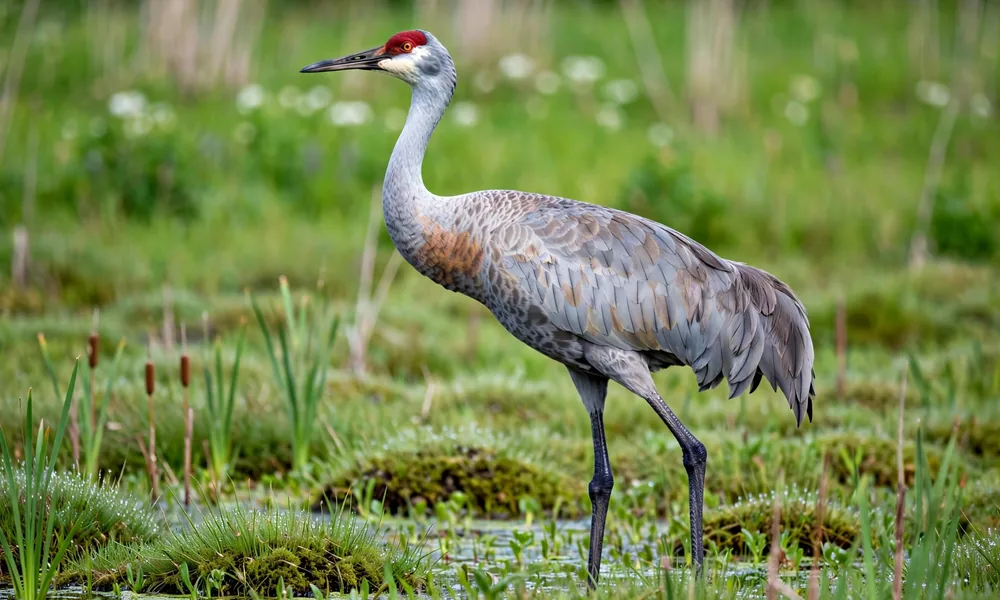
A sandhill crane is a large, long-legged, long-necked bird, grey all over, with a bare patch of red skin on its forehead, a white cheek and a long, dark, pointed bill. In the breeding season the grey plumage often looks stained and rusty, because the birds rub mud into their feathers. In flight the long neck stays straight and the long dark legs trail behind, unlike herons, which fly with their necks folded back.
Size varies a great deal between the subspecies. The lesser sandhill crane of the far north is the smallest and lightest, while the greater sandhill crane of the south is the tallest and heaviest, and males average heavier than females. Their wingspan, typically 1.65 to 2.30 metres, makes them skilled soaring birds: they ride rising columns of warm air called thermals and can stay aloft for hours with only occasional wingbeats. Their call is a loud, trumpeting bugle that carries for kilometres.
The sandhill crane species and their relatives
The sandhill crane belongs to the crane family, Gruidae, which holds fifteen living species, and it is a single species with six generally recognised subspecies. Three are migratory: the lesser sandhill crane, A. c. canadensis, of Alaska, Arctic Canada and north-eastern Siberia; the Canadian sandhill crane, A. c. rowani, of central Canada; and the greater sandhill crane, A. c. tabida, of southern Canada and the west-central United States. Three are largely resident: the Florida form, A. c. pratensis; the Mississippi form, A. c. pulla; and the Cuban form, A. c. nesiotes.
The bird was long known as Grus canadensis, but a molecular study published in 2010 showed that the old genus Grus was not a natural group, so the sandhill crane was moved to the resurrected genus Antigone. Not every authority agrees on the subspecies count: some lists recognise five, treating the Canadian form rowani as disputed. Its closest relatives are the other cranes, above all the whooping crane of North America, the tallest bird on the continent, and the common crane of Europe and Asia.
| Type | Animal | Where it lives | Best-known food | Length or Weight |
|---|---|---|---|---|
| Family | Cranes of family Gruidae | Wetlands and grasslands worldwide | Plants, seeds and small animals | About 80 to 150 cm tall |
| Species | Sandhill crane (Antigone canadensis) | North America, north-eastern Siberia | Waste corn, seeds and insects | 80 to 122 cm, 2.7 to 6.7 kg |
| Species | Whooping crane (Grus americana) | Canada and the United States | Crabs, molluscs and small fish | About 150 cm, 6 to 7 kg |
| Species | Common crane (Grus grus) | Europe and Asia | Seeds, roots and insects | About 120 cm, 4 to 6 kg |
| Species | Grey crowned crane (Balearica regulorum) | Eastern and southern Africa | Insects, frogs and seeds | About 100 cm, 3 to 4 kg |
| Species | Red-crowned crane (Grus japonensis) | East Asia | Fish, frogs and plants | About 150 cm, 7 to 10 kg |
How sandhill cranes live
Sandhill cranes are omnivores, though plants dominate the diet for much of the year. They walk slowly through wetlands and fields with their bills down, rooting for seeds, roots, tubers and berries. On the Platte River in spring, waste corn makes up about ninety per cent of what staging birds eat. Breeding birds in the north eat a wider diet, adding insects, snails, small mammals, frogs and small reptiles.
Sandhill cranes are famous for their dancing. Mated pairs bow to each other with wings spread, leap high into the air, and toss sticks or stubble skywards, and the display strengthens the pair bond. Pairs usually stay together for life, which can last well over twenty years. Pairs also duet in a behaviour called unison calling: standing close together, they give a synchronised, complex call in which the female gives two calls for every one from the male.
Breeding begins in April or May in migratory populations, while resident birds in Florida and Cuba may lay from December to August. Both members of the pair build the nest together, a mound of plant material in shallow water or marshy ground. The female usually lays two olive-brown, heavily spotted eggs, sometimes one or three, and both parents share the incubation for about thirty days. The chicks, often called colts, can leave the nest within a day and first fly at about two months old. Young birds reach breeding age at three to five years, and wild birds typically live about twenty years, with the oldest known bird reaching thirty-six.
Where sandhill cranes live
Sandhill cranes live in open country: wet meadows, marshes, prairies and the shallow edges of rivers and lakes. They need open ground for feeding and shallow water for roosting at night, since standing in water is their main defence against coyotes and other land predators. They are most at home where wetlands meet farmland.
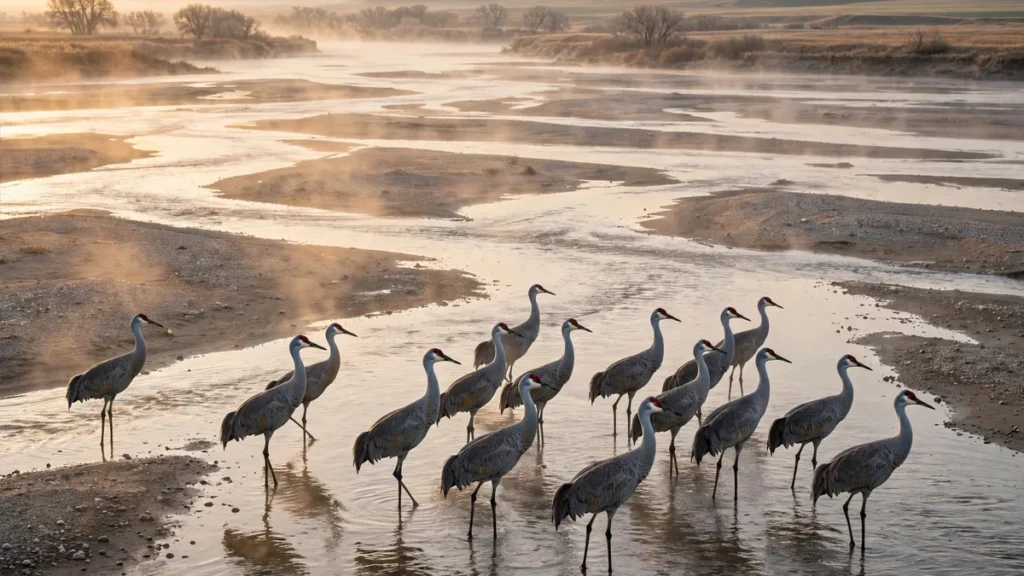
The migratory birds breed across a vast northern arc, from north-eastern Siberia and Alaska across Arctic and sub-Arctic Canada to the northern United States, then fly south for the winter to the southern United States and Mexico. The central Platte River valley in Nebraska is the single most important spring staging area on the continent: more than eighty per cent of the mid-continent population, estimated at over 660,000 birds, passes through it between mid-February and mid-April, and up to 450,000 lesser sandhill cranes alone have been counted there in a season.
The sandhill crane is listed as Least Concern on the IUCN Red List, and its overall trend is increasing. Published estimates of the total population differ, from about 670,000 to about 830,000 birds, roughly 450,000 to 550,000 of them mature adults. That security is uneven, however. The Mississippi sandhill crane, with only a small wild population in coastal Mississippi, and the Cuban sandhill crane are both federally Endangered in the United States, and both depend on intensive recovery work.
Best seasons for sandhill crane watching
The best time to watch sandhill cranes is spring on the Platte River in Nebraska, from late February to mid-April, with numbers peaking in late March. The birds arrive at the river to roost at dusk and leave at dawn in vast, noisy flocks. In autumn and winter, Bosque del Apache National Wildlife Refuge in New Mexico is the classic site, with a crane festival held there each November. The same river valleys also attract the osprey.
Staying safe around sandhill cranes
A sandhill crane is a large, powerful bird with a long, pointed bill, and it can strike if it feels cornered, so the rule is simple: admire it from a distance and never approach a nest or a family with small chicks. Never feed cranes by hand, and never offer them bread or scraps, since human food harms their health and teaches them to approach roads and car parks.
Watch from a path, a blind or a car window, keep dogs on a lead, and stay out of the shallow water where the birds roost. Like the eastern bluebird, the sandhill crane rewards a quiet watcher far more than a chasing one.
Sandhill crane watching checklist
A little preparation turns a spring morning on the Platte into one of the great wildlife experiences of North America.
- A spring visit to the Platte River in Nebraska, from late February to mid-April, with numbers peaking in late March.
- A dawn or dusk start, when the cranes leave or return to their river roosts in vast flocks.
- Binoculars or a spotting scope, since the birds often feed far out in the fields.
- Warm, windproof clothing, because the Nebraska spring is cold before sunrise.
- A booked viewing blind, which puts you close to the roost without disturbing the birds.
- An ear tuned to the bugling call, which carries for kilometres across the open plains.
- Respect for roosting birds, keeping dogs on a lead and never wading into the river.
Frequently asked questions
How many sandhill crane species are there?
There is one sandhill crane species, Antigone canadensis, with six generally recognised subspecies: the lesser, Canadian and greater forms, which migrate, and the Florida, Mississippi and Cuban forms, which are largely resident. Some authorities recognise five, treating the Canadian form as disputed.
Why do sandhill cranes dance?
Sandhill cranes dance to strengthen the pair bond and to choose a mate. Mated pairs bow, leap into the air with wings spread and toss sticks or stubble skywards, and the display continues throughout the birds’ long lives together.
What does a sandhill crane eat?
A sandhill crane eats mostly plants: seeds, roots, tubers and berries, with waste corn a staple on the staging grounds. It also eats insects, snails, small mammals, frogs and small reptiles.
Where is the best place to see sandhill cranes?
The central Platte River valley in Nebraska is the best place, with more than eighty per cent of the mid-continent population passing through each spring and numbers peaking in late March. Bosque del Apache in New Mexico is the classic winter site.
Are sandhill cranes endangered?
Not as a species. The sandhill crane is listed as Least Concern on the IUCN Red List, its numbers are increasing, and the total population is estimated at roughly 670,000 to 830,000 birds. Two subspecies, the Mississippi and Cuban, are federally Endangered in the United States.
How is this guide different from the roseate spoonbill guide?
This guide covers the sandhill crane, a tall grey bird of prairies and river valleys that bugles, dances and soars on thermals, while our roseate spoonbill species guide covers the roseate spoonbill, a pink wading bird of coastal wetlands that sweeps its spoon-shaped bill through shallow water. One is a grey giant of the open plains; the other is a pink specialist of the tidal flats.
Conclusion
The sandhill crane species needs no introduction once you have heard it: one species, Antigone canadensis, whose bugling call has sounded over North America for about 2.5 million years, and whose spring gathering on the Platte is one of the great wildlife spectacles on Earth.
If you go looking for one, go in spring, go at dawn, and listen before you look, since the call carries for kilometres before the birds appear.