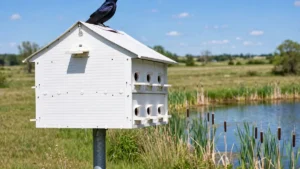
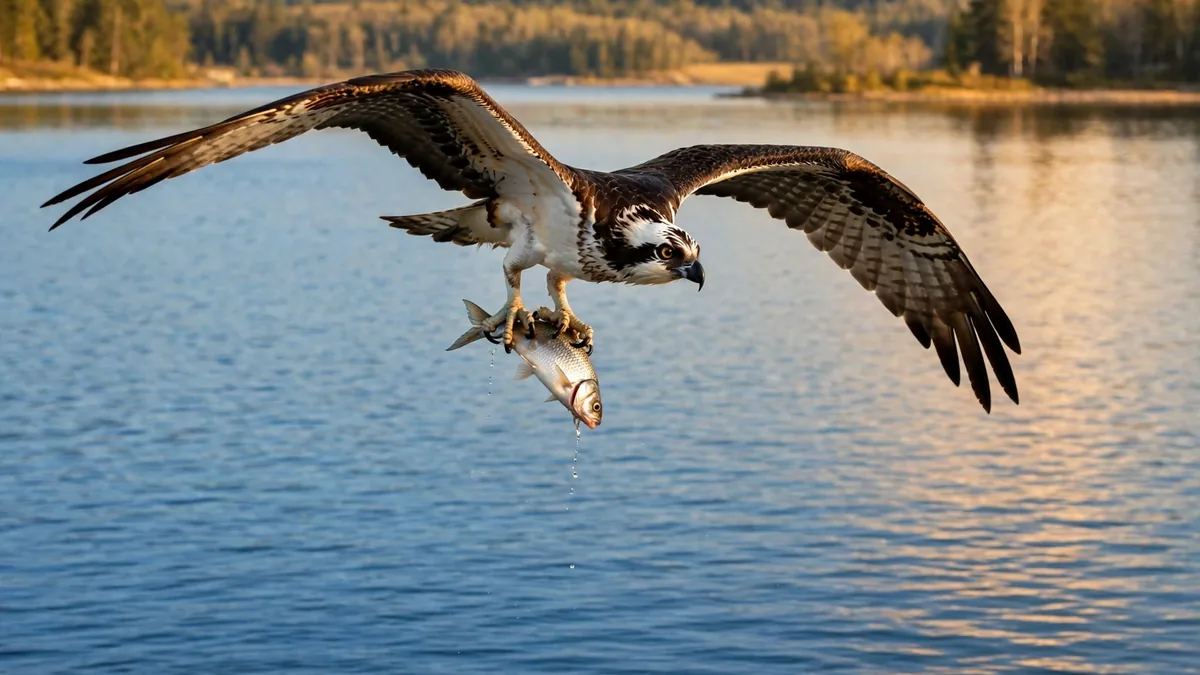
The osprey species is a single species in the sense this guide uses the name, Pandion haliaetus, a fish-eating raptor with a white head, a bold dark eye-stripe and long, narrow wings that plunges feet-first into lakes, rivers and seas for live fish. If you are asking how many osprey species there are, the answer is one, and it is one of the most widespread birds of prey on Earth.
The osprey is a specialist like no other raptor: fish make up about 99 percent of its diet, and its whole body is built for catching them, from its reversible outer toe to the spiny pads on its feet. It was nearly lost in the last century, when the pesticide DDT thinned its eggshells, and its recovery since is one of the great conservation comebacks.
Key takeaways
- The osprey species is Pandion haliaetus, a large fish-eating raptor with a white head, a dark eye-stripe and brown upperparts.
- Adults are 50 to 66 centimetres long, with a wingspan of 127 to 180 centimetres and a weight of 0.9 to 2.1 kilograms.
- Ospreys live near water on every continent except Antarctica, and fish make up about 99 percent of their diet.
- They hunt by plunging feet-first into the water, gripping fish with spiny feet and a reversible outer toe, and carry the catch headfirst.
- The species is listed as Least Concern, with 100,000 to 1.2 million mature individuals and numbers still rising.
What makes an osprey an osprey
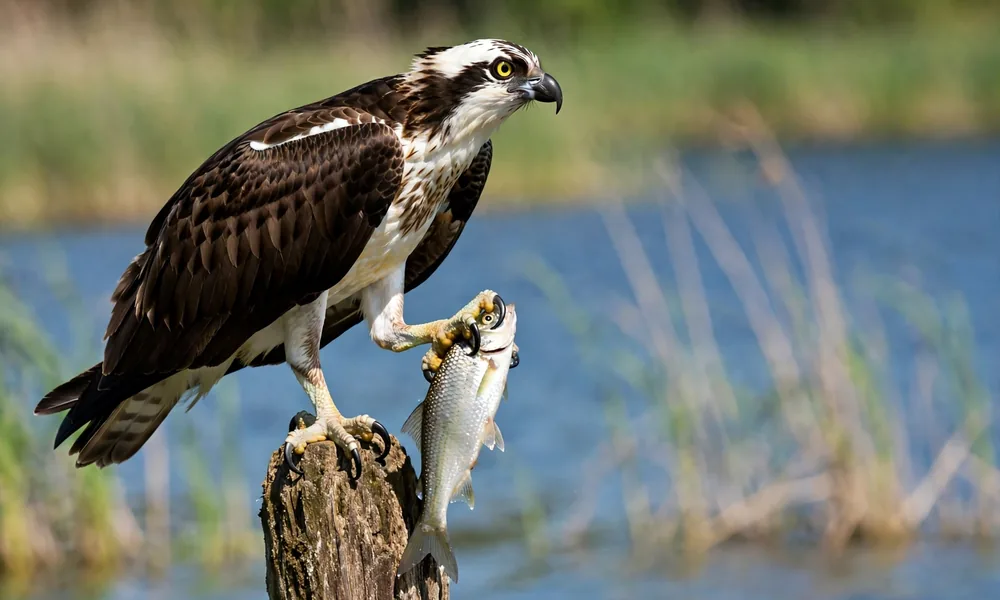
An osprey is easy to recognise: a white head crossed by a bold dark stripe through the eye, dark brown upperparts, white underparts, and long, narrow wings that bend at the wrist, giving it a crooked shape in flight. Its eyes are yellow, its bill is dark and hooked, and its tail is short and barred. Females are slightly larger and usually show a speckled brown necklace across the breast.
What sets the osprey apart is its feet. Its outer toe can turn backwards, so it can grip a slippery fish with two toes in front and two behind, and the soles of its feet are covered in sharp spines. Its talons are long and curved, its nostrils close when it dives, and its plumage is dense and oily, shedding water as it lifts out. Its call is a high, whistling cheep-cheep, often given as it circles above the water.
The osprey species and their relatives
The osprey belongs to Pandion, a genus with a single living species, and it is the only member of its own family, Pandionidae. Four subspecies are generally recognised: haliaetus of Eurasia, carolinensis of North America, ridgwayi of the Caribbean, and cristatus of Australia, and the last, the eastern osprey, is sometimes treated as a separate species, Pandion cristatus. This guide follows the single-species framing, with cristatus as a subspecies.
Its nearest relatives are the fish eagles, above all the bald eagle of North America, the African fish eagle and the white-tailed eagle of northern Europe and Asia, all birds that live by the water and eat fish. The osprey differs from them in taking almost nothing but live fish, which it catches itself, and in its unique feet. It shares its lakes and coasts with other fish eaters, such as the common loon and the cormorant, but they hunt underwater, while the osprey hunts from the air.
| Type | Animal | Where it lives | Best-known food | Length or Weight |
|---|---|---|---|---|
| Genus | Ospreys (genus Pandion) | Watersides worldwide except Antarctica | Live fish | About 50 to 66 cm long |
| Species | Western osprey (Pandion haliaetus) | Europe, Asia, Africa and the Americas | Live fish | About 50 to 66 cm long |
| Species | Eastern osprey (Pandion cristatus) | Coasts and rivers of Australia | Live fish | About 50 to 60 cm long |
| Species | Bald eagle (Haliaeetus leucocephalus) | North America near water | Fish and carrion | About 70 to 102 cm long |
| Species | African fish eagle (Haliaeetus vocifer) | Lakes and rivers of sub-Saharan Africa | Fish | About 63 to 75 cm long |
| Species | White-tailed eagle (Haliaeetus albicilla) | Coasts and lakes of northern Europe and Asia | Fish and waterbirds | About 70 to 92 cm long |
How ospreys live
Ospreys hunt by sight, soaring or hovering 10 to 30 metres above the water and watching for fish near the surface. When one is spotted, the bird folds its wings and plunges feet-first into the water in a great splash, sometimes going right under, and then lifts out with the fish gripped in both feet. Most catches are 15 to 33 centimetres long, and the bird turns the fish headfirst in flight, carrying it to a perch or back to the nest. A hunting osprey succeeds about one time in four, and needs roughly 400 grams of fish a day.
Ospreys are birds of the day, spending much of it perched near the water, preening and watching, between short hunting flights. They are strong, steady fliers, and northern birds make long migrations, European birds travelling to sub-Saharan Africa and North American birds to Central and South America, journeys the young make alone in their first autumn. Some populations, such as the Caribbean and Australian ones, do not migrate at all.
Ospreys nest in a huge stick nest, built in a tall tree, on a cliff, a pole or a purpose-built platform, and the same nest is used and added to for years until it can weigh a hundred kilograms or more. The female lays two to four eggs, usually three, and both parents incubate them for 35 to 43 days. The young leave the nest after 50 to 60 days, and the chicks hatch days apart, so when food is scarce the older, stronger chick may take it all. Great horned owls and eagles sometimes raid nests, but an adult osprey has few enemies, and wild birds can live for 30 years.
Where ospreys live
Ospreys breed across the northern world, in North America, Europe and northern Asia, and in Australia, and they winter further south, in South America, Africa and southern Asia. They are found on every continent except Antarctica, though in South America they occur only as non-breeding visitors.
An osprey needs one thing above all: shallow, fish-rich water, and it will nest beside almost any of it, from sea coasts and estuaries to lakes, rivers, reservoirs and marshes. Nests are built in the open, on dead trees, cliffs, channel markers, telephone poles and nesting platforms, and the birds have taken happily to artificial platforms. In Britain, where they were lost as a breeding bird, they returned to Scotland in the 1950s and were reintroduced at Rutland Water from 1996.
The osprey is listed as Least Concern on the IUCN Red List, with about 100,000 to 1.2 million mature individuals and a trend that is still increasing. The European population is estimated at 19,200 to 27,100 mature individuals. The birds crashed in the 1950s and 1960s, when DDT thinned their eggshells and breeding failed, and they recovered only after the pesticide was banned, in the United States in 1972, and after legal protection and nest platforms. In the Mediterranean, where only a few hundred birds remain, the regional assessment is Endangered.
Best seasons for osprey watching
The best time to look for ospreys is spring and summer, roughly March to September in Europe and North America, when the birds have returned to their nests and are fishing for their young. Early morning and late afternoon are best, when the light is low and the fish are near the surface, and a nest with chicks is a fine sight. Autumn is the season for migration, when ospreys pass coastal watchpoints in numbers, and in the far south they can be watched through winter.
Staying safe around ospreys
An osprey is a harmless bird that would rather fly away than meet a person, and it has no defence beyond its talons and its loud alarm call. Watch from a distance with binoculars and never approach or climb to a nest, because a disturbed pair may abandon the eggs or the young. Keep to marked paths around lakes and reservoirs, and give a bird carrying a fish room, since a startled osprey may drop its catch.
Keep dogs on a lead near known nest sites, since a dog can disturb a nesting bird or be struck by a defending parent. Stay on public land or ask before crossing private ground, and never handle an osprey, which is protected by law in most of its range. If you find a nest, enjoy it from well away and do not return every day, because repeated visits can draw predators.
Osprey watching checklist
A little preparation turns a walk beside a lake or a coast into a real chance of seeing an osprey.
- A spring or summer visit to a lake, reservoir, estuary or coast with shallow, fish-rich water.
- Binoculars, because an osprey over the water is easy to miss.
- An ear tuned for the high cheep-cheep call, which carries further than the bird is visible.
- Patience on the shore at dawn or dusk, when the birds hunt.
- A look out for nests on poles, platforms and dead trees.
- A camera with a zoom lens, for close views from a distance without approaching a nest.
- Respect for nest sites and private land, because a disturbed nest may be abandoned.
Frequently asked questions
How many osprey species are there?
There is one osprey species in this guide, Pandion haliaetus, found on every continent except Antarctica. Four subspecies are generally recognised, and the eastern osprey of Australia is sometimes treated as a separate species, Pandion cristatus, but this guide follows the single-species framing.
What does an osprey eat?
An osprey eats almost nothing but live fish, which make up about 99 percent of its diet, drawn from more than eighty species in fresh and salt water. It takes birds, snakes and small mammals only rarely, and it rarely touches carrion.
How does an osprey catch fish?
An osprey hunts from the air, hovering or soaring above the water until it spots a fish near the surface, then plunging feet-first into the water in a great splash. Its outer toe turns backwards to grip the fish with two toes in front and two behind, its spiny foot pads hold the catch fast, and it carries the fish headfirst.
Are ospreys dangerous?
No, ospreys are harmless to people and would rather fly away than confront anyone. They have sharp talons and a loud alarm call, but only in defence of a nest, so admire them from a distance and never climb to a nest.
How is this guide different from the northern goshawk guide?
This guide covers the osprey, a white-headed raptor of lakes, rivers and coasts that plunges feet-first into the water for live fish, while our northern goshawk species guide covers the northern goshawk, a slate-grey forest hunter that ambushes pigeons and squirrels among the trees. One hunts over water; the other in the forest.
Are ospreys endangered?
No, not in the strict sense. The osprey is listed as Least Concern on the IUCN Red List, with about 100,000 to 1.2 million mature individuals and numbers still rising. It crashed in the 1950s and 1960s, when DDT thinned its eggshells, but it recovered after the pesticide was banned, though in the Mediterranean only a few hundred birds remain.
Conclusion
The osprey species needs no introduction once you have seen it: one species, Pandion haliaetus, a white-headed hunter with a dark eye-stripe and long, kinked wings, built for a life over the water.
If you go looking for one, go in spring, go early, and watch the water for a bird that hovers, folds its wings and falls. Find an osprey rising from a lake with a fish in its talons, and you will see why it is so admired.