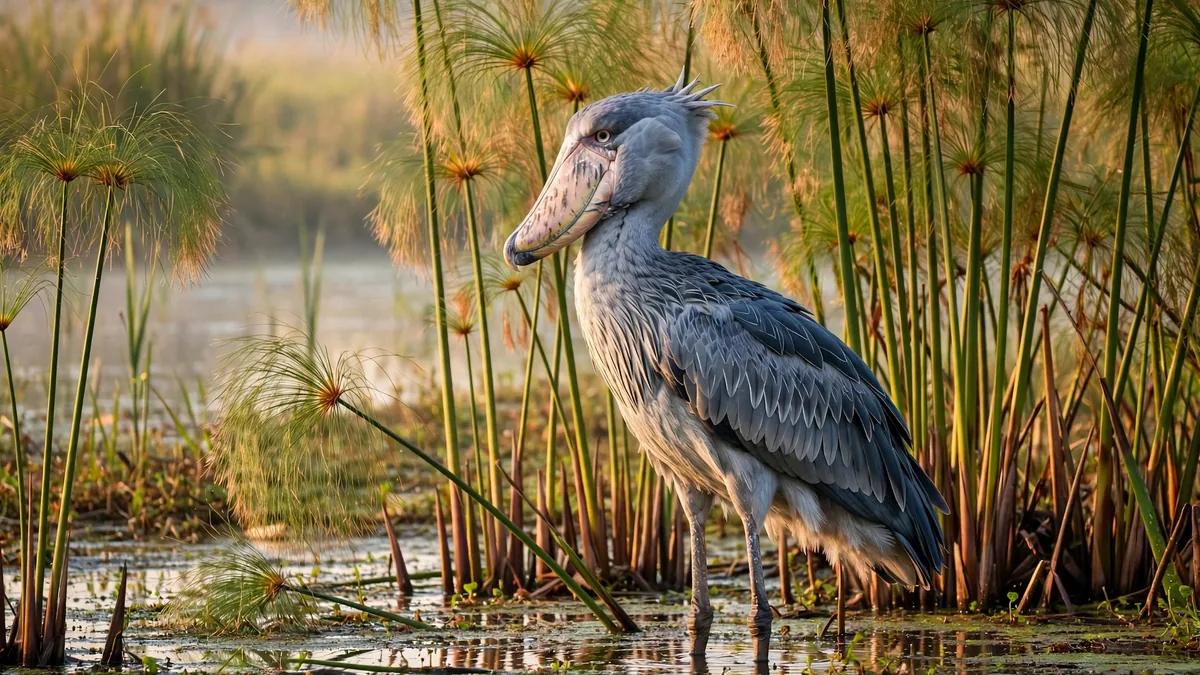
The shoebill species is a single species, Balaeniceps rex, a tall, grey wading bird of the freshwater swamps of east-central Africa, and the only living member of its family, Balaenicipitidae. If you are asking how many shoebill species there are, the answer is one, and no other living bird looks like it, above all because of its huge, clog-shaped bill.
The shoebill looks like a bird from the age of dinosaurs, with a massive pale bill, yellow eyes and long, thin legs, and it hunts by standing motionless for hours in shallow, muddy water. When a lungfish rises to breathe, the bird lunges forward in a sudden collapse and seizes it in that enormous bill. It is a rare, solitary bird of remote wetlands, and one of the most sought-after sights in African birdwatching.
Key takeaways
- The shoebill species is Balaeniceps rex, a single species and the only living member of the family Balaenicipitidae.
- Shoebills stand 110 to 140 centimetres tall, with a wingspan of up to about 230 centimetres and a bill 19 to 24 centimetres long.
- They live in large freshwater swamps dominated by papyrus and reeds, above all in South Sudan, Uganda, Tanzania and Zambia.
- Their diet is dominated by lungfish, along with catfish, tilapia, water snakes, frogs and even young crocodiles.
- The species is listed as Vulnerable, with only 3,300 to 5,300 mature individuals estimated, and the population is decreasing.
What makes a shoebill a shoebill
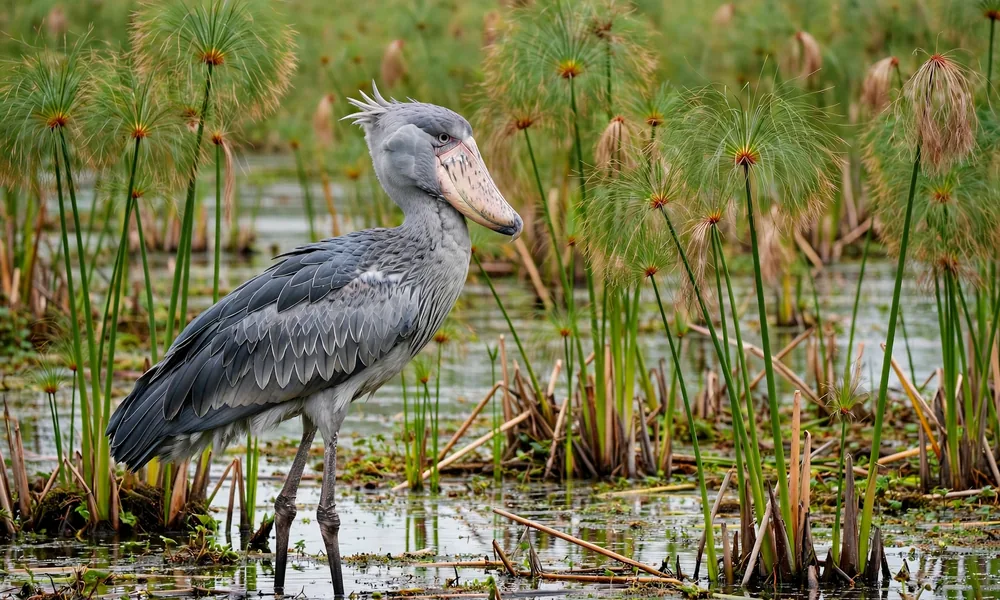
A shoebill is a large, slate-grey bird with a white belly, yellow eyes, a small crest at the back of the head, long dark legs and broad wings built for soaring. Its defining feature is the bill: a massive, pale, clog-shaped structure, tan with brown mottling, about 19 to 24 centimetres long and about 10 centimetres wide, with sharp edges and a hook on the end. It is one of the longest bills of any living bird, and it gives the species its name.
The bill is a tool, not a curiosity. Its broad, flat shape and sharp edges grip large, slippery prey, and the hook at the tip helps the bird hold a lungfish while it swallows it whole. The shoebill also has unusually large feet, which spread its weight over floating vegetation, and it can stand still for hours without moving, a hunting style that few other large wading birds use. Males are slightly heavier than females, at about 5.5 kilogrammes against 5, and the sexes look alike.
The shoebill species and their relatives
The shoebill belongs to Balaenicipitidae, a family with only one living member, and it is placed in the order Pelecaniformes, alongside pelicans, herons and ibises. It was once classified as a stork, but genetic work has moved it closer to the pelicans and the hamerkop, a small African wading bird now thought to be its nearest living relative.
That lonely position is part of what makes the shoebill so famous. Most large wading birds belong to big families with dozens of species, but the shoebill stands alone, a survivor of a line with no other living branches. Like its pelican and heron cousins it hunts fish in shallow water, but it does so in its own way, standing still in papyrus swamps where few other large birds can feed.
| Type | Animal | Where it lives | Best-known food | Length or Weight |
|---|---|---|---|---|
| Family | Balaenicipitidae, the shoebill family | Swamps of east-central Africa | Lungfish and other large fish | One living species |
| Species | Shoebill (Balaeniceps rex) | South Sudan to Zambia | Lungfish, catfish and tilapia | 110 to 140 cm tall |
| Species | Hamerkop (Scopus umbretta) | Wetlands of sub-Saharan Africa | Frogs, fish and tadpoles | About 56 cm long |
| Species | Grey heron (Ardea cinerea) | Europe, Asia and Africa | Fish and amphibians | 90 to 98 cm tall |
| Species | Great white pelican (Pelecanus onocrotalus) | Africa, Europe and Asia | Fish | 140 to 175 cm long |
| Species | Saddle-billed stork (Ephippiorhynchus senegalensis) | Sub-Saharan Africa | Fish and frogs | 145 to 150 cm tall |
| Species | African sacred ibis (Threskiornis aethiopicus) | Sub-Saharan Africa | Insects and crustaceans | About 68 cm long |
How shoebills live
Shoebills feed mainly on large fish, above all the marbled lungfish, an air-breathing fish that thrives in the oxygen-poor water of the swamps. They also take bichirs, catfish and tilapia, along with eels, water snakes, frogs and even young Nile crocodiles. The bird hunts by standing motionless for hours in shallow water, waiting for a fish to rise to breathe, then lunging forward in a sudden movement that birdwatchers call collapsing, falling onto its prey with its bill wide open.
Shoebills are very solitary, and even a mated pair feeds at opposite sides of their territory. Breeding pairs are monogamous, and the birds mature at three to four years old. They build a nest on water or floating vegetation, a platform of trampled plants that can be up to two and a half metres wide. The female lays one to three eggs, and both parents incubate them for about a month, though usually only one chick survives, leaving the nest after about three months.
The shoebill is mostly sedentary, though it moves locally to follow the best feeding water as levels rise and fall, and in South Sudan there are seasonal movements between feeding and breeding areas. Wild birds may reach 35 years, and captive birds have lived to 50. They are quiet birds, and they greet each other at the nest by clattering their huge bills together, a sound that carries across the swamp.
Where shoebills live
Shoebills live only in tropical east-central Africa, in large, permanent freshwater swamps of papyrus, reeds and cattails, with shallow, poorly oxygenated water where fish must rise to breathe. Their stronghold is South Sudan, where the Sudd, one of the largest wetlands in the world, is thought to hold most of the global population. Smaller populations occur in Uganda, western Tanzania, the eastern Democratic Republic of the Congo, northern Zambia, Rwanda and western Ethiopia.
Within that range the birds are thinly spread, and the best-known places to find them are the Bangweulu Swamps of Zambia, the Malagarasi wetlands of Tanzania and Mabamba Swamp on the shores of Lake Victoria in Uganda. They need large, undisturbed wetlands with open water among the reeds, and avoid swamps that have been drained, burned or heavily grazed.
The shoebill is listed as Vulnerable on the IUCN Red List, assessed by BirdLife International, and the population is decreasing. Estimates of its numbers differ: BirdLife International puts the global population at 3,300 to 5,300 mature individuals, or roughly 5,000 to 8,000 birds in total, while an older estimate from 1997 gave 12,000 to 15,000 birds, a figure now thought to have been too high. The main threats are habitat loss as land is cleared for pasture, swamp burning, cattle trampling nests, hunting for food or because the bird is seen as a bad omen, and pollution from oil and tanneries.
Best seasons for shoebill watching
The best time to look for shoebills is the dry season, when falling water levels concentrate the birds in the remaining open water, and the best time of day is the early morning, when they stand in the shallows waiting for fish. Mabamba Swamp in Uganda, reached by boat from Entebbe, is the most reliable place for visitors, and the Bangweulu Swamps of Zambia are the other classic site. A local guide is almost essential, since the birds are thinly spread and the swamps are hard to cross without one.
Staying safe around shoebills
A shoebill is a large bird with a powerful bill that can deliver a serious bite, so keep a respectful distance and never approach one on foot through the reeds. The main risk, though, is to the bird: a disturbed shoebill may leave a feeding area or a nest and not return. Watch from a boat or a path with binoculars, keep quiet, and never push closer for a photograph.
Never disturb a nest, and never pay for a visit that involves chasing a bird or flushing it from cover, since disturbance is one of the pressures on the species. Like the roseate spoonbill, another wading bird of shallow water, the shoebill rewards a patient watcher far more than a hurried one.
Shoebill watching checklist
A little preparation turns a morning on an African swamp into a real chance of seeing one of the world’s most extraordinary birds.
- A dry-season visit to Mabamba Swamp in Uganda or the Bangweulu Swamps of Zambia, when water levels are low.
- An early morning start, when shoebills stand motionless in the shallows waiting for fish.
- A boat trip with a local guide, who knows where the birds are feeding that week.
- Binoculars, since a shoebill often stands still and half hidden among the papyrus.
- Sun protection and water, because the swamps are hot and exposed.
- Patience and a quiet approach, because a disturbed bird may leave and not return.
- Respect for nests and wetlands, keeping to the boat and never pushing into the reeds.
Frequently asked questions
How many shoebill species are there?
There is one shoebill species, Balaeniceps rex, the only living member of the family Balaenicipitidae. No other living bird belongs to the family, which makes the shoebill one of the most isolated species in the bird world.
Why is the shoebill’s bill so large?
The shoebill’s bill is a tool for catching large, slippery prey. Its broad, flat shape and sharp edges grip lungfish, catfish and tilapia, and the hook at the tip helps hold a fish while it is swallowed whole. The bill is about 19 to 24 centimetres long, one of the longest bills of any living bird.
What does a shoebill eat?
A shoebill eats mainly large fish, above all the marbled lungfish, along with bichirs, catfish and tilapia. It also takes eels, water snakes, frogs and even young Nile crocodiles, all caught by standing motionless in shallow water and lunging at prey that rises to breathe.
Where do shoebills live?
Shoebills live only in the large freshwater swamps of east-central Africa, from South Sudan to Zambia, including Uganda, Tanzania, the Democratic Republic of the Congo, Rwanda and Ethiopia. Their stronghold is the Sudd of South Sudan, with important populations in the Bangweulu Swamps of Zambia and Mabamba Swamp in Uganda.
Are shoebills endangered?
Not officially endangered, but listed as Vulnerable on the IUCN Red List, with only 3,300 to 5,300 mature individuals estimated and the population decreasing. Habitat loss, swamp burning, cattle trampling nests, hunting and pollution are the main threats.
How is this guide different from the scarlet tanager guide?
This guide covers the shoebill, a huge, grey wading bird of African papyrus swamps that hunts lungfish with a clog-shaped bill, while our scarlet tanager species guide covers the scarlet tanager, a small, insect-eating songbird of eastern North American forests that weighs less than 40 grams. One is a giant of the swamp; the other is a jewel of the canopy.
Conclusion
The shoebill species needs no introduction: one species, Balaeniceps rex, the only living member of its family, a tall grey bird with a bill like a Dutch clog that hunts lungfish in the papyrus swamps of east-central Africa.
If you go looking for one, go in the dry season, go early, and take a local guide, since the birds are thinly spread and the swamps are hard to cross alone. Find a shoebill standing motionless in the shallows on a quiet morning, and you will understand its fame.