The turkey vulture species is a single species, Cathartes aura, the most widespread vulture of the Americas, found from southern Canada to the tip of South America. If you are asking how many turkey vulture species there are, the answer is one, a dark, long-winged scavenger with a bare red head.
On a warm day you can see turkey vultures rocking and tilting on rising air, wings held in a shallow V, barely flapping for hours at a time. They are nature’s clean-up crew, turning carcasses that could spread disease into dinner.
Key takeaways
- The turkey vulture species is Cathartes aura, a single species with five recognised subspecies in the New World vulture family Cathartidae.
- Adults have a bare red head, dark plumage and a wingspan of 160 to 183 centimetres, and soar with wings held in a shallow V.
- It is the only vulture that finds food by smell as well as by sight, following the scent of gas given off by dead animals.
- Turkey vultures eat almost entirely carrion, prefer it fresh, and can go for more than two weeks without food.
- Listed as Least Concern, with a stable or increasing population of about 5 million to 18 million birds.
What makes a turkey vulture a turkey vulture
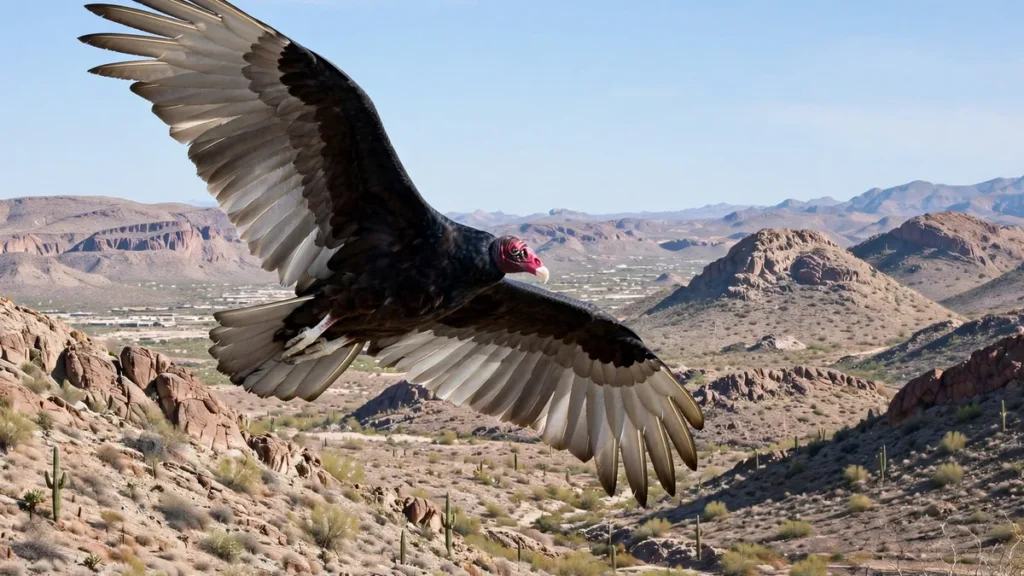
A turkey vulture is a large bird, 62 to 81 centimetres long, with a wingspan of 160 to 183 centimetres and a weight of 0.8 to 2.3 kilogrammes. Its plumage is dark brown-black, and the long, broad wings show a two-toned pattern underneath: silvery flight feathers against black coverts. The head and neck are bare of feathers, red in the adult and dark grey in the young bird, with an ivory bill and pinkish legs. The name comes from its likeness, at a distance, to a wild turkey.
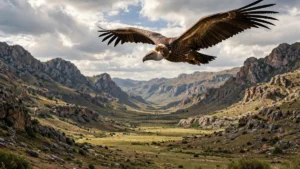
In flight the turkey vulture is unmistakable. It holds its wings in a noticeable dihedral, a shallow V, and rocks gently from side to side, especially in strong wind, flapping only in short bursts. It is a master of soaring, riding thermals for hours with hardly a wingbeat, and it often flies low over fields and roads, scanning and sniffing for dead animals. It has no song, only a hiss, and its defence is to vomit stomach acid at an attacker.
The turkey vulture species and their relatives
The turkey vulture belongs to Cathartes, a small genus of New World vultures in the family Cathartidae, and it is a single species with five recognised subspecies. The nominate race, C. a. aura, is the Antillean turkey vulture, the smallest of the five, found from Mexico south through South America and the Greater Antilles. The eastern race, C. a. septentrionalis, breeds in eastern North America and barely migrates, while the western race, C. a. meridionalis, breeds across western North America and is the most migratory. The tropical race, C. a. ruficollis, is darker and ranges from Panama to Argentina and Trinidad, and the Chilean race, C. a. jota, is larger and browner and reaches Tierra del Fuego. The five races differ only slightly, and National Geographic’s 2006 book listed only four, so the count depends on the authority.
Its closest relatives are the other vultures of Cathartes, the lesser yellow-headed vulture and the greater yellow-headed vulture, both birds of tropical America with yellowish heads. The wider family holds the black vulture, with shorter wings and a quicker, shallower flap, and the huge California condor and king vulture. Unlike the Old World vultures, which are related to eagles and hawks, the New World vultures are a separate, older group.

| Type | Animal | Where it lives | Best-known food | Length or Weight |
|---|---|---|---|---|
| Genus | Vultures of genus Cathartes | The Americas | Carrion | About 62 to 81 cm long |
| Species | Turkey vulture (Cathartes aura) | Southern Canada to Tierra del Fuego | Carrion, found by smell | 62 to 81 cm, 0.8 to 2.3 kg |
| Species | Lesser yellow-headed vulture (Cathartes burrovianus) | Central and South America | Carrion in wet lowlands | About 60 cm, 0.9 to 1.5 kg |
| Species | Greater yellow-headed vulture (Cathartes melambrotus) | Amazon rainforest | Carrion in deep forest | About 75 cm, 1.4 to 1.7 kg |
| Species | Black vulture (Coragyps atratus) | Southern United States to South America | Carrion, found by sight | About 65 cm, 1.2 to 1.9 kg |
| Species | California condor (Gymnogyps californianus) | Western United States | Large carcasses | About 120 cm, 8 to 11 kg |
How turkey vultures live
Turkey vultures feed almost entirely on carrion, the dead bodies of mammals, birds, reptiles and fish, and they prefer animals that have died recently, avoiding carcasses that have rotted too far. They are the only vultures that find food by smell, following ethyl mercaptan, a gas given off by dead animals in the early stages of decay, and they can smell a carcass hidden under the canopy. They rarely kill live prey, though they sometimes take insects, eggs or a little fruit.
They roost in large groups, sometimes several hundred birds together, often with black vultures, on dead trees, towers and cliffs, and they spread their wings in the morning sun to warm up and dry off. On hot days they cool themselves by defecating on their own legs, a habit called urohidrosis. They are diurnal, active in daylight, and they search for food alone or in small groups, soaring for hours without landing.
Breeding birds are monogamous, often staying together for the year and reusing the same nest site. They build no nest at all: the female lays one to three eggs, usually two, on the bare ground in a shallow cave, a hollow log, a rock crevice, thick vegetation or an abandoned hawk nest. The eggs are creamy white with brown spots, and both parents incubate them for 38 to 41 days. The chicks hatch covered in white down, are fed regurgitated food, and fledge after 66 to 88 days. Wild birds usually live 10 to 16 years, captives up to 30.
Where turkey vultures live
Turkey vultures live across almost the whole of the Americas, from southern Canada to Tierra del Fuego at the southern tip of Chile, the widest range of any New World vulture. They use nearly every habitat, from forest and woodland to savanna, grassland, desert, farmland and suburbs, but they favour open country with woodland nearby, where they can soar over fields and still find trees to roost and nest in. They avoid enclosed forest, which makes take-off hard, and completely treeless prairie.
Northern birds are migratory, moving south when the cold arrives, and winter numbers are rising in states that were once too snowy for them, while southern birds stay put all year. In South America they live from the coasts to the foothills of the Andes.
The turkey vulture is listed as Least Concern on the IUCN Red List, with a stable population trend. Published figures disagree widely: Partners in Flight puts the global breeding population at about 5 million birds, while other estimates run as high as 18 million, so the true total is uncertain but certainly runs into the millions. Numbers are stable or rising across most of the range, helped by roads, which supply a steady stream of carrion. The main threats are lead poisoning from shot animals, collisions with vehicles and power lines, and poisoned bait, while eggs and chicks are taken by raccoons, foxes and owls.
Best seasons for turkey vulture watching
Turkey vultures are easiest to watch from spring to autumn, when thermals are strong and the birds soar for hours over open country. In the northern United States and Canada, look for them from March to October, when the migrants return. In the southern United States, Mexico and South America they are present all year. Mid-morning to early afternoon is best, once the thermals are rising.
Staying safe around turkey vultures
A turkey vulture is a shy, non-aggressive bird, and the main risk is to the bird rather than to you. Never approach a roost or nest site closely, since a startled bird may vomit stomach acid. Watch from a distance with binoculars. Like the California condor and the bald eagle, the turkey vulture is protected by law in the United States under the Migratory Bird Treaty Act.
Slow down on roads through open country, because vultures feeding on roadkill are slow to take off and often killed by cars. Like the red-tailed hawk, the turkey vulture does a useful job for free, and it asks only to be left in peace.
Turkey vulture watching checklist
A little preparation turns a warm day in open country into a real chance of watching turkey vultures soar.
- A visit from spring to autumn in the north, or at any time of year in the south, when the birds are present and the thermals are strong.
- A mid-morning start, once the sun has warmed the ground and the birds are riding the thermals.
- Binoculars, since a soaring vulture is often high overhead and hard to identify with the naked eye.
- An eye for the shallow V of the wings and the rocking, tilting flight, which separates it from hawks and eagles.
- A scan of dead trees, towers and cliffs, where the birds gather to roost and sun their wings.
- Patience and a wide sky, because a vulture may soar for hours over the same patch of country.
- Respect for roosts and nests, keeping your distance and never approaching a feeding bird or a chick.
Frequently asked questions
How many turkey vulture species are there?
There is one turkey vulture species, Cathartes aura, with five recognised subspecies: the nominate C. a. aura of Mexico, South America and the Greater Antilles, the eastern C. a. septentrionalis, the western C. a. meridionalis, the tropical C. a. ruficollis and the Chilean C. a. jota.
How do turkey vultures find dead animals?
Turkey vultures find carrion by smell as well as by sight, unique among vultures. They follow ethyl mercaptan, a gas given off by dead animals in the early stages of decay, and they can smell a carcass hidden under the forest canopy.
What does a turkey vulture eat?
A turkey vulture eats almost entirely carrion, the dead bodies of mammals, birds, reptiles and fish, preferring animals that died recently. It rarely kills live prey, though it sometimes takes insects, eggs or a little fruit.
Why is the turkey vulture’s head bare?
The bare head stays cleaner while the bird feeds inside a carcass, since feathers would trap rotting flesh. The skin is red in adults and dark grey in young birds.
Are turkey vultures endangered?
Not officially. The turkey vulture is listed as Least Concern on the IUCN Red List, with a stable or increasing population estimated at about 5 million to 18 million birds. Lead poisoning, collisions with vehicles and power lines, and poisoned bait are the main threats.
How is this guide different from the tawny frogmouth guide?
This guide covers the turkey vulture, a large, dark, day-flying scavenger of the Americas that finds dead animals by smell and soars for hours on a two-metre wingspan, while our tawny frogmouth species guide covers the tawny frogmouth, a mottled Australian night bird that hunts insects on the ground and hides by pretending to be a branch. One cleans up the daylight; the other owns the dark.
Conclusion
The turkey vulture species needs no introduction once you have seen it: one species, Cathartes aura, a wide-ranging scavenger with a bare red head, a two-metre wingspan and a sense of smell no other vulture can match.
If you go looking for one, go on a warm day, go late in the morning, and look up. Find one rocking on a thermal high above an open field, and you will see the clean-up crew at work: a bird that takes only what is already dead, and leaves the land a little safer than it found it.