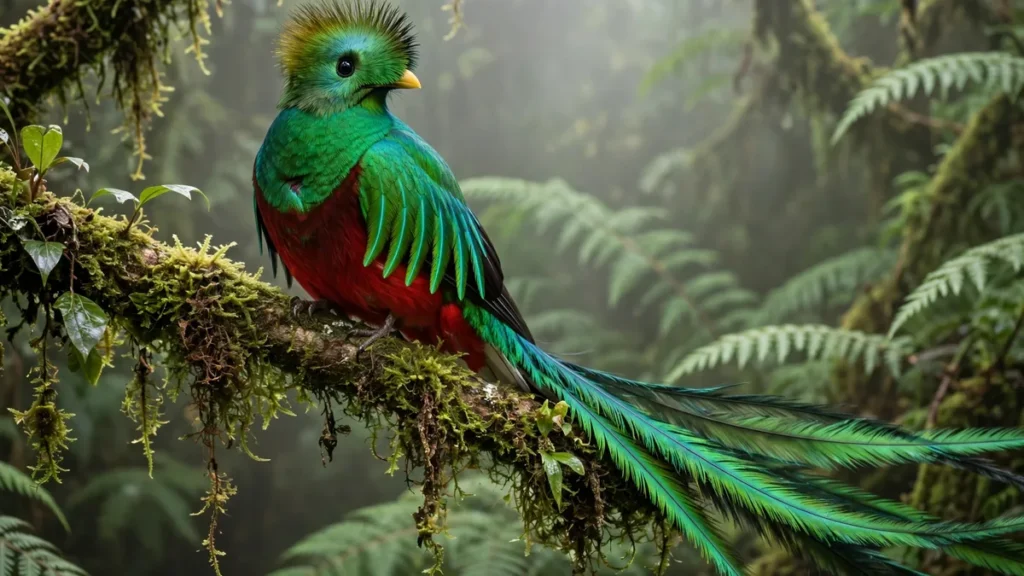
The resplendent quetzal species is a single species, Pharomachrus mocinno, a jewel of the Central American cloud forest famous for the male’s streaming green plumes. If you are asking how many resplendent quetzal species there are, the answer is one, a fruit-eating trogon of the high mountains that lives between about 1,200 and 3,000 metres above sea level.
For the Maya and the Aztec peoples the quetzal was sacred, its long green feathers valued above gold and worn only by rulers and priests, and its rippling plumes were linked with Quetzalcoatl, the feathered serpent. Today it is Guatemala’s national bird, on the flag and coat of arms, and the currency is called the quetzal.
Key takeaways
- The resplendent quetzal species is Pharomachrus mocinno, a single species with two subspecies, and the largest member of the trogon family.
- Males are 36 to 40 centimetres long and weigh about 200 grams, with breeding plumes stretching a male to about a metre in total.
- Resplendent quetzals live in cloud forest from southern Mexico to western Panama, moving up and down the slopes as fruit ripens.
- They eat mainly wild avocados and other laurel fruit, swallowing the fruit whole and regurgitating the pits, with insects, frogs and lizards added for their chicks.
- The species is Near Threatened, with a decreasing population, and protected on Appendix I of CITES, which bans international trade.
What makes a resplendent quetzal a resplendent quetzal
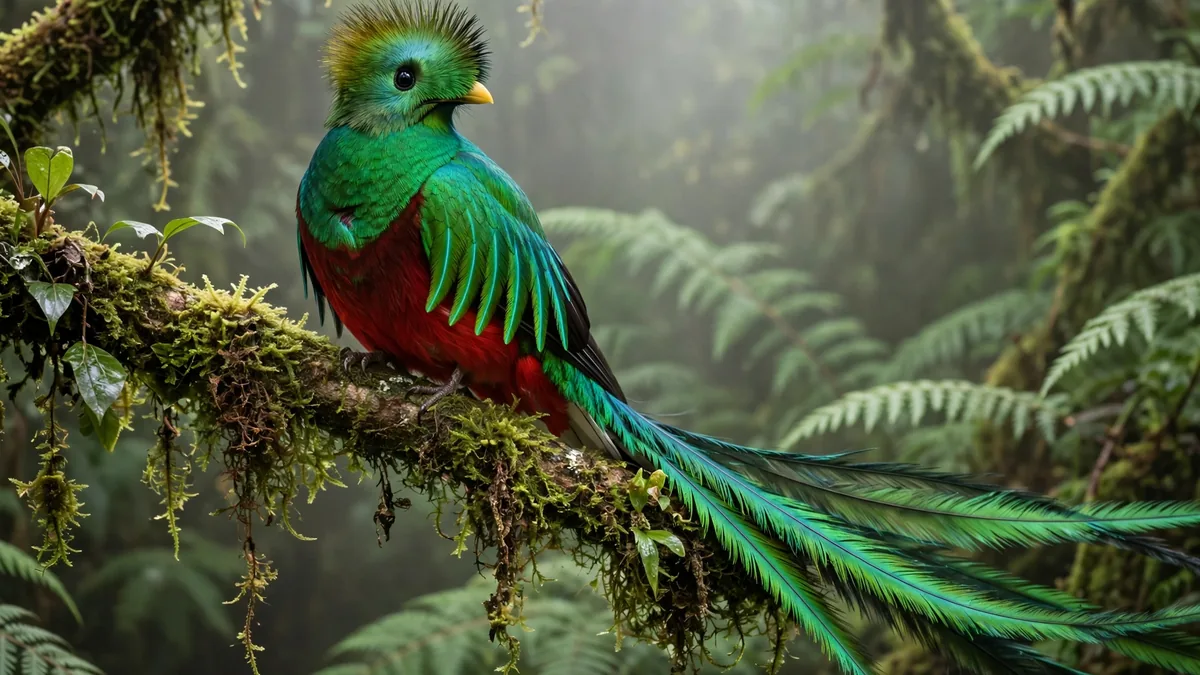
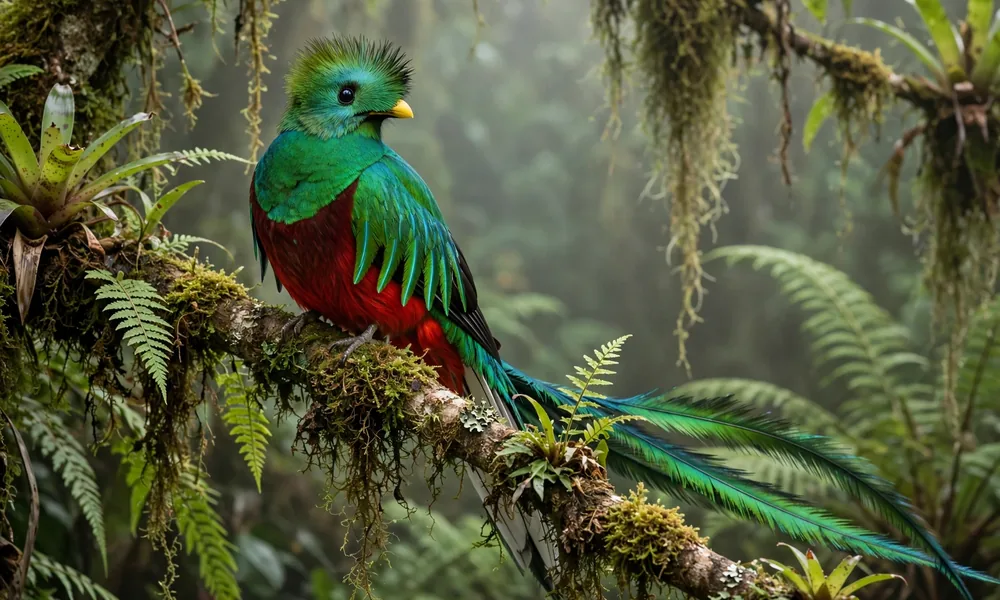
A male resplendent quetzal is impossible to mistake. His head, back and chest shine iridescent emerald green, his belly is deep crimson, and a bristly golden-green crest stands above a yellow bill. The green is structural, not pigment, so the bird flashes green and blue as it turns. The female is duller, with a grey-green breast, a dark bill and no crest, and she lacks the male’s long plumes.
The famous streaming train is not the tail at all. It is made of two enormously long uppertail coverts, feathers that overlie the base of the tail, and in a breeding male they can reach 60 to 65 centimetres beyond a short tail of only about 14 centimetres. They grow in for the breeding season and are moulted afterwards. The quetzal has short legs and weak feet, and it perches upright and still, watching for fruiting trees before swooping out to feed.
The resplendent quetzal species and their relatives
The resplendent quetzal belongs to Pharomachrus, a small genus of five quetzal species in the trogon family, Trogonidae, a group of brilliantly coloured, fruit-eating birds of the tropics. Two subspecies are recognised: P. m. mocinno, of southern Mexico to western Nicaragua, and the slightly smaller P. m. costaricensis, of Costa Rica and western Panama. This guide covers the resplendent quetzal as a single species, not the whole quetzal group, although its four close relatives share the same cloud-forest way of life.
Its closest relatives are the other members of Pharomachrus, above all the golden-headed quetzal of the Andes and the crested quetzal, which share the green-and-red pattern but never grow plumes as long as the resplendent male’s. Quetzals nest in holes in rotting trees, and a toucan may peer into a nest hole or take over a cavity, so a breeding pair must guard its tree. No reliable global total exists: the IUCN gives 50,000 to 499,999 mature birds, while a recent study suggests about 334,000 birds in total, so every figure is an estimate.
| Type | Animal | Where it lives | Best-known food | Length or Weight |
|---|---|---|---|---|
| Genus | Quetzals of genus Pharomachrus | Mountain forests of the Americas | Laurel fruit and insects | About 28 to 40 cm long |
| Species | Resplendent quetzal (Pharomachrus mocinno) | Cloud forest, Mexico to Panama | Wild avocados and laurel fruit | Body 36 to 40 cm, plumes to about 1 m |
| Species | Golden-headed quetzal (Pharomachrus auriceps) | Cloud forest of the Andes | Fruit, insects and small frogs | About 33 to 36 cm long |
| Species | Crested quetzal (Pharomachrus antisianus) | Cloud forest of the Andes | Fruit and insects | About 33 cm long |
| Species | White-tipped quetzal (Pharomachrus fulgidus) | Mountain forest of Venezuela and Guyana | Fruit and insects | About 28 to 30 cm long |
| Species | Pavonine quetzal (Pharomachrus pavoninus) | Amazon rainforest | Fruit and insects | About 33 cm long |
How resplendent quetzals live
Resplendent quetzals are specialised fruit-eaters, and wild avocados and other laurel fruit matter most to them. A quetzal plucks a fruit in flight, hovering or swooping from a perch, swallows it whole, digests the pulp and later regurgitates the large pit, which makes the bird an important disperser of avocado trees, since few other birds can swallow such large fruit. The birds also take insects such as wasps, ants and larvae, snails, frogs and lizards.
Breeding is a shared task. The pair carves a nest hole in a rotting tree, or enlarges an old woodpecker hole, and the female lays two pale blue eggs on the bare wood. Both parents incubate for about 18 days, the male by day and the female by night, his long plumes folding forwards over his back and out of the hole like a bunch of fern. When the chicks hatch, both parents feed them, at first mostly insects and lizards, then fruit, and the young leave the nest at about three to four weeks old.
Outside the breeding season quetzals usually live alone, although several may gather in one fruiting tree. They are altitudinal migrants, moving up and down their own mountains rather than travelling to another country, following the laurels as they ripen at different heights. They fly with a strong, undulating flight, the male’s plumes streaming behind him. A quetzal that is caught rarely survives long in captivity, which is why the bird became a symbol of liberty in Guatemala.
Where resplendent quetzals live
Resplendent quetzals live in a narrow band of montane cloud forest from Chiapas in southern Mexico through Guatemala, Honduras, El Salvador and Nicaragua to Costa Rica and western Panama. They need tall, undisturbed evergreen forest, and they are most often seen at the middle and upper levels of the trees. Below, in the lowland rainforest, lives the scarlet macaw, a much larger parrot of the hot lowlands.
A quetzal’s home must offer tall forest, old rotting trees for nests and plenty of fruiting trees. The best-known places to look are the Monteverde Cloud Forest Reserve in Costa Rica, the Biotopo del Quetzal in Baja Verapaz in Guatemala, which was created to protect the national bird, and Los Quetzales National Park in Panama. The birds move between reserves as the fruit ripens, so a forest empty in one month may be full the next.
The resplendent quetzal is listed as Near Threatened on the IUCN Red List, a status assessed in 2022 and published in 2023, with the population trend described as decreasing. The main threat is cloud-forest loss to logging and farming, which takes both the fruiting trees and the rotting nest trees, above all in the northern part of the range. It is also listed on Appendix I of CITES, so international trade in the bird is banned, and the species is protected by law across its range.
Best seasons for resplendent quetzal watching
The best time to look for resplendent quetzals is the dry season, roughly February to May, when the birds are breeding, the males are in full plume and the fruiting trees draw them to known feeding spots. Breeding runs from about March to May in Guatemala and peaks in February to April in Costa Rica, so a guided walk at dawn in those months gives the best chance. Early morning is best, when the birds call and feed.
Staying safe around resplendent quetzals
A resplendent quetzal is a shy forest bird that would rather slip away through the canopy than meet a person, and it has no defence beyond its camouflage and its speed in flight. Watch from the trail with binoculars, keep your voice down, and never approach a nest hole, because a disturbed pair may abandon their eggs, and a nest in a rotting tree is easily damaged by a careless footstep.
Stay on the marked trails, never feed a quetzal, and never buy a live quetzal or its feathers, since the bird is protected by law and fares badly in captivity. A local guide knows the fruiting trees and helps you see the bird without disturbing it.
Resplendent quetzal watching checklist
A little preparation turns a misty cloud-forest walk into a real chance of seeing Central America’s most famous bird.
- A dry-season visit, roughly February to May, when breeding males are in full plume and fruiting trees draw the birds in.
- An early morning start in a reserve such as Monteverde or the Biotopo del Quetzal, when the birds call and feed.
- A local guide who knows which avocado trees are fruiting, since the birds follow the fruit.
- Binoculars, because a quetzal perched still in the canopy can vanish into the green.
- Warm, waterproof clothing and sturdy shoes for a cool, wet, steep forest.
- Patience and a quiet voice, because a quetzal watched from the trail will stay, while a noisy approach sends it away.
- Respect for nest trees, park rules and the ban on feeding or trading in the bird, which is protected by law.
Frequently asked questions
How many resplendent quetzal species are there?
There is one resplendent quetzal species, Pharomachrus mocinno, with two subspecies: P. m. mocinno of southern Mexico to western Nicaragua and P. m. costaricensis of Costa Rica and western Panama. The two differ slightly in size and bill shape, but they are one species.
Why is it called a resplendent quetzal?
Resplendent means shining brilliantly, and the name fits the male’s iridescent emerald plumage, which flashes green and blue as he turns in the light. Quetzal comes from quetzalli, the Nahuatl word for a large, beautiful tail feather.
What does a resplendent quetzal eat?
A resplendent quetzal eats mainly fruit, above all wild avocados and other fruit of the laurel family, which it swallows whole and later regurgitates as pits. It also eats insects, snails, frogs and lizards, and the chicks are fed mostly insects in their first days.
Are resplendent quetzals endangered?
Not in the strict sense, but they are heading in the wrong direction. The resplendent quetzal is listed as Near Threatened on the IUCN Red List, with a decreasing population. The main threat is the loss of cloud forest to logging and farming, which removes both its food trees and its nest trees.
Where is the best place to see a resplendent quetzal?
The best-known places are the Monteverde Cloud Forest Reserve in Costa Rica, the Biotopo del Quetzal in Guatemala and Los Quetzales National Park in Panama. Go in the dry season, from about February to May, start at dawn, and hire a local guide who knows which avocado trees are fruiting.
How is this guide different from the red-winged blackbird guide?
This guide covers the resplendent quetzal, a single cloud-forest trogon of Central America that eats wild avocados, nests in rotting trees and is Guatemala’s national bird, while our red-winged blackbird species guide covers the red-winged blackbird, a common marsh bird of North America that eats seeds and insects. One is a rare jewel of the misty high forest; the other is a familiar bird of the open marsh.
Conclusion
The resplendent quetzal species needs no introduction once you have seen it: one species, Pharomachrus mocinno, an emerald-and-crimson jewel of the cloud forest with a train of green plumes, sacred to the Maya and Aztec peoples.
If you go looking for one, go in the dry season, go early, and go with a guide who knows the fruiting trees. Find a male perched in the mist with his plumes streaming, and you will see why this bird became the national symbol of Guatemala.