The snow goose species is a single species, Anser caerulescens, a medium-sized goose of the Arctic tundra that comes in two colours, white and dark grey-blue. If you are asking how many snow goose species there are, the answer is one, and its two colour forms were once thought to be two separate species, the snow goose and the blue goose, until naturalists found that they interbreed freely.
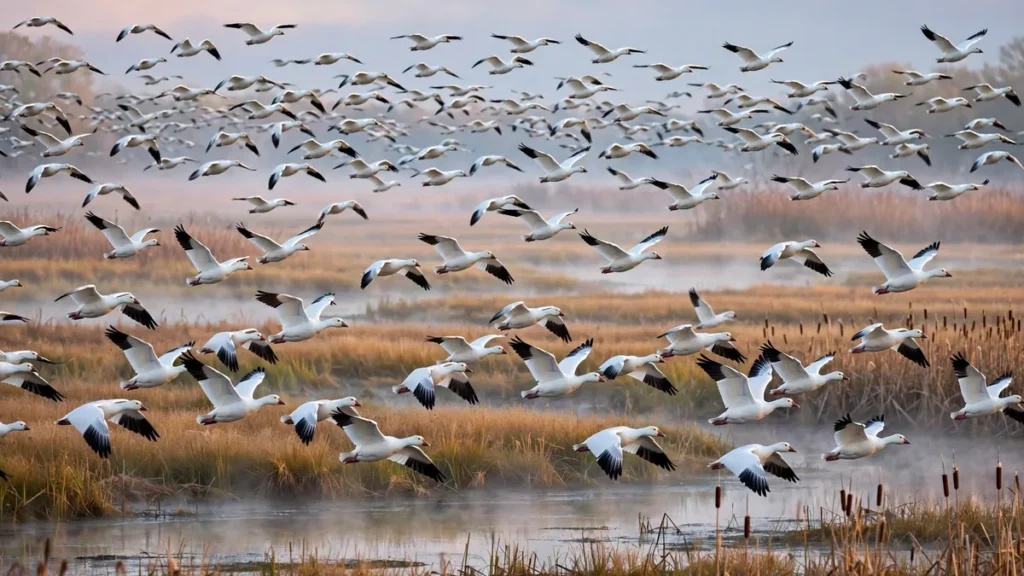
A snow goose on its own is a plain bird, but snow geese are rarely on their own: they travel in flocks of tens of thousands that rise from a marsh like a snowstorm in reverse, honking so loudly that the sound carries for more than a kilometre.
Key takeaways
- The snow goose species is Anser caerulescens, a single species with two subspecies, the lesser and the greater snow goose, and two colour morphs, white and blue.
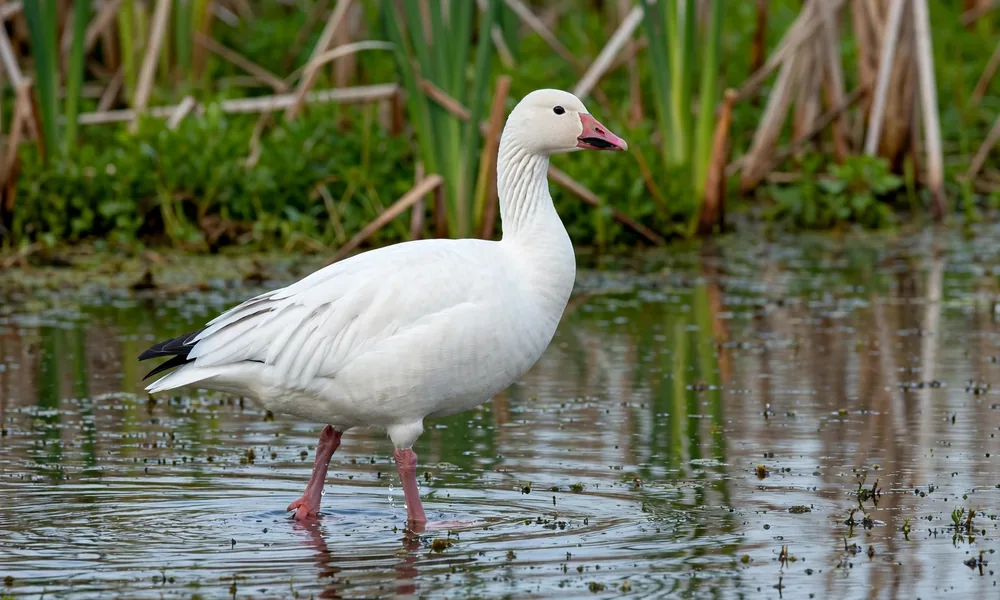
- White-morph birds are white with black wingtips, while blue-morph birds have a dark grey-blue body with a white head and neck; both have a pink bill and rose-pink legs.
- Snow geese are 69 to 83 centimetres long, with a wingspan of 135 to 165 centimetres and a weight of about 1.6 to 3.3 kilograms.
- They breed on the Arctic tundra of Canada, Greenland, Alaska and north-east Siberia, and winter in wetlands and farm fields across the United States and Mexico.
- The species is Least Concern, with estimates from about 5 million to as many as 20 million birds, so many that they damage their own breeding habitat.
What makes a snow goose a snow goose
A snow goose is a chunky, medium-sized goose with a fairly long neck, a stout pink bill and dark pink legs. The white morph is white all over except for black primary feathers, which show as black wingtips in flight, while the blue morph has a bluish-grey body, dark wings and a white head, neck and tail tip. Young birds are dingy grey above and white below, with a dark bill, and they whiten over their first year.
The feature that settles the identification is the bill. A snow goose has a pink bill with black cutting edges, a dark patch along the edge that looks like a grin when seen from the side, and this grin patch separates it from white farmyard geese and from the smaller Ross’s goose, its closest relative.
The snow goose species and their relatives
The snow goose belongs to Anser, the genus of grey geese in the duck family, Anatidae, and it is a single species with two recognised subspecies. The lesser snow goose, A. c. caerulescens, breeds from north-east Siberia across northern Alaska and Arctic Canada, and winters in the western and south-central United States, northern Mexico and Japan. The greater snow goose, A. c. atlanticus, breeds in north-east Canada and north-west Greenland, and winters along the Atlantic coast from New Jersey to North Carolina. The greater is the larger bird, but the two overlap in size.
The two colour morphs cut across the subspecies, though not evenly. The blue morph is commonest in the central and eastern Arctic colonies of the lesser snow goose, making up 85 to 90 per cent of birds in some colonies on Baffin Island, and it is rare among greater snow geese. Its sister species is the smaller Ross’s goose.
| Type | Animal | Where it lives | Best-known food | Length or Weight |
|---|---|---|---|---|
| Genus | Geese of genus Anser | Northern hemisphere wetlands | Grasses, grains, roots | About 60 to 90 cm |
| Species | Snow goose (Anser caerulescens) | Arctic North America | Grasses, sedges, waste grain | 69 to 83 cm, 1.6 to 3.3 kg |
| Species | Ross’s goose (Anser rossii) | Arctic Canada, winters in the west | Grasses and sedges | About 58 to 66 cm, 1.2 to 1.6 kg |
| Species | Greater white-fronted goose (Anser albifrons) | Arctic tundra | Grasses, roots, grain | About 65 to 78 cm, 2 to 3 kg |
| Species | Greylag goose (Anser anser) | Europe and Asia | Grasses, roots, grain | About 74 to 91 cm, 2.5 to 4 kg |
| Species | Bean goose (Anser fabalis) | Northern Europe and Asia | Grasses, roots, grain | About 68 to 90 cm, 2.5 to 4 kg |
How snow geese live
Snow geese eat only plants. On the breeding grounds they graze on the leafy parts of grasses, sedges and rushes, and grub out the roots and tubers of tundra plants with their bills. In migration and in winter they feed in shallow water and on land, eating marsh plants and, above all, waste grain left in farm fields: corn, rice and wheat.
Breeding runs through the short Arctic summer, from late May to mid-August. Pairs form when the birds are two or three years old and mate for life, finding a new mate only if one is lost. They arrive on the tundra in June and nest on the ground, often in colonies of tens of thousands of pairs. The female lays three to five creamy-white eggs and incubates them for 22 to 25 days while the male stands guard, and the goslings can swim and feed themselves within a day of hatching. They fledge at 42 to 50 days and migrate south with their parents.
Snow geese are among the most social of all birds. They nest in huge colonies, feed in vast flocks, and migrate in skeins that can number tens of thousands. In late summer the adults moult their flight feathers and cannot fly for about three weeks, regaining flight at about the time their young begin to fly.
Where snow geese live
Snow geese live in two worlds. In summer they are birds of the high Arctic tundra, nesting on flat, grassy ground near lakes, rivers and the coast, from north-east Siberia across northern Alaska and Arctic Canada to north-west Greenland. In winter they spread across North America, using coastal marshes, bays, wet grasslands and farm fields, from south-western British Columbia through the United States to Mexico. They follow the Pacific, Central, Mississippi and Atlantic flyways.
The autumn migration runs from September into December, and the spring return from February through April. Greater snow geese follow the Atlantic coast, while lesser snow geese use the central and western flyways, wintering on the Gulf Coast, in the Mississippi valley and in California’s Central Valley. In winter, dark blue-morph birds predominate along the Gulf of Mexico, while flocks on the Atlantic coast and in the west are largely white.
The snow goose is listed as Least Concern on the IUCN Red List, and its population trend is increasing. Around 1900 the population had fallen to only 2,000 to 3,000 birds, and hunting was banned in the eastern United States in 1916. Since then the birds have rebounded, helped by the waste grain of modern farming. Published estimates of the total now range widely, from about 5 to 6 million to as many as 10 to 20 million birds, because no single survey counts them all. The problem now is the opposite of scarcity: in places the geese are so numerous that their grazing and grubbing strips the tundra bare, damaging the habitat for themselves and for other Arctic birds.
Best seasons for snow goose watching
The best time to see snow geese is autumn and winter, when the flocks are at their largest and closest to people. Bosque del Apache National Wildlife Refuge in New Mexico holds its greatest numbers from early November to late January, when thousands of geese roost in the ponds overnight and lift off together at dawn. Middle Creek in Pennsylvania is famous in late winter, with flocks building up in February and March.
Staying safe around snow geese
A snow goose is a harmless bird, and the risk runs the other way: a flock that is flushed wastes the energy it needs for migration and the breeding season ahead. Never walk into a feeding flock or drive at birds on a road, and keep dogs under control near roosting and feeding sites. Give nesting birds a wide berth, since geese can be noisy and aggressive at close quarters in the breeding season.
Watch from a vehicle where possible, since a car works as a blind and the birds are far less likely to flush, and use binoculars or a spotting scope because the flocks often feed far from the road. Go early or late, when the geese leave their roosts at dawn and return at dusk. Like the osprey, the snow goose rewards a patient watcher who arrives before sunrise.
Snow goose watching checklist
A little preparation turns a cold morning at a refuge into one of the great wildlife spectacles of North America.
- A winter visit, from November to January, to Bosque del Apache in New Mexico.
- An arrival before sunrise, when thousands of geese lift off from their roosting ponds together.
- Binoculars or a spotting scope, since the flocks often feed far from roads and paths.
- A car to watch from, which works as a blind and keeps the birds from flushing.
- Warm clothing and gloves, because the best viewing happens on cold mornings.
- An ear tuned to the honking.
- Patience and a respectful distance, never walking into a feeding flock.
Frequently asked questions
How many snow goose species are there?
There is one snow goose species, Anser caerulescens, with two subspecies: the lesser snow goose, A. c. caerulescens, of the central and western Arctic, and the greater snow goose, A. c. atlanticus, of the eastern Arctic and Greenland.
What is the difference between a white snow goose and a blue goose?
There is no difference in species: the white and blue forms are two colour morphs of the snow goose, set by a single gene, and they interbreed freely. The white morph is white with black wingtips, while the blue morph has a dark grey-blue body with a white head and neck.
What does a snow goose eat?
A snow goose eats only plants. On the tundra it grazes on grasses, sedges and rushes and grubs out roots and tubers, and in winter it feeds on marsh plants and waste grain such as corn, rice and wheat left in farm fields.
Where do snow geese go in winter?
Snow geese migrate south from the Arctic tundra between September and December. Greater snow geese winter along the Atlantic coast, while lesser snow geese winter on the Gulf Coast, in the Mississippi valley and in California’s Central Valley.
Are snow geese endangered?
No. The snow goose is listed as Least Concern on the IUCN Red List and its numbers are increasing, with estimates ranging from about 5 million to as many as 20 million birds. The concern now is the opposite: in places the flocks are so large that they damage the Arctic tundra they breed on.
How is this guide different from the shoebill guide?
This guide covers the snow goose, a sociable Arctic goose that migrates in flocks of tens of thousands and eats only plants, while our shoebill species guide covers the shoebill, a solitary, statue-still wading bird of African swamps that hunts fish alone. One is a bird of the crowd; the other is a bird of the shadows.
Conclusion
The snow goose species needs no introduction once you have seen it: one species, Anser caerulescens, in two colours and two subspecies, whose flocks turn a winter marsh white and fill the sky with honking.
If you go looking for snow geese, go in winter, go before sunrise, and stand at the edge of a refuge pond. When the flock lifts as one, you will understand why this plain white goose is one of the great spectacles of North American birdlife.