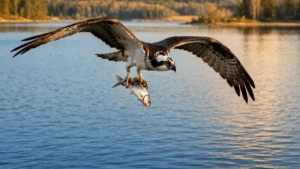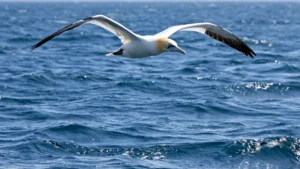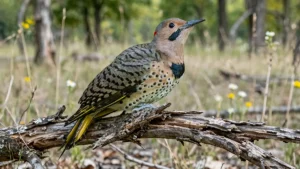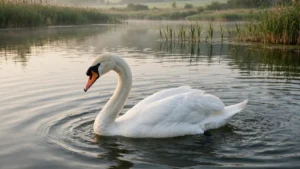
The purple martin species is a single species, Progne subis, the largest swallow in North America and one of the continent’s best-loved birds. If you are asking how many purple martin species there are, the answer is one, a glossy blue-black aerial hunter that catches its food on the wing and, in the east, nests almost entirely in houses put up by people.
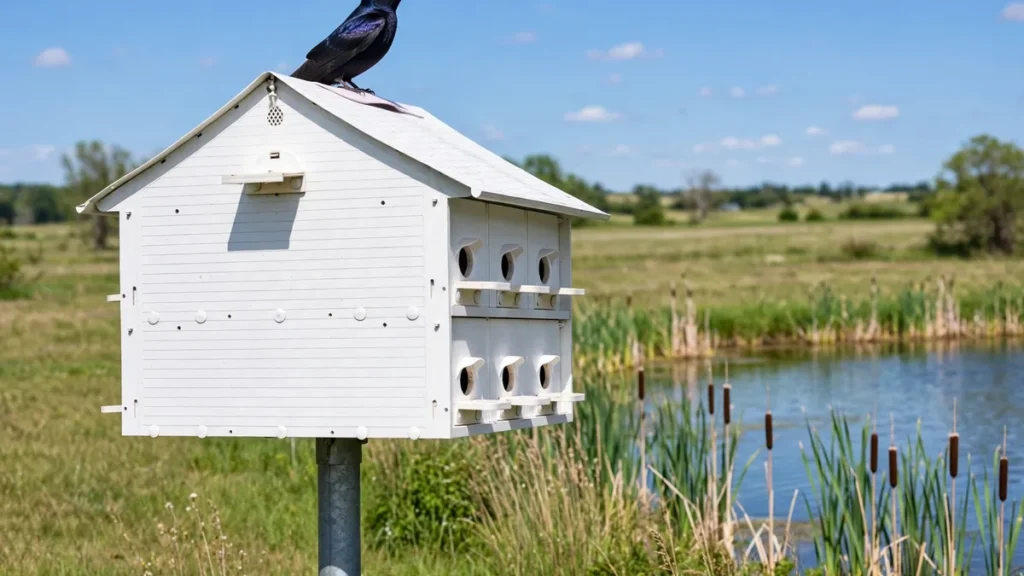
The purple martin is a bird that lives in partnership with people. In the eastern half of North America, nearly every pair nests in a martin house, a cluster of gourds or a nest box hung by a human landlord, a habit that began centuries ago when Indigenous peoples of the south-east hung hollowed gourds for the birds.
Key takeaways
- The purple martin species is Progne subis, a single species with three subspecies and the largest swallow in North America.
- Adult males are glossy dark blue-black, while females and young birds are duller above and greyish below.
- In the east, purple martins nest almost entirely in human-provided houses and gourds; in the west they still use natural cavities.
- They eat flying insects caught on the wing, and they migrate to the Amazon basin of South America for the winter.
- The species is listed as Least Concern, with a global population of about 9.3 million birds, though numbers have fallen by about a quarter since 1966.
What makes a purple martin a purple martin
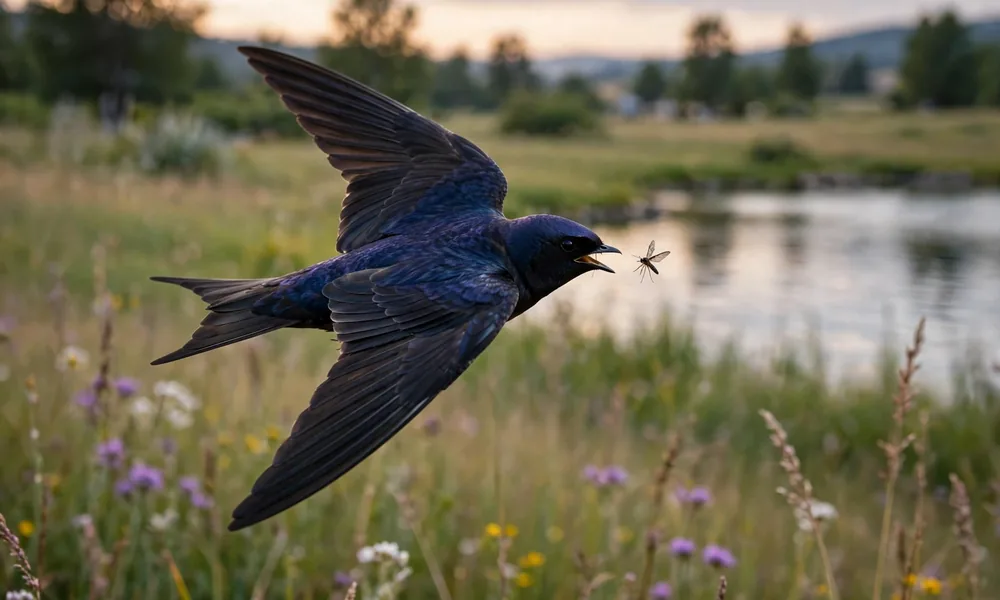
A purple martin is a large, broad-winged swallow, 19 to 23 centimetres long with a wingspan of 38 to 46 centimetres and a weight of about 45 to 60 grams. The adult male is dark and glossy all over, deep blue-black with a purple sheen that catches the light, while the female is duller above and pale grey below, with a whitish forehead and a dark cap. Young males look much like females in their first year.
In flight the purple martin is unmistakable, with long pointed wings, a slightly forked tail and a graceful, gliding style quite unlike the quick, fluttering flight of smaller swallows. Its wings beat in slow strokes, broken by long glides, and it can stay in the air for hours without landing. Its song is a rich, gurgling chatter, and at dawn the males sing a churring dawn song around the colony.
The purple martin species and their relatives
The purple martin belongs to Progne, a small genus of large martins in the swallow family Hirundinidae, and it is the only member of the genus that breeds across temperate North America. Three subspecies are recognised: the nominate race, P. s. subis, the eastern bird, which nests almost entirely in human-provided housing; P. s. hesperia, the smaller desert martin of the south-west, which nests in old woodpecker holes in giant saguaro cacti; and P. s. arboricola, the larger western martin, which nests in natural tree cavities from the Pacific coast to the Rocky Mountains.
The purple martin’s closest relatives are the other martins of the genus Progne, the grey-breasted martin of Central and South America, the Caribbean martin and the southern martin, and together they form a group of big, dark, cavity-nesting swallows. Among swallows, the purple martin stands out for its size and its relationship with people: eastern birds have largely abandoned natural nest sites, and without the houses put up for them, they would have nowhere to breed. The Partners in Flight estimate is about 9.3 million birds, and the long-term trend is downward, though the species remains widespread.
| Type | Animal | Where it lives | Best-known food | Length or Weight |
|---|---|---|---|---|
| Genus | Martins of genus Progne | Open country of the Americas | Flying insects | Up to about 23 cm long |
| Species | Purple martin (Progne subis) | North America, winters in South America | Flying insects | 19 to 23 cm, 45 to 60 g |
| Species | Grey-breasted martin (Progne chalybea) | Central and South America | Flying insects | About 18 to 20 cm long |
| Species | Caribbean martin (Progne dominicensis) | Caribbean islands | Flying insects | About 18 to 20 cm long |
| Species | Southern martin (Progne elegans) | South America | Flying insects | About 19 to 21 cm long |
| Species | Barn swallow (Hirundo rustica) | Worldwide, open country near water | Flying insects | About 17 to 19 cm long |
How purple martins live
Purple martins are aerial insectivores, catching almost all of their food on the wing. They eat dragonflies, beetles, moths, wasps, bees and flies, and they drink by skimming low over water without landing. They forage over towns, parks, open fields, lakes and rivers, often high in the sky, and they are most active when insects are thickest in the air.
Breeding is a noisy, social affair. Purple martins nest in colonies, sometimes of dozens of pairs sharing one house, and the older males arrive first in spring to claim the best compartments. The female builds a nest of leaves, grass and mud inside the cavity and lays three to six white eggs, incubated for about two weeks. Both parents feed the young, which leave the nest after about four weeks. Martins often return to the same house year after year.
The eastern martins’ dependence on people is the most remarkable part of their story. In the east, natural nest cavities were taken over long ago by the introduced European starling and house sparrow, and the martins that survived were the ones that moved into gourds and boxes defended by people. Colonies with an active landlord thrive, while neglected housing soon stands empty. In the west, martins still nest in natural cavities.
Where purple martins live
Purple martins breed across temperate North America, from the Gulf Coast north to southern Canada and west to the Pacific coast, with separate populations in the desert south-west and north-western Mexico. In the east they are birds of open country near people and water, nesting in martin houses in gardens, parks, farms and lakeshores, always with clear, open flying space around the colony.
When breeding ends, the birds gather in enormous roosts, sometimes of hundreds of thousands, and fly south to South America, wintering in the lowlands east of the Andes, above all in Brazil and Bolivia. The journey from the Great Lakes to Brazil covers about 8,000 kilometres and takes four to six weeks, with a stopover in the Yucatan or Cuba. The largest roost in the United States is on Bomb Island in Lake Murray, South Carolina, where up to a million martins have gathered in a single late-summer evening, so many that their dawn departure shows up on weather radar.
The purple martin is listed as Least Concern on the IUCN Red List, and National Geographic describes its population trend as stable, but the longer record is less comfortable: the North American Breeding Bird Survey shows a decline of about 25 per cent between 1966 and 2019, the main threats are spring cold snaps, which kill more martins than any other cause by grounding their insect food, competition for nest sites with starlings and sparrows, and pesticide use on their wintering grounds. The barn swallow shares the martin’s taste for open skies, but no other swallow depends on human landlords as the purple martin does.
Best seasons for purple martin watching
The best time to look for purple martins is the breeding season, from spring to late summer, when the birds are around their colonies all day. The first males reach the far south as early as January, Virginia and Kansas in early March, southern Canada in mid-April and the far north in May. Late summer is the time for the great roosts, when thousands of birds pour into a single island or bridge at dusk, a great sight of North American birdwatching.
Staying safe around purple martins
A purple martin is a harmless bird that lives high in the air and has no defence beyond its speed and its colony, and it would rather fly away than meet a person. Watch a colony from the ground with binoculars, enjoy the dawn song and the evening return, and never climb up to a martin house during the nesting season, because a disturbed colony may abandon its young.
Leave nest checks to the landlord, who lowers the house on its pole to look inside. If you put up a martin house, place it in the open near water, at least 12 metres from trees, and keep starlings and house sparrows out, because an unmanaged house does more harm than good.
Purple martin watching checklist
A little preparation turns a colony visit into a real chance of seeing North America’s largest swallow at close quarters.
- A visit to a martin colony in spring or summer, when the birds are busy around their house.
- A morning start for the dawn song, or an evening visit for the birds returning to roost.
- Binoculars or a spotting scope, because martins spend most of their day high in the air.
- An open site near water, where martins hunt insects over fields, lakes and rivers.
- An eye for the big, dark swallow with slow, gliding wingbeats.
- A camera with a zoom lens, for close views from the ground without climbing to the house.
- Respect for the colony and its landlord, since a disturbed colony may abandon its young.
Frequently asked questions
How many purple martin species are there?
There is one purple martin species, Progne subis, with three subspecies: the nominate P. s. subis of the east, P. s. hesperia of the desert south-west and P. s. arboricola of the west. The three differ in size and nesting, but they are one species.
Why do purple martins depend on people?
In the east, purple martins nest almost entirely in houses and gourds provided by people, because the natural tree cavities they once used were taken over by introduced European starlings and house sparrows. The habit began centuries ago, when Indigenous peoples of the south-east hung hollowed gourds for the birds.
What does a purple martin eat?
A purple martin eats flying insects, caught on the wing: dragonflies, damselflies, beetles, moths, wasps, bees and flies. It feeds over open country and water, often high in the sky.
Where do purple martins spend the winter?
Purple martins spend the winter in the lowlands of South America east of the Andes, above all in Brazil and Bolivia. They return north in spring, reaching Florida and Texas as early as January.
Are purple martins endangered?
No, purple martins are listed as Least Concern on the IUCN Red List, with a global population of about 9.3 million birds. But the trend is downward: numbers have fallen by about 25 per cent since 1966, and by about 42 per cent in Canada since 1970, so it still depends on its landlords and its wintering grounds.
How is this guide different from the piping plover guide?
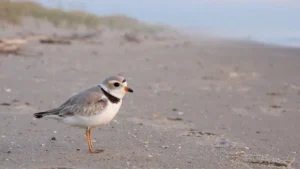
This guide covers the purple martin, a large glossy swallow that hunts insects high in the air, gathers in colonies and nests in houses put up by people, while our piping plover species guide covers the piping plover, a small sand-coloured shorebird that nests alone in a scrape on beaches and eats worms and insects from the sand. One is a bird of the open sky; the other is a bird of the open beach.
Conclusion
The purple martin species needs little introduction once you have seen it: one species, Progne subis, the largest swallow in North America, a glossy blue-black aerial hunter.
If you go looking for one, go in spring, go to a colony, and look up. Find a purple martin gliding over a lakeside meadow or chattering around its house at dawn, and you will see why so many people put up a pole, hang the gourds, and wait for the martins to come home.