The nightingale species covered by this guide is the common nightingale, Luscinia megarhynchos, a small brown songbird of dense scrub and woodland edges, famous for one of the richest songs of any bird in the world. If you are asking how many nightingale species there are, the answer is two in the sense this guide uses the name: the common nightingale and the thrush nightingale, and this guide is about the common nightingale.
The nightingale is a bird you are far more likely to hear than to see. It is plain brown, shy, and hidden deep in brambles and thickets, yet its song has filled poetry and music for centuries.
Key takeaways
- This guide covers the common nightingale, Luscinia megarhynchos; the name nightingale also covers the thrush nightingale, Luscinia luscinia.
- Adults are 15 to 16.5 centimetres long, with a wingspan of 20 to 25 centimetres and a weight of 16 to 30 grammes.
- Nightingales breed in dense scrub and woodland edges across Europe and western Asia, and winter in sub-Saharan Africa.
- They eat mostly insects from the leaf litter, with berries and fruit in late summer before migration.
- The species is listed as Least Concern, with an estimated 37.1 to 55.8 million mature birds.
What makes a nightingale a nightingale
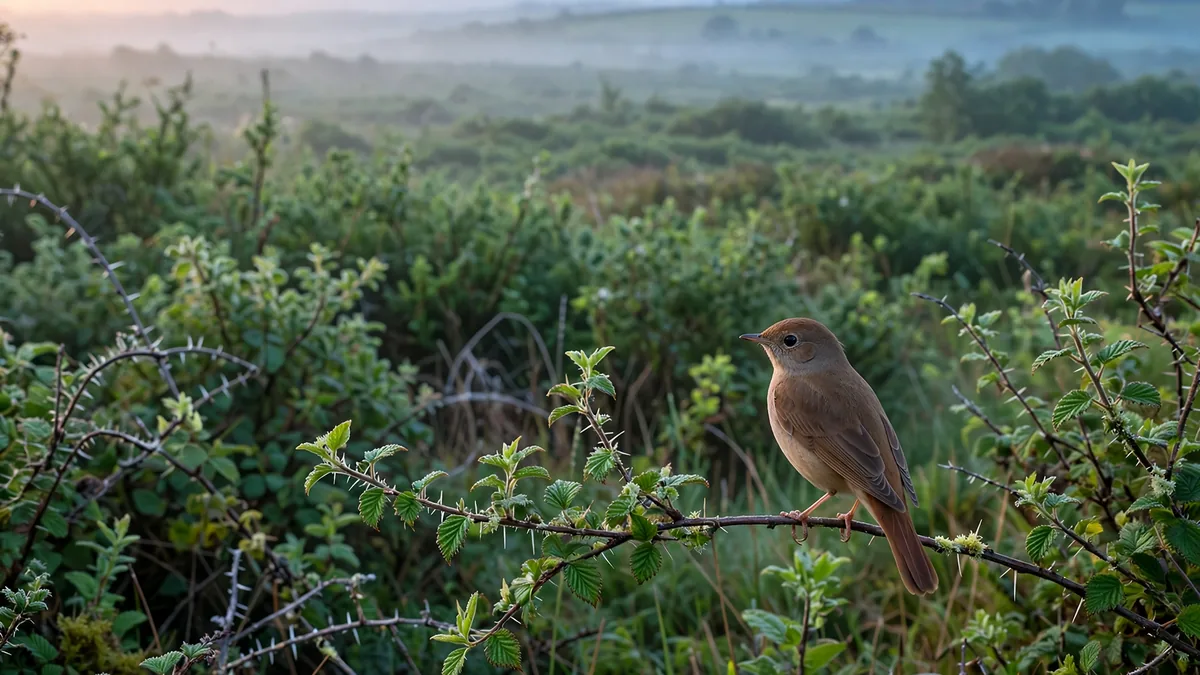
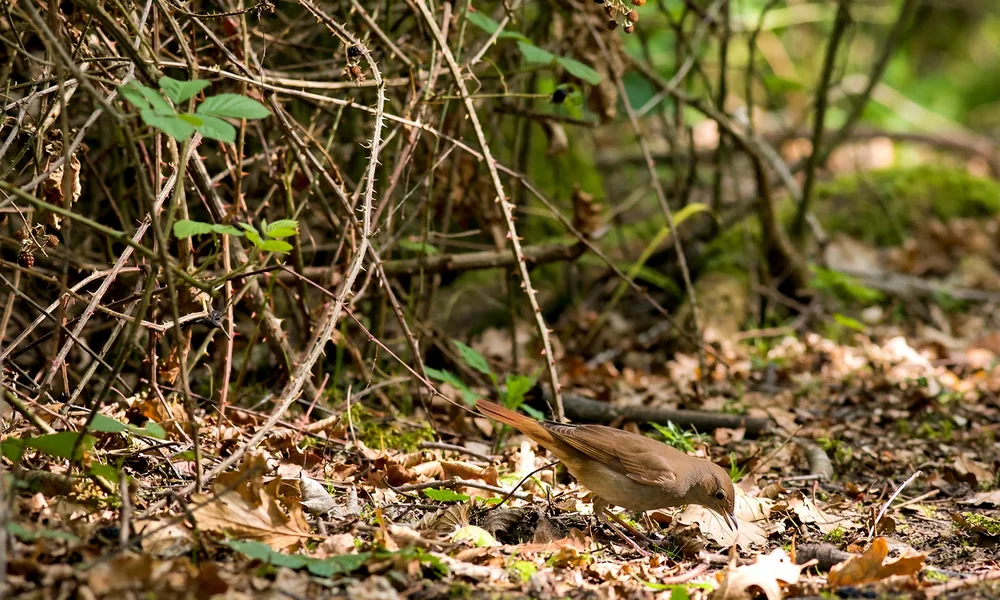
A nightingale is a small songbird, 15 to 16.5 centimetres long, with a wingspan of 20 to 25 centimetres and a weight of 16 to 30 grammes, slightly larger than a European robin but much plainer. Its upperparts are warm brown, its underparts are pale buff, and its tail is rusty reddish brown, often cocked upwards. It has a large dark eye and long pale legs, and males and females look alike.
What makes a nightingale is its voice. A male may know 180 to 260 different song types, around 190 on average, and he strings them together in ever-changing order, rarely repeating the same sequence. The song is a loud, varied series of whistles, trills, gurgles and slow fluting phrases, sung by day and by night. The famous night song comes mostly from unpaired males trying to attract a female passing overhead in the dark.
The nightingale species and their relatives
The nightingale belongs to Luscinia, a small genus in the Old World flycatcher family Muscicapidae, though it was once classed with the thrushes. The common nightingale, Luscinia megarhynchos, breeds across southern and central Europe and western Asia, while its closest relative, the thrush nightingale, Luscinia luscinia, breeds further north and east, from Denmark and eastern Europe into Central Asia. Three subspecies of the common nightingale are recognised, differing in size and in the warmth of their brown plumage.
Its other relatives in the same genus include the bluethroat, a northern bird with a bright blue throat, while the family also holds the chats and the familiar American robin, though that robin is a thrush rather than a flycatcher. The European robin, which the nightingale is often compared with, is a separate bird with a red breast and a far simpler song, and it stays in Europe through the winter while the nightingale crosses the Sahara.
| Type | Animal | Where it lives | Best-known food | Length or Weight |
|---|---|---|---|---|
| Genus | Nightingales (genus Luscinia) | Europe, Asia and Africa | Insects | About 15 to 17 cm long |
| Species | Common nightingale (Luscinia megarhynchos) | Southern and central Europe to Central Asia | Beetles, ants and caterpillars | About 15 to 16.5 cm long |
| Species | Thrush nightingale (Luscinia luscinia) | Northern and eastern Europe to Central Asia | Insects and berries | About 16 to 17 cm long |
| Species | Bluethroat (Luscinia svecica) | Northern Europe and Asia | Insects | About 13 to 14 cm long |
| Species | European robin (Erithacus rubecula) | Europe and western Asia | Insects, worms and berries | About 12.5 to 14 cm long |
| Species | Black redstart (Phoenicurus ochruros) | Europe, Asia and North Africa | Insects | About 13 to 14.5 cm long |
How nightingales live
Nightingales eat mostly insects and other invertebrates, above all beetles, ants, flies, spiders, earthworms and caterpillars, which they find by hopping through leaf litter and low vegetation on or near the ground. They pick prey from fallen leaves and loose soil, and the chicks are fed entirely on invertebrates. As summer ends, nightingales shift towards soft fruits and berries, building up fat reserves for their long journey south.
Nightingales are shy, secretive birds that stay hidden in dense vegetation, and they are solitary or in pairs during the breeding season. The male arrives first in spring, claims a territory in thick scrub and sings to warn off rivals and attract a female, and pairs are usually together for one breeding season only. Their flight is low and direct, and they are most active at dawn and dusk.
The female builds the nest, a bulky cup of dead leaves and grass, lined with fine grasses, feathers and hair, sited on or very close to the ground, usually below half a metre, at the base of a thicket or in low herbage. She lays four to five eggs and incubates them for about 13 to 14 days while the male brings her food, and both parents feed the chicks, which leave the nest at 11 to 13 days old. A pair may raise one or two families in a summer, and the breeding season runs from late April to mid-July. Nightingales live only one to five years.
Where nightingales live
Nightingales breed across a broad sweep of territory, from Portugal, Spain and Morocco in the west through southern and central Europe, the Middle East and Iran into Central Asia, reaching Kazakhstan, Kyrgyzstan, Tajikistan and the far west of China and Mongolia. Within this range they favour dense, low vegetation: thickets of bramble and hawthorn, woodland edges with heavy undergrowth, coppiced woodland and riverbank scrub, where shade and cover are plentiful. They need bare ground beneath the thicket, where they can hop through the leaf litter and feed.
In late summer they leave their breeding grounds and travel south to spend the winter in sub-Saharan Africa, from West Africa across to the Great Rift Valley, a journey of thousands of kilometres that takes them across the Sahara. On their wintering grounds they live quietly in scrub and savanna, and they return to Europe between late April and May. The thrush nightingale winters further south still, in southern Africa.
The common nightingale is listed as Least Concern on the IUCN Red List, with a very preliminary estimate of 37.1 to 55.8 million mature birds, and the global population is considered stable. That secure global picture hides local losses: in Britain the species is red-listed, having fallen by more than half since the 1960s, and it now breeds mainly in the south-east of England. Keeping thickets dense and shady, with bare ground beneath, is the simplest way to help them.
Best seasons for nightingale watching
The best time to look for nightingales is late April to June, when the males have returned from Africa and are singing at full strength to claim territories and attract mates. Go at dawn or dusk and listen first: the loud, varied song is far easier to find than the small brown bird itself. Like the barn owl, the nightingale is a bird of the half-light, though the owl hunts in silence and the nightingale sings. By July the song fades, and by September the birds are gone south.
Staying safe around nightingales
A nightingale is a harmless bird that would rather stay hidden than meet a person, and it has no defence beyond its cover. Listen from the path, never push into a thicket to find the singer, and never approach a nest on the ground, because a disturbed nest may be abandoned. Keep dogs on a lead near known scrub, since a dog can flush a bird from its nest in the leaf litter.
If you hear a nightingale, enjoy it from the path and do not return every day, because repeated visits can wear a trail and draw predators to the site. Stay on marked paths in woodland and farmland, ask before crossing private land, and never handle a nightingale, which is protected by law in most of Europe. If you meet one on the ground, stop and give it room to hop away into cover, which it will usually do at once.
Nightingale watching checklist
A little preparation turns a walk through scrub and woodland edge into a real chance of hearing a nightingale at close range.
- A late spring visit, from late April to June, to dense scrub, coppiced woodland or an overgrown hedgerow.
- A dawn or dusk start, when the song carries furthest through the still air.
- Binoculars, because a nightingale in a thicket is easy to miss until it moves or cocks its tail.
- An ear tuned for the loud, varied song of whistles, trills and fluting phrases, which carries further than the bird is visible.
- Patience at the edge of the thicket, where the birds feed in the leaf litter.
- A camera with a zoom lens, for close views from a distance without pushing into the scrub.
- Respect for ground nests and private land, because a disturbed nest may be abandoned.
Frequently asked questions
How many nightingale species are there?
There are two nightingale species in the sense this guide uses the name: the common nightingale, Luscinia megarhynchos, and the thrush nightingale, Luscinia luscinia. This guide is about the common nightingale, which breeds across southern and central Europe and western Asia.
Why is it called a nightingale?
The name comes from Old English nihtegale, meaning night singer, because the males sing through the night in spring. In fact they sing by day as well, but the night performances carry clearly through still air when other birds are silent.
What does a nightingale eat?
A nightingale eats mostly insects and other invertebrates, above all beetles, ants, flies, spiders, earthworms and caterpillars, which it finds by hopping through leaf litter on the ground. In late summer it also eats soft fruits and berries, building up fat for its migration to Africa.
Are nightingales dangerous?
No, nightingales are harmless to people and would rather stay hidden in dense scrub than confront anyone. They have no defence beyond their cover, so listen from the path, keep dogs on a lead near thickets, and never approach a ground nest.
How is this guide different from the mute swan guide?
This guide covers the nightingale, a small brown songbird of dense scrub that hides in brambles and sings one of the richest songs of any bird, while our mute swan species guide covers the mute swan, a great white waterbird of lakes and slow rivers that eats water plants and guards its territory with hisses and raised wings. One weighs about 20 grammes and is heard far more than seen; the other weighs up to 12 kilogrammes and rules a lake.
Are nightingales endangered?
No, not in the strict sense. The common nightingale is listed as Least Concern on the IUCN Red List, with an estimated 37.1 to 55.8 million mature birds and a stable global trend. In Britain, though, it is red-listed, having fallen by more than half since the 1960s.
Conclusion
The nightingale species is a bird that needs no introduction once you have heard it: two species share the name, and this guide has covered the common nightingale, Luscinia megarhynchos, a small brown bird with a reddish tail and a song of hundreds of phrases.
If you go looking for one, go in late spring, go at dusk, and listen before you look. Find a nightingale pouring its song out of a dark thicket, and you will understand why poets have praised it for centuries, and why keeping its scrub matters most.