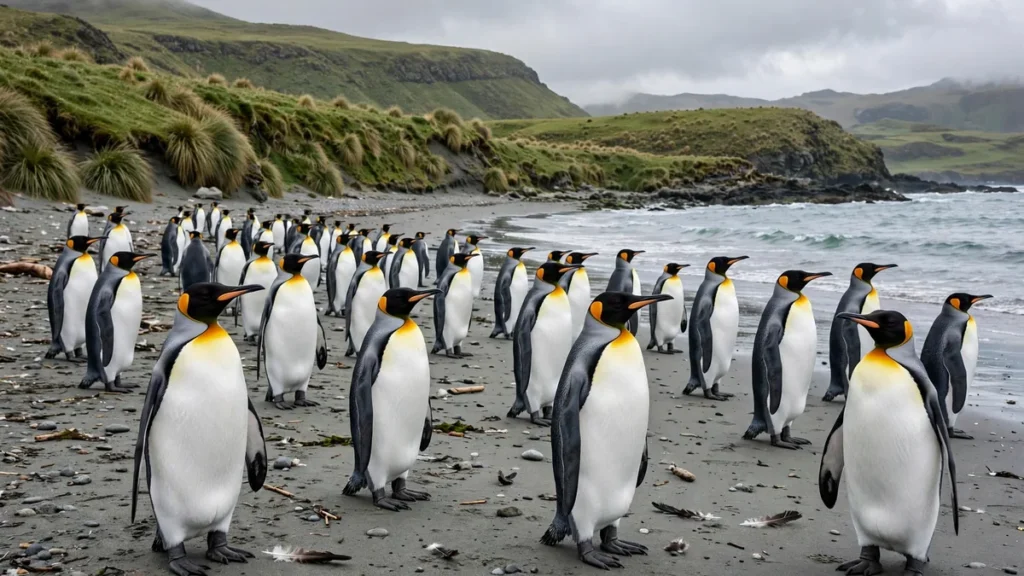
The king penguin species is a single species, Aptenodytes patagonicus, the second largest penguin in the world, a tall, upright bird with vivid orange-gold markings on its head and breast that breeds in huge colonies on the subantarctic islands. If you are asking how many king penguin species there are, the answer is one, and it is the smaller, brighter cousin of the emperor penguin, with the longest breeding cycle of any penguin.
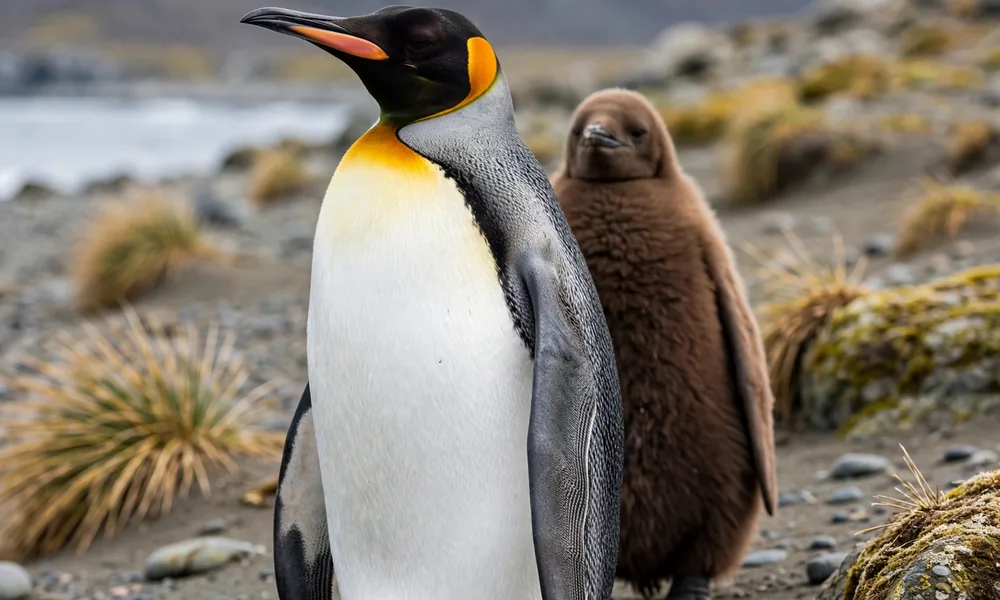
The king penguin stands about 85 to 95 centimetres tall and weighs roughly 9 to 16 kilograms, and it is unmistakable on a crowded beach: a black head and throat, a silvery-grey back, a white belly, and two teardrop-shaped patches of bright orange-gold on the sides of the head that fade into a golden-orange wash across the upper breast. Its long, slender bill is dark with a pink-orange plate along the lower edge, and it walks slowly and upright.
Key takeaways
- There is one king penguin species, Aptenodytes patagonicus, the second largest penguin after the emperor penguin.
- Adults stand about 85 to 95 centimetres tall and weigh roughly 9 to 16 kilograms, with bright orange-gold head patches.
- King penguins breed in huge colonies on subantarctic islands, including South Georgia and the Falkland Islands.
- They eat mainly lanternfish, with squid and krill as well, diving routinely past 100 metres.
- The species is listed as Least Concern, with roughly 1.6 million breeding pairs and a population that is assessed as increasing.
What makes a king penguin a king penguin
A king penguin is a large, stately bird, and its colouring is the key to telling it apart from the emperor penguin, the only penguin bigger than it is. The king is smaller and slimmer, its back is a grizzled silvery grey rather than black, and its orange-gold markings are brighter and more extensive, running from the ear patches down across the whole upper breast. The emperor has a pale pink wash on its breast, paler yellow ear patches, and lives much further south, on the sea ice around Antarctica.
The chicks look nothing like their parents, hatching naked and soon growing a thick coat of dark brown down, so woolly that early explorers mistook them for a separate species and called them woolly penguins. The chicks keep this brown coat for ten to thirteen months, until they moult into the sleek black, white and gold plumage of an adult.
The king penguin species and their relatives
The king penguin belongs to Aptenodytes, a genus with just two living species: the king penguin and the emperor penguin. The two are close relatives, and they are the only penguins that do not build a nest, carrying their single egg on top of their feet instead. The International Ornithologists’ Union treats the king penguin as one species with no recognised subspecies, although two regional forms are sometimes named.
All penguins belong to the order Sphenisciformes, a family of flightless seabirds found only in the Southern Hemisphere, and our penguin species guide covers the whole family. Within that family the king penguin is a great diver: its bones are solid rather than hollow, its feathers are short, dense and waterproof, and a thick layer of fat keeps it warm far below the surface.
| Type | Animal | Where it lives | Best-known food | Length or Weight |
|---|---|---|---|---|
| Genus | Great penguins (genus Aptenodytes) | Antarctic and subantarctic seas | Fish, squid and krill | About 85 to 122 cm tall |
| Species | King penguin (Aptenodytes patagonicus) | Subantarctic islands | Lanternfish, squid, krill | About 85 to 95 cm tall |
| Species | Emperor penguin (Aptenodytes forsteri) | Antarctic coast and sea ice | Fish, krill, squid | About 110 to 122 cm tall |
| Species | Gentoo penguin (Pygoscelis papua) | Subantarctic islands, Antarctic Peninsula | Krill, fish, squid | About 75 to 90 cm tall |
| Species | Chinstrap penguin (Pygoscelis antarcticus) | Antarctic and subantarctic islands | Krill, small fish | About 68 to 76 cm tall |
| Species | Humboldt penguin (Spheniscus humboldti) | Coasts of Peru and Chile | Anchovies, sardines, squid | About 56 to 70 cm tall |
How king penguins live
King penguins are hunters of the deep, open sea. Almost all of their diet is fish, above all lanternfish, the small, silvery fish that rise towards the surface at night and sink again by day, with squid and krill taken as well. A foraging bird routinely dives past 100 metres and may stay down for about five minutes, and dives of more than 300 metres have been recorded. They can take as many as 2,000 fish in a single day when the fishing is good.
Breeding is the longest and slowest of any penguin. The cycle lasts 13 to 16 months, so a successful pair breeds only about twice in three years. There is no nest: the female lays a single egg, and the parents take turns holding it on top of their feet, tucked under a fold of warm belly skin called the brood pouch. Incubation lasts about 54 days, and both parents take turns feeding the chick regurgitated fish.
The chick spends its first winter in a crèche, a huddle of brown, woolly youngsters that keeps the cold out while the parents are away at sea for weeks at a time. In winter, feeding visits grow rare and the chick lives largely off its fat reserves. It finally moults into adult plumage and heads to sea at 13 months old. King penguins can live for 26 years in the wild, and longer in captivity.
Where king penguins live
King penguins breed on subantarctic islands between about 45 and 55 degrees south, at the northern edge of the Southern Ocean. The largest colonies are on South Georgia, the Crozet Islands, the Kerguelen Islands and the Prince Edward Islands, with smaller numbers on Heard Island, Macquarie Island, the Falkland Islands and the coast of Tierra del Fuego. On land they favour flat or gently sloping beaches and valleys that are free of snow and ice and close to the sea, and their colonies can hold tens of thousands of birds.
At sea they range widely across the Southern Ocean, following the Antarctic Polar Front, the band of cold, productive water where lanternfish gather in huge numbers. Once hunted heavily for blubber, oil, meat and feathers, they are now fully protected and their numbers have recovered strongly. The emperor penguin, their closest relative, lives further south on the Antarctic sea ice.
The king penguin is listed as Least Concern on the IUCN Red List, and recent estimates put the breeding population at 1.6 million pairs, with the trend assessed as increasing. The main threat now is warming water shifting the lanternfish on which the birds depend, and the long breeding cycle makes recovery from a bad year slow. At sea, adults are hunted by leopard seals and killer whales, while skuas, giant petrels and snowy sheathbills take eggs and chicks on land.
Best seasons for king penguin watching
The best time to see king penguins is the austral summer, from November to March, when the colonies are at their busiest and the beaches are crowded with adults, moulting birds and brown, woolly chicks. South Georgia is the classic place to go, above all St Andrews Bay and Salisbury Plain, where the colonies stretch as far as the eye can see. Visits are by expedition ship only.
Staying safe around king penguins
King penguins are not dangerous to people, but they are wild animals in a fragile place, and the rules for visiting them are strict. Keep at least five metres from the birds, never walk between a penguin and the sea, and never touch a bird or a chick, however tame it seems. If one waddles towards you, step aside and let it pass. Stay with your group and keep to the marked landing areas.
The Southern Ocean is cold, rough and a long way from help, so never go ashore without a guide and never wander away from the group. Dress for wind, rain and sudden cold, and wear sturdy boots for slippery rock and wet sand. A cornered bird can give a nasty bite with its sharp beak, so admire them from a respectful distance.
King penguin watching checklist
A little preparation turns an expedition landing into a real chance of seeing the Southern Ocean’s most elegant penguin up close.
- An expedition cruise to South Georgia or the Falkland Islands, booked well ahead.
- An austral summer trip, from November to March, when the colonies are at their busiest and the chicks are in their brown down.
- Binoculars, for a close view of the orange-gold head patches and the golden breast.
- Warm, windproof and waterproof clothing, with sturdy, grippy boots for wet sand and slippery rock.
- A camera with a zoom lens, for close views from the five-metre distance the rules require.
- Patience on the beach, because the best moments come to those who stand still.
- Respect for the rules: keep your distance and let the penguins pass.
Frequently asked questions
How many king penguin species are there?
There is one king penguin species, Aptenodytes patagonicus, the second largest penguin in the world. The International Ornithologists’ Union recognises no subspecies, although two forms are sometimes named, one around South Georgia and the Falklands and the other around the islands of the Indian Ocean.
What is the difference between a king penguin and an emperor penguin?
The king penguin is smaller and slimmer than the emperor, at about 85 to 95 centimetres against the emperor’s 110 to 122, and its orange-gold head and breast markings are brighter and more extensive. The king also lives further north, breeding on subantarctic islands, while the emperor breeds on the sea ice around Antarctica itself.
What does a king penguin eat?
A king penguin eats mainly lanternfish, the small, silvery fish of the deep Southern Ocean, with squid and krill as well. It dives routinely past 100 metres to catch them, and on record to more than 300 metres, and it can take as many as 2,000 fish in a single day when the fishing is good.
How long does it take a king penguin to raise a chick?
It takes 13 to 16 months, the longest breeding cycle of any penguin. The single egg is incubated on the parents’ feet for about 54 days, and the chick spends its first winter in a crèche before heading to sea at about 13 months old.
How is this guide different from the killdeer guide?
This guide covers the king penguin, a tall, flightless seabird of the subantarctic islands that dives hundreds of metres for lanternfish and raises a single chick over 13 to 16 months, while our killdeer species guide covers the killdeer, a small, ground-nesting plover of North American fields and shores that eats insects and worms and defends its nest with a broken-wing act. One is a Southern Ocean diver the size of a small child; the other is a shorebird about the size of a robin.
Are king penguins endangered?
No. The king penguin is listed as Least Concern on the IUCN Red List, with roughly 1.6 million breeding pairs and a population assessed as increasing. Its numbers recovered strongly after hunting for blubber and oil ended, though warming seas and shifts in lanternfish remain a concern for the future.
Conclusion
The king penguin species is a bird built for extremes: one species, Aptenodytes patagonicus, a tall, golden-breasted diver that raises a single chick through a subantarctic winter in a breeding cycle longer than a year.
If you go looking for one, go to South Georgia in the southern summer, stand still on the beach, and let the colony come to you. Gold on black against the grey Southern Ocean, it is a sight you will not forget.