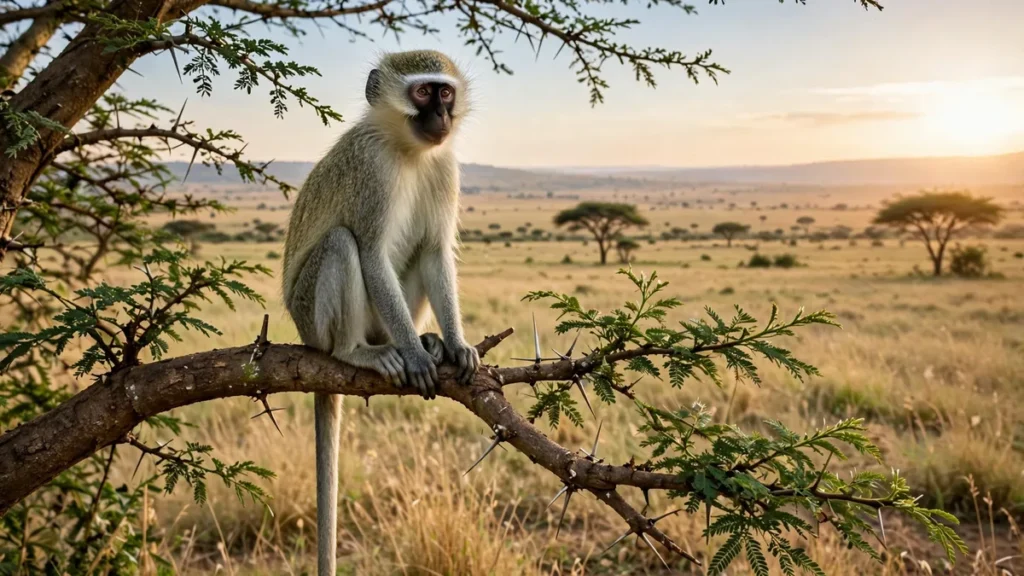
The vervet monkey species are six closely related monkeys of the genus Chlorocebus, social daytime animals that live across the savannas and woodlands of sub-Saharan Africa. If you are asking how many vervet monkey species there are, the answer is six: the vervet, the green monkey, the tantalus monkey, the grivet, the Bale monkey and the malbrouck.
Vervets are among the most familiar monkeys in Africa, and the easiest to recognise: grey-green fur, a black face framed by a white brow band and pale whiskers, and a long tail carried high as they trot across open ground. They spend their days in noisy troops, feeding, grooming and calling warnings to each other, at home on the ground and in the trees.
Key takeaways
- There are six vervet monkey species in the genus Chlorocebus, all of them savanna monkeys of sub-Saharan Africa.
- An adult male weighs about 5.5 kilograms on average and measures about 49 centimetres from head to tail base, while females average about 4.1 kilograms and 43 centimetres.
- Vervets live in troops of 10 to 70 animals, with females staying in their birth troop for life and males leaving when they mature.
- They are omnivores that eat fruit, leaves, flowers, seeds, insects and small animals, and they store food in cheek pouches to eat later.
- Vervets are famous for their alarm calls, with different calls for leopards, eagles and snakes, so the troop knows what danger is coming.
What makes a vervet monkey a vervet monkey
A vervet monkey is a medium-sized, largely ground-dwelling monkey with yellow to greenish-brown fur, white or pale yellow underparts, and a sooty black face, hands and feet. Its most distinctive marks are the white brow band and pale, backswept whiskers framing the face, and its greenish tinge comes from individual hairs banded black and yellow. Adult males have bright blue skin on the scrotum and a red penis, a striking feature shared by all six species.
Vervets move on all fours and are equally comfortable on the ground and in the trees, which sets them apart from forest monkeys that rarely leave the canopy. Like the baboon, another African monkey that spends much of its day on the ground, the vervet is bold and adaptable, but far smaller and lighter, escaping danger by climbing into trees rather than standing its ground. All species have cheek pouches that can be stuffed with food for eating later in safety.
The vervet monkey species and their relatives
The six vervet monkey species were once all placed in the genus Cercopithecus with the guenons, but they are now recognised as their own genus, Chlorocebus. The six are the vervet, Chlorocebus pygerythrus, of eastern and southern Africa; the green monkey, Chlorocebus sabaeus, of West Africa; the tantalus monkey, Chlorocebus tantalus, of central Africa; the grivet, Chlorocebus aethiops, of Ethiopia and north-eastern Africa; the Bale monkey, Chlorocebus djamdjamensis, of the Bale Mountains of Ethiopia; and the malbrouck, Chlorocebus cynosuros, of Angola and the southern Congo.
The species are told apart mainly by coat colour and small details of face and tail. The green monkey has yellow whiskers and a yellow and black tail, the grivet a white tuft on its tail tip and a thin white brow band, and the vervet shorter whiskers with black hands, feet and tail tip. The Bale monkey is the darkest, with a browner coat for its cool mountain home.

| Type | Animal | Where it lives | Best-known food | Length or Weight |
|---|---|---|---|---|
| Species | Vervet (Chlorocebus pygerythrus) | Eastern and southern Africa | Fruit, leaves and insects | About 5.5 kg for males |
| Species | Green monkey (Chlorocebus sabaeus) | West Africa | Fruit, leaves and insects | About 3.5 to 5 kg |
| Species | Tantalus monkey (Chlorocebus tantalus) | Central Africa | Fruit, leaves and insects | About 4 to 6 kg |
| Species | Grivet (Chlorocebus aethiops) | Ethiopia and north-eastern Africa | Fruit, leaves and insects | About 3 to 5 kg |
| Species | Bale monkey (Chlorocebus djamdjamensis) | Bale Mountains, Ethiopia | Bamboo, leaves and fruit | About 3 to 5 kg |
| Species | Malbrouck (Chlorocebus cynosuros) | Angola and southern Congo | Fruit, leaves and insects | About 4 to 6 kg |
How vervet monkeys live
Vervet monkeys are omnivores, eating plants, insects and other invertebrates, small vertebrates and fungi, with a heavy emphasis on fruit. They feed together, and cooperative foraging is common: while some feed on the ground, others keep watch from the trees. They must drink water daily in the dry season, so their ranges are tied to rivers and waterholes.
Vervets live in troops of 10 to 70 individuals, with several adult males and many related females. Females stay in their birth troop for life, ranked in a clear hierarchy that their daughters inherit. Males leave their birth troop when they reach maturity and join another troop, where they must work their way up the male hierarchy.
Grooming is a constant part of troop life, building friendships, calming tensions and courting mates as well as cleaning fur. Vervets are also famous for their alarm calls. They give different calls for leopards, eagles and snakes, and the troop reacts in the right way: climbing a tree for a leopard, running for cover for an eagle, and standing to peer into the grass for a snake. Young monkeys learn the calls by watching adults, practising on the wrong animals until they get them right.
Breeding takes place from about April to June in Africa, and a single infant is born after about five and a half months. Infants are born with a black coat and a pink face, and adult colouring develops over about 12 weeks. Females become sexually mature at about four years of age, and males at about five. Vervets live for about 11 to 13 years in the wild, and far longer in captivity, where some have lived into their late twenties.
Where vervet monkeys live
Vervet monkeys occur throughout sub-Saharan Africa, in savannas, riverine woodland and dry deciduous forest, from Senegal to Ethiopia and south to South Africa. They prefer open country and woodland to dense rainforest, and are sometimes known collectively as savanna monkeys. Green monkeys were also carried to the Caribbean centuries ago, and their descendants still live wild on islands such as Barbados and Saint Kitts.
Like the capuchin monkey, a clever New World monkey, the vervet is adaptable and quick to learn, and often lives close to people, raiding crops and gardens. That brings it into conflict with farmers, but also helps it thrive in a changing landscape. Five of the six species are listed as Least Concern on the IUCN Red List, while the Bale monkey, which lives only in a small area of Ethiopian mountains, is Vulnerable. No reliable total population figure exists for the genus, so none is given here.
Vervets are prey for leopards, pythons, birds of prey and baboons, and for people in some areas. Their main defence is the troop itself: many eyes watching, alarm calls naming the danger, and a quick retreat into the trees.
Best seasons for vervet monkey watching
Vervets are active all year round, but the dry season is often the easiest time to watch them. From about June to October in southern and eastern Africa, the grass is short, the trees are thin, and troops gather at waterholes in the morning and late afternoon. In the wet season they are still easy to find near lodges and camps, where they often feed in the gardens.
Staying safe around vervet monkeys
A vervet monkey is a wild animal and should never be fed or approached closely, however tame it looks. Monkeys that have learned to take food from people can become bold and may snatch bags, food or sunglasses, and a cornered monkey can bite. Keep food out of sight, keep windows and doors closed at lodges, and never try to touch a monkey or its baby.
If a monkey approaches, stay calm, do not show your teeth in a grin, which monkeys read as a threat, and walk away slowly without turning your back. Watch from a distance with binoculars or a zoom lens, and let the troop carry on undisturbed.
Vervet monkey watching checklist
A morning in the savanna with a vervet troop is one of the easiest wildlife encounters in Africa, and a little preparation makes it better.
- A visit to a savanna reserve such as Kruger in South Africa or the Serengeti in Tanzania, where troops are common.
- A dry-season morning, when troops gather at waterholes and feed in the open.
- Binoculars, for watching grooming and alarm calls from a respectful distance.
- A camera with a zoom lens, for close views without approaching the troop.
- Sun protection and water, because the savanna sun is strong even in the morning.
- Food kept out of sight in a closed bag, so bold monkeys are not tempted to snatch it.
- Patience and a quiet seat near a waterhole, because a troop that feels safe will feed, groom and play for hours.
Frequently asked questions
How many vervet monkey species are there?
There are six recognised vervet monkey species in the genus Chlorocebus: the vervet, the green monkey, the tantalus monkey, the grivet, the Bale monkey and the malbrouck, living across sub-Saharan Africa from Senegal to Ethiopia and south to South Africa.
What do vervet monkeys eat?
Vervet monkeys are omnivores with a heavy emphasis on fruit: they eat fruit, leaves, flowers, seeds, insects and other invertebrates, and sometimes small vertebrates and fungi. They store food in their cheek pouches and eat it later in safety, often in the trees.
Why do vervet monkeys have different alarm calls?
Vervets give a different call for each main predator: one for leopards, one for eagles and one for snakes. The troop reacts in the right way, climbing a tree for a leopard, running for cover for an eagle, and standing to look into the grass for a snake. Young monkeys learn the calls by watching adults.
How long do vervet monkeys live?
Vervet monkeys live for about 11 to 13 years in the wild, and far longer in captivity, where some have lived into their late twenties and one reached 31. Females mature at about four years of age, and males at about five.
How is this guide different from the vampire bat guide?
This guide covers the vervet monkey, a social daytime monkey of the African savanna that lives in troops of 10 to 70, eats fruit and insects, and warns its troop with different alarm calls, while our vampire bat species guide covers the vampire bat, a nocturnal flying mammal of the American tropics that feeds entirely on blood and roosts in dark caves. One is a noisy, sun-loving monkey, and the other is a quiet night-flying bat.
Are vervet monkeys endangered?
Mostly no. Five of the six species are listed as Least Concern on the IUCN Red List, and they are widespread and adaptable. The exception is the Bale monkey, which lives only in the Bale Mountains of Ethiopia and is listed as Vulnerable because its range is so small.
Conclusion
The vervet monkey species are six savanna monkeys that have made a success of life in the open: clever, social and quick to learn, with alarm calls naming their enemies and troops that look after their own.
If you go looking for one, go in the morning to a waterhole and sit quietly. Watch a troop feed, groom and chatter in the acacia shade, and you will see why these are among the most studied and best-loved monkeys in Africa.