The pronghorn species is a single species, Antilocapra americana, the fastest land animal in North America and the only living member of its own family, Antilocapridae. If you are asking how many pronghorn species there are, the answer is one, and it is not an antelope at all, though it is often called the American antelope, and its closest living relatives are the giraffes.
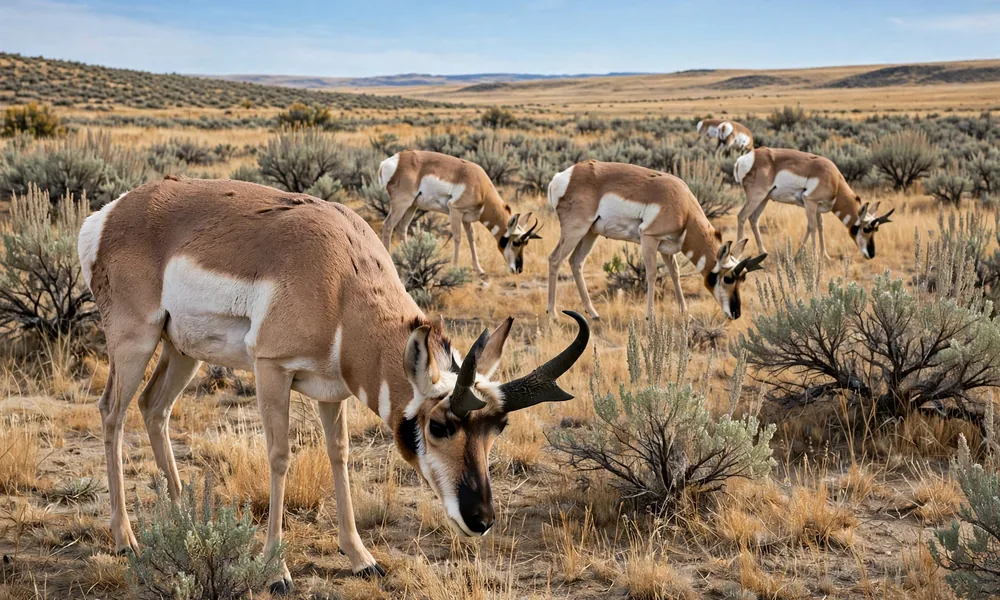
A pronghorn is built for open country and for speed. It stands about three feet tall at the shoulder, with a tan coat, a white belly and rump, and black horns that split into a forward-pointing prong, and it can run at more than 53 miles an hour, fast enough to leave a coyote behind, and hold half that speed for miles.
Key takeaways
- There is one pronghorn species, Antilocapra americana, the only living member of the family Antilocapridae, and it is not a true antelope.
- An adult is about 1.3 to 1.5 metres long, stands about 80 to 100 centimetres at the shoulder, and weighs roughly 40 to 65 kilograms.
- Pronghorns are the fastest land animal in North America, running at more than 53 miles an hour in a sprint and holding about half that speed for miles.
- They live in the open grasslands, sagebrush steppe and deserts of western North America, from southern Canada to northern Mexico, and make the longest land migration in the continental United States.
- The species is listed as Least Concern, with about one million animals, after falling to fewer than 20,000 in 1924, though two southern subspecies are endangered.
What makes a pronghorn a pronghorn
A pronghorn is a lean, deer-sized animal with a reddish-brown back, a white belly and a wide white rump patch. When startled, it raises the hairs on its rump to flash that white patch as a warning. Its large dark eyes can spot movement several miles away.
The horns give the animal its name. Both males and females grow horns, but the males carry the famous pair: black, backward-curving horns up to about 18 inches long, each with a forward-pointing prong. The horns are not antlers, and not the permanent horns of a goat or an antelope. Each horn has a bony core covered by a keratin sheath, like a fingernail, and the pronghorn is the only horned animal that sheds that sheath and grows a new one every year.
The pronghorn species and its relatives
The pronghorn belongs to Antilocapra, a genus with only one living species, and to Antilocapridae, a family with only one living species too. Long ago the family held many species, but every other one is extinct, so the pronghorn is the last survivor of a whole ancient lineage. Its closest living relatives are the giraffes, which belong to the sister family Giraffidae.
Five subspecies are usually recognised, and they differ mainly in where they live and in how large they grow. The American pronghorn of the northern and central plains is the widespread form, while the Mexican, Oregon, Sonoran and peninsular pronghorns live further south and west. The two southernmost forms are in serious trouble, even though the species as a whole is doing well.
| Type | Animal | Where it lives | Best-known food | Length or Weight |
|---|---|---|---|---|
| Genus | Pronghorns (genus Antilocapra) | Western North America | Forbs, grasses and sagebrush | About 1.3 to 1.5 m long |
| Species | Pronghorn (Antilocapra americana) | Southern Canada to northern Mexico | Forbs, grasses and sagebrush | About 40 to 65 kg |
| Subspecies | American pronghorn (A. a. americana) | Northern and central plains | Forbs and grasses | About 40 to 60 kg |
| Subspecies | Oregon pronghorn (A. a. oregona) | Oregon and the Great Basin | Forbs and shrubs | About 40 to 60 kg |
| Subspecies | Mexican pronghorn (A. a. mexicana) | Northern Mexico | Shrubs and forbs | About 34 to 48 kg |
| Subspecies | Sonoran pronghorn (A. a. sonoriensis) | Arizona and Sonora, Mexico | Shrubs, forbs and cacti | About 34 to 48 kg |
| Subspecies | Peninsular pronghorn (A. a. peninsularis) | Baja California, Mexico | Shrubs and cacti | About 34 to 48 kg |
How pronghorns live
Pronghorns are herbivores and picky eaters. They browse mainly on forbs, the soft flowering plants of the prairie, with grasses in spring and shrubs such as sagebrush in autumn and winter, and they will eat cacti in the desert south. They chew the cud, swallowing food and bringing it back up to chew again. They get most of the water they need from the plants they eat, so they can live where there is no standing water.
Pronghorns are most active at dawn and dusk, resting through the heat of the day. Their social life changes with the seasons. In summer, females with fawns gather in small nursery groups and young males form bachelor herds, while in winter the small bands join into great herds that can number a thousand animals. In the autumn rut, bucks gather harems of females and defend them fiercely, sometimes fighting rivals.
After a pregnancy of about 245 to 255 days, roughly eight months, a female usually gives birth to twins in late spring, each fawn weighing about 3 to 4 kilograms. The newborns can stand within a day and outrun a human within a few days, yet for their first weeks they lie hidden in the grass while their mother feeds nearby. Fawns are weaned at about four to five months, and wild pronghorns live for about nine or ten years.
Speed is the pronghorn’s defence, and it is built for it from nose to tail. Its large heart and lungs, long legs and hollow hairs are all built for running. A pronghorn can leap about six metres in a single bound.
Where pronghorns live
Pronghorns live only in North America, in the treeless plains, basins and deserts of the west, from the southern prairie provinces of Canada through the western United States to northern Mexico. They prefer open country with long sightlines, from near sea level to about 3,350 metres up. About half of all pronghorns live in Wyoming.
The pronghorn makes the longest land migration in the continental United States. Each year herds travel about 150 miles each way between Grand Teton National Park and the Upper Green River Basin in Wyoming, a round trip of about 300 miles. The autumn journey south takes about three days, while the spring return takes about a month. On the way the animals must cross roads and crawl under fences, and fences are the greatest obstacle, since a pronghorn almost always goes under a fence rather than jumping it.
The pronghorn is listed as Least Concern on the IUCN Red List, with a stable population of about one million animals. That is a remarkable recovery: there were probably 35 million pronghorns in the early 1800s, but hunting and the loss of grassland to farms and fences cut them to fewer than 20,000 by 1924. Protection and regulated hunting brought them back. The Sonoran and peninsular pronghorns are both endangered, surviving only in the low hundreds.
Best seasons for pronghorn watching
The best time to watch pronghorns is spring and autumn. In May and June the does drop their twins on the green plains. In September and October the bucks are in rut, gathering harems and clashing horns. In winter the great herds gather on the sagebrush flats.
Grand Teton and Yellowstone National Parks are the classic places to see pronghorns, and the migration can be watched in Wyoming in spring and autumn. Grasslands National Park in Saskatchewan is the best place in Canada. Go at dawn or dusk, when the animals are feeding.
Staying safe around pronghorns
A pronghorn is a wild animal and should be watched from a distance, never approached or fed. It is not normally dangerous to people, but a cornered animal can kick, and a buck in the autumn rut is unpredictable and best given a wide berth. Keep well back, use binoculars, and never chase one.
Your car makes a good hide: pull over safely, switch the engine off and watch from inside. Never try to touch a fawn lying alone in the grass: it is not abandoned, and its mother will return when you have gone.
Pronghorn watching checklist
A little preparation turns a drive across the western plains into a real chance of seeing North America’s fastest animal.
- A visit to Grand Teton or Yellowstone National Park, or the open plains of Wyoming, Montana or Saskatchewan.
- An early morning or late evening start, when pronghorns are feeding.
- Binoculars or a spotting scope, because pronghorns feed in wide open country.
- A car used as a hide, pulled safely off the road with the engine off, since pronghorns tolerate quiet vehicles.
- A camera with a zoom lens, for close views of the pronged horns without approaching the animals.
- Water, sun protection and warm layers, because the plains are dry, windy and cold at dawn.
- A field guide to North American mammals, for telling a pronghorn from the deer and antelope it is often confused with.
Frequently asked questions
How many pronghorn species are there?
There is one pronghorn species, Antilocapra americana, and it is the only living member of its genus and its family, Antilocapridae. Five subspecies are usually recognised.
Is a pronghorn an antelope?
No. A pronghorn is often called the American antelope, but true antelopes live in Africa and Asia, and the pronghorn is not one of them. It belongs to its own North American family, and its closest living relatives are the giraffes, not the antelopes. Like the gazelle, a true antelope, it is built for speed on open ground.
How fast can a pronghorn run?
A pronghorn can run at more than 53 miles an hour in a sprint, making it the fastest land animal in North America and the second fastest in the world after the cheetah. It can also hold about half that speed for miles, far longer than a cheetah can hold its top speed.
What does a pronghorn eat?
Pronghorns are herbivores that eat forbs, grasses, sagebrush and other shrubs, and cacti in the desert south. They chew the cud like other ruminants, and they get most of their water from the plants they eat.
How is this guide different from the proboscis monkey guide?
This guide covers the pronghorn, one species of fast-running hoofed mammal that lives on the open plains of western North America and eats sagebrush and prairie plants, while our proboscis monkey species guide covers the proboscis monkey, a tree-dwelling monkey of the mangrove forests of Borneo. Pronghorns race across grassland, and proboscis monkeys leap through riverside trees.
Are pronghorns endangered?
No, not as a species. The pronghorn is listed as Least Concern on the IUCN Red List, with about one million animals and a stable population. Two southern subspecies are endangered, though: the Sonoran pronghorn and the peninsular pronghorn of Baja California.
Conclusion
The pronghorn species is a survivor: Antilocapra americana, the last of an ancient family, the fastest animal on its continent, and a migrant that still walks a 6,000-year-old road across Wyoming. From 35 million animals to fewer than 20,000 and back to about a million, its story is one of the great recoveries in North American wildlife.
If you go looking for one, go at dawn and go to open country. Watch it run, and you will see why the plains made this animal fast.