The musk ox species is a single species, Ovibos moschatus, a shaggy Arctic herbivore that survives winters of minus 40 degrees Celsius on the treeless tundra of Canada and Greenland. If you are asking how many musk ox species there are, the answer is one, and it is the only living member of its genus, an Ice Age survivor hunted almost to extinction and then brought back by protection and reintroduction.
The musk ox gets its name from the strong musky scent bulls give off in the breeding season and from its resemblance to an ox, yet it is not an ox at all. It is a member of the goat family, closer to sheep and goats than to cattle, and its closest living relative is the takin of the Himalayas. Its long coat hangs almost to the ground, and its herds stand their ground against wolves in a famous defensive circle.
Key takeaways
- There is one musk ox species, Ovibos moschatus, the only living member of the genus Ovibos.
- An adult bull stands about 1.2 to 1.5 metres at the shoulder and weighs roughly 250 to 400 kilograms, while cows weigh about 180 to 275 kilograms.
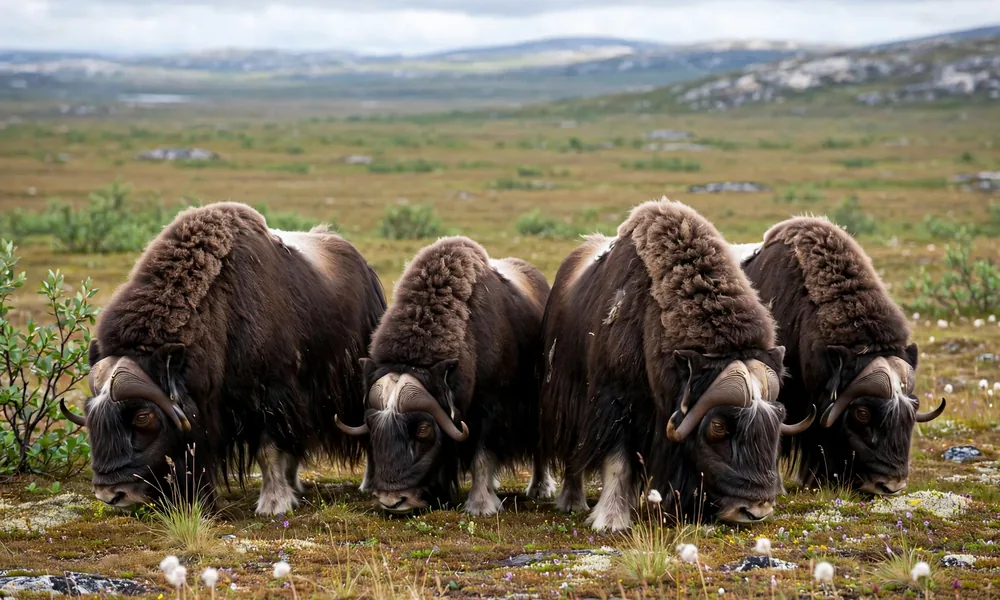
- Musk oxen live in herds and defend their calves by forming a circle or line with horns facing outwards.
- The species is listed as Least Concern, with about 134,000 to 137,000 mature animals, after recovering from near extinction.
- Its double coat includes qiviut, a fine underwool shed each spring and one of the warmest natural fibres in the world.
What makes a musk ox a musk ox
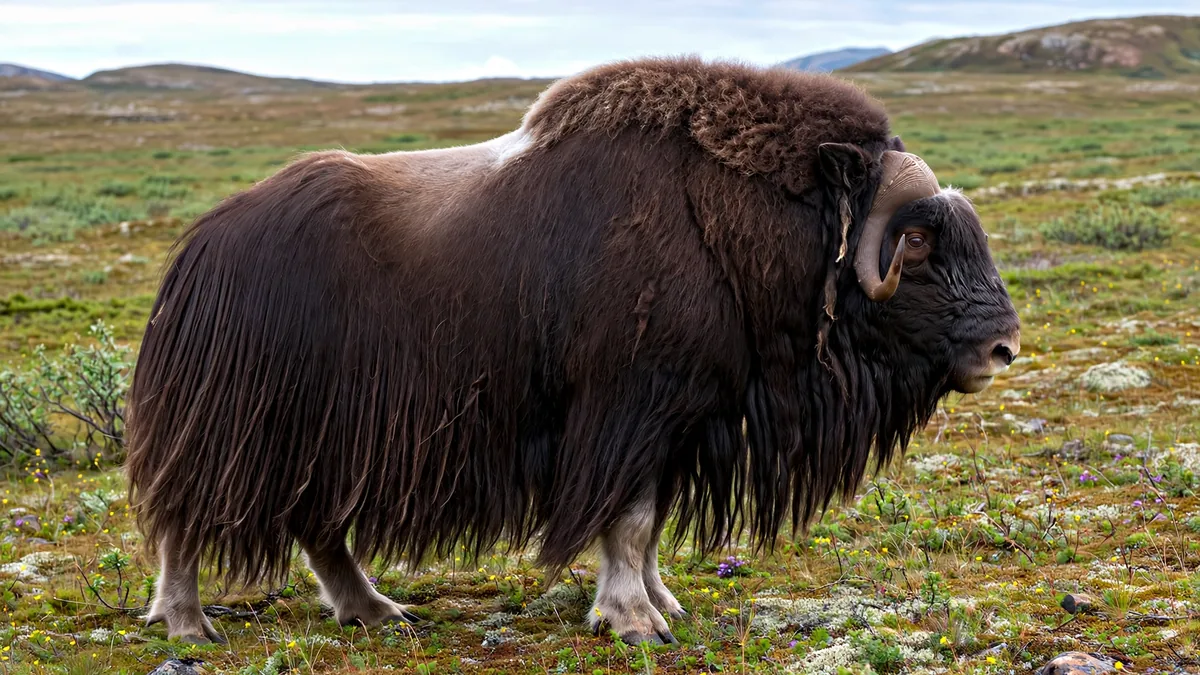
A musk ox is a stocky, powerfully built animal with a large head, a short neck, short stout legs and a slight hump over the shoulders. Its coat is its most striking feature: long, coarse, dark brown guard hairs that can reach almost to the ground, hiding a short tail and nearly covering its small ears. The long guard hairs are the longest hair of any mammal in North America.
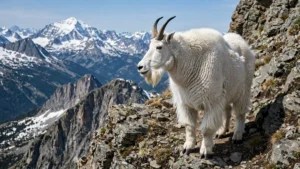
Both cows and bulls carry horns, though the bulls are much larger and heavier, with broad bases that meet across the forehead in a thick boss. The horns sweep down beside the face and then curve upwards at the tips, and old bulls can have horns up to about 60 centimetres long. Like the mountain goat, another member of the goat family, the musk ox is sure-footed on rough ground, but it is far heavier and shaggier, built for cold rather than for cliffs. Its wide, rounded hooves spread on soft snow and act like shovels.
The musk ox species and their relatives
The musk ox belongs to Ovibos, a genus with a single living species. It is a member of the family Bovidae and the subfamily Caprinae, the goats and sheep, and the Alaska Department of Fish and Game names the takin of the Himalayas as its closest living relative. The mountain goat, the chamois and the serow are also close cousins within the same subfamily.
The musk ox has changed remarkably little since the Pleistocene, when musk oxen roamed right around the northern hemisphere. After the Ice Ages ended, they were confined to northern Canada, the high Arctic islands and Greenland, and hunting severely depleted them in the late nineteenth century. The Thelon Game Sanctuary, established in 1927 in Canada’s Northwest Territories, helped save the species on the mainland.
| Type | Animal | Where it lives | Best-known food | Length or Weight |
|---|---|---|---|---|
| Genus | Musk oxen (genus Ovibos) | Arctic tundra of Canada and Greenland | Grasses, sedges and willows | About 1.2 to 1.5 m at the shoulder |
| Species | Musk ox (Ovibos moschatus) | Arctic Canada, Greenland and Alaska | Grasses, sedges and willows | About 250 to 400 kg for bulls |
| Species | Takin (Budorcas taxicolor) | Mountains of the eastern Himalayas | Bamboo, leaves and grasses | About 150 to 350 kg |
| Species | Mountain goat (Oreamnos americanus) | Mountains of western North America | Grasses, mosses and lichens | About 45 to 140 kg |
| Species | Bighorn sheep (Ovis canadensis) | Mountains of western North America | Grasses and shrubs | About 50 to 140 kg |
| Species | Chamois (Rupicapra rupicapra) | Mountains of Europe | Grasses, herbs and leaves | About 25 to 50 kg |
How musk oxen live
Musk oxen are herbivores that eat a great variety of plants, including grasses, sedges, forbs and woody plants such as willows. In summer they feed heavily and store fat for the winter, when food is scarce. They cannot dig through heavy snow, so in winter they stay where the snow is shallow or blown clear, pawing down to the plants with their broad front hooves.
Musk oxen are gregarious and seldom seen alone except during the rut. Summer herds are usually small, often about five to twelve animals, while winter herds are larger, commonly twelve to thirty and sometimes up to seventy-five. Herds are often led by a single female, and the animals stay close together. Musk oxen can run at about 60 kilometres per hour and climb with surprising agility despite their bulk.
The breeding season begins in late summer, with a rut of about two months. Bulls challenge each other with deep bellows, rubbing a scent gland against the ground, and then charge from as far as 50 metres away, colliding squarely on the horn bases. The force has been compared to a car hitting a concrete wall at about 27 kilometres per hour, and battles can last through twenty clashes, though the bulls’ heads are heavily armoured, with about ten centimetres of horn and eight centimetres of bone over the brain. After about eight months, a single calf is born in April or May, weighing about 14 kilograms, and it grows fast. Musk oxen live for about 12 to 20 years in the wild.
Where musk oxen live
Musk oxen live on the Arctic tundra, generally in low-lying coastal and inland plains or river valleys where shrubs are most abundant. Most live in Canada, above all in the Northwest Territories and Nunavut, including large Arctic islands such as Banks Island and Victoria Island, and in Greenland. Like the reindeer, another tundra herbivore, it moves between feeding grounds as the seasons change.
Outside their native range, musk oxen were reintroduced to Alaska in 1935 and 1936, when animals were brought to Nunivak Island, and some descendants were later moved to Siberia and Scandinavia. Small introduced herds now live in Norway, around Dovrefjell, and in Sweden. In the High Arctic the sun does not appear above the horizon between November and February, yet the musk ox functions normally at minus 40 degrees Celsius in high winds and blowing snow, thanks to its double coat.
The musk ox is listed as Least Concern on the IUCN Red List, and its numbers are broadly stable. The IUCN assessment puts the total at about 134,000 to 137,000 mature individuals, most of them in Canada, with about 9,500 to 12,500 in Greenland. A circumpolar review published in 2020 estimated roughly 170,000 in total but recorded an 8 per cent decline over three generations, so the picture is mixed: the species has recovered strongly from near extinction, but some local populations are falling, and a warming Arctic brings new pressures, including rain on snow and more predation on calves.
Best seasons for musk ox watching
The best time to watch musk oxen is summer, from about June to August, when the tundra is free of deep snow, the days are long and the herds are spread out across the valleys feeding. In Greenland, the area around Kangerlussuaq is one of the best-known places to see them, and in Norway the Dovrefjell mountains hold a small, well-watched herd often seen from the walking trails.
Staying safe around musk oxen
A musk ox is a wild animal and should be watched from a distance, never approached or fed. Musk oxen are not usually aggressive, but a bull in the rut is unpredictable, and a herd with calves will defend itself, forming a line or a circle with horns facing outwards. Keep well back and never walk between a herd and its calves.
In Norway, park guidance is to keep at least 200 metres from musk oxen, and dogs must be kept on a lead, because dogs can provoke a charge. If a musk ox lowers its head, paws the ground or starts to approach, move away calmly. Follow the guide’s instructions and stay on the marked paths.
Musk ox watching checklist
A little preparation turns a walk across the tundra into a real chance of seeing this Ice Age survivor.
- A visit to the tundra around Kangerlussuaq in Greenland or Dovrefjell in Norway, ideally with a local guide.
- A summer trip, from about June to August, when the days are long and calves are beside their mothers.
- Binoculars, because musk oxen blend into the tundra and are often spotted from a ridge first.
- Warm, windproof clothing, because even in summer the Arctic wind is cold.
- Sturdy waterproof boots, for wet tundra and snow patches.
- A camera with a zoom lens, for close views from a distance.
- Patience and a respectful distance, because a herd that feels watched will stand in a defensive circle rather than feed.
Frequently asked questions
How many musk ox species are there?
There is one musk ox species, Ovibos moschatus, the only living member of the genus Ovibos. It lives across the Arctic tundra of Canada and Greenland, with reintroduced herds in Alaska, Norway, Sweden and Siberia.
Why is it called a musk ox if it is not an ox?
The name comes from the strong musky scent bulls produce in the breeding season and from its superficial resemblance to an ox. Despite the name, it is not closely related to cattle: it belongs to the goat subfamily Caprinae, and its closest living relative is the takin.
What does a musk ox eat in winter?
In winter, musk oxen eat grasses, sedges, willows and other woody plants, pawing through shallow snow with their broad front hooves. They store large amounts of fat in summer to help them through the winter, when food is scarce and temperatures can fall below minus 40 degrees Celsius.
How do musk oxen protect their calves from wolves?
When wolves approach, the adults run together and form a line if there is one predator, or a tight circle if surrounded, with the calves in the middle and every adult facing outwards. The defence is so effective against the wolf that a herd that stands its ground is nearly impossible to attack, though the same behaviour once made musk oxen easy targets for hunters.
How is this guide different from the mountain goat guide?
This guide covers the musk ox, one heavy Arctic species that lives on the flat tundra of Canada and Greenland, eats grasses and sedges, and defends its calves in a horned circle, while our mountain goat species guide covers the mountain goat, a smaller, white, cliff-dwelling goat of western North America. Musk oxen stand their ground on open ground, and mountain goats escape danger by climbing steep rock.
Are musk oxen endangered?
No. The musk ox is listed as Least Concern on the IUCN Red List, with about 134,000 to 137,000 mature individuals and a broadly stable population. It came close to extinction from hunting in the late nineteenth century, but protection and reintroductions brought it back, though a warming Arctic remains a concern.
Conclusion
The musk ox species is a living piece of the Ice Age: one species, Ovibos moschatus, that has outlasted mammoths and still stands on the Arctic tundra.
If you go looking for one, go in summer, go with a guide, and keep your distance. Watch a herd feed across the tundra, and you will see an animal that has barely changed in tens of thousands of years.