The oryx species are four species in the genus Oryx, desert antelopes with long horns that can live for weeks without drinking water. If you are asking how many oryx species there are, the answer is four: the gemsbok, the East African oryx, the scimitar-horned oryx and the Arabian oryx, and two of the four were once extinct in the wild.
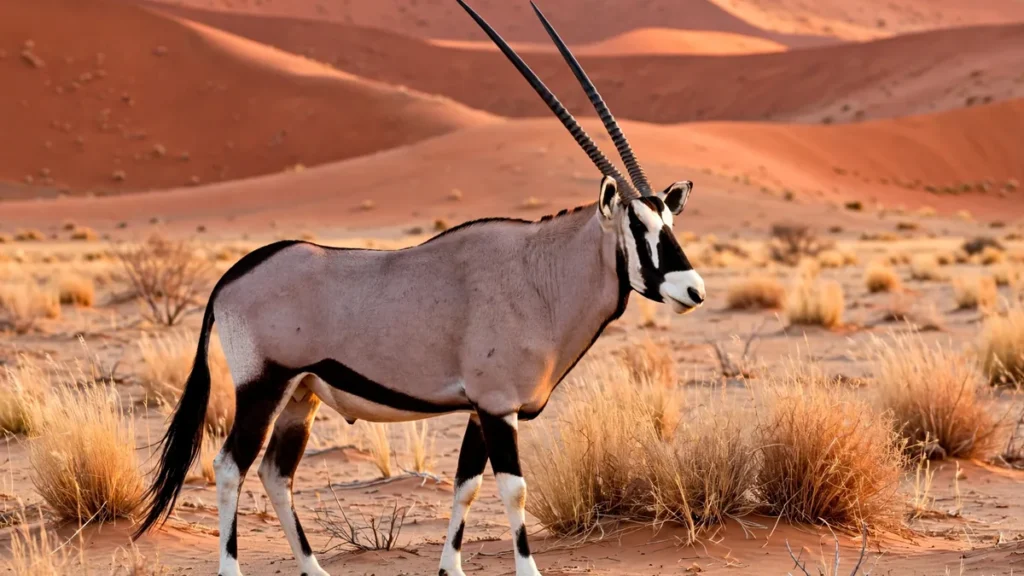
Every oryx wears the same bold design: a black-and-white mask across the face, and a pair of long horns carried by both males and females. The name comes from the Greek word oryx, meaning a pickaxe, a reference to those horns, and in profile an oryx can look like a single-horned unicorn, which is why the Arabian oryx is known as the unicorn of the desert.
Key takeaways
- There are four oryx species in the genus Oryx: the gemsbok, the East African oryx, the scimitar-horned oryx and the Arabian oryx.
- Both males and females carry long horns, reaching about 85 centimetres in the gemsbok and up to about 120 centimetres in the scimitar-horned oryx.
- Oryxes can live for weeks without drinking water, getting moisture from grasses, melons, roots and dew, and letting their body temperature rise to save water.
- The gemsbok is listed as Least Concern, the Arabian oryx as Vulnerable, and the East African and scimitar-horned oryxes as Endangered.
- Oryxes live in herds of about ten to forty animals, and a female usually bears a single calf after about eight to nine months.
What makes an oryx an oryx
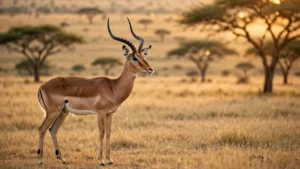
An oryx is a large, powerfully built antelope of the dry places, with a pale coat, long legs and a pair of horns that are almost straight in three species and swept back like a scimitar in the fourth. The face mask is the quickest way to recognise one: bold black and white patches across the forehead, cheeks and muzzle. A gemsbok’s heavy black markings set it apart from the paler East African oryx, while the Arabian oryx is almost entirely white.
The horns are the oryx’s signature and its defence. They are heavily grooved, grow throughout the animal’s life and can reach over a metre long, and both sexes carry them. Oryxes use them against lions, leopards, cheetahs and hyenas, and a cornered oryx can kill a lion with a thrust. The horns are also the reason for the unicorn legend: seen side-on, the two horns line up into one.
The oryx species and their relatives
The oryx belongs to Oryx, a genus of four species in the antelope family Bovidae, in the subfamily Hippotraginae, the grazing antelopes. The gemsbok of southern Africa is the largest and heaviest, the East African oryx is its slimmer, paler cousin of the Horn of Africa, the scimitar-horned oryx is the white antelope of the Sahel with curved horns and a russet neck, and the Arabian oryx is the smallest and whitest of all. The fringe-eared oryx of southern Kenya and northern Tanzania is usually treated as a subspecies of the East African oryx.
Oryxes share their dry country with other large antelopes, including the eland, the world’s largest antelope, whose scientific name, Taurotragus oryx, even borrows the oryx name. Like the giraffe, another tall animal of the African savanna, the oryx feeds in the open, but where the giraffe reaches up into the trees, the oryx feeds at ground level, digging for roots and tubers when the grass is gone.
| Type | Animal | Where it lives | Best-known food | Length or Weight |
|---|---|---|---|---|
| Genus | Oryxes (genus Oryx) | Deserts and dry savannas of Africa and Arabia | Grasses, leaves and melons | About 0.8 to 1.2 m at the shoulder |
| Species | Gemsbok (Oryx gazella) | Namibia, Botswana and South Africa | Grasses, roots and melons | About 180 to 240 kg |
| Species | East African oryx (Oryx beisa) | Ethiopia, Kenya and Tanzania | Grasses, leaves and tubers | About 120 to 210 kg |
| Species | Scimitar-horned oryx (Oryx dammah) | Sahel, reintroduced in Chad | Grasses, leaves and buds | About 140 to 210 kg |
| Species | Arabian oryx (Oryx leucoryx) | Arabian Peninsula, reintroduced | Grasses, roots and melons | About 65 to 75 kg |
How oryxes live
Oryxes are herbivores that feed in the early morning and late afternoon, resting through the hottest hours. Their diet is grasses, leaves, buds, fruit, roots and tubers, and they dig for underground plants when the surface grass is gone. They also eat wild melons, an important source of water. Their kidneys lose as little water as possible, and they only begin to sweat when their body temperature passes about 46 degrees Celsius.
The oryx’s most famous trick is its own body temperature. Rather than sweating to stay cool, an oryx lets its temperature rise to match the desert air, reaching over 45 degrees Celsius, so it loses far less water than an animal that sweats to stay at a normal temperature. With pale coats that reflect the sun, resting in shallow scrapes in the shade and feeding at dawn and dusk, this lets oryxes go for weeks without drinking. They can also sense rain from far away and travel towards it to find fresh grass.
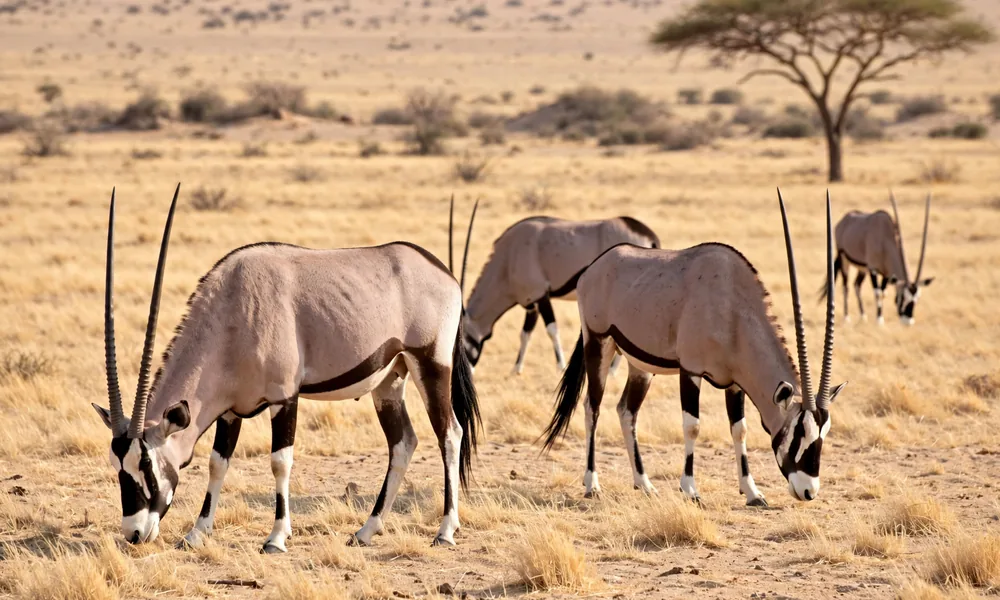
Oryxes usually live in herds of about ten to forty animals, made up of females, their young and a few males, though gatherings of a few hundred can form where rain has produced good grazing. There is no fixed breeding season, though most births follow the rains, and after about eight to nine months a female gives birth to a single calf, weighing about 10 kilograms. The calf is hidden away for two to three weeks while its mother visits it to feed. Oryxes can live for about 20 years.
Where oryxes live
Three oryx species live in Africa and one in the Middle East. The gemsbok lives in the Kalahari and Namib deserts of Namibia, Botswana, South Africa and parts of Zimbabwe and Angola, and it is the only oryx that is not threatened: it is listed as Least Concern, with large numbers on private land and in national parks. The East African oryx lives in the dry lowlands of Ethiopia, Kenya, South Sudan and northern Tanzania, and it is listed as Endangered, having fallen by about half since the mid-1990s, from about 34,000 animals to about 16,000 to 18,000, through poaching, competition with livestock and drought.
The scimitar-horned oryx once roamed the Sahel in herds of thousands, but hunting wiped it out, and it was declared Extinct in the Wild in 2000. In 2016, twenty-five captive-bred animals were flown from Abu Dhabi to Chad and released into the Ouadi Rime-Ouadi Achim reserve, and the herd grew so well that the species was downlisted to Endangered in 2023, with more than 600 animals living free in Chad by 2026. The Arabian oryx was declared extinct in the wild in 1972, but captive breeding saved it, and there are now about 1,200 to 1,600 in the wild, listed as Vulnerable.
Best seasons for oryx watching
The best time to watch gemsbok is the dry season in southern Africa, from about May to October, when the grass is short and the animals gather at waterholes. Etosha National Park in Namibia and the Kgalagadi Transfrontier Park on the border of South Africa and Botswana are the best-known places to see them.
For the East African oryx, the dry season in Kenya and Tanzania is also best, with Samburu and Tarangire among the most reliable places. The Arabian oryx is best seen in the cooler months, from about October to April, in the reserves of Oman, Saudi Arabia and the United Arab Emirates.
Staying safe around oryxes
An oryx is a wild animal and should be watched from a distance, never approached on foot or fed. The horns are the danger: an oryx that feels cornered will lower its head and charge, and those long, sharp horns can kill a lion. Keep well back and stay inside your vehicle on a safari.
Oryx watching checklist
A little preparation turns a desert drive into a chance of seeing the unicorn of the desert.
- A visit to Etosha National Park in Namibia or the Kgalagadi Transfrontier Park in the dry season.
- An early morning or late afternoon start, when oryxes feed.
- Binoculars, because oryxes feed far out on the open plains and blend into the dry grass.
- Plenty of drinking water, a hat and sunscreen, because the desert heat is the real danger.
- A camera with a zoom lens, for close views of the face mask and horns without approaching the herd.
- A field guide to African antelopes, for telling a gemsbok from an East African oryx.
- Patience at a waterhole, because oryxes often arrive in small groups and linger to drink.
Frequently asked questions
How many oryx species are there?
There are four oryx species in the genus Oryx: the gemsbok of southern Africa, the East African oryx of the Horn of Africa, the scimitar-horned oryx of the Sahel and the Arabian oryx of the Arabian Peninsula. The fringe-eared oryx of southern Kenya and Tanzania is usually treated as a subspecies of the East African oryx, though some experts argue it should count as a fifth species.
How can an oryx live without drinking water?
An oryx gets most of its water from its food: grasses, roots, tubers and wild melons, plus dew on rocks and plants. Its kidneys lose very little water, it only sweats when its body temperature passes about 46 degrees Celsius, and it lets its body temperature rise to match the desert air instead of sweating to stay cool. Together, these adaptations let it go for weeks without drinking.
What is the difference between a gemsbok and an East African oryx?
The gemsbok is larger and heavier, at about 180 to 240 kilograms, with bold black markings and an all-black tail. The East African oryx is slimmer and paler, at about 120 to 210 kilograms, with far less black on its legs. The two were once treated as one species, but studies have shown them to be separate.
Are scimitar-horned oryxes still extinct in the wild?
No. The scimitar-horned oryx was declared Extinct in the Wild in 2000, but captive-bred animals were reintroduced to Chad from 2016, and the herd grew so well that the IUCN downlisted the species to Endangered in 2023. More than 600 animals now live free in the Ouadi Rime-Ouadi Achim reserve in Chad.
How is this guide different from the musk ox guide?
This guide covers the oryx, four species of desert antelope that live in the hot, dry country of Africa and Arabia, eat grasses and melons, and can go for weeks without drinking water, while our musk ox species guide covers the musk ox, one heavy Arctic species that lives on the frozen tundra of Canada and Greenland. Oryxes let their body temperature rise to save water in the desert, and musk oxen grow a double coat to keep warm in the cold.
Are oryxes endangered?
It depends on the species. The gemsbok is listed as Least Concern and is common in southern Africa, the Arabian oryx is listed as Vulnerable with about 1,200 to 1,600 in the wild, and the East African and scimitar-horned oryxes are both listed as Endangered. Two of the four were once extinct in the wild and exist today only because of captive breeding and reintroduction.
Conclusion
The oryx species show how an animal can master the driest places on Earth: four species, each with its own desert, all sharing the black-and-white mask and the ability to live where other antelopes cannot.
If you go looking for one, go at dawn to a waterhole, and watch for the long horns against the dry grass. See a gemsbok stand in the red dunes of the Namib, and you will understand why this antelope became the unicorn of the desert.