The pine marten species is a single species, Martes martes, a chocolate-brown tree-climbing member of the weasel family that lives in the forests of Europe and western Asia. If you are asking how many pine marten species there are, the answer is one, and it is one of Britain’s great wildlife comebacks: hunted almost to extinction in Britain and Ireland, it is now spreading back through Scotland, Wales and northern England, helped by legal protection and reintroduction.
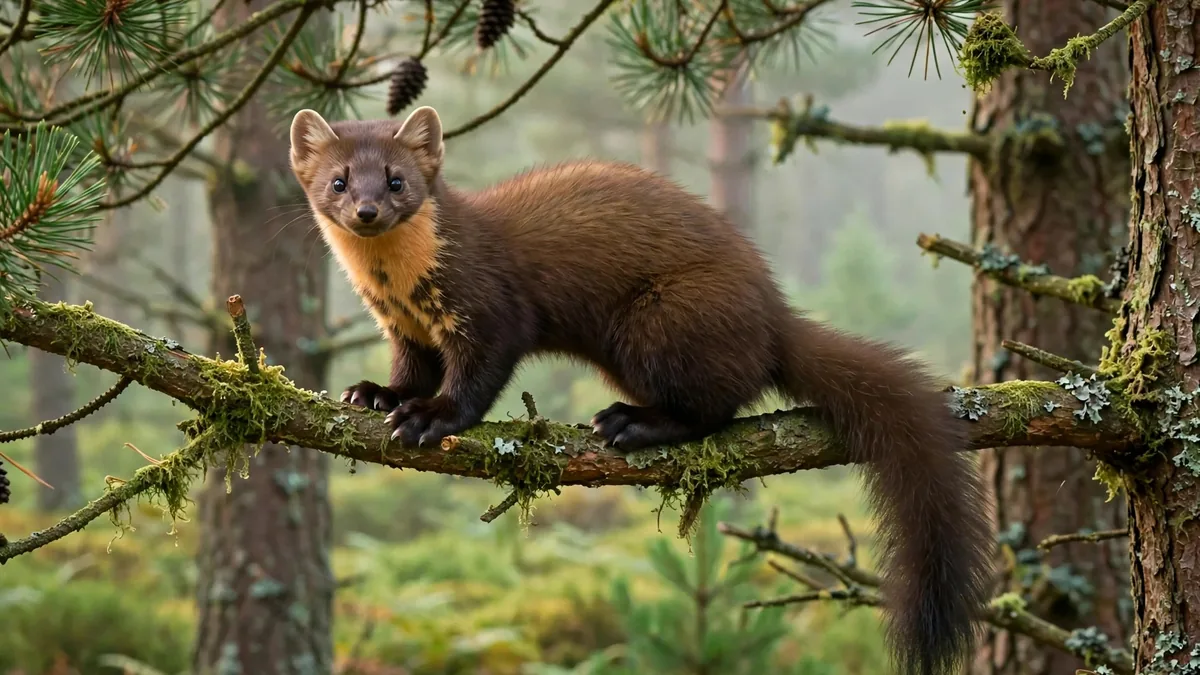
The pine marten gets its name from its love of pine woods, though it is just as happy in oak, beech and mixed forest. It is about the size of a small house cat, but longer, lower and much lighter, with a long bushy tail, large rounded ears and a creamy yellow bib on its throat. It is shy and mostly nocturnal, so most people never see one, even where it is common.
Key takeaways
- There is one pine marten species, Martes martes, though its genus holds seven marten species in total.
- An adult is about 45 to 58 centimetres long, with a bushy tail of about 16 to 28 centimetres, and weighs roughly 0.8 to 1.8 kilograms.
- They are solitary, territorial and mostly active at night and at dusk, hunting voles, mice, squirrels and birds, and eating berries in summer and autumn.
- They mate in summer, but delayed implantation means the kits are not born until the following March or April.
- It is listed as Least Concern, yet in Britain and Ireland it was nearly wiped out and is still recovering.
What makes a pine marten a pine marten
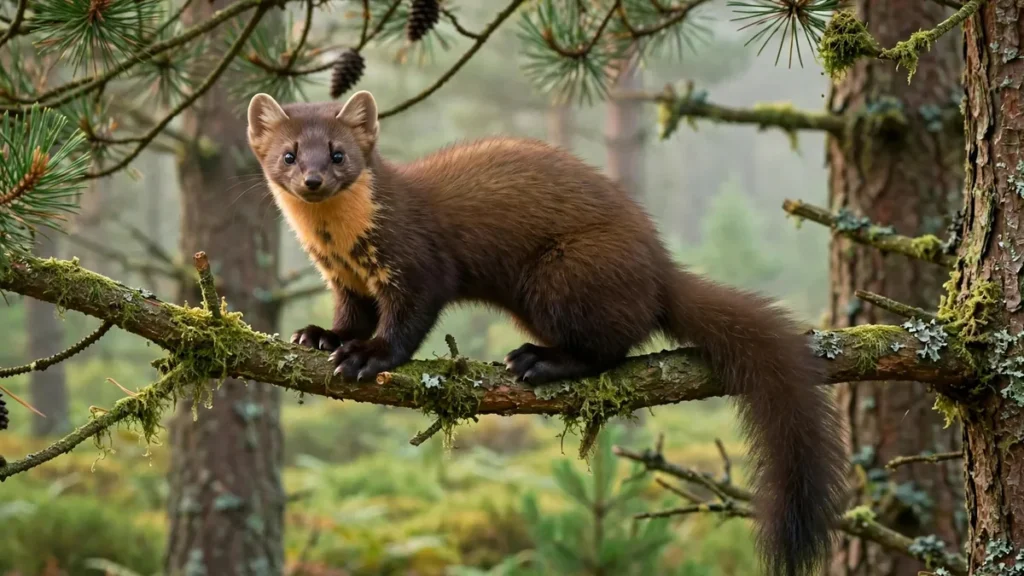
A pine marten is covered in rich chocolate-brown fur, short and coarse in summer and longer and silkier in winter. Its throat bib is creamy yellow to orange, ending in a rounded point, and no two bibs are quite alike, so researchers can tell individuals apart from photographs. Its ears are large and rounded with pale edges, and its dark eyes give it an alert, curious look.
The pine marten has semi-retractable claws, which let it grip bark and climb like a squirrel, and its long bushy tail works as a balance pole as it leaps between branches. Like the fisher, another tree-climbing member of the genus Martes, it is built for life above the ground, yet it does much of its hunting on the forest floor. An adult is about 45 to 58 centimetres from nose to the base of the tail, with a tail of about 16 to 28 centimetres, and weighs roughly 0.8 to 1.8 kilograms, with males larger than females.
The pine marten species and its relatives
The pine marten belongs to Martes, a genus of seven marten species across the forests of Europe, Asia and North America. Its closest lookalike is the beech marten, also called the stone marten, which has a white bib, a pink nose and a taste for rocky ground, farms and villages, while the pine marten keeps to woodland and has a creamy bib and a dark nose. The bib, the nose and the habitat are the clues most watchers use to tell them apart.
The pine marten is a member of the family Mustelidae, the weasels, stoats, otters, badgers and wolverines, and it shares the family with the European otter, a water-loving cousin, and the badger, a heavy digger that lives underground. Among martens it is the European woodland specialist, while its relatives range from the Siberian sable to the yellow-throated marten of Asian forests, the largest marten of all.

| Type | Animal | Where it lives | Best-known food | Length or Weight |
|---|---|---|---|---|
| Genus | Martens (genus Martes) | Forests of Europe, Asia and North America | Small mammals, birds and berries | About 45 to 58 cm long |
| Species | Pine marten (Martes martes) | Forests of Europe and western Asia | Voles, squirrels and berries | About 0.8 to 1.8 kg |
| Species | Beech marten (Martes foina) | Europe and Asia, rocky ground and villages | Rodents, birds and fruit | About 40 to 55 cm long |
| Species | American marten (Martes americana) | Boreal forests of Canada and Alaska | Voles and red squirrels | About 0.5 to 1.3 kg |
| Species | Sable (Martes zibellina) | Taiga forests of Siberia | Voles, birds and berries | About 38 to 56 cm long |
| Species | Yellow-throated marten (Martes flavigula) | Forests of Asia, from India to Korea | Small mammals, fruit and honey | About 56 to 72 cm long |
| Species | Japanese marten (Martes melampus) | Forests of Japan and Korea | Rodents, birds and fruit | About 47 to 54 cm long |
How pine martens live
Pine martens are omnivores, and their diet changes with the seasons. Through the year they hunt voles, mice, squirrels and rabbits, along with birds and their eggs, frogs, insects and carrion, and in late summer and autumn they eat a great deal of fruit and berries. In Scotland, bilberries can make up about a third of the summer diet and turn the marten’s droppings blue, often the first sign a watcher finds.
Pine martens are solitary and territorial, marking a home range with scent and with dark, twisted droppings left in prominent places. Males roam much further than females and may travel several miles in a single night. They rest by day in dens high in old trees, in hollow trunks, old squirrel dreys and abandoned bird nests, moving between several dens every few days.
Pine martens are mainly active at night and at dusk, though they can be seen in daylight in summer. They are excellent climbers, yet they find much of their food on the ground. They breed slowly: they mate in July or August, but the fertilised egg does not implant for about seven months, so the kits are born the following March or April. A litter is usually one to three kits, and up to five when food is plentiful. Each kit weighs only about 30 grams at birth, blind and covered in fine pale hair, and the young leave the den at about six or seven weeks and are independent by autumn. They first breed at two or three years old, and most live only three or four years in the wild, though some reach about 11 years, and up to 18 years in captivity.
Where pine martens live
Pine martens live across most of Europe, from Ireland, Britain and Scandinavia east to western Siberia, and south to Spain, Italy, the Balkans, Turkey, the Caucasus and northern Iran. They also live on Sardinia, Sicily, Corsica, Mallorca and Menorca, probably brought there by people long ago. Everywhere they need mature woodland, with old trees full of holes, fallen logs and dense cover, and they are rarely found far from trees.
In Britain and Ireland the story is different: hunted for its fur and killed as a supposed pest, it survived only in the north-west Highlands of Scotland, with small remnants in Ireland. Protected by law since 1988, it has spread across much of Scotland, with about 3,700 adults there.
Reintroduction is speeding the return. Between 2015 and 2017 the Vincent Wildlife Trust moved 51 pine martens from Scotland to mid-Wales, and they have bred there every year since. In the autumn of 2024, fifteen more were released in Devon, in the Two Moors project to bring them back to Dartmoor and Exmoor. The pine marten is listed as Least Concern on the IUCN Red List, but in England and Wales it remains rare.
Best seasons for pine marten watching
The best time to look for pine martens is summer, when the animals are sometimes active before dusk, and autumn, when they are busy feeding on berries and rowan fruit. Dawn and dusk are the best hours, and the Scottish Highlands, the Cairngorms and the forests of Argyll are the most reliable places, along with Killarney National Park in Ireland. A hide near a feeding station, or a guided night walk, gives the best chance of all.
Staying safe around pine martens
A pine marten is a wild animal with sharp teeth and claws, and it should be watched from a distance and never approached or fed. Feeding teaches martens to visit houses and cars, where they can chew wiring, and human food can make them ill. A cornered marten will bite, so keep dogs on a lead and give any animal you spot plenty of space. If you find a den, leave quietly and do not return, because a disturbed mother may abandon her kits.
Pine marten watching checklist
A quiet evening in old woodland is the best way to meet Britain’s shyest forest hunter.
- A visit to mature woodland in the Scottish Highlands, the Cairngorms or Killarney.
- A dawn or dusk start, when martens leave their dens and begin to hunt.
- Binoculars, because a marten may be high in the canopy or across a clearing.
- A torch with a red filter for a guided night walk, which disturbs the animals less.
- Quiet clothing and soft shoes, because a marten will vanish at the first snap of a twig.
- A camera with a zoom lens, for a close view of the throat bib without getting close.
- A field guide to mustelids, for telling a pine marten from a beech marten by its bib, nose and habitat.
Frequently asked questions
How many pine marten species are there?
There is one pine marten species, Martes martes, but its genus holds seven marten species in total, including the beech marten, the American marten, the sable, the yellow-throated marten and the Japanese marten.
What does a pine marten eat?
Pine martens are omnivores that eat voles, mice, squirrels, rabbits, birds and their eggs, frogs, insects and carrion, along with berries, fruit, nuts, fungi and honey. In summer, bilberries can make up about a third of the diet of Scottish pine martens.
How can you tell a pine marten from a beech marten?
A pine marten has a creamy yellow to orange bib, a dark nose and a preference for woodland, while a beech marten has a white bib, a pink nose and a taste for rocky ground, farms and villages. The pine marten is also the only one of the two that lives in Britain and Ireland.
Do pine martens help red squirrels?
Yes, research in Ireland and Scotland has found that where pine martens return, the non-native grey squirrel declines and the native red squirrel can recover. Grey squirrels did not evolve alongside pine martens, so they are less wary of them and spend more time on the ground, making them easier prey than red squirrels.
How is this guide different from the oryx guide?
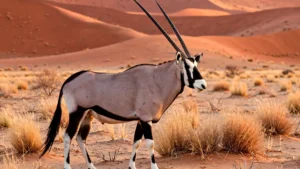
This guide covers the pine marten, one species of small tree-climbing mustelid that lives in the forests of Europe and western Asia and hunts voles and squirrels at night, while our oryx species guide covers the oryx, a large desert antelope of Africa and Arabia with long straight horns that grazes on dry grassland. Pine martens climb trees in damp woodland, and oryx live in open desert.
Are pine martens endangered?
No, not globally. The pine marten is listed as Least Concern on the IUCN Red List, because it is still widespread across Europe and western Asia. In Britain and Ireland it was nearly wiped out by hunting and is still recovering, and it is fully protected by law.
Conclusion
The pine marten species shows how a single forest animal can come back from the edge: Martes martes, hunted almost to extinction in Britain and Ireland, and now spreading again through the woodlands of Scotland, Wales and England.
If you go looking for one, go at dusk, go quietly, and look for a flash of chocolate brown in the canopy. Watch it pause on a branch, its creamy bib bright, and you will see why this shy hunter has become the symbol of Britain’s returning wildwoods.