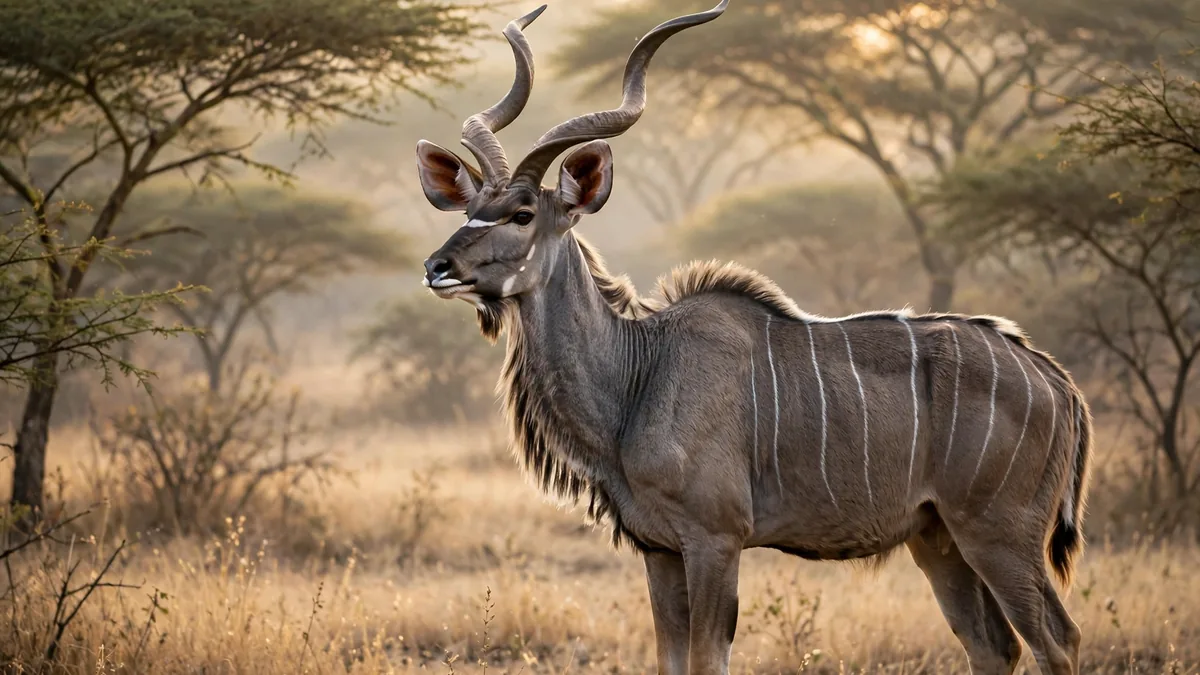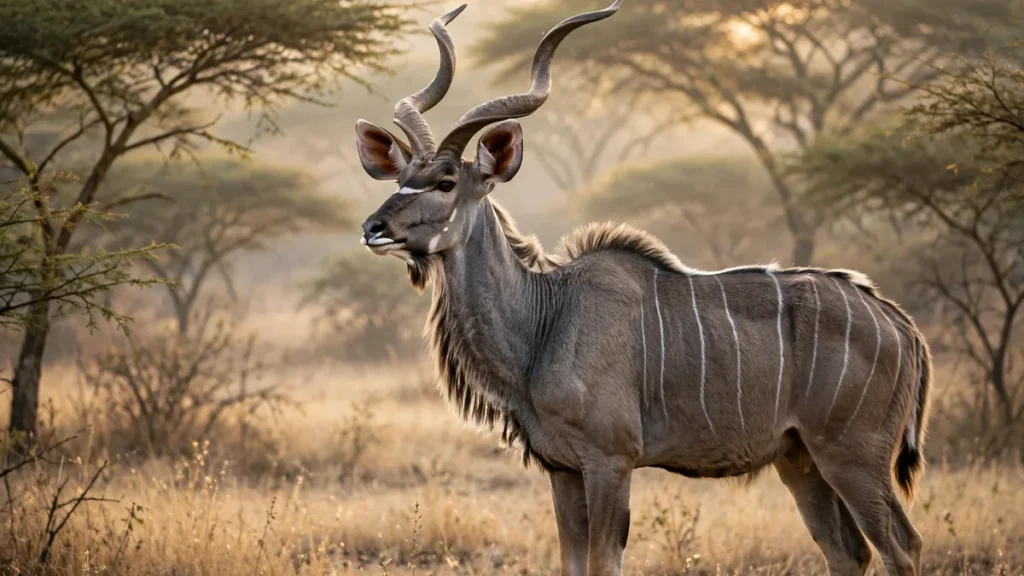
The kudu species are two spiral-horned antelopes from Africa, the greater kudu and the lesser kudu, and they share the genus Tragelaphus. If you are asking how many kudu species there are, the answer is two, and both are famous for the same things: tall spiral horns on the males, thin white stripes down their flanks, and an uncanny ability to disappear into dry bush the moment you look away.
Kudus are woodland antelopes rather than open-plains grazers, living among trees, thickets and rocky hillsides and browsing on leaves and shoots. They feed in the early morning and late afternoon, and they can clear a fence nearly three metres high from a standing start when startled.
Key takeaways
- There are two kudu species, the greater kudu (Tragelaphus strepsiceros) and the lesser kudu (Tragelaphus imberbis).
- A greater kudu bull stands up to 1.6 metres at the shoulder and weighs 190 to 270 kilograms, while a lesser kudu bull weighs only 92 to 108 kilograms.
- Only male kudus grow horns, and a greater kudu bull’s horns make about two and a half twists and average 120 centimetres along the curve.
- Kudus browse on leaves, shoots, herbs, flowers, fruit and seed pods, and get much of their water from the plants they eat.
- The greater kudu is Least Concern and the lesser kudu is Near Threatened, with about 118,000 animals and falling.
What makes a kudu a kudu
A kudu is a tall, narrow-bodied antelope with long legs, a short mane along the neck, and large round ears. Its coat ranges from reddish brown to blue-grey, with thin vertical white stripes along its sides, a white chevron between the eyes, and a bushy tail that is white underneath with a dark tip. The stripes break up its outline in dappled shade, so a kudu standing still in thick bush can be hard to see. Like the giraffe, it feeds at head height and above, reaching leaves shorter grazers cannot touch.
The horns are what most people remember. Only the bulls carry them, growing in an open spiral that slants back from the head, with about two and a half twists in a greater kudu and two to two and a half in a lesser kudu. A young bull’s horns begin to grow at six to twelve months old and reach their full two and a half turns at about six years old. Bulls also grow a fringe of longer hair under the throat, and older greater kudu bulls turn dark grey-blue.
The kudu species and their relatives
Kudus belong to Tragelaphus, a genus of spiral-horned antelopes in the family Bovidae, and the name comes from the Khoikhoi language of southern Africa. The greater kudu, Tragelaphus strepsiceros, is the larger of the two and one of Africa’s largest antelopes, second only to the eland. It lives across eastern and southern Africa and carries four to twelve white stripes, most often six to ten. The lesser kudu, Tragelaphus imberbis, is a smaller, slimmer animal of the dry thornbush of north-eastern Africa, wearing eleven to fifteen fine white stripes on each side plus a pale stripe along its back.
Their spiral-horned family also includes the eland, bushbuck, nyala, bongo and sitatunga. The eland is the giant of the group and the only one clearly bigger than a greater kudu, while the bushbuck is a small, secretive cousin of dense cover. All share the same family traits — white striping, large ears and twisting horns — and all browse in woodland and thicket rather than on open grassland.

| Type | Animal | Where it lives | Best-known food | Size |
|---|---|---|---|---|
| Genus | Kudus (genus Tragelaphus) | Eastern and southern Africa | Leaves and fruit | Up to 1.6 m at the shoulder |
| Species | Greater kudu (Tragelaphus strepsiceros) | Eastern and southern Africa | Leaves and seed pods | Bulls 190 to 270 kg |
| Species | Lesser kudu (Tragelaphus imberbis) | North-eastern Africa | Leaves, shoots and herbs | Bulls 92 to 108 kg |
| Relative | Common eland (Taurotragus oryx) | Eastern and southern Africa | Leaves and fruit | Bulls up to 942 kg |
| Relative | Bushbuck (Tragelaphus scriptus) | Sub-Saharan Africa | Leaves and fruit | About 24 to 80 kg |
| Relative | Nyala (Tragelaphus angasii) | Southern Africa | Leaves and fruit | Bulls 98 to 125 kg |
| Relative | Bongo (Tragelaphus eurycerus) | Central and West Africa | Leaves and shrubs | About 150 to 405 kg |
How kudus live
Kudus are browsers: leaves and shoots make up most of their food, with herbs, flowers, fruit and seed pods, and tubers and roots dug up in the dry season. Greater kudus favour acacia leaves and pull down branches with their horns to reach them. They get much of their moisture from their food and can go for days without drinking, though they drink at waterholes and travel far to find water in drought.
Females and their young live in small herds of about six to ten, while adult bulls live alone or in small bachelor groups outside the breeding season. Greater kudus feed in the early morning and late afternoon and rest in shade at midday, while lesser kudus feed through the night and shelter in thickets after sunrise. Both rely on stillness and camouflage before running, and can clear a fence nearly three metres high from a standing start.
A female greater kudu gives birth to a single calf after about 240 days, usually in the rainy season when the grass is tall, and the calf weighs about 16 kilograms. She leaves the herd to give birth and hides the calf in thick vegetation for the first few weeks, returning to suckle it, and it is weaned by about six months. Greater kudus live about seven to eight years in the wild and up to 20 years in captivity, while lesser kudus live about 10 to 15 years.
Where kudus live
The greater kudu lives across eastern and southern Africa, from Ethiopia and Kenya south to South Africa, with a separate population in Chad. It favours mixed woodland, bushland, rocky hillsides and thickets, and it avoids wide open grassland, preferring country where trees and bushes give it both food and cover. It also does well on farmland, browsing on hedges and crops.
The lesser kudu has a much smaller home, living only in the dry bushland of north-eastern Africa, in Ethiopia, Kenya, Somalia, South Sudan, Tanzania and Uganda. It lives among acacia and commiphora thornbush in semi-arid country, avoiding open areas and long grass for shaded thickets where its stripes hide it. It survives in very dry country by eating succulent plants and getting its water from its food.
The greater kudu is Least Concern, with roughly 300,000 to 350,000 mature animals, most on private farmland in Namibia and South Africa. In the north of its range, hunting and habitat loss have reduced numbers. The lesser kudu is Near Threatened, with about 118,000 animals left and a falling population, and about a third live in protected areas such as Tsavo in Kenya and Ruaha in Tanzania. Like the gazelle, the lesser kudu is most at risk where its habitat is cleared or heavily hunted.
Best seasons for kudu watching
The best time is the dry season, roughly May to October in southern Africa, when the bush thins out and kudus come to waterholes in the early morning and late afternoon. In East Africa the dry months vary, but the rule holds: go at dawn or dusk and look along thicket edges rather than open grass. In the rainy season, roughly November to April in the south, tall grass hides kudus well, though most calves are born then.
Staying safe around kudus
A kudu would rather run than fight, but a cornered bull is dangerous, because his long spiral horns can cause serious injury, so never approach one on foot or block its escape route. Watch from a vehicle or from a distance with binoculars, keep quiet, and never try to feed one. On foot, give any antelope a wide berth, especially a bull in the breeding season.
Kudu watching checklist
A little preparation turns a dawn drive into a real chance of seeing a great bull kudu step out of the thicket.
- A dry-season morning or late afternoon, when kudus come out of the thicket to feed and drink.
- A waterhole or woodland edge in a reserve such as Kruger, Etosha or Tsavo.
- Binoculars, because a kudu often stands motionless in shade far from the road.
- A camera with a zoom lens, for close views without leaving the vehicle or getting too near.
- Quiet voices and slow movements, because a kudu will vanish into the bush at the first sudden sound.
- A field guide to African antelopes, for telling a greater kudu from a lesser kudu.
- Sun protection, water and a hat, because the best kudu watching happens in hot, dry country.
Frequently asked questions
How many kudu species are there?
There are two: the greater kudu, Tragelaphus strepsiceros, and the lesser kudu, Tragelaphus imberbis. Both are spiral-horned antelopes with white stripes, but the greater kudu is much larger and lives across eastern and southern Africa, while the lesser kudu is smaller and lives only in the dry thornbush of north-eastern Africa.
Do female kudus have horns?
No. Only male kudus grow horns, in both species. Females are hornless, smaller, and usually a warmer reddish-brown, while older greater kudu bulls turn dark grey-blue. A female can still be recognised by her white side stripes, large round ears and the white chevron between her eyes.
What does a kudu eat?
Kudus browse on leaves, shoots, herbs, flowers, fruit and seed pods, with tubers and roots in the dry season. Greater kudus favour acacia leaves and pull down branches with their horns, while lesser kudus eat mostly foliage, 60 to 80 per cent of their diet. Both get much of their water from the plants they eat.
How big do kudu horns grow?
A greater kudu bull’s horns average about 120 centimetres along the curve, and the longest ever recorded measured about 187.6 centimetres. They make about two and a half twists and take about six years to reach full size. A lesser kudu bull’s horns are much smaller, 50 to 70 centimetres long, with two to two and a half twists.
How is this guide different from the Japanese macaque species guide?
This guide covers the kudu, two species of spiral-horned African antelopes that browse on leaves in woodland and thicket and vanish into the bush at the first sign of danger, while our Japanese macaque species guide covers the Japanese macaque, a single species of snow-loving monkey that lives in troops in the forests and mountains of Japan and bathes in hot springs. Kudus hide with stillness and stripes, and macaques survive through group life and clever hands.
Are kudus endangered?
The greater kudu is listed as Least Concern, with roughly 300,000 to 350,000 mature animals, though numbers have fallen in the north of its range through hunting and habitat loss. The lesser kudu is listed as Near Threatened, with about 118,000 animals left and a falling population, threatened by habitat loss, hunting and disease, and about a third live in protected areas.
Conclusion
The kudu species show how much character can fit into one quiet antelope: two spiral-horned browsers, one great and grey across the woodlands of eastern and southern Africa, one smaller and redder in the dry thornbush of the north-east, both wearing white stripes that hide them in the shade.
If you go looking for one, go at dawn in the dry season, go quietly, and watch the thicket edge rather than the open grass. Look for the flick of a large round ear or the pale line of a stripe, and you may see a great bull step out, horns spiralling in the morning light, before he melts away.