The marmoset species are about 22 small, long-tailed monkeys from South America, including the smallest monkey in the world. If you are asking how many marmoset species there are, the answer is about 22, across four genera — Callithrix, Mico, Cebuella and Callibella — all tree-dwelling monkeys with claw-like nails, long tails and a taste for tree sap.
Marmosets are among the smallest true monkeys, most of them about the size of a squirrel, with a body around 20 centimetres long and a tail longer than the body. They live in the rainforests and dry forests of South America, mostly in Brazil and the Amazon basin, where they move through the trees in noisy family groups, leaping between branches and gouging holes in bark to drink the gum that oozes out.
Key takeaways
- There are about 22 marmoset species in the family Callitrichidae, across the genera Callithrix, Mico, Cebuella and Callibella, though the count varies.
- Most marmosets are about 20 centimetres long in the body, with a tail of 25 to 40 centimetres and a weight of roughly 100 to 400 grams, while the pygmy marmoset weighs only about 100 to 140 grams.
- Marmosets have claw-like nails instead of flat nails, and long lower front teeth for gouging holes in tree bark to drink the gum that flows out.
- Marmosets live in family groups of 3 to 15 animals, usually give birth to twins, and the whole family helps to carry and feed the babies.
- The common marmoset is Least Concern, but the pygmy marmoset is Vulnerable, and several Atlantic Forest marmosets are threatened by habitat loss and the pet trade.
What makes a marmoset a marmoset
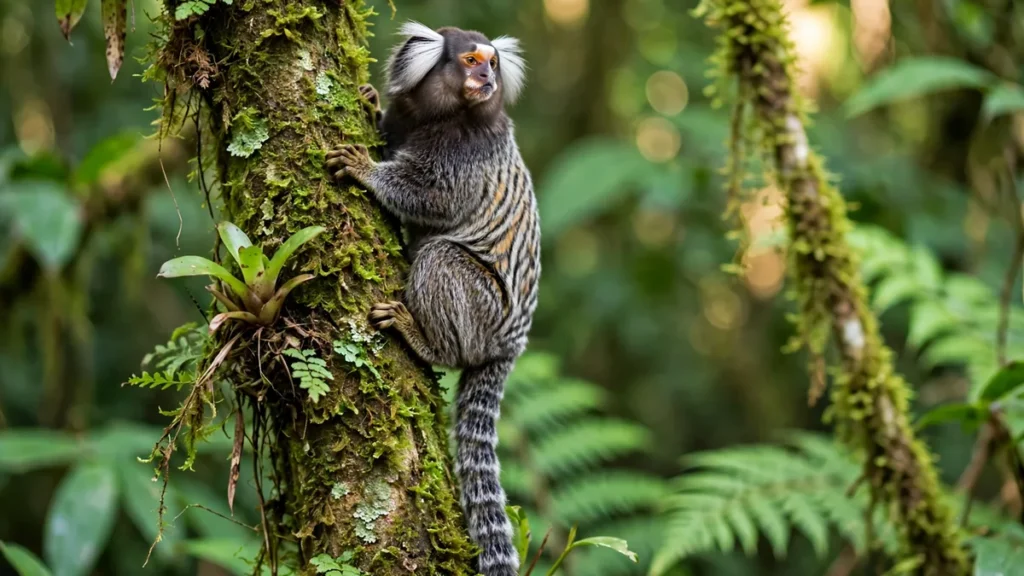
A marmoset is built for life in the trees. It has a small, light body, long hind legs for leaping, a long tail for balance, and soft, dense fur that can be grey, brown, black, white or golden, often with stripes, tufts or a mane around the face. The common marmoset has grey-brown fur, a striped tail and bright white ear tufts, which is why it is also called the white-tufted-ear marmoset.
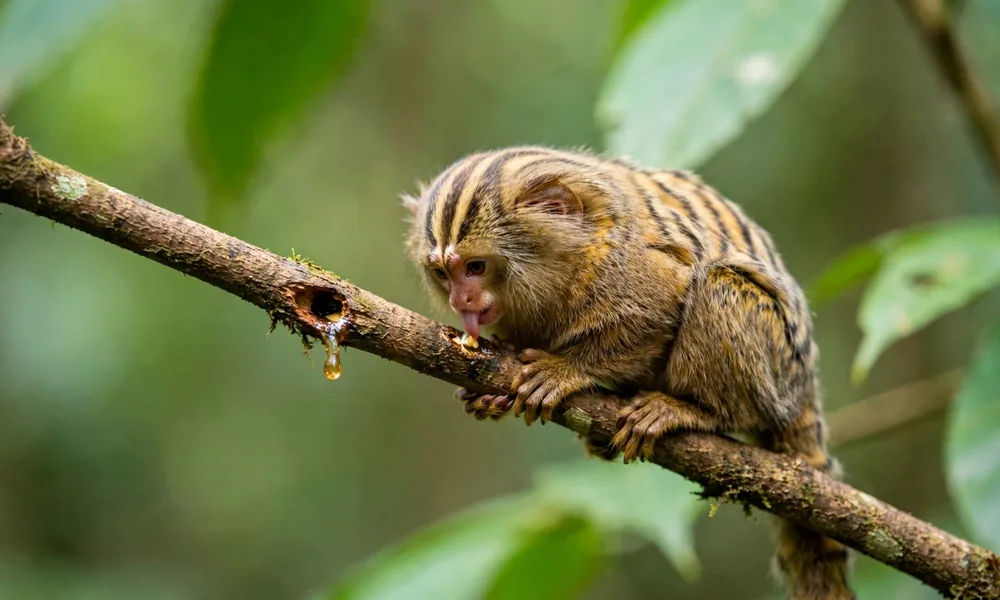
What really sets marmosets apart from other monkeys is their hands and their teeth. Instead of flat nails, marmosets have sharp, claw-like nails on most of their fingers and toes, which let them cling to tree trunks like squirrels and run up and down vertical bark. Their lower front teeth are long and chisel-shaped, and they use them to bite into bark and open gum holes, then lap up the sticky sap. Like the capuchin monkey, another clever New World monkey, a marmoset spends its day searching for food in the canopy.
The marmoset species and their relatives
Marmosets belong to the family Callitrichidae, the small New World monkeys of Central and South America, and the family also includes the tamarins. The Atlantic marmosets of the genus Callithrix live along the coast of Brazil, and the best-known is the common marmoset, Callithrix jacchus, of the dry scrub forest of north-eastern Brazil, which has spread into towns and gardens. Close relatives include the black-tufted marmoset, Callithrix penicillata, of central Brazil, and the Endangered buffy-tufted marmoset, Callithrix aurita, of the Atlantic Forest.
The Amazonian marmosets of the genus Mico live south of the Amazon River, and there are about 14 of them, including the silvery marmoset, Mico argentatus, and the tassel-ear marmoset, Mico humeralifer. The pygmy marmosets of the genus Cebuella are the smallest of all, and scientists now recognise two: the western pygmy marmoset, Cebuella pygmaea, and the eastern pygmy marmoset, Cebuella niveiventris. The last genus, Callibella, holds one species, Roosmalens’ dwarf marmoset, Callibella humilis, described only in 1998. Like the squirrel monkey, another small South American monkey, marmosets are rarely seen alone.
| Type | Animal | Where it lives | Best-known food | Length or Weight |
|---|---|---|---|---|
| Genus | Marmosets (family Callitrichidae) | South American forests, mostly Brazil | Gum, insects and fruit | About 20 cm in the body |
| Species | Common marmoset (Callithrix jacchus) | Dry scrub forest, north-eastern Brazil | Gum, insects and fruit | About 20 cm, 250 to 400 g |
| Species | Black-tufted marmoset (Callithrix penicillata) | Central Brazil | Gum, insects and fruit | About 20 cm, about 300 g |
| Species | Buffy-tufted marmoset (Callithrix aurita) | Atlantic Forest, south-eastern Brazil | Gum, insects and fruit | About 20 cm, 300 to 400 g |
| Species | Silvery marmoset (Mico argentatus) | Rainforest south of the Amazon | Gum, insects and fruit | About 20 cm, about 300 g |
| Species | Western pygmy marmoset (Cebuella pygmaea) | Western Amazon rainforest | Gum and insects | About 12 to 15 cm, 100 to 140 g |
| Species | Roosmalens’ dwarf marmoset (Callibella humilis) | Amazon rainforest of Brazil | Gum, insects and fruit | About 15 cm, about 150 g |
How marmosets live
Marmosets are gum feeders, and tree sap shapes their whole lives. A marmoset bites a hole in the bark with its long lower teeth and licks up the gum that oozes out, returning to the same holes day after day. The pygmy marmoset spends about 60 to 80 per cent of its feeding time on tree gum, and one family may centre its whole home range on just one or two productive trees. Other marmosets add insects, spiders, fruit, flowers and nectar, and the common marmoset spends about a quarter to a third of its feeding time hunting insects.
Marmosets live in family groups of 3 to 15 animals, usually a breeding pair, their offspring and sometimes a few extra adults. Only one female usually breeds, and she normally gives birth to twins after a pregnancy of about 145 days. The babies are carried everywhere by their father and older brothers and sisters, who hand them back to their mother only to feed. The young stay with the family for a year or more, learning where the gum trees are.
Marmosets are active by day, awake for about 11 to 12 hours. They feed in the morning, rest in the shade at midday, and feed again in the afternoon before settling in a tree hole or a dense tangle of branches for the night. They leap several metres between branches and chatter with chirps, trills and long calls. Marmosets breed from about 12 to 18 months old, and they can live for about 14 years in the wild and longer in captivity.
Where marmosets live
Marmosets live in the forests of South America, and most of them live in Brazil. The common marmoset lives in the dry scrub forest called caatinga in north-eastern Brazil, as well as in Atlantic Forest and in towns and gardens. The Atlantic marmosets live along Brazil’s Atlantic coast, while the Amazonian marmosets live in the rainforests south of the Amazon River, in Brazil, Peru, Bolivia and Colombia.
Each marmoset species has its own patch of forest, and many live in quite small areas. The pygmy marmoset lives in flooded and riverside forest in the western Amazon, staying close to the trees it feeds from, and its home range can be as small as half a hectare. The silvery marmoset lives in the eastern Amazon, and Roosmalens’ dwarf marmoset lives in a small area of rainforest in the Brazilian state of Amazonas. Marmosets rarely come to the ground, spending almost their whole lives in the lower and middle layers of the forest.
Most marmoset species are not yet in serious trouble, but several are. The common marmoset is listed as Least Concern, because it is widespread and has adapted well to towns and disturbed forest. The western pygmy marmoset is Vulnerable, and the buffy-tufted marmoset of the Atlantic Forest is Endangered, because its forest home has been cut to small fragments. Like the colobus monkey, another forest monkey that depends on unbroken trees, marmosets suffer when their forest is logged, and many are caught for the pet trade, sold as finger monkeys despite needing a complex diet and a family group.
Best seasons for marmoset watching
The best time to watch marmosets is in the dry season, roughly from May to September in most of Brazil, when the monkeys are active in the lower branches. Mornings are best, because the groups set out to feed soon after dawn and often return to the same gum trees, so a local guide can find them quickly.
Staying safe around marmosets
A marmoset is small and shy, and not dangerous to people, but it is a wild animal and should be watched from a distance rather than approached or touched. Never try to feed a marmoset, because human food can make it ill, and a marmoset used to being fed can become bold and bite. Stay quiet, keep a good distance, and never try to catch or hold one, especially a baby.
Marmoset watching checklist
A little preparation turns a forest walk into a real chance of seeing a marmoset family at work.
- A dry-season morning, when marmoset families set out to feed soon after dawn.
- A local guide who knows the gum trees the families return to every day.
- Quiet feet and patience, because a marmoset family will freeze or slip away at footsteps.
- Binoculars, for watching tiny monkeys high in the trees without getting close.
- A camera with a zoom lens, for close views of ear tufts and striped tails.
- A field guide to South American monkeys, for telling a common marmoset from a black-tufted marmoset.
- Long sleeves, insect repellent and water, because marmoset forests are hot and full of mosquitoes.
Frequently asked questions
How many marmoset species are there?
There are about 22 marmoset species, across four genera: Callithrix, the Atlantic marmosets; Mico, the Amazonian marmosets; Cebuella, the pygmy marmosets; and Callibella, which holds one species, Roosmalens’ dwarf marmoset.
What is the smallest marmoset?
The pygmy marmoset, also the smallest monkey in the world. An adult is only about 12 to 15 centimetres long in the body, with a tail of about 17 to 23 centimetres, and weighs only about 100 to 140 grams, less than a bar of chocolate.
What does a marmoset eat?
Marmosets eat tree gum and sap, insects, spiders, fruit, flowers and nectar. Tree gum matters most: a marmoset gouges a hole in the bark and licks up the sap, and the pygmy marmoset spends about 60 to 80 per cent of its feeding time on gum.
Do marmosets live in groups?
Yes. Marmosets live in family groups of 3 to 15 animals, usually a breeding pair, their offspring and sometimes a few extra adults. Only one female usually breeds, and she normally gives birth to twins, carried by their father and older brothers and sisters.
How is this guide different from the llama species guide?
This guide covers the marmoset, about 22 species of tiny tree-dwelling monkeys from South American forests that eat tree gum and insects, while our llama species guide covers the llama, a large domesticated camelid of the high Andes kept for wool, meat and carrying loads. Marmosets cling to tree trunks, and llamas graze on mountain grassland.
Are marmosets endangered?
It depends on the species. The common marmoset is Least Concern, because it is widespread and adapts well to towns and disturbed forest. The western pygmy marmoset is Vulnerable, and the buffy-tufted marmoset is Endangered, threatened by the loss of its Atlantic Forest home and by capture for the pet trade.
Conclusion
The marmoset species show how much variety can fit into one small group of monkeys: about 22 species across four genera, from the tiny pygmy marmoset of the Amazon to the white-tufted common marmoset of Brazil’s dry forests.
If you go looking for one, go on a dry-season morning, go quietly, and look for a family working a gum tree. Watch them gouge the bark and lick up the sap, and you will see why these small monkeys charm everyone who watches them.