The llama species is a single domesticated animal, Lama glama, bred from the wild guanaco in the Andes mountains of South America thousands of years ago. If you are asking how many llama species there are, the answer is one, and there are no wild llamas at all: every llama alive today is domestic, kept for its wool, its meat and its work as a pack animal on steep mountain trails.
Llamas are the largest South American camelids, standing 1.7 to 1.8 metres tall at the head and weighing 130 to 200 kilograms. They are calm, intelligent animals with long necks and shaggy coats that hum to each other, and they have carried loads across the high Andes for thousands of years.
Key takeaways
- There is one llama species, Lama glama, bred from the wild guanaco in the Andes of Peru about 4,000 to 5,000 years ago.
- An adult llama stands 1.7 to 1.8 metres tall at the head, 102 to 127 centimetres at the shoulder, and weighs 130 to 200 kilograms.
- Llamas carry about 25 to 30 per cent of their body weight as pack animals, and give wool, meat, and dung used as fuel and fertiliser.
- A female llama bears a single cria after about 350 days, and llamas live for 15 to 25 years, sometimes past 30.
- As a domestic species the llama has no IUCN Red List assessment, while its wild ancestor the guanaco is Least Concern.
What makes a llama a llama
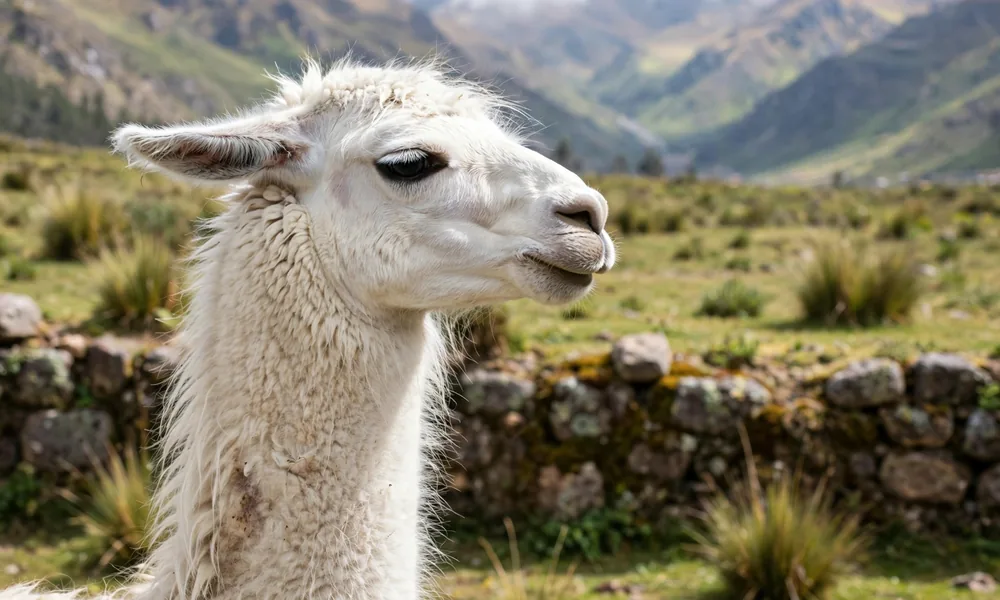
A llama is a long-necked camelid with a small head, upright spear-shaped ears, a split upper lip and a shaggy coat in white, brown, black, grey or patches. It has a three-chambered stomach and padded two-toed feet that grip rocky ground without cutting it up. Its blood carries extra haemoglobin and oval red blood cells, which help it take in oxygen in the thin air of the high Andes. Like the giraffe, it feeds at head height and above, though it eats mostly grass and low shrubs rather than tree leaves.
Llamas are best known for their wool and their work. There are two traditional types, the Qara, with short wool and a nearly bare face, and the Chaku, with long, thick wool over its whole body. A llama can carry about 25 to 30 per cent of its body weight, usually 25 to 34 kilograms, for 8 to 13 kilometres a day along mountain paths, needing no road, no fuel and very little food. Llamas spit when threatened, and hum almost constantly to each other, a soft sound that keeps a herd in touch.
The llama species and their relatives
Llamas belong to the camel family, Camelidae, and their closest relatives are the guanaco, the vicuna and the alpaca. The llama was domesticated from the guanaco, Lama guanicoe, in the highlands of Peru about 4,000 to 5,000 years ago, while the alpaca was domesticated from the vicuna for its fine fibre. The camel family began on the plains of North America about 40 million years ago, and llama ancestors reached South America about three million years ago, while cousins that headed west became the camels of Asia and Africa.
The llama is the largest of the four South American camelids, bigger than the guanaco it came from and far bigger than the alpaca, which weighs only 60 to 80 kilograms. The camel is a more distant cousin, built for deserts rather than mountains, with one hump or two and a much heavier body. All camelids share long necks, padded feet, three-chambered stomachs and the ability to live on rough, poor food in harsh country.
| Type | Animal | Where it lives | Best-known food | Size |
|---|---|---|---|---|
| Genus | Llamas and guanacos (genus Lama) | South America | Grass and shrubs | Up to 1.8 m at the head |
| Species | Llama (Lama glama) | Andes, domestic | Grass and shrubs | 130 to 200 kg |
| Relative | Guanaco (Lama guanicoe) | Wild Andes and Patagonia | Grass and shrubs | 90 to 140 kg |
| Relative | Alpaca (Vicugna pacos) | Andes, domestic | Grass and shrubs | 60 to 80 kg |
| Relative | Vicuna (Vicugna vicugna) | Wild high Andes | Coarse highland grass | 35 to 65 kg |
| Relative | Bactrian camel (Camelus bactrianus) | Central Asia | Dry shrubs | 300 to 690 kg |
| Relative | Dromedary camel (Camelus dromedarius) | North Africa and Arabia | Dry shrubs | 400 to 600 kg |
How llamas live
Llamas graze on grasses, leaves and shrubs, and need less food than a sheep or a horse of the same size, because their three-chambered stomach digests tough, poor forage very efficiently. They spend the day grazing and resting in turn, chewing the cud, and drink little water for their size. In the Andes they graze the coarse bunch grasses of the high puna, the treeless grassland above about 3,200 metres.
Llamas are social herd animals that stay in touch by humming, and males sort out rank by wrestling with their necks and spitting at each other. Males grow sharp fighting teeth and make a strange gargling sound, called orgling, when breeding. Llamas are intelligent and learn simple tasks after a few repetitions, which is why they make good pack animals and, in some countries, guard animals: a few llamas in a flock of sheep or goats will chase off dogs and foxes.
A female llama bears a single cria after about 350 days, usually in the morning, and the birth takes less than half an hour. The cria weighs 9 to 14 kilograms, stands and nurses within an hour, and is weaned at about four to six months. Females are first bred at 15 to 18 months old and males at two and a half to three years. Llamas live for 15 to 25 years, and some live past 30.
Where llamas live
Llamas live in the high Andes of Peru, Bolivia, Chile and Argentina, mostly on the Altiplano, the high plateau between 2,300 and 4,000 metres above sea level. There are about three million llamas, most of them in Bolivia and Peru, and they are also kept as farm animals and pets in North America, Europe and Australia. They are built for cold nights and thin air: Altiplano temperatures drop below freezing almost every night, and thick wool and efficient blood keep a llama warm and breathing easily.
The llama’s home is the puna, the high, dry grassland of the Andes, where the ground is rocky and the grass is coarse. Llamas share this country with alpacas, vicunas and guanacos, and with the farmers who have herded them for thousands of years. The Inca Empire kept llamas as its only beast of burden, carrying goods between mountain towns and to the silver mines, and their breeding was controlled by the state.
As a domestic species the llama has no IUCN Red List assessment of its own, and is often described as Least Concern, because there are millions of them. Its wild ancestor, the guanaco, is listed as Least Concern and still lives wild from the Andes to Patagonia. The llama’s real problem is not numbers but work: trucks and roads have taken over much of its old job, and fewer Andean families keep herds than a generation ago.
Best seasons for llama watching
The best time is the dry season, roughly May to October, when the skies are clear, the trails are open and herds graze on the Altiplano all day. The wet season, about November to April, brings rain and cloud that hide the high peaks, though the grass is greener and many crias are born then. Llamas are out in daylight, so any morning on a high trail or a farm near Cusco, La Paz or the Colca Canyon is a good time to watch them.
Staying safe around llamas
A llama is calm and gentle, but large and strong, and it will spit, kick or bite if cornered, so never walk up behind one, grab at its face, or feed it from your hand. A llama’s spit is stomach contents, unpleasant and hard to wash off, so keep your distance from one laying its ears back or raising its head. Watch from a few metres away, move slowly, and let the llama come to you if it is curious.
Llama watching checklist
A little preparation turns a high mountain walk into a real chance of seeing llamas grazing against a backdrop of snow peaks.
- A dry-season morning on the Altiplano, when llamas are out grazing in clear mountain light.
- A high trail or farm near Cusco, La Paz or the Colca Canyon.
- Warm layers and sun protection, because high mountain air is cold in the shade and fierce in the sun.
- Water and snacks, because the best llama country is high, dry and far from shops.
- Binoculars, for picking out a herd grazing on a distant slope.
- A camera, for the classic shot of a llama against snow peaks.
- Time to walk slowly and acclimatise, because the thin air at 3,500 metres tires visitors fast.
Frequently asked questions
How many llama species are there?
There is one llama species, Lama glama. It was bred from the wild guanaco in the Andes of Peru about 4,000 to 5,000 years ago, and there are no wild llamas: every llama is descended from domestic herds, while the guanaco still lives wild.
What is the difference between a llama and an alpaca?
Llamas are larger and were bred as pack animals, standing 1.7 to 1.8 metres at the head and weighing 130 to 200 kilograms, with a longer face and a coarser coat. Alpacas are smaller, at 60 to 80 kilograms, with a short, blunt face and dense, soft fleece, bred from the vicuna for fine fibre rather than for carrying loads.
What does a llama eat?
Llamas graze on grasses, leaves and shrubs, and thrive on the coarse bunch grasses of the high Andes. They need less food than a sheep or a horse of the same size, because their three-chambered stomach digests tough forage very efficiently, and they drink little water.
How much weight can a llama carry?
A llama can carry about 25 to 30 per cent of its body weight, usually 25 to 34 kilograms, for 8 to 13 kilometres a day along mountain paths. It can carry more for short distances, but herders rarely ask it to, and an overloaded llama will simply lie down and refuse to move.
How is this guide different from the kudu species guide?
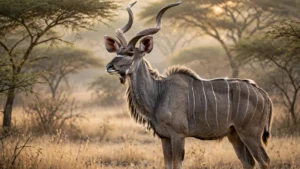
This guide covers the llama, a single domesticated camelid from the Andes that carries loads, gives wool and hums to its herd mates on cold high plateaus, while our kudu species guide covers the kudu, two species of wild spiral-horned antelopes that browse on leaves in African woodlands and vanish into the bush at the first sign of danger. Llamas work beside people, and kudus avoid them.
Are llamas endangered?
No. As a domestic species the llama has no IUCN Red List assessment, and with about three million animals, most in Bolivia and Peru, it is not at risk. Its wild ancestor, the guanaco, is Least Concern, and the vicuna, the alpaca’s wild ancestor, is also Least Concern.
Conclusion
The llama species is a story of partnership: one domesticated camelid, Lama glama, bred from the wild guanaco thousands of years ago, that still carries loads, gives wool and grazes the high grasslands of the Andes beside the people who made it.
If you go looking for one, go to the high Andes in the dry season, walk slowly in the thin air, and watch for a long neck and a shaggy coat against the snow. Stand still, let the herd hum, and you will see why the llama has been the Andes’ most trusted animal for thousands of years.