
Camel species are the ships of the desert, and there are only three living camel species in the world: the one-humped dromedary, the two-humped Bactrian camel and the two-humped wild Bactrian camel. If you are wondering which camel species exist and how camels survive in the driest places on Earth, the short answer is this: camels store fat in their humps, lose very little water, walk on wide padded feet that do not sink in sand, and can drink more than 100 litres of water in a few minutes after days without a drink.
Key takeaways
- There are only three living camel species: the dromedary, the Bactrian camel and the wild Bactrian camel.
- The dromedary has one hump, while both Bactrian camels have two humps, and the hump stores fat, not water.
- A thirsty camel can drink more than 100 litres of water in a few minutes.
- The wild Bactrian camel is the only truly wild camel, with only about 950 left in the Gobi Desert.
- Dromedaries live across North Africa and the Middle East, Bactrian camels live in Central Asia, and wild Bactrian camels survive in the Gobi.
What makes a camel a camel
A camel is a large mammal with a long curved neck, a split upper lip, two rows of eyelashes, nostrils that close against blowing sand, and one or two humps on its back. All three camel species belong to the genus Camelus, and their closest living relatives are the llamas, alpacas, guanacos and vicunas of South America, which share the same family but have no humps at all.
The hump is the camel’s most famous feature, and the most misunderstood: it does not store water, it stores fat, up to 36 kilograms in a large dromedary. The camel burns that fat for energy when food is scarce, and as the fat is used up, the hump shrinks and flops to one side.
Camels are built for sand from the feet up. Each foot has two broad toes joined by a wide, leathery pad that spreads the camel’s weight so it does not sink into soft sand. Camels walk by moving both legs on the same side together, a swaying gait called pacing, and their thick eyelashes and closable nostrils keep sand out.
Camels are also masters of saving water. They can lose up to a quarter of their body weight in water without harm, while most mammals would die after losing a tenth. When they do find water, they can drink more than 100 litres in a few minutes, replacing in one long drink what they lost over many days.
The three camel species
The dromedary, also called the Arabian camel, is the camel most people picture: a tall, sandy-coloured animal with a single hump, long legs and a short coat. Dromedaries make up about 94 percent of all the camels in the world, around 14 million animals, living across North Africa, the Middle East and South Asia. Every dromedary alive today is domesticated or descended from domesticated animals, kept for transport, milk, meat and racing. Over a million feral dromedaries also roam the Australian outback.
The Bactrian camel is the two-humped camel of Central Asia, a shorter, stockier animal with a thick shaggy coat that grows long in winter and sheds in spring. Bactrian camels live in the cold deserts of Mongolia and northern China, where winters are bitter and summers are hot. They are entirely domesticated, about 1.4 million of them, kept for transport, wool, milk and meat.
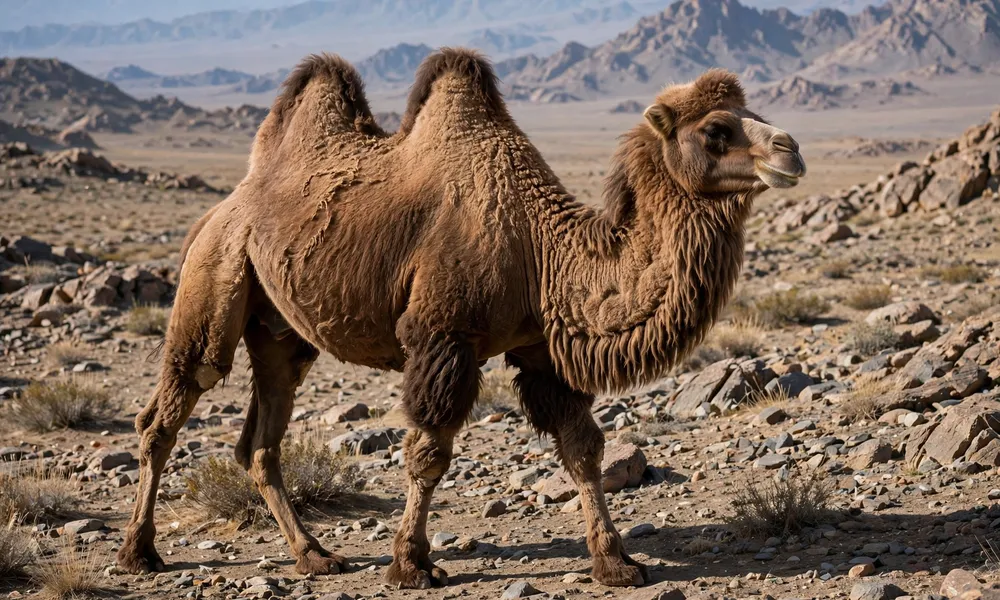
The wild Bactrian camel is the rarest of the three, a separate species from the domestic Bactrian camel, not simply a wild version of it, and it split from its domestic cousin about a million years ago. Wild Bactrian camels live only in the remote Gobi and Taklamakan deserts of north-western China and south-western Mongolia, where they survive on salt water that no other mammal could drink. Only about 950 remain, and it is listed as critically endangered.
The three species are easy to tell apart. Count the humps first: one hump means a dromedary, two humps means a Bactrian or a wild Bactrian. Dromedaries are tall and light, with short hair and long legs built for hot sand. Bactrian camels are shorter and heavier, with a thick coat for cold winters. Wild Bactrian camels are leaner, with smaller, more pointed humps.
How camels survive the desert
Their body temperature can rise and fall by several degrees through the day, so they sweat far less than other large mammals. A camel’s thick coat insulates it from the sun by day and keeps it warm at night. Dromedaries can endure air temperatures above 50 degrees Celsius, and Bactrian camels can endure winters below minus 30 degrees.
Camels eat what other animals cannot. Their split upper lip lets them pick leaves from thorny acacia branches, and their tough mouths can chew salty shrubs and dry grasses that would poison most grazers. Wild Bactrian camels in the Gobi eat salt-loving plants and drink brackish water so salty it would make a human ill. Dromedaries can go for a week or more without food, living on the fat in their humps.
A camel lives for 40 to 50 years, and a female gives birth to a single calf after a pregnancy of about 13 months, one of the longest of any land mammal. The calf can stand within hours of birth and stays with its mother for several years, learning where to find water. Among the desert animals of the Sahara and the Gobi, camels are the only large mammals that can cross the driest stretches without carrying water at all.
Where camels live
Camels live in the deserts and dry grasslands of Africa and Asia, from the Sahara in the west to the Gobi in the east. Dromedaries live across North Africa and the Middle East, and they were introduced to Australia in the nineteenth century, where their feral descendants now roam the outback. Bactrian camels live in Mongolia, northern China and Kazakhstan, in cold deserts where the winters are long and harsh.
Wild Bactrian camels live in a far smaller area than their domestic cousins, in the most remote parts of the Gobi Desert in China and Mongolia, far from roads and settlements. Their range has shrunk as mining, hunting and habitat loss have pushed them into the harshest corners of the desert. The tundra animals of the far north face cold like the Bactrian camel does, but the Bactrian camel faces it in a desert, where winter temperatures can fall below minus 30 degrees and summer temperatures can rise above 40 degrees.
Camels and people
People have kept camels for thousands of years. Dromedaries were domesticated in Arabia about 3,000 years ago, and Bactrian camels were domesticated in Central Asia around the same time. Camel caravans carried silk, spices, salt and gold across the deserts of Asia and Africa, and without camels the great trade routes of the Silk Road and the Sahara would have been impossible.
Camel racing is a much-loved sport in the Arabian Peninsula, where specially bred racing dromedaries can run at more than 60 kilometres per hour. Camel milk is a staple food in many desert communities, rich in vitamin C and lower in fat than cow’s milk, and camel wool is woven into warm clothing and tents. The mountain animals of the high passes include the Bactrian camel, which has carried traders over the mountains of Central Asia for centuries.
| Name | Type | Where it lives | Humps |
|---|---|---|---|
| Dromedary | Species | North Africa, Middle East, South Asia | One |
| Bactrian camel | Species | Central Asia | Two |
| Wild Bactrian camel | Species | Gobi Desert of China and Mongolia | Two |
| Arabian racing dromedary | Breed | Arabian Peninsula | One |
| Somali dromedary | Population | Horn of Africa | One |
| Australian feral dromedary | Population | Australian outback | One |
| Mongolian Bactrian | Population | Mongolia and northern China | Two |
| Kazakh Bactrian | Population | Kazakhstan and Central Asia | Two |
Best seasons for camel watching
Autumn and spring are the finest seasons for camel watching. In autumn, the heat of summer has eased, and camels are out grazing in the cool of the morning and evening. In spring, Bactrian camels are shedding their thick winter coats in great shaggy patches, and wildflowers are blooming after the winter rains.
Winter is best for Bactrian camels in Mongolia and northern China, when their coats are thickest and the snow shows their tracks clearly. Summer is hardest, when the midday heat drives camels into the shade.
Staying safe around camels
Camels are wild animals, and they deserve respect. Never approach a camel from behind, never walk between a mother and her calf, and never try to feed a camel by hand unless a handler tells you it is safe. Keep a respectful distance and watch with binoculars rather than walking closer.
Camel watching checklist
- Count the humps: one hump means a dromedary, two humps means a Bactrian or a wild Bactrian.
- Watch at dawn and dusk, when camels graze and the light is at its best.
- Look for wide, padded footprints in the sand, the sure sign of a camel trail.
- Carry plenty of water and sun protection: the desert is hot and dry, with almost no shade.
- Never approach a camel from behind, never walk between a mother and her calf, and keep a respectful distance.
- Leave no trace: take your rubbish home and keep to marked paths.
Frequently asked questions
How many camel species are there?
There are only three living camel species in the world: the dromedary, the Bactrian camel and the wild Bactrian camel. The table above shows those three species, plus five breeds and populations, honestly labelled. The dromedary has one hump, and both Bactrian camels have two humps.
How is this guide different from the desert animals guide?
This guide covers only the three camel species, from the dromedary of the Sahara to the wild Bactrian camel of the Gobi, and how each one survives the desert. The desert animals guide covers the whole community of animals that live in deserts, from fennec foxes and sand cats to scorpions and lizards.
Do camels store water in their humps?
No, a camel’s hump stores fat, not water. The fat can weigh up to 36 kilograms in a large dromedary, and the camel burns it for energy when food is scarce. Camels save water in other ways: they sweat very little and can drink more than 100 litres in a few minutes.
How long can a camel go without water?
A camel can go for several days without drinking, and a dromedary can survive for a week or more between drinks in cooler weather. Camels can lose up to a quarter of their body weight in water without harm.
What is the rarest camel species?
The wild Bactrian camel is the rarest camel species, with only about 950 left in the remote Gobi and Taklamakan deserts of China and Mongolia. It is the only truly wild camel in the world, and it survives on salt water that no other mammal could drink.
Where is the best place to see a wild camel?
Wild Bactrian camels are best in the protected reserves of the Gobi Desert in Mongolia and north-western China, but they are extremely shy, and visits need a permit and a local guide. Domestic dromedaries are far easier to see, in the deserts of Morocco, Egypt and Jordan, and Bactrian camels are best in Mongolia.
Conclusion
Camel species, all three of them, are the great desert travellers: dromedaries crossing the Sahara on one hump, Bactrian camels carrying loads through the cold deserts of Central Asia, and wild Bactrian camels surviving on salt water in the remote Gobi.
The next step is to pick one species and one desert — a dawn walk in the Sahara for dromedaries, or a winter trip to Mongolia for Bactrian camels.














