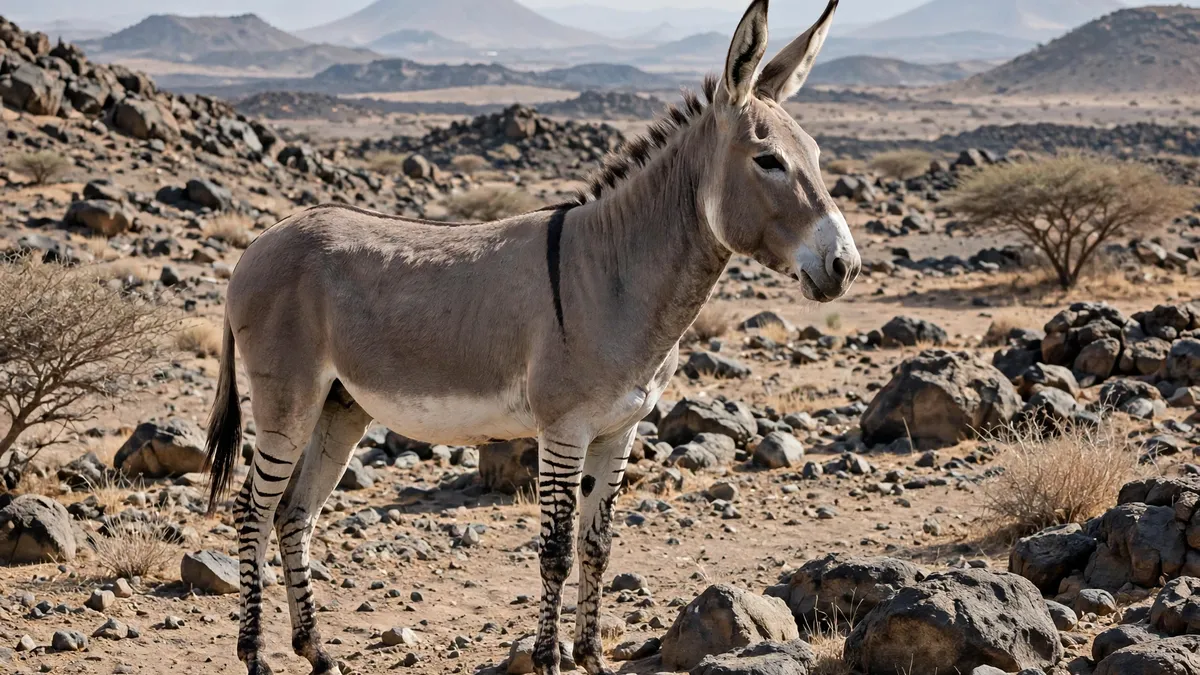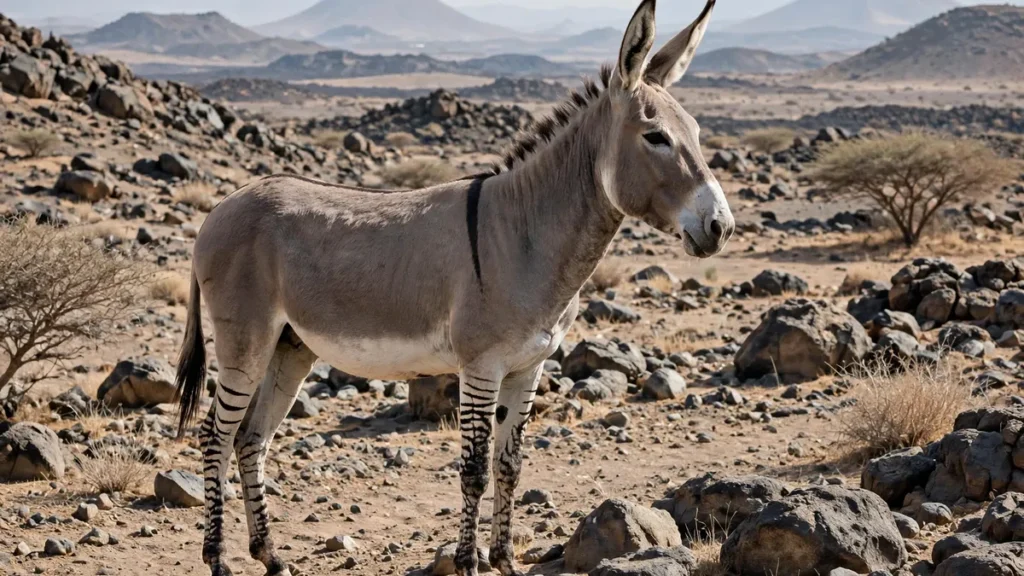
Donkey species include just one truly wild donkey, the African wild ass, and the domestic donkey, which descends from it and comes in many breeds from the Poitou to the miniature Mediterranean donkey. If you are wondering how many donkey species there are and what makes a donkey different from a horse, the short answer is this: donkeys are desert-adapted, sure-footed animals with long ears and a loud bray, built to carry loads across rocky, waterless country where a horse would struggle.
Key takeaways
- There is only one living wild donkey species, the African wild ass; every domestic donkey descends from it.
- The African wild ass is critically endangered, with only a few hundred animals left in the deserts of the Horn of Africa.
- Donkeys are desert specialists, able to go without water, eat tough thorny plants, and climb steep rocky paths.
- Donkeys carry loads, pull carts and ploughs, and their loud bray can be heard for kilometres across the desert.
- Wild asses are best seen in the Danakil Desert of Eritrea and Ethiopia, and domestic donkeys work in villages and mountains almost everywhere.
What makes a donkey a donkey
A donkey is a member of the horse family with long ears, a short upright mane, a thin tail with a tuft at the end, and a dark stripe down its back that often crosses the shoulders to form a cross. Donkeys belong to the genus Equus, like horses and zebras, but they are smaller and stockier than horses, with narrow hooves that grip rocky ground. Their long ears pick up faint sounds across open desert, and their large eyes give them a wide field of vision.
Donkeys are desert animals through and through. They can go for days without drinking, and they can eat tough, thorny plants that other grazing animals leave alone. Their digestive system squeezes more nutrition out of poor food than a horse’s does, which is why donkeys stay healthy on sparse desert scrub. Donkeys are also famously sure-footed, picking their way down steep mountain paths that would defeat a horse, and they are cautious rather than panicky, stopping to think when they meet something unfamiliar.
Donkeys are clever animals with excellent memories, and they remember the routes they walk and the people who treat them well for many years. They have good hearing and eyesight, and they can spot a threat from far away across open country. Unlike horses, which tend to flee from danger, donkeys often stand their ground, and farmers in many countries keep a donkey with a flock of sheep or goats because it will chase away dogs and coyotes.
The African wild ass: the only wild donkey
The African wild ass is the only wild donkey species in the world, a slender, grey animal about 1.2 metres at the shoulder, with a white belly, a spiky black-and-grey mane and, in the Somali subspecies, black stripes on its legs like a zebra. It lives in the deserts and other arid areas of the Horn of Africa, in Eritrea, Ethiopia and Somalia, where temperatures can reach 50 degrees and water is scarce for months at a time.
The African wild ass has two subspecies: the Somali wild ass, which still survives in small numbers, and the Nubian wild ass, which may already be extinct in the wild, with no confirmed sightings since the 1970s. The species is critically endangered, with only a few hundred animals left, making it the most threatened wild equid in the world. Wild asses live in small, loose groups, wandering widely across the desert in search of grass and water, and they are hunted for food and medicine, and pushed out by livestock competing for the same scarce grazing.
The domestic donkey and its breeds
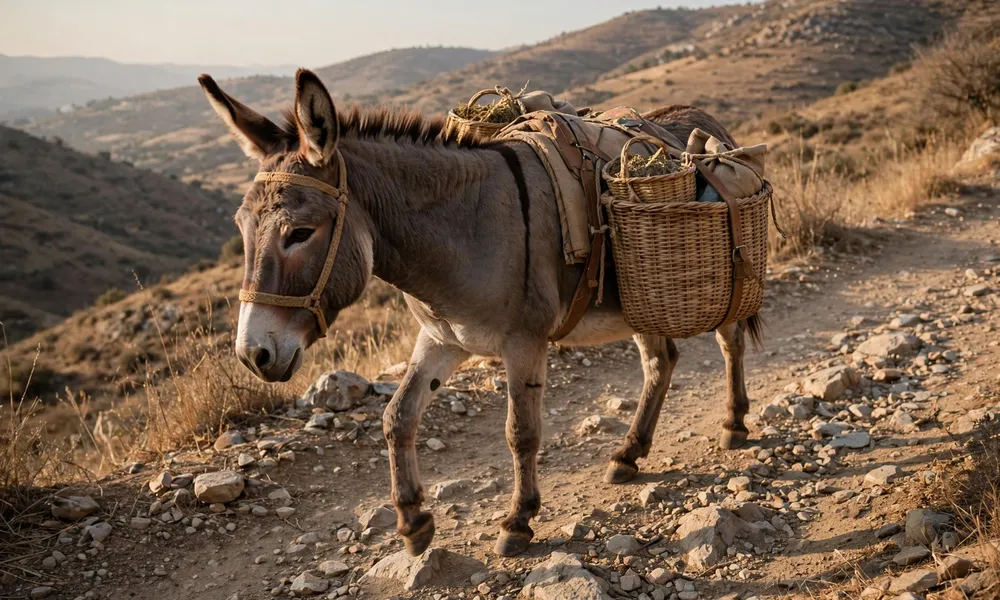
The domestic donkey was domesticated from the African wild ass around 7,000 years ago in north-east Africa, and it has since become one of the most important working animals in the world, carrying loads, pulling carts and ploughs, and working in mines and on building sites. The Poitou donkey is one of the oldest and largest breeds, a shaggy, dark-coated donkey from western France that was bred to produce strong mules. The miniature Mediterranean donkey is one of the smallest breeds, standing less than a metre at the shoulder, and is kept as a companion and a pet.
Feral burros are domestic donkeys that have gone back to living wild, most famously in the deserts of the American South-West, where they were left behind by miners and prospectors. A mule is not a donkey at all but a hybrid, the offspring of a female horse and a male donkey, prized for its strength and sure-footedness. Among the desert animals of the American South-West, feral burros share the range with coyotes and rattlesnakes, drinking at desert springs and grazing on sparse shrubs.
How donkeys live: deserts, loads and braying
Donkeys spend their days grazing on tough grasses and shrubs, and they can survive on food so poor that a horse would lose condition on it. They drink deeply when they find water, and they can go for days without it, losing up to a third of their body weight in water and recovering quickly when they drink again. Their narrow hooves and short, upright pasterns give them a sure footing on rocky ground, and they can climb steep mountain tracks carrying a load of up to a third of their own body weight.
Donkeys are social animals that live in small groups and form strong bonds with each other and with the people who care for them. They communicate with a loud, rasping bray that can be heard for kilometres, and with ear movements, tail swishes and body posture. A donkey’s bray is one of the loudest sounds any land animal makes, and in the desert it carries far across the empty country. Donkeys live for 25 to 30 years, and some reach 40, making them among the longest-lived of all working animals.
Where donkeys live
Wild African wild asses live only in the deserts of the Horn of Africa, in the Danakil Desert of Eritrea and Ethiopia and the dry country of Somalia, where few other large animals can survive. Domestic donkeys live almost everywhere people do, from the villages of Africa and Asia to the farms of Europe and the ranches of the Americas, and they are still the main transport in many mountain villages. The mountain animals of the high valleys include donkeys carrying firewood and crops up steep tracks, and the coastal animals of Mediterranean islands include donkeys that have carried loads up cliff paths for centuries. In cities, donkeys are rarer now, but they still work in markets and on building sites in many parts of the world.
| Donkey | Type | Where it lives | Height at the shoulder |
|---|---|---|---|
| African wild ass | Wild species | Deserts of the Horn of Africa | About 1.2 metres |
| Somali wild ass | Subspecies | Danakil Desert of Eritrea and Ethiopia | About 1.2 metres |
| Nubian wild ass | Subspecies | Nubian Desert, possibly extinct in the wild | About 1.2 metres |
| Domestic donkey | Domesticated | Worldwide, wherever people keep donkeys | Varies by breed |
| Poitou donkey | Breed | Western France, now worldwide | About 1.4 metres |
| Miniature Mediterranean donkey | Breed | Sardinia and Sicily, now worldwide | Under 1.0 metres |
| Feral burro | Feral population | Deserts of the American South-West | About 1.2 metres |
| Mule | Hybrid | Worldwide, wherever horses and donkeys meet | About 1.5 metres |
Best seasons for donkey watching
Winter and spring are the finest seasons for donkey watching in the desert. In winter, the desert is at its coolest, and wild asses come to waterholes in the early morning, when the light is low and the animals are easiest to spot. In spring, the desert briefly greens after the rains, and the asses graze in the open, sometimes with foals at foot.
Summer is the hardest season in the Horn of Africa, when temperatures climb above 45 degrees and the wild asses retreat to the shade of rocky hills by day. Autumn is also a good time, when the heat eases and the donkeys are out grazing in the cooler hours. Domestic donkeys are best seen all year round in mountain villages, where they carry loads along the tracks at dawn and dusk.
Staying safe around donkeys
Donkeys are gentle animals, but they are strong, and they deserve respect. Never approach a donkey you do not know, never stand directly behind one, and never feed a donkey without its owner’s permission. Watch wild asses with binoculars or from a vehicle rather than walking closer: a disturbed animal may flee and abandon its young, so the best view is always the distant one. Keep dogs on a lead near donkeys, and stay on marked paths.
Donkey watching checklist
- Look for wild asses at desert waterholes in the early morning.
- Watch for the Somali wild ass’s zebra-striped legs in the Danakil Desert.
- Listen for a donkey’s bray carrying across the desert at dawn.
- Scan mountain tracks for donkeys carrying loads at dawn and dusk.
- Never approach a donkey, never stand behind one, and keep dogs on a lead.
- Leave no trace: take your rubbish home and keep to marked paths.
Frequently asked questions
How many donkey species are there?
There is only one living wild donkey species, the African wild ass. The domestic donkey descends from it, and it comes in many breeds. The table above shows eight of the best-known: the African wild ass, the Somali wild ass, the Nubian wild ass, the domestic donkey, the Poitou donkey, the miniature Mediterranean donkey, the feral burro and the mule.
How is this guide different from the mountain animals guide?
This guide covers only donkeys, from the critically endangered African wild ass to the Poitou donkey and the mule. The mountain animals guide covers the whole community of animals that live in the mountains, from ibex and eagles to marmots and snow leopards.
What is the difference between a donkey and a mule?
A donkey is a domesticated animal descended from the African wild ass, while a mule is a hybrid, the offspring of a female horse and a male donkey. Mules are stronger and more sure-footed than either parent, but they are almost always sterile and cannot breed.
Why are donkeys so good in deserts?
Donkeys can go for days without water, eat tough thorny plants, and squeeze more nutrition out of poor food than a horse can. Their narrow hooves grip rocky ground, and their long ears and cautious nature help them survive in harsh, waterless country.
Are African wild asses really critically endangered?
Yes, the African wild ass is critically endangered, with only a few hundred animals left in the wild, making it the most threatened wild equid in the world. The Nubian subspecies may already be extinct in the wild, and the surviving Somali wild ass is threatened by hunting and competition with livestock.
Where is the best place to see a wild ass?
Wild asses are best in the Danakil Desert of Eritrea and Ethiopia, at waterholes in the early morning in winter and spring. Seeing one takes patience, a local guide and a good pair of binoculars, because the animals are shy and range widely across the desert.
Conclusion
Donkey species, in the strict sense, number just one wild donkey, the African wild ass, alongside the domestic donkey and its many breeds: Poitou donkeys bred for strength, miniature Mediterranean donkeys kept as companions, feral burros running free in the American South-West, and mules carrying loads up mountain tracks.
The next step is to pick one donkey and one season — a winter morning at a desert waterhole, a spring afternoon in a mountain village, or a summer evening listening for a bray across the hills — and plan your visit around it.