Mountain animals are the creatures that live on high slopes and peaks, from the ibex and the mountain goat to the golden eagle, the marmot and the snow leopard. If you are wondering how wildlife survives at altitude, the short answer is this: through thick fur, large lungs, strong legs, and habits shaped by thin air, bitter cold, steep ground and short summers.
This guide covers the best-known mountain animals, grouped by the way they make a living on the slopes. Whether you need the list for a quiz, for school or simply out of curiosity, the animals below are the ones that matter most, and they show how life adapts to one of the hardest places on earth.
Key takeaways
- Mountain animals include ibex, mountain goats, eagles, marmots, snow leopards, chamois and ptarmigan.
- Thin air, cold and steep ground shape every mountain animal, from its lungs to its feet.
- Many mountain animals migrate up and down the slope with the seasons, following the snow line.
- The snow leopard is the most elusive mountain predator, and the golden eagle is the master of mountain skies.
- Mountain animals are sensitive to a warming climate, because their cold habitat is shrinking from below.
Climbers of the high slopes
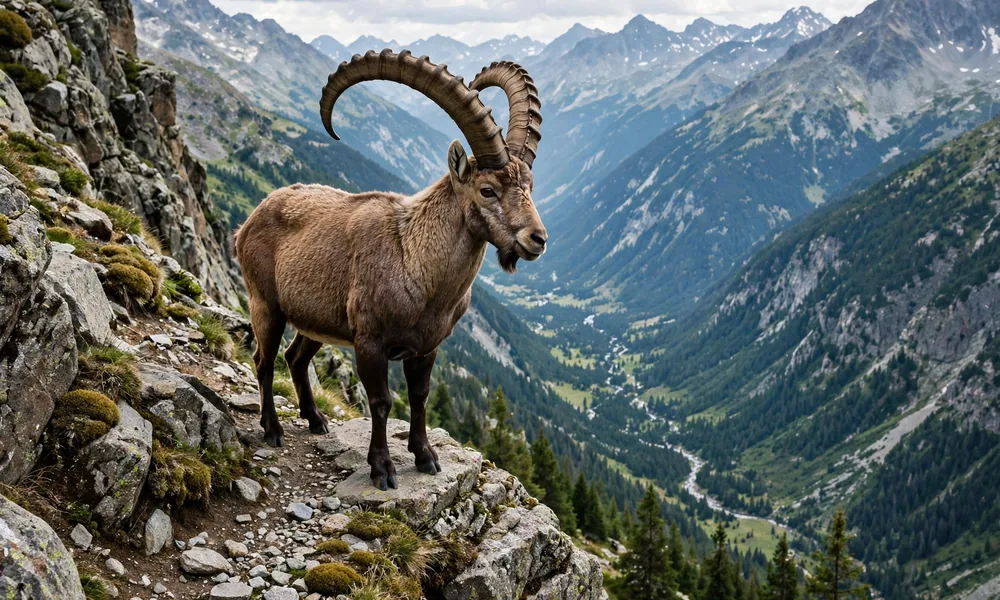
The Alpine ibex is the great climber of the European mountains. It has short, powerful legs and cloven hooves with rough, grippy soles, and it can climb near-vertical rock faces that would defeat most animals. Males carry huge, curved horns, which they use in contests with other males, clashing them together with a crack that echoes across the valley. Ibex live above the tree line in summer, grazing on alpine grasses and herbs, and they move lower in winter, when the high slopes are buried in snow.
The mountain goat of North America is a similar specialist, though it is not a true goat at all. Its white coat blends with the snow, and its hooves have rough pads that grip rock like climbing shoes. It lives on the steepest cliffs, where predators cannot follow, and it eats grasses, herbs and shrubs, even licking rocks for the salt and minerals it needs. The chamois, a smaller relative of the goat-antelope family, is famous for its speed on rock, leaping from ledge to ledge with an ease that looks effortless.
In the Himalayas, the markhor carries horns that spiral like a corkscrew. Like the forest animals of the valleys below, these climbers depend on quiet ground, and they are most at home where people rarely go.
Predators of the peaks
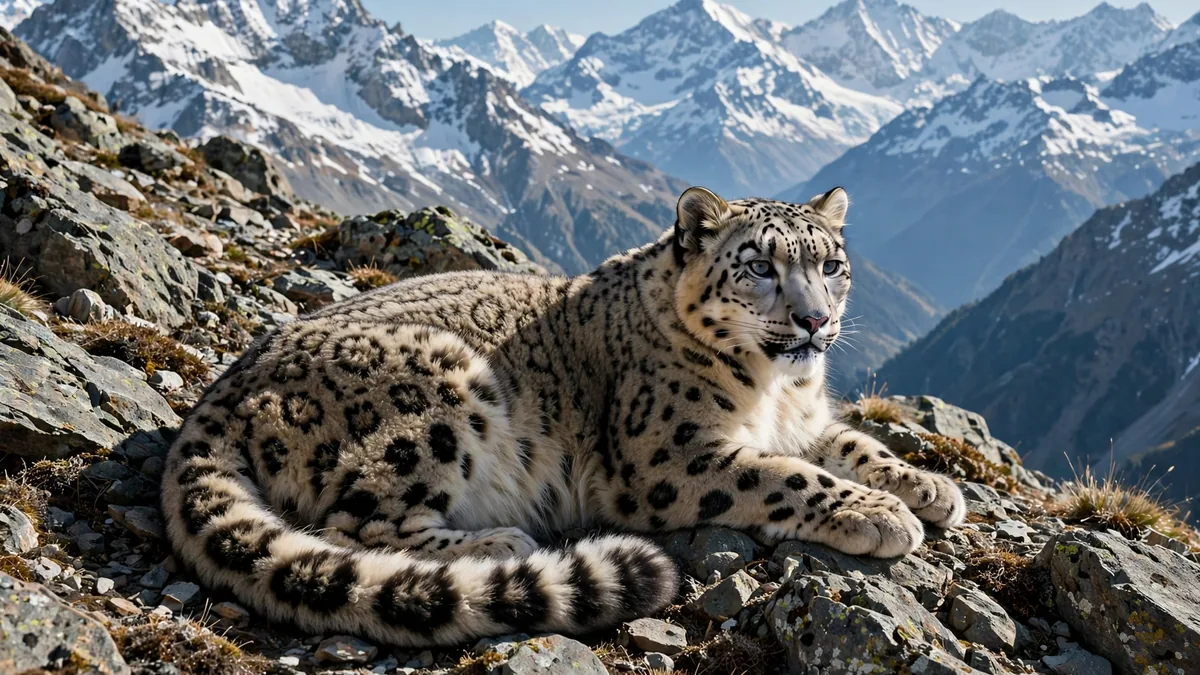
The snow leopard is the most elusive predator of the mountains, and one of the hardest animals on earth to see in the wild. It lives in the high ranges of Central Asia, its thick, smoky-grey coat patterned with dark rosettes, and its long tail, which it wraps around itself like a scarf when it rests. The snow leopard hunts wild sheep and goats, leaping across gaps between rocks and ambushing prey from above, and it can take animals much larger than itself. It is rarely seen, and it avoids people, which is one reason it has survived in such harsh country.
The puma, or mountain lion, is the great cat of the Americas, and it ranges from the high Andes to the Rocky Mountains. It is a powerful, solitary hunter, taking deer and smaller animals, and it can leap great distances, both up and down steep slopes. The lynx, which also lives in the mountains of Europe, is a smaller cat, with tufted ears and a short tail, and it hunts hares and roe deer in the forests and rocky slopes below the peaks.
The wolverine is a fierce scavenger of the northern mountains, and the grey wolf hunts there in packs, taking deer and wild sheep. Mountain predators are few, and each needs a large territory, because prey is thin on the high slopes.
Birds of the high mountains
The golden eagle is the master of mountain skies. It soars on broad wings over ridges and valleys, watching the ground below with eyesight far sharper than ours, and it dives at great speed to take hares, marmots and other prey. Golden eagles pair for life, and they return to the same nest, or eyrie, year after year, adding to it until it becomes a huge structure of sticks on a cliff ledge. They are found across the mountains of Europe, Asia and North America.
The bearded vulture, or lammergeier, is a strange and spectacular mountain bird. It feeds on bones, dropping them from a height onto rocks to crack them open, then swallowing the pieces whole. Its wings are huge, and its rusty-orange chest comes from iron-rich mud, which it rubs into its feathers. The alpine chough is a smaller, cleverer bird, a black crow with a yellow beak that follows walkers and climbers in the hope of food, and it is famous for its acrobatics in mountain winds.
The ptarmigan is a grouse that changes with the seasons: brown and mottled in summer, pure white in winter, with feathered feet that act like snowshoes. It lives above the tree line, feeding on buds, leaves and berries, and it digs into the snow to shelter from storms.
Small animals of the slopes
The marmot is the most familiar small animal of the high mountains. It is a large ground squirrel, and it spends the summer eating alpine grasses and flowers, growing fat for the long winter. Marmots hibernate for months, in burrows deep underground, and their sleep is one of the longest of any mammal. They live in family groups, and they whistle loudly to warn each other of eagles and other predators, which is why walkers often hear them before they see them.
The pika is a small, round-eared relative of the rabbit, and it lives among the boulder fields of high mountains. It does not hibernate, so it spends the summer cutting grass and flowers and piling them into haystacks under the rocks, drying them for the winter. The pika is famously sensitive to heat, and it is one of the animals most watched by scientists studying a warming climate, because it cannot move higher when the slopes below grow too warm.
How mountain animals survive the cold
Cold is the great challenge of mountain life, and every mountain animal has its own answer. Thick fur is the first line of defence: the snow leopard, the ibex and the mountain goat all grow dense winter coats, and the ptarmigan grows feathers down to its toes. Fat is the second: marmots and bears put on weight through the summer, and they live off that fat through the long winter, when food is buried under snow.
Hibernation is the most dramatic answer of all. Marmots sleep for months, their heart rate and body temperature falling to a fraction of their waking levels, and they wake only in spring, when the snow melts and the grass returns. Bears hibernate too, in dens dug into slopes or hollowed from rock, and they give birth to their cubs while they sleep. Not every animal hibernates: the ibex, the chamois and the ptarmigan stay active all winter, digging through the snow for food and sheltering in the lee of rocks and trees.
Mountain animals and people
People have always lived in the mountains, herding, hunting and climbing. The ibex was once hunted almost to extinction in the Alps, and its recovery through protection and reintroduction is one of the great conservation stories of Europe. The snow leopard is still under pressure, from the loss of its prey and from conflict with herders.
Tourism brings both help and harm. Walkers and climbers bring money to mountain communities, and that money can pay for protection, but disturbance can drive animals from their feeding grounds, especially in winter, when every calorie counts. Like the Norway animals of the high fells, mountain animals need quiet ground, and the best way to see them is from a distance, with binoculars, and without approaching.
The warming climate is the greatest long-term threat. As temperatures rise, the snow line moves higher, and the cold habitat that mountain animals depend on shrinks from below. The pika, the ptarmigan and the snow leopard have nowhere higher to go, and scientists watch them closely, because they are among the first animals to show the effects of a changing climate.
| Animal | Type | Where it lives | Best-known fact |
|---|---|---|---|
| Alpine ibex | Mammal | European Alps | Climbs near-vertical rock |
| Snow leopard | Mammal | Mountains of Central Asia | Most elusive mountain predator |
| Golden eagle | Bird | Mountains worldwide | Soars and dives at great speed |
| Marmot | Mammal | European and Asian mountains | Hibernates for months |
| Mountain goat | Mammal | Rocky Mountains, North America | White coat, grips cliffs |
| Bearded vulture | Bird | Mountains of Europe, Asia, Africa | Eats bones, drops them to crack |
| Ptarmigan | Bird | Arctic and alpine tundra | Turns white in winter |
| Pika | Mammal | High mountains of Asia and America | Builds haystacks for winter |
Mountain animals checklist
- Start with the climbers: ibex, mountain goat, chamois and markhor.
- Remember the predators: snow leopard, puma, lynx and wolverine.
- Do not forget the birds: golden eagle, bearded vulture, ptarmigan and alpine chough.
- Add the small ones: marmot, pika, mountain hare and stoat.
- Check the adaptations: thick fur, large lungs, grippy hooves and seasonal colour change.
- Use this guide for quizzes, school projects and mountain trips, and add your own favourites.
Frequently asked questions
What is the most famous mountain animal?
The snow leopard is probably the most famous, because it is so elusive and so beautiful, and because it lives in some of the highest mountains on earth. The Alpine ibex and the golden eagle are also famous, and the marmot is the most familiar to walkers.
How do mountain animals survive the cold?
They use thick fur, fat stores, hibernation and shelter. Marmots and bears sleep through the winter, while ibex, chamois and ptarmigan stay active, digging through the snow for food and sheltering from the wind.
What is the highest-living mammal?
The pika lives at very high altitudes, and the snow leopard hunts at heights where few other large predators can follow. The yak, a domesticated animal of the Himalayas, also lives at great heights, carrying loads across high passes.
Do mountain goats really climb cliffs?
Yes. Mountain goats live on the steepest cliffs, where predators cannot follow, and their hooves have rough pads that grip rock. They are among the best climbers of any hoofed animal, and they can move confidently across near-vertical ground.
Why is the snow leopard so hard to see?
The snow leopard is solitary, shy and superbly camouflaged, and it lives in remote, rugged country at high altitude. It avoids people, hunts mostly at dawn and dusk, and its range is huge, so even researchers can spend weeks in its habitat without a sighting.
What do mountain animals eat in winter?
They eat what they can find under the snow: dried grasses, bark, buds and lichens. Marmots and bears avoid the problem by hibernating, while ptarmigan dig through the snow for buds, and ibex move lower, where the snow is thinner and food is easier to reach.
Conclusion
Mountain animals are specialists, shaped by thin air, cold and steep ground into some of the toughest creatures on earth. Pick a favourite, learn its story, and the next mountain you climb will feel alive.
If this guide has sparked your interest, the next step is simple: take binoculars on your next mountain walk, keep your distance, and watch the slopes — the ibex, the eagle and the marmot are there, even when they are hard to see.