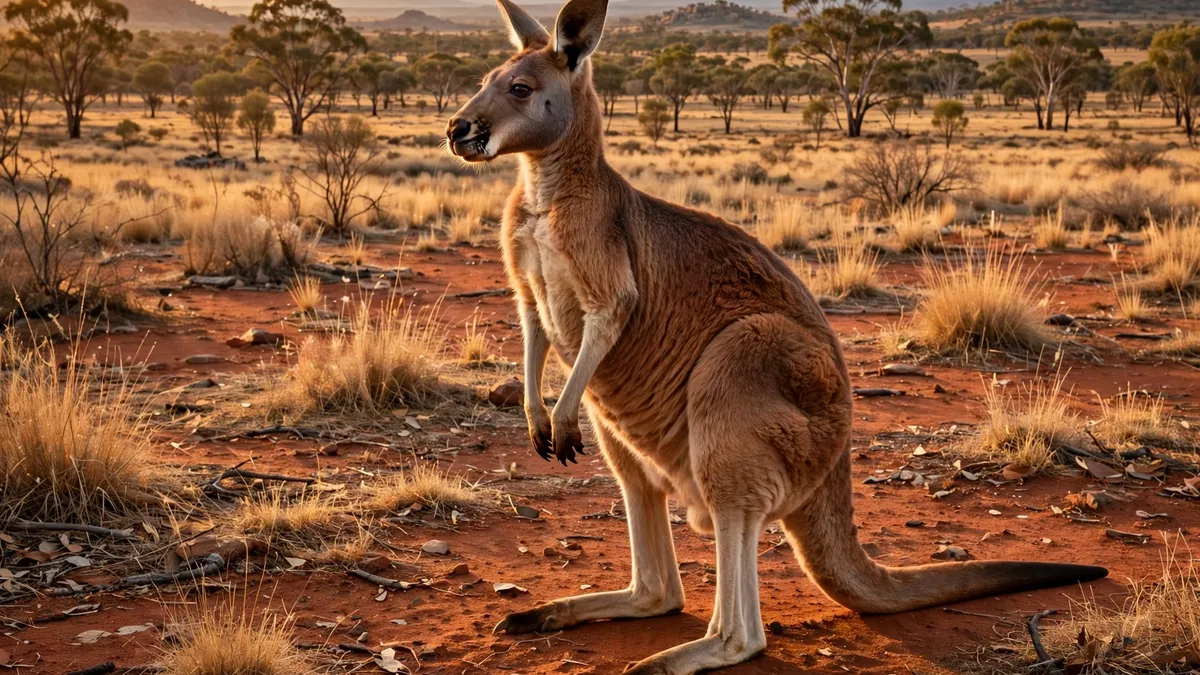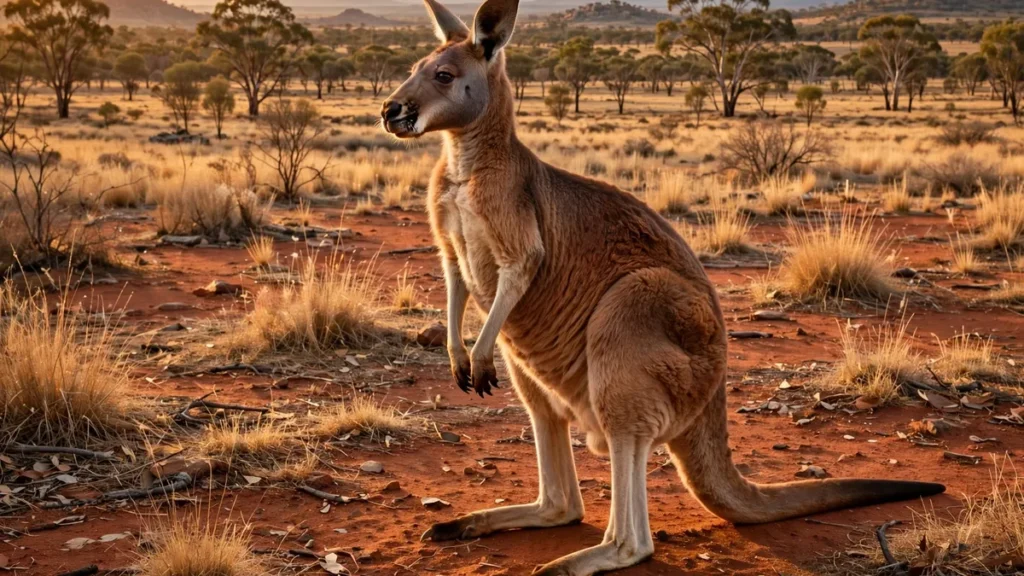
Kangaroo species are the great hoppers of Australia, and there are only four true kangaroo species in the world: the red kangaroo, the eastern grey kangaroo, the western grey kangaroo and the antilopine kangaroo. If you are wondering which kangaroo species exist and what makes a kangaroo different from a wallaby, the short answer is this: true kangaroos are the four largest members of the macropod family, hopping across open grassland on huge hind legs and raising their joeys in a pouch.
Key takeaways
- There are only four true kangaroo species: red, eastern grey, western grey and antilopine kangaroos.
- Wallabies, wallaroos and pademelons are close relatives, but they are not true kangaroos.
- The red kangaroo is the largest marsupial in the world, and it can hop at more than 60 kilometres per hour.
- Joeys are born tiny, about the size of a jelly bean, and grow up in the pouch for months.
- Kangaroos are herbivores that graze at dawn and dusk, and they live only in Australia and New Guinea.
What makes a kangaroo a kangaroo
A kangaroo is a large marsupial with huge hind legs, long hind feet, a powerful tail and small forelegs, built for hopping across open country. All four kangaroo species belong to the macropod family, which means “big foot”, a family of about 60 species that also includes wallabies, wallaroos and tree-kangaroos.
Hopping is the kangaroo’s great trick, and it is one of the most efficient ways to move on Earth. A kangaroo’s long elastic tendons work like springs, storing energy when the animal lands and releasing it on the next bound. A kangaroo can cover nine metres in a single bound, and a red kangaroo in full flight can reach more than 60 kilometres per hour.
The tail is the third leg of a kangaroo. When a kangaroo moves slowly, it uses its tail as a prop, planting it on the ground and swinging its hind legs forward past it, a movement scientists call pentapedal walking. When it hops, the tail swings as a counterbalance.
Kangaroos are marsupials, which means their young are born very early and finish growing in a pouch. A newborn joey is blind, hairless and no bigger than a jelly bean, and it climbs unaided into its mother’s pouch, where it stays for months. It first peeks out after a few months, then leaves the pouch for good at about a year old.
The four kangaroo species
The red kangaroo is the largest kangaroo species, and the largest marsupial in the world. A big male, called a boomer, can stand two metres tall and weigh 90 kilograms, with a rich red coat and pale underparts. Red kangaroos live in the arid centre of Australia, where they can go for long periods without drinking, getting most of their water from the plants they eat.
The eastern grey kangaroo is the kangaroo most people see first. It is the most common and widespread of the four, living across the fertile eastern part of Australia, from Cape York in Queensland down to Victoria and Tasmania. Eastern greys are grey-brown, a little smaller than red kangaroos, and they are often seen in large mobs on golf courses and in national parks.
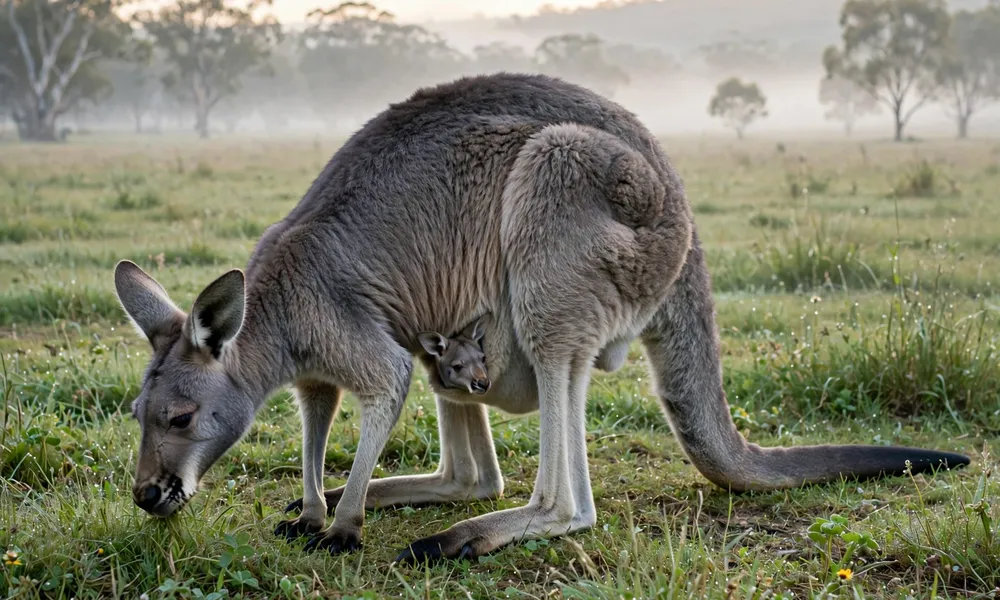
The western grey kangaroo lives in southern Australia, in Western Australia, South Australia and the Murray-Darling basin, in open woodland, scrub and mallee. It looks much like the eastern grey, but it is slightly smaller and darker. Western greys are quieter and more cautious, and they often feed in small groups under cover.
The antilopine kangaroo is the kangaroo of the tropical north, living in the savannas and open woodlands of northern Queensland, the Northern Territory and the Kimberley. It is sometimes called the antilopine wallaroo, but in its habits it is a true kangaroo, grazing in open grassland in mobs. Antilopine kangaroos are reddish on top and pale below, and males are much larger and redder than females.
The four species are easy to tell apart by where you see them. In the dry red centre, a big red kangaroo is almost certainly a red. In the fertile east, a grey kangaroo on a golf course is an eastern grey. In the south, a darker grey kangaroo in the scrub is a western grey. In the tropical north, a kangaroo in the tall grass is an antilopine.
How kangaroos hop, graze and raise joeys
Kangaroos are herbivores, grazing on grasses, shrubs, leaves and herbs. They are most active at dawn and dusk, when the heat of the day has eased. In the middle of the day they rest in the shade. Red kangaroos in the outback can go for months without drinking, getting their water from the plants they eat.
Kangaroos live in groups called mobs, which can range from a handful of animals to more than a hundred. A mob is usually led by a dominant male, and males fight for rank by standing upright and boxing with their forelimbs, balancing on their tails and kicking with their powerful hind feet. Females with joeys stay close together, and the whole mob watches for danger, with one animal often acting as a lookout.
Breeding can happen at any time of year when food is plentiful, and a female kangaroo can have three young at three different stages at once: an older joey at foot, a younger joey in the pouch, and an embryo waiting in the womb. This is called embryonic diapause, and it means the female can pause the embryo’s development until the pouch is free. A joey stays in the pouch for six to eight months, then leaves for good at about a year old. Among the forest animals of Australia, kangaroos are the only large mammals that raise their young in a pouch.
Where kangaroos live
Kangaroos live only in Australia and New Guinea, in almost every habitat on the Australian mainland, from the tropical savannas of the north to the cool forests of Tasmania. Red kangaroos live in the arid centre, eastern greys live in the fertile east, western greys live in the south, and antilopine kangaroos live in the tropical north.
The open grasslands and savannas are the kangaroo’s home, but they also live in woodland and scrub. Eastern grey kangaroos are common on the edges of towns and cities, grazing on lawns and golf courses. The desert animals of the Australian outback include the red kangaroo, which thrives in country so dry that most large mammals could not survive there, and the coastal animals of the eastern seaboard include the eastern grey kangaroo, grazing on the grassy dunes behind the beaches.
Kangaroos and people
Kangaroos are the symbol of Australia, appearing on the national coat of arms, on coins and on road signs across the country. They are one of the first animals visitors hope to see, and they are a common sight in national parks and on country roads. Kangaroos have lived alongside Aboriginal peoples for tens of thousands of years.
Kangaroos are not endangered, with tens of millions across Australia, though numbers rise and fall with drought and rain. They are hunted for meat and leather, and sometimes culled where their numbers damage crops. Road collisions are a real danger to kangaroos and to drivers, especially at dawn and dusk.
| Name | Type | Where it lives | Size |
|---|---|---|---|
| Red kangaroo | True kangaroo | Arid centre of Australia | Up to 2 metres, 90 kg |
| Eastern grey kangaroo | True kangaroo | Eastern Australia and Tasmania | Up to 1.8 metres, 66 kg |
| Western grey kangaroo | True kangaroo | Southern Australia | Up to 1.7 metres, 54 kg |
| Antilopine kangaroo | True kangaroo | Tropical north of Australia | Up to 1.8 metres, 70 kg |
| Common wallaroo | Close relative | Rocky hills across Australia | Up to 1.6 metres, 47 kg |
| Red-necked wallaby | Close relative | Eastern Australia and Tasmania | Up to 1 metre, 27 kg |
| Swamp wallaby | Close relative | Eastern Australia | Up to 1 metre, 20 kg |
| Quokka | Close relative | South-west Western Australia | Up to 0.6 metres, 5 kg |
Best seasons for kangaroo watching
Autumn and spring are the finest seasons for kangaroo watching. In autumn, the heat of summer has eased, the grass is green after the rains, and kangaroos are out grazing in large mobs. In spring, the year’s joeys are beginning to peek out of their mothers’ pouches.
Summer can also be good, but the midday heat drives kangaroos into the shade, so the best watching is at dawn and dusk. Winter is the best season in the tropical north, when the dry season brings clear skies and kangaroos gather around the remaining waterholes.
Staying safe around kangaroos
Kangaroos are wild animals, and they deserve respect. Never approach a kangaroo, never try to touch one, and never feed one by hand, because a kangaroo that expects food can become aggressive. A large male can stand two metres tall and kick with great force, so keep a respectful distance and watch with binoculars. Never walk between a mother and her joey, and keep dogs on a lead.
Kangaroo watching checklist
- Watch at dawn and dusk, when kangaroos graze and the light is at its best.
- Look for mobs in open grassland, on golf courses and on the edges of national parks.
- Check the pouch: a joey’s head or feet peeking out is a sure sign of a mother.
- Watch for the lookout: one kangaroo standing upright while the rest graze.
- Never approach a kangaroo, never feed one, and keep dogs on a lead.
- Leave no trace: take your rubbish home and keep to marked paths.
Frequently asked questions
How many kangaroo species are there?
There are only four true kangaroo species: the red kangaroo, the eastern grey kangaroo, the western grey kangaroo and the antilopine kangaroo. The table above shows those four species, plus four close relatives, honestly labelled. Wallabies, wallaroos and pademelons are close relatives, but they are not true kangaroos.
How is this guide different from the forest animals guide?
This guide covers only the four true kangaroo species and their close relatives, from the red kangaroo of the outback to the antilopine kangaroo of the tropical north. The forest animals guide covers the whole community of animals that live in forests, from deer and owls to bears and squirrels.
What is the largest kangaroo species?
The red kangaroo is the largest kangaroo species, and the largest marsupial in the world. A big male can stand two metres tall and weigh 90 kilograms, and it can hop at more than 60 kilometres per hour.
How long does a joey stay in the pouch?
A joey stays in its mother’s pouch for six to eight months. It first peeks out after a few months, then leaves the pouch for short trips, and finally leaves for good at about a year old.
Are wallabies kangaroos?
No, wallabies are not true kangaroos, though they are close relatives in the same macropod family. Kangaroos are the four largest members of the family, while wallabies are smaller, usually less than a metre tall, and live in denser scrub and forest.
Where is the best place to see a kangaroo?
Kangaroos are best at dawn and dusk in the national parks and open grasslands of Australia. Eastern greys are easy to see around Canberra and Sydney, red kangaroos are best in the outback of central Australia, and antilopine kangaroos are best in the savannas of the north.
Conclusion
Kangaroo species, all four of them, are the great hoppers of Australia: red kangaroos bounding across the red centre, eastern greys grazing in the east, western greys in the scrub of the south, and antilopine kangaroos in the tall grass of the tropical north.
The next step is to pick one species and one place — a dawn walk in a national park for eastern greys, or a trip into the outback for red kangaroos.