The atlantic halibut species is a single fish, Hippoglossus hippoglossus, and it is the largest flatfish in the world, a huge, flat, bottom-dwelling fish of the cold North Atlantic that can reach 4.7 metres long and weigh 320 kilograms. If you are asking how many atlantic halibut species there are, the answer is one: there is a single atlantic halibut species, Hippoglossus hippoglossus, one of only two true halibut, living on the seabed from Labrador and Greenland to Iceland, the Barents Sea and as far south as the Bay of Biscay and Virginia.
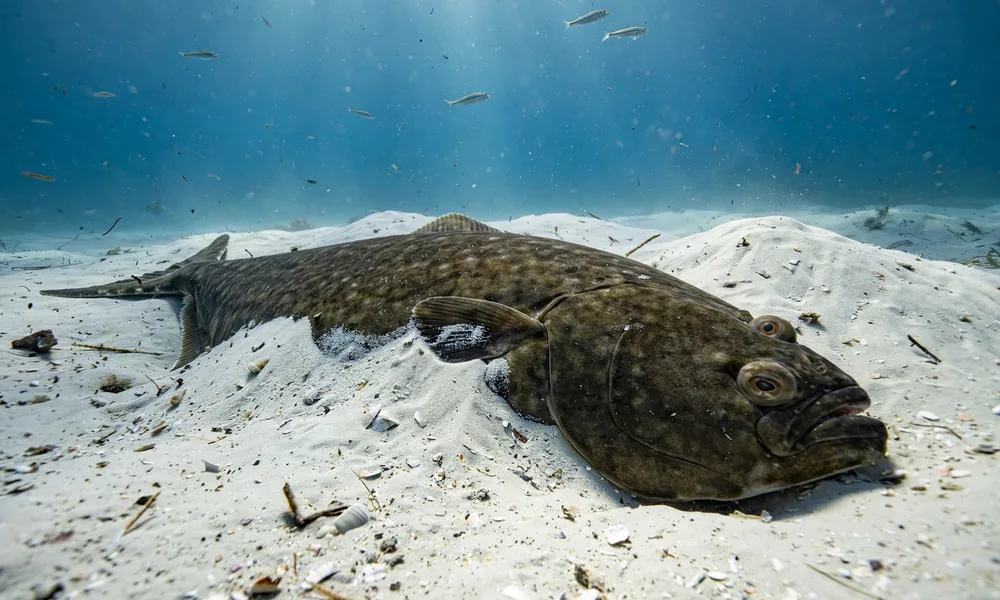
An Atlantic halibut seems to have been pressed flat. It lies on its left side on sand, gravel or clay, with both eyes on the right side of its head and its dark upper side blending into the seabed. It waits, half buried, for prey to swim within reach, and it can also rise into open water and migrate long distances.
Key takeaways
- There is one atlantic halibut species, Hippoglossus hippoglossus, one of only two true halibut in the genus Hippoglossus.
- Atlantic halibut are the largest flatfish in the world, reaching up to 4.7 metres and 320 kilograms.
- Atlantic halibut are right-eyed flatfish: they lie on their left side, with both eyes on the right side of the head.
- They live on the seabed of the cold North Atlantic at 50 to 2,000 metres, feeding mainly on cod, haddock, herring and capelin.
- Atlantic halibut are listed as Near Threatened, because they grow slowly, mature late and were heavily overfished.
What makes an Atlantic halibut an Atlantic halibut
An Atlantic halibut is unmistakable once you know what to look for: a very large, elongated, diamond-shaped flatfish with a wide mouth full of sharp, curved teeth, a concave tail fin and a lateral line that arches strongly over the pectoral fin. The upper side is dark chocolate, olive or slate, sometimes almost black, while the blind underside is white. Young fish are paler and more mottled, which helps them hide on the shallow seabed.
The most remarkable feature is the eyes. A halibut is born with one eye on each side of its head, but as it grows one eye migrates across the snout to join the other, so the adult has both eyes on the right side. The Atlantic halibut lies on its left side, with its dark, eyed side facing up and its white, blind side facing down. Unlike the great white shark, a fast open-water hunter, the halibut is built for stillness, with a flattened body and colouring that makes it almost invisible against sand and gravel.
The Atlantic halibut species and their relatives
There is one atlantic halibut species, Hippoglossus hippoglossus, and it belongs to the family Pleuronectidae, the righteye flounders, a large family of flatfish that mostly carry their eyes and colour on the right side of the body. Its closest relative is the Pacific halibut, Hippoglossus stenolepis, the only other true halibut, which lives in the North Pacific and looks almost identical; the two are best told apart by where they live.
Other fish called halibut are more distant cousins. The Greenland halibut, also called the Greenland turbot, is in the same family but a different genus and is almost the same colour on both sides. The California halibut is a lefteye flounder from the eastern Pacific that can carry its eyes on either side. Most other flatfish are far smaller: the European flounder reaches only about 50 centimetres.
| Type | Animal | Where it lives | Best-known food | Length or Weight |
|---|---|---|---|---|
| Family | Righteye flounders (family Pleuronectidae) | Cold seas of the northern hemisphere | Fish, crustaceans and molluscs | About 20 cm to 4.7 m long |
| Species | Atlantic halibut (Hippoglossus hippoglossus) | North Atlantic, from Labrador to the Bay of Biscay | Cod, haddock, herring and capelin | Up to 4.7 m long and 320 kg |
| Species | Pacific halibut (Hippoglossus stenolepis) | North Pacific, from California to Japan | Cod, pollock, herring and squid | Up to about 2.7 m long and 363 kg |
| Species | Greenland halibut (Reinhardtius hippoglossoides) | Arctic and near-Arctic Atlantic and Pacific | Fish, squid and crustaceans | About 1.3 m long and up to 44 kg |
| Species | California halibut (Paralichthys californicus) | Eastern Pacific, from Washington to Baja California | Anchovies, squid and small fish | About 1.5 m long and up to 33 kg |
| Species | European flounder (Platichthys flesus) | European coasts, estuaries and rivers | Worms, shrimps and small fish | About 50 cm long |
How Atlantic halibut live
Atlantic halibut eat mainly other fish. Adults hunt cod, haddock, herring, sand eels and capelin, and also take squid and large crustaceans. Young halibut eat plankton, then krill and small fish, before switching to fish as they grow. They are ambush hunters, lying motionless and half buried on the seabed until prey swims within reach, then striking with a sudden lunge of the wide mouth.
Males reach maturity at about seven to eight years old and females at ten to eleven, and individuals can live for up to 50 years. Females are much larger than males: adult males average only about 10 to 15 kilograms, while large females can reach 250 kilograms or more. Spawning takes place in deep water, between December and April, at depths of 300 to 700 metres and temperatures of 5 to 7 degrees Celsius. Females are batch spawners, and a large female can produce from half a million to seven million eggs in one season.
The young begin life near the surface. Eggs hatch after two to three weeks into larvae about 6.5 millimetres long, which drift and feed on plankton. At about 80 days old the left eye begins to migrate across the head, and at around 4 centimetres long the young fish settle to the bottom. Young halibut between two and four years old live close to shore in shallow nursery grounds, then move into deeper water as they grow.
Where Atlantic halibut live
Atlantic halibut live in the temperate and Arctic waters of the northern Atlantic, from Labrador and Greenland to Iceland, the Barents Sea and as far south as the Bay of Biscay and Virginia. In the west they range from Labrador to Virginia, and in the east from Iceland and the United Kingdom to northern Europe and Russia. They live on the ocean floor at 50 to 2,000 metres, on sand, gravel or clay, though most are found between 100 and 700 metres, in water of about 3 to 8 degrees Celsius.
Halibut are demersal fish, which means they live on or near the bottom, but they are not tied to one spot. Like salmon, Atlantic halibut migrate across hundreds of kilometres between shallow coastal nurseries, deep feeding grounds and deep offshore spawning areas, and young fish stay close to shore for their first years.
Atlantic halibut are listed as Near Threatened, because they were heavily overfished in the past and their slow growth and late maturity make them slow to recover. Rated Endangered in 1996, its status has since improved to Near Threatened, but numbers remain below historic levels in many areas. Seals eat halibut, and they are a staple food of the Greenland shark. Today catch limits, closed areas and minimum sizes protect enough fish to spawn.
Best seasons for Atlantic halibut watching
Atlantic halibut are not a fish most people will ever see alive, because they live on the deep seabed far offshore, but the best chance comes in summer, from June to September, when the seas of northern Norway and Iceland are calmest and boat trips run to the fishing grounds. Anglers fishing deep in Norwegian fjords sometimes see a large fish at the surface beside the boat before it is released. Public aquariums in Norway and Iceland sometimes keep young halibut, offering the closest view of the fish.
Staying safe around Atlantic halibut
An Atlantic halibut is not dangerous to a swimmer or a diver, because it lives far below the surface and avoids people, but a large halibut brought to a boat is a powerful animal. A fish of 100 kilograms or more can thrash violently, and its wide mouth holds sharp, curved teeth, so anglers should keep hands clear of the mouth and follow local rules on releasing large fish. Never handle a halibut in the water, and never dive alone in cold northern seas.
Atlantic halibut watching checklist
Seeing an Atlantic halibut takes planning and a boat that can reach deep water, so prepare for a northern summer day on the sea.
- A boat trip in northern Norway or Iceland in June to September.
- Warm, waterproof clothing and sea boots, for a long day on cold water.
- A visit to a public aquarium in Norway or Iceland, for a close view of a young halibut.
- Binoculars and a camera, for seabirds and seals on the same northern coasts.
- A local fishing guide, who knows the deep grounds where halibut feed.
- Knowledge of local catch and release rules, so a large fish can be returned safely.
- Patience, because halibut live deep and unseen, and a sighting is never guaranteed.
Frequently asked questions
How many atlantic halibut species are there?
There is one atlantic halibut species, Hippoglossus hippoglossus. It is one of only two true halibut, the other being the Pacific halibut of the North Pacific.
How big can an Atlantic halibut get?
Atlantic halibut can reach up to 4.7 metres long and 320 kilograms, making them the largest flatfish in the world. Most adults are 1 to 2 metres long, and the largest are almost always old females.
What does an Atlantic halibut eat?
Atlantic halibut eat mainly other fish, including cod, haddock, herring, sand eels and capelin, and they also take squid, large crustaceans and other bottom-living animals. Young halibut feed on plankton, then krill and small fish, before switching to fish.
Why do Atlantic halibut have both eyes on one side of their head?
Atlantic halibut are born with one eye on each side of the head, but during metamorphosis the left eye migrates across the snout to the right side. The adult then lies on its left side, with both eyes on the upper, dark side.
How is this guide different from the atlantic cod species guide?
This guide covers the Atlantic halibut, a single flatfish species that lies on the seabed, hunts other fish by ambush and can reach 4.7 metres long, while our atlantic cod species guide covers the Atlantic cod, a round-bodied fish that swims in mid-water and in shoals and is itself one of the halibut’s favourite prey.
Are Atlantic halibut endangered?
No, not at present. Atlantic halibut are listed as Near Threatened, after being rated as Endangered in 1996. They were heavily overfished because they grow slowly and mature late, so careful catch limits remain important.
Conclusion
The atlantic halibut species shows how strange life on the seabed can be: a single species, Hippoglossus hippoglossus, that begins life as an ordinary upright fish, turns itself sideways, and grows into the largest flatfish in the world.
If you go looking for one, go north in summer, by boat over deep sand and gravel, with a guide who knows the grounds. Watch the water beside the boat for the wide, flat shape rising from the deep, and remember that the giant you hope to see may be fifty years old.