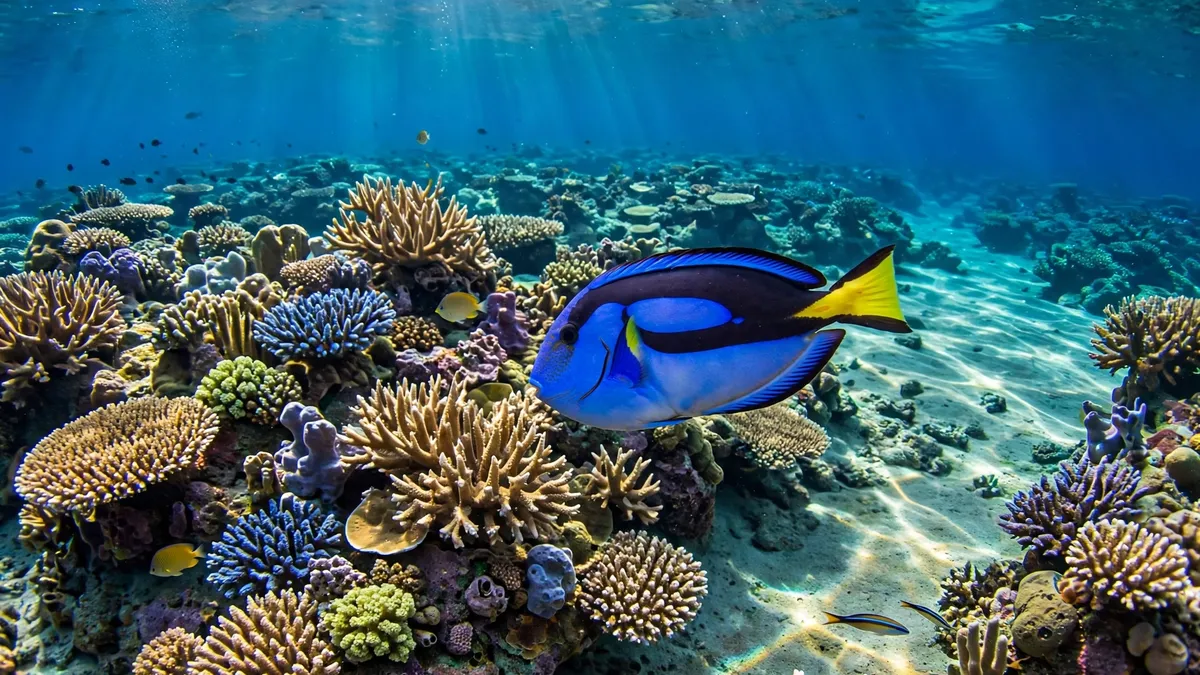
The blue tang species is a single fish, Paracanthurus hepatus, and it is one of the most recognisable fish on any coral reef, a flat, round-bodied fish in royal blue with a black palette-shaped marking and a bright yellow tail. If you are asking how many blue tang species there are, the answer is one: there is a single blue tang species, Paracanthurus hepatus, also called the regal tang and the palette surgeonfish, and it is the only species in its genus, living on clear coral reefs across the tropical Indo-Pacific.
Most people meet the blue tang as Dory, the forgetful fish from the films Finding Nemo and Finding Dory, but the real fish is far more interesting. A young blue tang is bright yellow with blue spots near its eyes, and only turns royal blue as it grows, flushing deeper blue and violet when stressed. It is also armed: a blue tang carries a razor-sharp, venomous spine on each side of its tail, which it can raise and slash at a predator.
Key takeaways
- There is one blue tang species, Paracanthurus hepatus, the only species in the genus Paracanthurus.
- Blue tangs grow to about 30 centimetres long, weigh around 600 grams, and live on reefs across the Indo-Pacific.
- Juvenile blue tangs are bright yellow and eat plankton, while adults are royal blue and graze mainly on algae.
- Blue tangs carry a sharp, venomous spine on each side of the tail base, which they use to defend themselves.
- Blue tangs are listed as Least Concern by the IUCN, though they are heavily caught for the aquarium trade and need healthy coral reefs to survive.
What makes a blue tang a blue tang
An adult blue tang is unmistakable: a deep, flat, almost circular body in royal blue, a broad black area across the back that loops down to enclose a blue oval on each flank, and a bright yellow tail. The fins are edged in dark blue and the snout is pointed. The fish is thin from side to side, like a pancake, which lets it slip into narrow cracks in the coral when a predator approaches, and it has nine spines in its dorsal fin and three in its anal fin.
The colour is not paint but light. Tiny crystals in special cells called iridophores bounce blue light back from the skin, which is why a blue tang seems to glow in clear water and why its blue deepens to violet when stressed. At the base of the tail, on each side, sits a scalpel-sharp spine in a shallow groove, tipped with venom that causes sharp pain to anything it stabs. Like stingrays, which also carry a venomous tail spine, a blue tang is a fish to admire from a respectful distance and never to grab.
The blue tang species and their relatives
There is one blue tang species, Paracanthurus hepatus, and it stands alone in its genus Paracanthurus, a genus created for this fish alone after it was first described in 1766. Its closest relatives are the sailfin tangs of the genus Zebrasoma, inside the surgeonfish family Acanthuridae, a family of about 80 reef species that all share the same weapon: sharp spines on the tail base, like a surgeon’s scalpel, which gives the family its name.
The wider surgeonfish family is full of colour and variety. The yellow tang of Hawaii is bright yellow all over and grazes algae on shallow reefs, the sailfin tangs carry a tall dorsal fin they can raise like a sail, and the Atlantic blue tang Acanthurus coeruleus is a separate species often confused with the Indo-Pacific blue tang because it shares the same common name and a similar blue colour. The two blue tangs live on opposite sides of the world and never meet in the wild.
| Type | Animal | Where it lives | Best-known food | Length or Weight |
|---|---|---|---|---|
| Family | Surgeonfish (family Acanthuridae) | Tropical reefs of the Atlantic, Indian and Pacific Oceans | Algae and plankton | About 15 to 40 cm long |
| Species | Blue tang (Paracanthurus hepatus) | Reefs of the Indo-Pacific | Algae and plankton | About 30 cm long |
| Species | Atlantic blue tang (Acanthurus coeruleus) | Reefs of the tropical Atlantic | Algae | About 39 cm long |
| Species | Yellow tang (Zebrasoma flavescens) | Reefs of Hawaii and the Pacific | Filamentous algae | About 20 cm long |
| Species | Sailfin tang (Zebrasoma veliferum) | Reefs of the Indo-Pacific | Algae and seaweed | About 40 cm long |
| Species | Convict surgeonfish (Acanthurus triostegus) | Reefs of the Indo-Pacific | Algae and detritus | About 26 cm long |
How blue tangs live
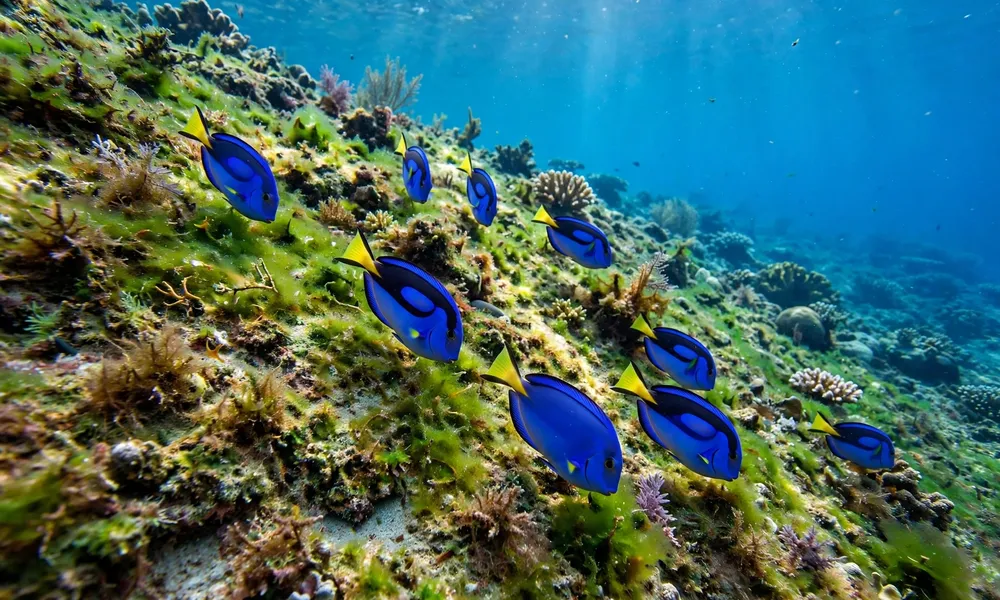
Blue tangs eat differently at different ages. Juveniles hide among coral heads and feed mainly on plankton drifting past in the current, while adults spend the daylight hours grazing on algae, nipping filamentous seaweed and turf algae from dead coral and reef rock with small, close-set teeth. Their grazing matters: by keeping fast-growing algae in check, blue tangs stop it from smothering the corals that build the reef.
Blue tangs live alone, in pairs, or in small groups of about 8 to 14 fish, and they are fast swimmers that dart between coral heads at the first sign of danger. When threatened they wedge themselves into branching coral, and if a predator persists they raise the spines on either side of the tail and whip their bodies from side to side, slashing at whatever comes close. Groupers, tuna and barracuda still eat them.
Breeding happens in groups, usually in the late afternoon and evening. Blue tangs are broadcast spawners: males and females release eggs and sperm into the water at the same time, and fertilisation happens in the open sea. The eggs are tiny, less than a millimetre across, and hatch within about a day, and the larvae drift with the plankton for several weeks before settling onto a reef. Fish reach maturity at about 9 to 12 months old, and they can live up to 30 years in the wild.
Where blue tangs live
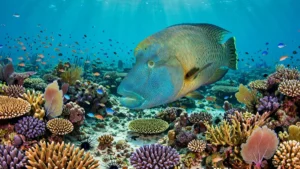
Blue tangs live on clear, current-swept coral reefs across the tropical Indo-Pacific, from East Africa and the Maldives east through Indonesia, the Philippines and southern Japan to the Great Barrier Reef of Australia, New Caledonia and Samoa. They are found on outer reef slopes, channels and reef flats, usually between 2 and 40 metres deep, where the current brings plankton and fresh algae.
The reef is not just where a blue tang lives; it is what a blue tang needs. Without branching coral to hide in and dead coral rock to graze on, the fish cannot feed or shelter, and that is why the fate of the blue tang is tied to the fate of coral reefs. Climate change threatens those reefs in two ways: warming water bleaches the coral, and more acidic water weakens the skeletons the corals build. Like clownfish, which also depend on a healthy reef and its anemones, a blue tang is only as secure as the reef it lives on.
Blue tangs are listed as Least Concern by the IUCN, because they are widespread and still common, but the listing hides a real worry. Until 2016 nobody knew how to breed blue tangs in captivity, so every blue tang sold for aquariums was caught in the wild, and the trade still takes large numbers, many caught with squirt bottles of cyanide that stun the fish and damage the reef. The United States alone imports about 100,000 blue tangs a year, almost all from Indonesia and the Philippines.
Best seasons for blue tang watching
The best time to see blue tangs is the dry season, when the water is clearest — April to October on the Great Barrier Reef, and May to September in Indonesia and the Philippines. Dive or snorkel on a clear outer reef slope in the late morning, when the fish are grazing, and look for the flash of royal blue and yellow above the coral. Juveniles are easiest to find close to coral heads in shallow water.
Staying safe around blue tangs
A blue tang is not aggressive towards people, but its tail spines are sharp, venomous and painful, so never try to catch, hold or corner one. Give a blue tang space on the reef and keep your hands away from coral crevices where one may be hiding. If you are stung, the pain can be severe and the wound needs cleaning and medical attention. Never eat a blue tang, because of the risk of ciguatera poisoning.
Blue tang watching checklist
A little preparation turns a morning on a coral reef into a real chance of seeing blue tangs grazing and flashing their royal blue and yellow colours in clear water.
- A mask, snorkel and fins for watching blue tangs on a clear outer reef slope.
- A dry-season visit, when the water is clearest — roughly April to October on the Great Barrier Reef.
- A late-morning dive or snorkel, when the fish are out grazing on algae in the open.
- Sharp eyes for a flash of royal blue and yellow above the coral, the easiest way to spot a blue tang.
- A look close to coral heads in shallow water, where bright yellow juveniles hover and pick plankton.
- A respectful distance from the fish, because a blue tang carries sharp, venomous tail spines.
- A reef fish guide, for telling the Indo-Pacific blue tang from the Atlantic blue tang.
Frequently asked questions
How many blue tang species are there?
There is one blue tang species, Paracanthurus hepatus, the only species in the genus Paracanthurus. It shares the common name blue tang with the Atlantic blue tang Acanthurus coeruleus, a separate species on the other side of the world.
Why are baby blue tangs yellow?
Juvenile blue tangs are bright yellow with blue spots near their eyes, and they turn royal blue as they grow and join the adults on the open reef.
What do blue tangs eat?
Juvenile blue tangs eat mainly plankton, while adults graze mainly on algae, nipping filamentous seaweed and turf algae from coral and rock with small, sharp teeth. Their grazing helps keep algae from overgrowing the corals.
Are blue tangs dangerous?
Blue tangs are not aggressive, but they carry a razor-sharp, venomous spine on each side of the tail base, which they raise and slash at predators when threatened. The sting is painful, so a blue tang should never be handled, and it should never be eaten, because it can carry toxins that cause ciguatera poisoning.
How is this guide different from the betta fish species guide?
This guide covers the blue tang, a single saltwater species that lives on coral reefs across the Indo-Pacific, grazes on algae and carries venomous tail spines, while our betta fish species guide covers the betta fish, a genus of 78 small freshwater species from the rice paddies of Southeast Asia, whose best-known member breathes air and builds a bubble nest. Blue tangs swim in clear tropical seas, and bettas live in ankle-deep water.
Are blue tangs endangered?
No. Blue tangs are listed as Least Concern by the IUCN, because they are widespread and still common on many reefs. They are under pressure from the aquarium trade and from the loss of coral reefs to warming and acidifying seas.
Conclusion
The blue tang species shows how much can rest on a single fish: one species, Paracanthurus hepatus, alone in its genus, grazing the algae that would otherwise smother a coral reef and flashing royal blue and yellow in clear water.
If you go looking for one, go to a clear outer reef in the dry season, go in the late morning, and watch for that flash of blue. Watch the fish graze and wedge itself into the coral, and you will understand why keeping its reef alive matters more than any single fish.