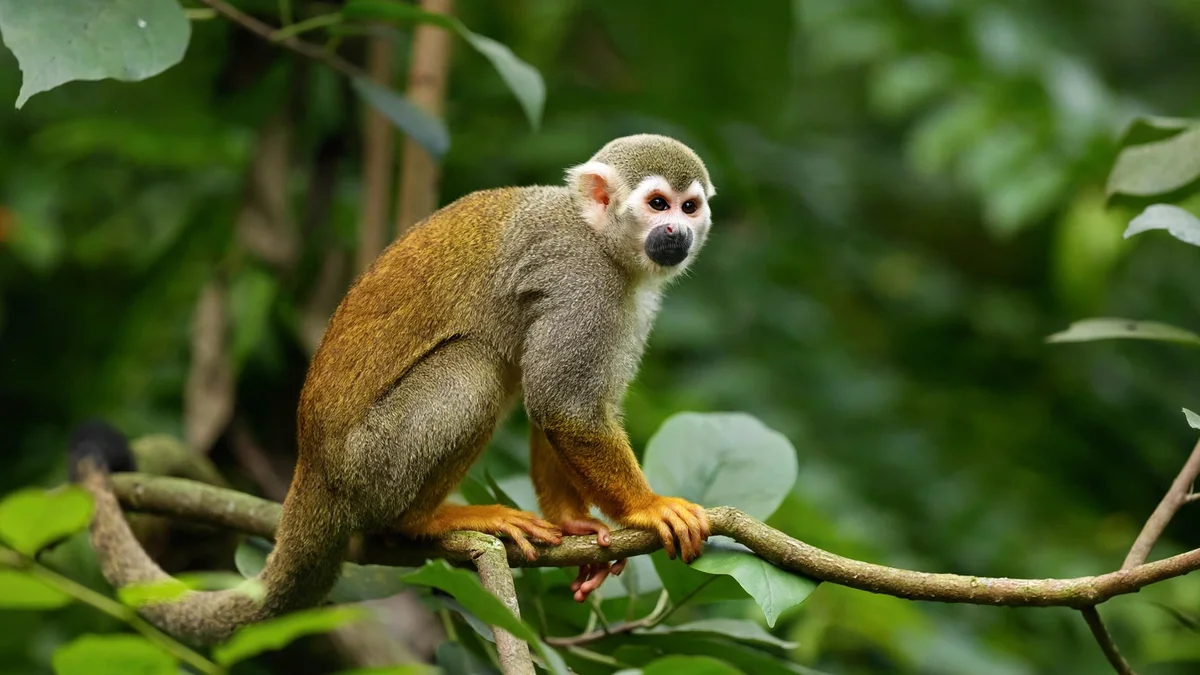
The squirrel monkey species number five in the widely used classification, small monkeys of the Central and South American rainforests, and some of the most social primates on Earth. If you are asking how many squirrel monkey species there are, the answer is five in the classification most guides use, the common, Bolivian, bare-eared, Central American and black squirrel monkeys, though newer taxonomies split the group into seven, and every squirrel monkey alive today belongs to one of them.
The squirrel monkey belongs to the family Cebidae, the capuchin and squirrel monkey family, and it lives in the rainforests of Central and South America, from Costa Rica to Brazil and Bolivia. Its small size, its white face mask, its orange limbs and its huge troops make it one of the most recognisable monkeys of the rainforest.
Key takeaways
- There are five widely recognised squirrel monkey species, and newer taxonomies split the group into seven.
- Squirrel monkeys live in troops of up to 500 animals, among the largest monkey troops in the world.
- Squirrel monkeys have the largest brain of any primate relative to body size, and they are famously clever and curious.
- Squirrel monkeys are daytime animals that spend almost their whole lives in the trees, rarely coming to the ground.
- Two squirrel monkey species are listed as Vulnerable, and the Central American squirrel monkey is listed as Endangered.
What makes a squirrel monkey a squirrel monkey
A squirrel monkey is a small monkey with olive-grey fur, a white face mask, a black muzzle, orange-yellow arms and legs, and a long non-gripping tail, and it measures roughly 25 to 35 centimetres long, with a tail of 35 to 42 centimetres, and usually weighs between 500 grammes and 1.1 kilogrammes. Males are larger than females, and they grow noticeably heavier in the breeding season, a change called fatting.
The face defines the squirrel monkey: a white mask around large dark eyes, with a black muzzle, which gives it the German name death’s-head monkey. Its brain is the largest of any primate relative to body size, and it is a famously clever and curious animal, learning quickly and exploring everything it can reach. Like other monkeys, the squirrel monkey has a long tail for balance, but the tail cannot grip branches, so the monkey moves by leaping through the canopy instead of swinging.
The squirrel monkey species and their relatives
There are five widely recognised squirrel monkey species. The common squirrel monkey lives in the rainforests of the Guianas and northern Brazil, and it is the best-known squirrel monkey, kept in zoos around the world. The black-capped squirrel monkey lives in Bolivia, Peru and western Brazil, the bare-eared squirrel monkey lives south of the Amazon, the Central American squirrel monkey lives only in Costa Rica and Panama, and the black squirrel monkey lives in a small area of central Brazil where the Japura river meets the Amazon.
The capuchin monkey is the squirrel monkey’s closest relative, a clever monkey that uses stone tools, while the howler monkey is a loud monkey of the same forests whose roar can be heard for kilometres. The spider monkey is a long-limbed monkey with a gripping tail, the tamarin is a tiny monkey with a lion-like mane, and the marmoset is a tiny monkey that gouges trees for gum. The owl monkey is the only monkey that is active at night, and the titi monkey is a small monkey that pairs for life.
| Type | Animal | Where it lives | Best-known food | Length or Weight |
|---|---|---|---|---|
| Species | Common squirrel monkey (Saimiri sciureus) | Guianas and northern Brazil | Fruit, insects and flowers | 25 to 35 cm, 0.5 to 1.1 kg |
| Close relative | Black-capped squirrel monkey | Bolivia, Peru and western Brazil | Fruit, insects and nectar | 25 to 37 cm, 0.6 to 1.2 kg |
| Close relative | Bare-eared squirrel monkey | South of the Amazon | Fruit, insects and flowers | 25 to 37 cm, 0.6 to 1.2 kg |
| Close relative | Central American squirrel monkey | Costa Rica and Panama | Fruit, insects and nectar | 25 to 32 cm, 0.6 to 1 kg |
| Close relative | Black squirrel monkey | Central Brazil, Japura river | Fruit, insects and flowers | 25 to 35 cm, 0.6 to 1 kg |
| Close relative | Capuchin monkey | Central and South American forests | Fruit, nuts and insects | 33 to 56 cm, 1.4 to 4.8 kg |
| Close relative | Spider monkey | Central and South American forests | Fruit, leaves and flowers | 55 to 65 cm, 6 to 9 kg |
How squirrel monkeys live
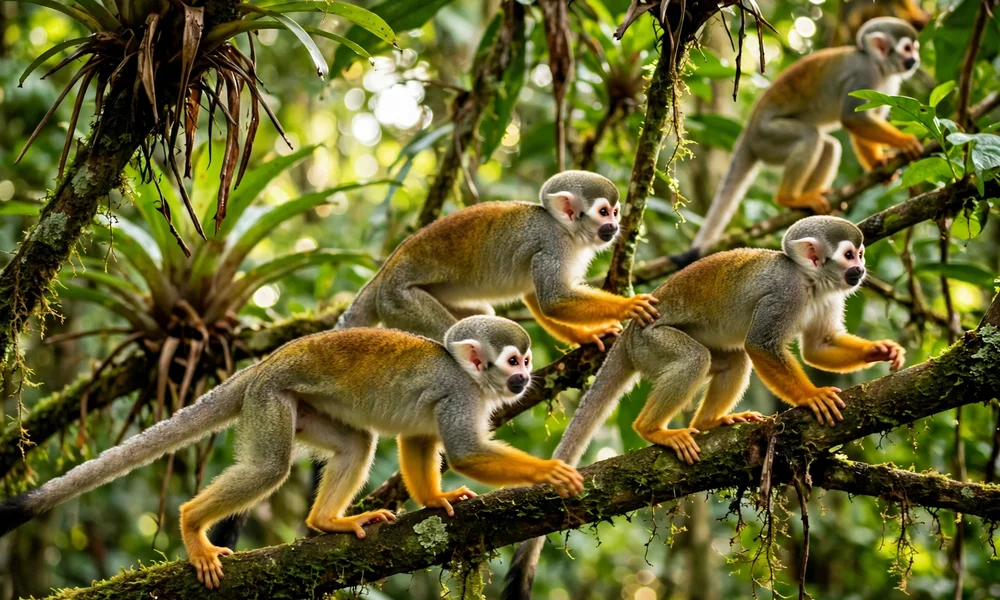
Squirrel monkeys are creatures of the rainforest canopy. A squirrel monkey lives in a troop, a group of 20 to 50 animals that feed, rest and travel together, and troops join into huge gatherings of up to 500 animals when fruit is plentiful. Like other South American animals, it follows the fruiting seasons, moving through the forest as different trees come into fruit.
Fruit makes up most of the diet, along with insects, flowers, nectar, leaves and the occasional small frog or lizard, and a squirrel monkey eats by picking fruit with its hands and snatching insects from leaves. It hunts insects by sight, moving quickly through the branches and catching grasshoppers and caterpillars, and it drinks by licking dew from leaves, rarely coming down to the ground to drink.
Breeding happens once a year, in the dry season, when food is plentiful, and after a gestation of about five months the female gives birth to a single baby, which clings to her back for its first weeks. The babies are born in a short burst of a few weeks, so the whole troop has infants at once, and the young are weaned at about four months, though they stay with their mothers for a year or more. Squirrel monkeys live for around 15 to 20 years in the wild, and up to 25 years in captivity.
Where squirrel monkeys live
The squirrel monkey lives in the rainforests of Central and South America, from Costa Rica through Panama, Colombia, Venezuela and the Guianas to Brazil, Peru and Bolivia, and it is most common in the lowland rainforest near rivers, where fruiting trees are thickest. The common squirrel monkey lives across the Guianas and northern Brazil, while the Central American squirrel monkey lives only in the forests of Costa Rica and Panama.
Rainforest canopy is the key requirement. A squirrel monkey needs tall trees to travel in, fruiting trees to feed from and thick foliage to hide in, so it follows the fruit as it ripens, and when the forest is cleared the monkey has nowhere to live. It stays in the middle layers of the forest, below the taller trees and above the ground, where the fruit and insects are thickest.
Two squirrel monkey species are listed as Vulnerable, and the Central American squirrel monkey is listed as Endangered, with only about 3,500 animals left in the wild. The main pressures are the loss of rainforest to farming and logging, trapping for the pet trade, and capture for medical research, which once took tens of thousands of squirrel monkeys from the wild. The common squirrel monkey is listed as Least Concern, but its numbers are falling as the forest shrinks.
Best seasons for squirrel monkey watching
There is no closed season, because squirrel monkeys are active all year, but the best time to look for them depends on where you go. In Costa Rica the best months are often December to April, the dry season, when the monkeys feed in the fruiting trees near the rivers. In the Amazon the best months are often June to October, when the troops are large and easy to find in the canopy.
Staying safe around squirrel monkeys
A squirrel monkey is a wild animal with sharp teeth and strong hands, and it can bite hard enough to draw blood, though squirrel monkeys almost never attack people. Keep your distance, never approach a monkey troop, and never try to touch or feed a monkey, because a monkey that learns to take food from people is more likely to be caught for the pet trade. If you see monkeys feeding, stay on the path and watch with binoculars, because monkeys that are disturbed may leave their feeding trees for good.
Squirrel monkey watching checklist
A little preparation turns a rainforest visit into a real chance of seeing a squirrel monkey, so pack for heat, humidity and long quiet hours.
- Binoculars with good low-light performance, for picking a small monkey out of the green canopy.
- A camera with a long lens, because monkeys should always be watched from a distance.
- Sun cream and a hat, because the best watching is in the bright morning sun.
- A booked boat tour with a guide who knows the monkey troops and the fruiting trees.
- A plan to be out in the morning, when the monkeys are most active and feeding.
- Patience and silence, because monkeys are shy animals and a noisy group will send them away.
- A field guide to monkeys, for telling a squirrel monkey from a capuchin at a glance.
Frequently asked questions
How many squirrel monkey species are there?
There are five widely recognised squirrel monkey species: the common, black-capped, bare-eared, Central American and black squirrel monkeys. Newer taxonomies split the group into seven, recognising Humboldt’s squirrel monkey and Collins’ squirrel monkey as separate species, but the five-species grouping is still the one most guides use.
Why do squirrel monkeys live in such huge troops?
Squirrel monkeys live in huge troops because safety comes in numbers. A troop of hundreds of eyes spots hawks and snakes far sooner than a lone monkey could, and the monkeys feed together, rest together and travel together, with the females and young in the centre and the males on the edges.
Do squirrel monkeys use tools?
Squirrel monkeys do not use tools in the wild the way capuchins do, but they are famously clever. They learn quickly, solve puzzles in captivity, and use their hands to pick fruit, catch insects and groom each other, and their brains are the largest of any primate relative to body size.
Can you keep a squirrel monkey as a pet?
No. A squirrel monkey is a wild animal that needs rainforest, lives in troops of dozens, and is fully protected by law in every country where it lives. Squirrel monkeys in zoos need huge enclosures with trees and climbing frames, and they are not pets.
How is this guide different from the giant otter species guide?
This guide covers five squirrel monkey species, tiny monkeys that live in huge troops in the rainforest canopy, while our giant otter species guide covers the single giant otter species, a river otter that hunts fish in noisy family groups in the Amazon. The monkey weighs about one kilogramme and leaps through the trees, and the otter weighs up to 32 kilogrammes and swims in the rivers below.
Are squirrel monkeys endangered?
Two squirrel monkey species are listed as Vulnerable, and the Central American squirrel monkey is listed as Endangered, with only about 3,500 animals left. The common squirrel monkey is listed as Least Concern, but its numbers are falling as the rainforest shrinks.
Conclusion
The squirrel monkey species show how much social life one small animal can hold: five species of tiny monkey, with brains bigger than any other primate’s for their size, troops of hundreds, and lives spent leaping through the rainforest canopy of the Americas.
If you go looking for one, go in the dry season to the forests of Costa Rica or the rivers of the Amazon, go quietly, and go with patience. Watch a troop of squirrel monkeys moving through the canopy and you will understand why it has earned its place as the liveliest monkey of the rainforest, and why keeping its forest matters most.