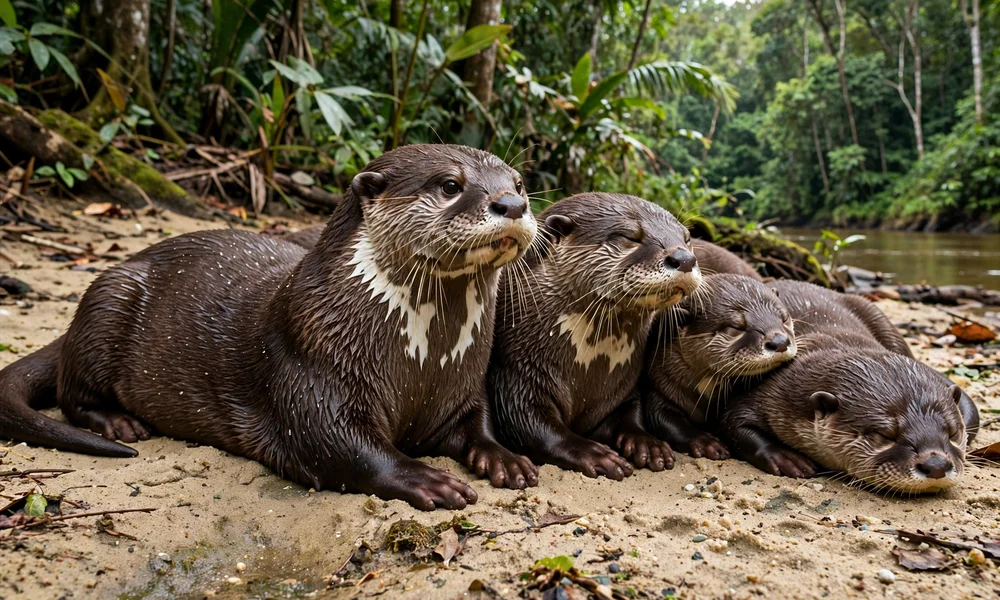
The giant otter species is a single species, Pteronura brasiliensis, a fish-eating otter of the Amazon rivers, and the longest otter on Earth. If you are asking how many giant otter species there are, the answer is one: there is only one giant otter species in the world, and every giant otter alive today belongs to it.
The giant otter belongs to the family Mustelidae, the weasel family, and it lives in the slow rivers, lakes and wetlands of South America, from the Amazon to the Pantanal. Its long sleek body, its pale throat patch, and its noisy family groups make it one of the most recognisable animals of the Amazon.
Key takeaways
- There is only one giant otter species, Pteronura brasiliensis, and it is the longest otter in the world, reaching up to 1.8 metres.
- Giant otters live in noisy family groups of three to eight animals, and each otter has a throat patch as unique as a fingerprint.
- Giant otters are the noisiest otters on Earth, with a vocabulary of squeaks, snorts, barks and hums that keeps the family together.
- Giant otters are top predators of the Amazon rivers, hunting fish together in packs like wolves.
- Giant otters are listed as Endangered, with fewer than 5,000 animals left in the wild.
What makes a giant otter a giant otter
A giant otter is a long sleek otter with chocolate-brown fur, a pale cream throat patch, a flat paddle-shaped tail and webbed feet, and it measures roughly 1.5 to 1.8 metres long and usually weighs between 22 and 32 kilogrammes, with males larger than females. It is the longest otter in the world, and the largest member of the weasel family after the sea otter.
The throat patch defines the giant otter: a cream or white mark on the throat and chest that is different on every animal, like a fingerprint, so researchers can tell otters apart by sight. Its voice is the loudest of any otter, with at least nine different calls, from warning snorts to the hum that parents use to call their pups, and a family group can be heard from hundreds of metres away. Like other otters, the giant otter has a long muscular body built for swimming, but it is a river animal, not a sea animal, and it never leaves fresh water.
The giant otter species and their relatives
There is one giant otter species, Pteronura brasiliensis, and it is the only living member of its genus. Giant otters in different river systems form separate populations, from the Amazon to the Orinoco and the Pantanal, but they are all the same species, and the animals move freely along the rivers following the fish.
The sea otter is the giant otter’s most famous relative, a marine otter of the North Pacific that uses stone tools, while the North American river otter is a playful otter of the rivers and lakes of North America. The Eurasian otter is the otter of the rivers of Europe and Asia, the neotropical otter is a shy otter that shares the giant otter’s rivers, and the marine otter is a small otter of the rocky coasts of South America. The Asian small-clawed otter is the smallest otter in the world, and the smooth-coated otter is an otter of the rivers of South and Southeast Asia.
| Type | Animal | Where it lives | Best-known food | Length or Weight |
|---|---|---|---|---|
| Species | Giant otter (Pteronura brasiliensis) | Amazon, Orinoco and Pantanal rivers | Fish, especially catfish and characins | 1.5 to 1.8 m, 22 to 32 kg |
| Close relative | Sea otter | North Pacific coasts | Sea urchins, clams and crabs | 1 to 1.5 m, 14 to 45 kg |
| Close relative | North American river otter | Rivers and lakes of North America | Fish, frogs and crayfish | 0.9 to 1.3 m, 5 to 14 kg |
| Close relative | Eurasian otter | Rivers of Europe and Asia | Fish, crabs and frogs | 0.9 to 1.3 m, 7 to 12 kg |
| Close relative | Neotropical otter | Rivers of Central and South America | Fish, crustaceans and frogs | 0.9 to 1.4 m, 5 to 15 kg |
| Close relative | Marine otter | Rocky coasts of South America | Crabs, shellfish and fish | 0.9 to 1.2 m, 3 to 5 kg |
| Close relative | Asian small-clawed otter | Wetlands of South and Southeast Asia | Crabs, molluscs and fish | 0.6 to 0.9 m, 2.7 to 5.4 kg |
How giant otters live
Giant otters are creatures of the slow river. A giant otter lives in a family group, a breeding pair with their young from several years, usually three to eight animals, that hunts, rests and sleeps together, and the group defends a stretch of river several kilometres long. Like other South American animals, it follows the seasons, moving with the fish as the rivers rise and fall.
Fish make up most of the diet, along with crabs, crayfish, snakes and the occasional caiman, and a giant otter eats about 3 to 4 kilogrammes of fish every day. It hunts in a pack, surrounding a shoal of fish and driving them into the shallows, and it catches its prey with its forepaws, holding the fish up to eat it while treading water, in a way no other otter does.
Breeding happens in the dry season, when the rivers are low and the fish are easy to catch, and the pair digs a den in the riverbank, lining it with leaves and grass, where the female gives birth to one to five pups. The pups are born blind and helpless, and both parents, helped by their older young, feed and guard them for about nine months before they can hunt for themselves. Giant otters live for around 10 to 13 years in the wild, and up to 17 years in captivity.
Where giant otters live
The giant otter lives in the slow rivers, lakes, oxbow lakes and wetlands of South America, from the Amazon basin through the Orinoco to the Pantanal of Brazil, Bolivia and Paraguay, and it is most common in the remote rivers of the Peruvian Amazon and the Pantanal, where the fish are plentiful and people are few. It is seen regularly in the oxbow lakes of Manu National Park in Peru, one of the best places in the world to watch giant otters.
Slow water is the key requirement. A giant otter needs a river with plenty of fish, with steep banks to dig dens in and fallen trees to rest on, so it follows the fish as they move with the floods, and when the river is dammed or polluted the otters have nowhere to live.
The species is listed as Endangered, and its numbers are still far below their historic levels. The main pressures are the loss of riverside forest to farming and cattle, mercury pollution from gold mining, and conflict with fishermen, who blame otters for taking their fish. Hunters reduced giant otters to a few thousand animals by the 1970s, before protection began, and the species is extinct in Argentina and Uruguay, with only small numbers left in Paraguay.
Best seasons for giant otter watching
There is no closed season, because giant otters are active all year, but the best time to look for them depends on where you go. In Peru the best months are often June to October, the dry season, when the rivers are low and the otters hunt in the oxbow lakes. In the Pantanal the best months are often July to September, when the water is low and the otters are easy to find near their dens.
Staying safe around giant otters
A giant otter is a wild animal with sharp teeth and strong jaws, and a family group can be aggressive when defending its pups, though giant otters almost never attack people. Keep your distance, never approach an otter den, and never try to touch or feed an otter, because a frightened family may abandon its den and the pups may die. If you see otters from a boat, keep the engine slow, stay quiet, and watch with binoculars, because otters that are disturbed may leave their river for good.
Giant otter watching checklist
A little preparation turns a river visit into a real chance of seeing a giant otter, so pack for heat, humidity and long quiet hours on the water.
- Binoculars with good low-light performance, for picking a dark back out of the river.
- A camera with a zoom lens, because otters should always be watched from a distance.
- Sun cream and a hat, because the best watching is in the bright midday sun.
- A booked boat tour with a guide who knows the otter dens and the safe routes.
- A plan to be out in the morning, when the otters are most active and hunting.
- Patience and silence, because otters are shy animals and a noisy group will send them away.
- A field guide to Amazon wildlife, for telling a giant otter from a neotropical otter at a glance.
Frequently asked questions
How many giant otter species are there?
There is one giant otter species, Pteronura brasiliensis. It is the only living member of its genus, and its closest relatives are the other otters of the weasel family. No second giant otter species is recognised.
Why are giant otters so noisy?
Giant otters are so noisy because they live and hunt in family groups that must stay in touch in murky water. They have at least nine different calls, from warning snorts to the hum that parents use to call their pups, and a family group can be heard from hundreds of metres away.
What do giant otters eat?
Giant otters eat fish, mostly catfish and characins, along with crabs, crayfish, snakes and the occasional small caiman. They hunt in packs, surrounding a shoal of fish and driving it into the shallows, and each otter eats 3 to 4 kilogrammes of fish a day.
Can you keep a giant otter as a pet?
No. A giant otter is a wild animal that needs a whole river, eats several kilogrammes of fish every day, and is fully protected by law in every country where it lives. Giant otters in zoos need huge pools with riverbanks and dens, and they are not pets.
How is this guide different from the sea otter species guide?
This guide covers the single giant otter species, a river otter that hunts fish in noisy family groups in the Amazon, while our sea otter species guide covers the single sea otter species, a marine otter that floats in kelp forests and cracks shellfish with stones. The giant otter is the longest otter on Earth at up to 1.8 metres, and the sea otter is the heaviest, at up to 45 kilogrammes.
Are giant otters endangered?
Giant otters are listed as Endangered, so they are not classed as extinct, but their numbers are still far below historic levels. Fewer than 5,000 animals remain in the wild, and gold mining, deforestation and conflict with fishermen are the main threats.
Conclusion
The giant otter species shows how much noise and family feeling one animal can hold: a single species of river otter, with a throat patch like a fingerprint, a vocabulary of nine calls, and a life spent hunting fish in packs through the rivers of the Amazon.
If you go looking for one, go in the dry season to the oxbow lakes of Manu in Peru, go quietly, and go with patience. Watch a giant otter family hunt together and you will understand why it has earned its place as the river wolf of the Amazon, and why keeping its rivers clean matters most.