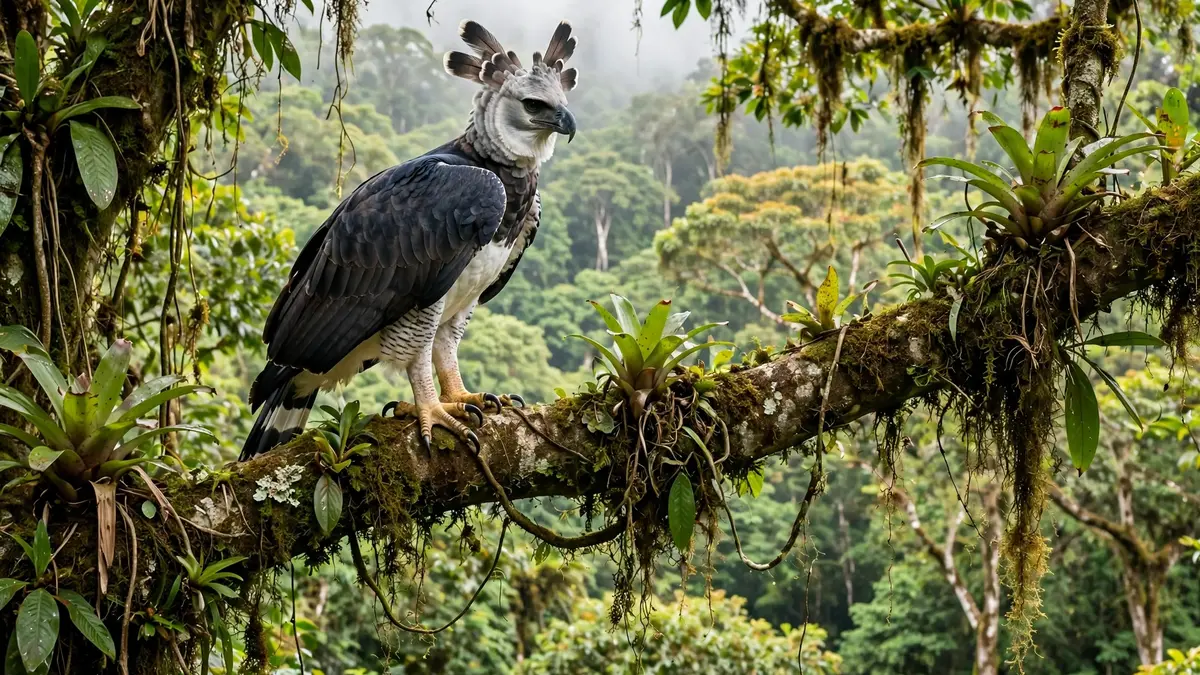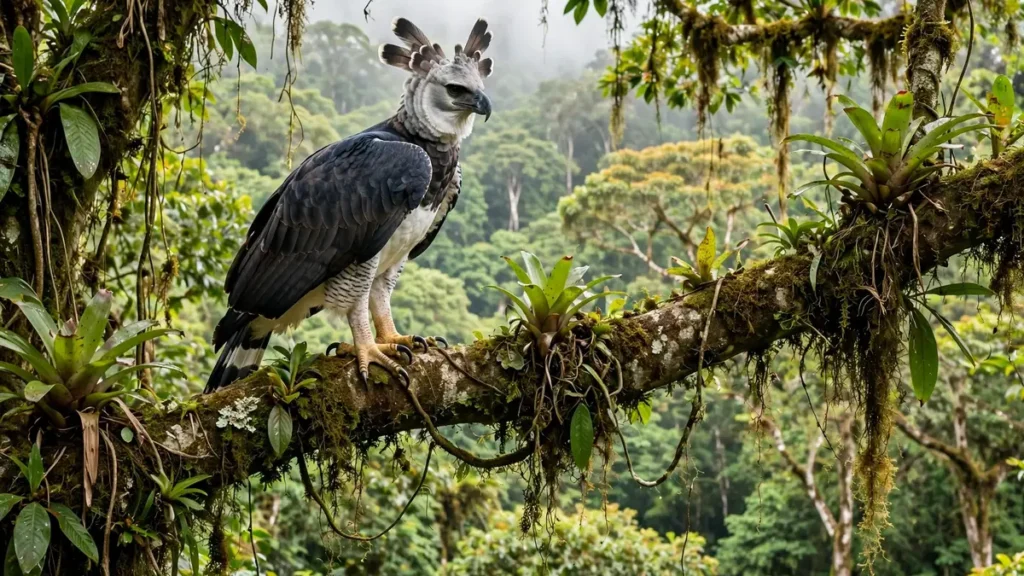
The harpy eagle species is a single species, Harpia harpyja, a huge eagle of the Central and South American rainforests, and the most powerful eagle in the Americas. If you are asking how many harpy eagle species there are, the answer is one: there is only one harpy eagle species in the world, and every harpy eagle alive today belongs to it.
The harpy eagle belongs to the family Accipitridae, the hawks and eagles, and it lives in the tropical rainforests of Central and South America, from Mexico to Argentina. Its grey plumage, its white head, its double crest and its enormous talons make it one of the most impressive birds of prey on Earth.
Key takeaways
- There is only one harpy eagle species, Harpia harpyja, and it is the most powerful eagle in the Americas.
- Harpy eagles have talons up to 13 centimetres long, as large as the claws of a grizzly bear.
- Harpy eagles hunt sloths and monkeys in the rainforest canopy, snatching them from the trees with a silent dive.
- Harpy eagles are among the largest eagles in the world, with females weighing up to 9 kilogrammes.
- Harpy eagles are listed as Near Threatened, and the loss of rainforest is the main threat.
What makes a harpy eagle a harpy eagle
A harpy eagle is a huge eagle with grey plumage, a white head, a double crest that it raises when excited, black-banded legs and massive yellow talons, and it measures roughly 86 to 107 centimetres long, with a wingspan of 1.8 to 2.2 metres, and usually weighs between 4 and 9 kilogrammes, with females much larger than males.
The talons define the harpy eagle: hind talons up to 13 centimetres long, as large as the claws of a grizzly bear, which can crush the bones of a sloth or a monkey in a single grip. Its wings are short and broad for its size, built for steering through the trees rather than soaring in the open, and it flies silently through the canopy, hunting by sight and by sound. Like other eagles, the harpy eagle has a hooked beak and fierce eyes, but it is a forest hunter, not an open-country hunter, and it perches for hours, waiting for a sloth to move.
The harpy eagle species and their relatives
There is one harpy eagle species, Harpia harpyja, and it is the only living member of its genus. Harpy eagles in different parts of the rainforest form separate populations, from Mexico to Argentina, but they are all the same species, and the birds move freely through the forest following the sloths and monkeys.
The crested eagle is the harpy eagle’s closest relative, a smaller eagle of the same forests with a long crest, while the Philippine eagle is a huge eagle of the Philippines that hunts monkeys in the same way. The martial eagle is the largest eagle of Africa, the crowned eagle is a forest eagle of Africa that hunts monkeys, and the golden eagle is a large eagle of the northern mountains. The bald eagle is the national bird of the United States, and the white-tailed eagle is a large eagle of the coasts of Europe and Asia.

| Type | Animal | Where it lives | Best-known food | Length or Weight |
|---|---|---|---|---|
| Species | Harpy eagle (Harpia harpyja) | Rainforests of Central and South America | Sloths, monkeys and opossums | 86 to 107 cm, 4 to 9 kg |
| Close relative | Crested eagle | Forests of Central and South America | Snakes, lizards and small mammals | 70 to 90 cm, 2 to 3.5 kg |
| Close relative | Philippine eagle | Rainforests of the Philippines | Monkeys, flying lemurs and birds | 86 to 102 cm, 4.5 to 8 kg |
| Close relative | Martial eagle | Open country of sub-Saharan Africa | Hares, small antelope and birds | 78 to 96 cm, 3 to 6.2 kg |
| Close relative | Crowned eagle | Forests of sub-Saharan Africa | Monkeys, small antelope and hyrax | 80 to 99 cm, 2.5 to 4.7 kg |
| Close relative | Golden eagle | Mountains of the northern hemisphere | Hares, rabbits and marmots | 66 to 100 cm, 2.8 to 6.7 kg |
| Close relative | Bald eagle | Coasts and lakes of North America | Fish, water birds and carrion | 70 to 102 cm, 3 to 6.3 kg |
How harpy eagles live
Harpy eagles are creatures of the rainforest canopy. A harpy eagle lives alone or in a pair, perching high in an emergent tree by day and hunting in the canopy, and it stays in the same territory for years, a stretch of forest up to 25 square kilometres. Like other South American animals, it follows the seasons, moving with the sloths and monkeys as the fruit ripens.
Sloths and monkeys make up most of the diet, along with opossums, porcupines, iguanas and the occasional bird, and a harpy eagle eats by snatching its prey from a branch in a silent dive, gripping it with talons that can crush bone. It hunts by sight, perching for hours and watching for movement in the canopy, and it can carry prey weighing up to 7 kilogrammes back to its nest, almost its own body weight.
Breeding happens every two to three years, and the pair builds a huge nest of sticks in the top of an emergent tree, sometimes more than 40 metres above the ground, where the female lays one or two white eggs. The female incubates the eggs for about 56 days, and the chick is born white and downy, fed by both parents for about six months before it can fly. The young stay with their parents for up to two years, learning to hunt, and harpy eagles live for around 25 to 35 years in the wild, and up to 50 years in captivity.
Where harpy eagles live
The harpy eagle lives in the tropical rainforests of Central and South America, from southern Mexico through Panama, Colombia, Venezuela and the Guianas to Brazil, Peru, Bolivia and northern Argentina, and it is most common in the lowland rainforest of the Amazon, where sloths and monkeys are plentiful. It is seen regularly in the Darien forest of Panama and the Amazon of Brazil, perched high in the emergent trees.
Rainforest canopy is the key requirement. A harpy eagle needs tall emergent trees to nest in, thick canopy to hunt in and plenty of sloths and monkeys to eat, so it follows the forest as it grows, and when the forest is cleared the eagle has nowhere to live. It depends on the canopy staying intact, and it hunts in the upper layers of the forest, where the sloths sleep and the monkeys feed.
The species is listed as Near Threatened, and its numbers are falling across its range. The main pressures are the loss of rainforest to farming, logging and cattle ranching, and shooting by farmers who blame eagles for taking their livestock. Harpy eagles need huge territories, so even small losses of forest push them out, and the species has already disappeared from large parts of Central America, including El Salvador and much of Mexico.
Best seasons for harpy eagle watching
There is no closed season, because harpy eagles are active all year, but the best time to look for them depends on where you go. In Panama the best months are often December to April, the dry season, when the eagles are breeding and easy to find near their nests. In Brazil the best months are often June to October, when the birds are hunting in the canopy in the early morning.
Staying safe around harpy eagles
A harpy eagle is a wild bird with a hooked beak and talons as large as a grizzly bear’s claws, and it can hurt a person badly, though harpy eagles almost never attack people. Keep your distance, never approach a harpy eagle nest, and never try to catch a harpy eagle, because a frightened bird may abandon its eggs and the chick may die. If you see harpy eagles hunting, stay on the path and watch with binoculars, because eagles that are disturbed may leave their territory for good.
Harpy eagle watching checklist
A little preparation turns a rainforest visit into a real chance of seeing a harpy eagle, so pack for heat, humidity and long quiet hours.
- Binoculars with good low-light performance, for picking a huge eagle out of the green canopy.
- A camera with a long lens, because eagles should always be watched from a distance.
- Sun cream and a hat, because the best watching is in the bright morning sun.
- A booked tour with a guide who knows the harpy eagle nests and the safe routes.
- A plan to be out at dawn, when the eagles leave their roosts to hunt.
- Patience and silence, because eagles are shy birds and a noisy group will send them away.
- A field guide to birds of prey, for telling a harpy eagle from a crested eagle at a glance.
Frequently asked questions
How many harpy eagle species are there?
There is one harpy eagle species, Harpia harpyja. It is the only living member of its genus, and its closest relative is the crested eagle of the same forests. No second harpy eagle species is recognised.
How big are harpy eagle talons?
Harpy eagle talons are up to 13 centimetres long, as large as the claws of a grizzly bear, and they can crush the bones of a sloth or a monkey in a single grip. The hind talon is the largest, and it is the weapon the eagle uses to kill its prey.
What do harpy eagles eat?
Harpy eagles eat sloths and monkeys, along with opossums, porcupines, iguanas and birds. They hunt by perching for hours and watching for movement in the canopy, then diving silently onto their prey and carrying it back to the nest.
Can you keep a harpy eagle as a pet?
No. A harpy eagle is a wild bird that needs the rainforest canopy, eats sloths and monkeys, and is fully protected by law in every country where it lives. Harpy eagles in zoos need huge aviaries with tall trees, and they are not pets.
How is this guide different from the secretary bird species guide?
This guide covers the single harpy eagle species, a forest eagle that hunts sloths in the rainforest canopy, while our secretary bird species guide covers the single secretary bird species, a bird of prey that hunts snakes on foot in the African savanna. The harpy eagle weighs up to 9 kilogrammes and hunts from the air, and the secretary bird weighs up to 4.3 kilogrammes and hunts on the ground.
Are harpy eagles endangered?
Harpy eagles are listed as Near Threatened, so they are not classed as endangered, but their numbers are falling. The loss of rainforest is the main threat, and the species has already disappeared from large parts of Central America.
Conclusion
The harpy eagle species shows how much power one bird can hold: a single species of forest eagle, with talons like a grizzly bear’s claws, wings built for the trees, and a life spent hunting sloths in the rainforest canopy of the Americas.
If you go looking for one, go in the dry season to the Darien forest of Panama or the Amazon of Brazil, go quietly, and go with patience. Watch a harpy eagle perched high in an emergent tree and you will understand why it has earned its place as the most powerful eagle of the Americas, and why keeping its rainforest matters most.