Key Takeaways
- Biologically, every monkey belongs to the simian group, where Old World species share a more recent common ancestor with apes than New World species do.
- A monkey split occurs between South American Platyrrhini species and Afro-Eurasian Catarrhini species based on nostril shape tail structure and specialized digestive systems.
- In each troop, mature males typically leave their birth group, while females tend to stay with their mothers and other close female relatives.
- Advanced cognitive abilities like stone tool use in capuchins and sweet potato washing in Japanese macaques demonstrate complex cultural learning.
What Is a Monkey?
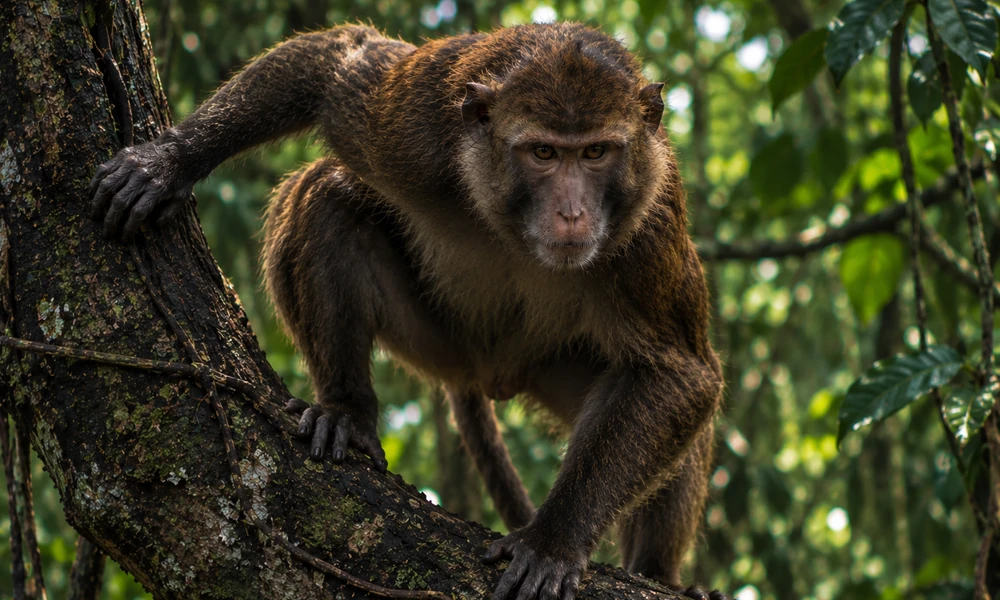
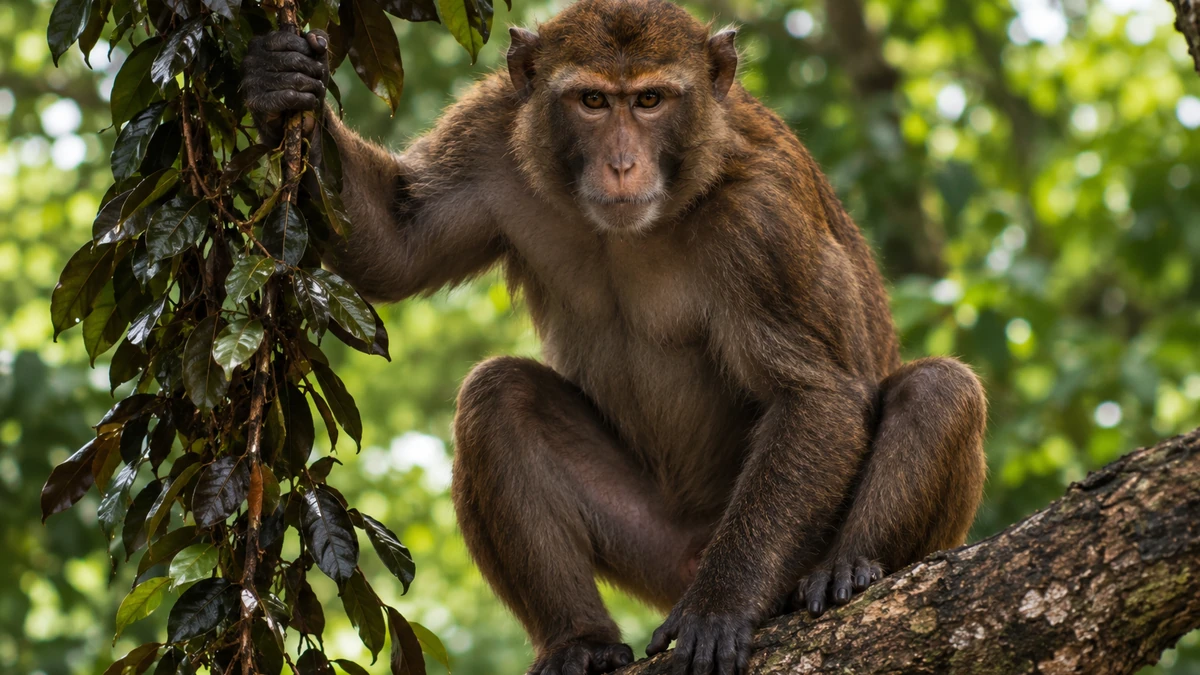
The word monkey describes a broad group of simian primates rather than a single neat evolutionary branch. Traditional views separate apes from every monkey species, but modern cladistic classification shows that apes sit within the larger simian tree. Every monkey belongs to the infraorder Simiiformes alongside apes, while prosimians like lemurs, lorises, galagos, and tarsiers remain completely separate.
Origin and Anatomy
Historical terminology causes widespread confusion across wildlife literature. The famous Barbary ape of Gibraltar lacks a visible tail, yet it is actually a true macaque species. The English word originated around 1580 from a German Reynard the Fox fable featuring a character named Moneke. Anatomically, every monkey possesses forward-facing eyes, flat nails on most digits, two chest nipples, and no facial sensory whiskers.
How Monkeys Fit in Classification
In biological classification, the infraorder Simiiformes encompasses all simians. From this main trunk, the tarsiers branch off as a sister group within Haplorhini. Simiiformes then splits into two major groups: Platyrrhini (New World monkeys with flat noses and prehensile tails in the Atelidae family) and Catarrhini (narrow-nosed primates).
Catarrhini includes two main groups: Cercopithecoidea, which contains Old World monkeys, and Hominoidea, which includes apes and humans. Old World monkeys may have cheek pouches for storing food or specialized stomachs for digesting leaves.
Types of Monkeys
New World Monkeys (Platyrrhini)
New World monkey species live across Central and South America. These primates divide into five primary families:
- Callitrichidae (marmosets and tamarins)
- Cebidae (capuchins and squirrel monkeys)
- Aotidae (night monkeys)
- Pitheciidae (sakis and uakaris)
- Atelidae (howler, spider, and woolly monkeys)
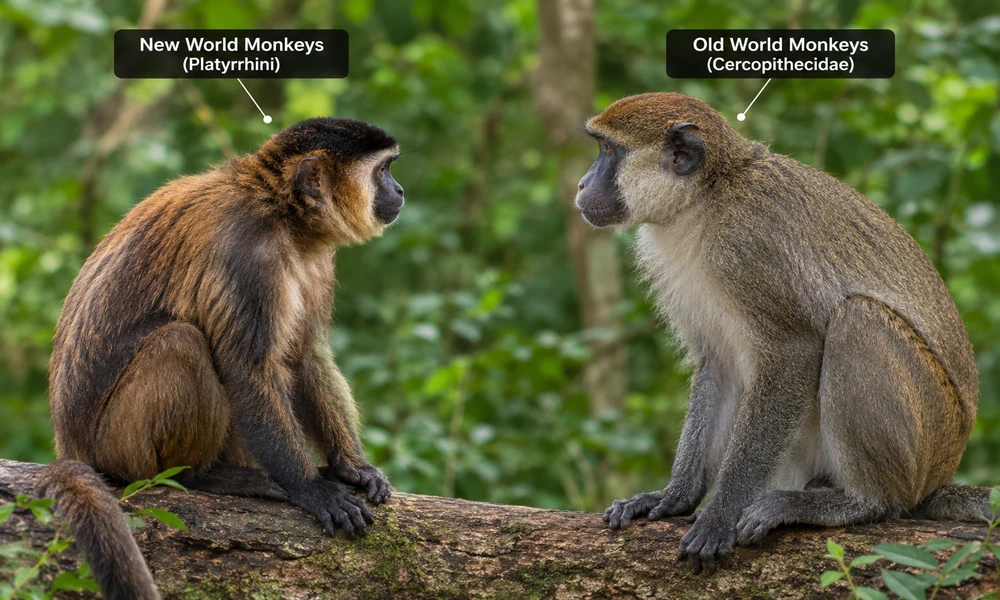
Their nostrils face sideways on wide, flat noses. While most species feature long tails, only members of the Atelidae family possess fully prehensile gripping tails capable of supporting their entire body weight. Color vision within New World groups varies significantly between monochromatic, dichromatic, and trichromatic vision.
Old World Monkeys (Cercopithecidae)
Old World monkey species inhabit tropical forests and savannas across Africa and Asia. Their nostrils sit close together and point downward. Tails are non-prehensile or completely missing. Old World monkeys generally have trichromatic color vision, allowing them to distinguish red, green and blue hues.
Many species also have toughened patches of skin called ischial callosities that provide support when sitting. This group is commonly divided into two subfamilies based on anatomical and dietary differences:
- Cercopithecinae: Includes guenons, macaques and baboons. Many members have expandable cheek pouches for temporarily storing food.
- Colobinae: Langurs and colobus monkeys equipped with complex multi-chambered fermenting stomachs to break down tough forest leaves.
Comparison
| Feature | New World Monkeys (Platyrrhini) | Old World Monkeys (Cercopithecidae) |
| Geographical Range | Central and South America | Africa and Asia |
| Nostril Orientation | Flat nose with sideways nostrils | Narrow nose with downward nostrils |
| Tail Adaptations | Prehensile only in Atelidae family | Non-prehensile or completely absent |
| Color Vision | Monochromatic, dichromatic, or trichromatic | Always trichromatic (like humans) |
| Sitting Pads | Completely absent | Ischial callosities present |
| Physical Thumbs | Non-opposable or reduced | Opposable thumbs with high grip precision |
Where Monkeys Live (Habitat and Range)
Global Distribution
New World monkey species cover tropical regions in Central and South America, concentrating heavily inside the Amazon basin while extending north into southern Mexico and south into northern Argentina. Old World monkey species span across sub-Saharan Africa, the Red Sea coast, and Asian regions from Afghanistan through Japan down into Southeast Asian islands.
Forest, Ground, and Daily Routines
Habitats vary from deep rainforests and gallery woodlands to open savannas and high mountain peaks. Rainforests provide habitat for many tree-dwelling monkey species, although some also travel on the ground. Baboons and certain macaques adapt to ground dwelling on open terrain.
Ground-dwelling species walk flat on their foot soles while keeping their palms raised, rarely standing or walking upright on two legs. Most species are diurnal, meaning they remain active during the day and rest at night. The South American owl monkey stands out as the single nocturnal exception.
Unique Regions and Parallel Adaptations
Gibraltar hosts the only free-ranging Old World monkey population in Europe, while Japanese macaques survive harsh northern winter snows. Small naturalized populations also exist on West Indies islands, Mauritius, and Palau.
Squirrel monkeys in South America and talapoin in Africa represent a prime biological example of convergent evolution. Both weigh roughly one kilogram, feature greenish coats, build large troops along river edges, and follow strict seasonal breeding windows despite evolving on separate continents.
Urban expansion brings many troops into direct contact with human towns near temples and agricultural borders. Viltnemnda notes that understanding these natural ranges helps field biologists monitor population shifts and human-wildlife conflicts effectively.
Body Anatomy and Senses
Size Range and Physical Features
Size range across simians is extraordinary, stretching from the tiny pygmy marmoset, which weighs barely 100 grams with a head-body length of 117 millimeters, up to the massive male mandrill, which reaches lengths near 1 meter and weighs up to 36 kilograms.
Hands and feet feature divergent thumbs and big toes for grasping branches. Flat nails cover the digits of most species, though marmosets retain sharp claws on all digits except the big toe. Old World species possess opposable thumbs that grant exceptional manual precision. New World species lack this degree of fine thumb manipulation.
Key Differences in Noses and Sitting Pads
Nose structures remain a primary defining boundary between the two geographic groups. Flat noses with wide sideways nostrils define New World species, whereas narrow noses with downward-pointing nostrils define Old World species. Sitting pads made of toughened calloused tissue allow Old World species to rest comfortably on thin branches or rough rocks. They share two chest nipples and lacks sensitive facial whiskers entirely.
Diet and Feeding Habits
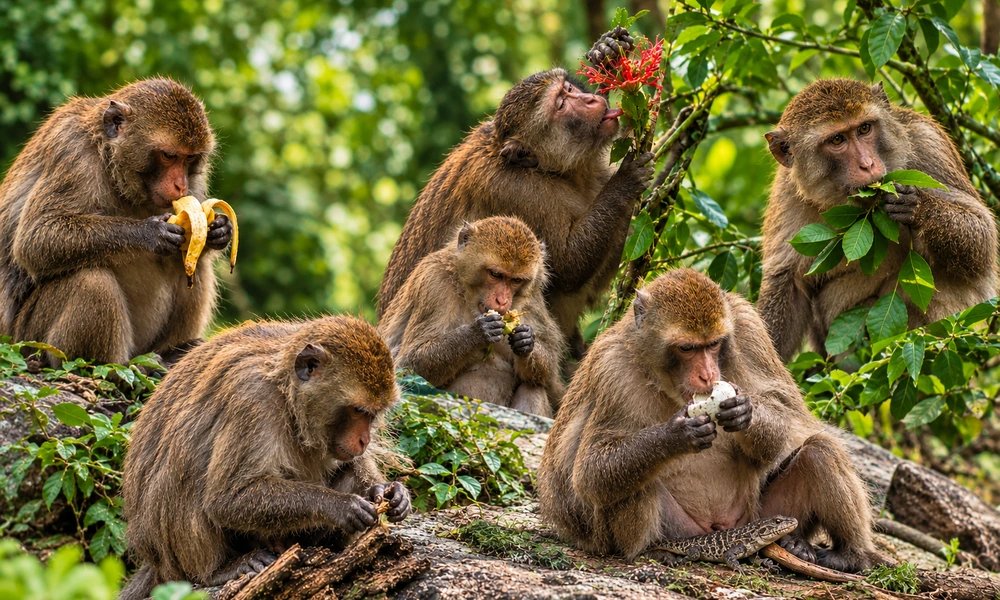
They face the continuous survival challenge of gathering enough energy from variable forest food sources. Diets shift dramatically based on seasonal fruit supply, regional habitat types, and body size. Common food sources include:
- Ripe fruits and nutrient-rich seeds
- Flowers, nectar, and tree sap
- Forest leaves and plant buds
- Insects, spiders, and small invertebrates
- Birds’ eggs and small vertebrates
Small species require high-energy items like tree gum, insects, and ripe fruits. Larger ground dwellers incorporate seeds, grasses, roots, and opportunistic meat prey.
Digestive Adaptations
The two main Old World subfamilies solve foliage digestion through entirely different physical strategies:
Cheek Pouches: Cercopithecine species use internal cheek pouches extending down the neck to store fruits and seeds quickly during competitive foraging runs. Storing food rapidly reduces the time a monkey stays exposed to dangerous predators in open areas.
Fermenting Stomachs: Colobine species rely on large multi-chambered stomachs packed with specialized bacteria. Cellulose breaks down through slow foregut fermentation, allowing these species to digest tough foliage packed with plant toxins that would sicken other primates.
Social Life and Living Arrangements
Troop Types and Structure
Almost every monkey lives inside organized social units known as troops or tribes. Group living offers protective advantages against forest predators and improves foraging efficiency across shared territories.
| Troop Type | Social Composition | Representative Species |
| Single-Male Troop | One dominant resident male with multiple females and offspring | Hamadryas baboons, mandrills, guenons, langurs |
| Multi-Male Troop | Multiple adult males and females with established hierarchies | Savanna baboons, macaques |
| Fission-Fusion Group | Subgroups split during the day and recombine at night | Spider monkeys |
Female Bonded Groups and Male Dispersal
Social cohesion depends on female philopatry. Females generally remain inside their birth troop for their entire lives, forming tight lineage bonds with mothers, sisters, and aunts.
Young males leave their native troop upon reaching sexual maturity. Male dispersal prevents inbreeding depression across generations, but it leaves incoming adult males unrelated and highly aggressive toward established group members. Spider monkey society functions under a flexible fission-fusion dynamic, mirroring the social dynamics of wild chimpanzees rather than standard Old World species.
Reproduction and Raising Young
Mating Cycles and Breeding Seasons
Female primates nurse their young and experience regular menstrual cycles. Menstrual bleeding in them is significantly less copious than the cycles seen in human beings and great apes.
Sexual behavior varies considerably across different simian species:
- Restricted Estrus: Certain species restrict mating strictly to the brief window surrounding female ovulation.
- Unrestricted Mating: Other species engage in sexual activity across all cycle phases to build social bonds or reduce male infanticide risk.
Breeding patterns are strongly tied to environmental conditions. Tropical rainforest species with constant food supplies often reproduce year-round. In contrast, species living in harsh or fluctuating climates undergo an anestrus phase lasting several months during which all sexual activity stops.
Raising the Next Generation
Single births represent the standard pattern across most medium and large primates. Marmosets and tamarins diverge from this norm by regularly giving birth to fraternal twins. Infants depend completely on maternal nursing for several months, learning critical foraging methods, predator identification, and group etiquette by watching adult members of the troop.
Intelligence and Communication
Large brain-to-body ratios, flexible hands, and sharp forward-facing vision give every strong cognitive processing capabilities. Capuchins in South America select heavy stones to crack open hard palm nuts on rock anvils, demonstrating a multi-step sequence of selecting an anvil stone, transporting it to the site, and striking the nut with precision. Baboons similarly shape wooden sticks to pull prey out of deep rock crevices.
Cultural Learning and Troop Signals
Culture in non-human animals was redefined by Japanese macaques on Koshima Island. Researchers observed a female named Imo wash sand off sweet potatoes in freshwater streams in 1953. This efficient feeding behavior spread from Imo to her peer playmates, then to mothers and siblings, until it eventually became a troop-wide cultural tradition passed to future generations.
Most species acquire survival skills through individual trial-and-error learning rather than imitation. Old World species generally exhibit higher performance scores on laboratory problem-solving tasks. Communication across a troop relies on a multi-modal blend of vocalizations, physical gestures, facial expressions, and tactical social grooming that maintains group harmony.
Evolution and History
The evolutionary history of simians spans tens of millions of years across major geological shifts:
- 70 Million Years Ago: The evolutionary line leading to simians splits from early tarsier ancestors.
- 35 Million Years Ago: The crucial split between New World Platyrrhini and Old World Catarrhini takes place.
- 25 Million Years Ago: Apes diverge from the Old World monkey lineage within Catarrhini.
Ocean Rafting and Fossil Records
Because South America was completely isolated by open ocean during the Eocene epoch, ancestral primates likely crossed the Atlantic Ocean from Africa on floating mats of storm debris. These small African raft-farers found open ecological niches across South American forests, radiating into modern New World families. Extinct fossil genera like Aegyptopithecus and Parapithecus (dating back 32 to 35 million years) represent basal simians that highlight key anatomical transitions in early primate history.
Monkeys and Humans
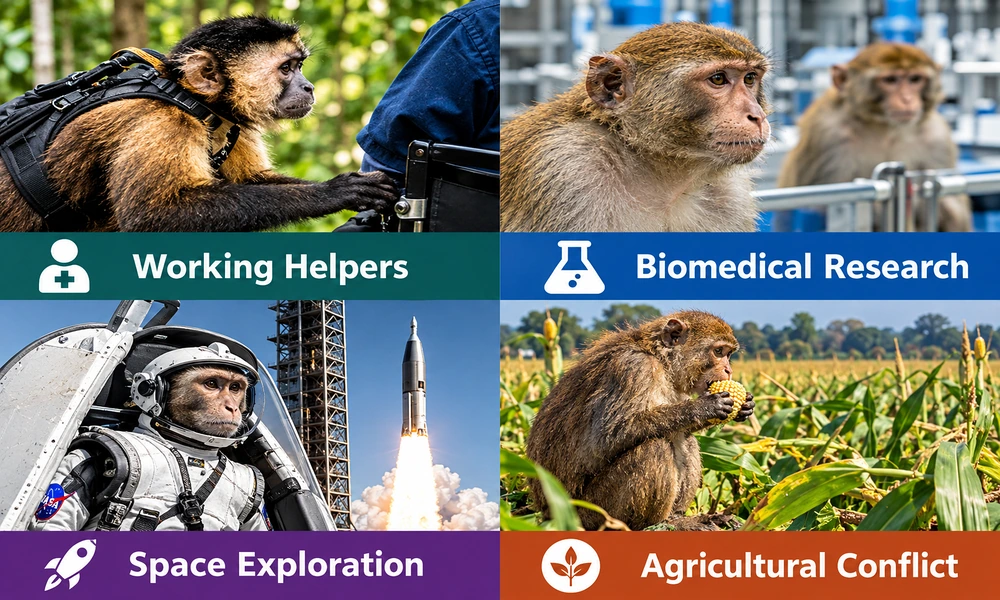
Monkeys maintain complex relationships with human societies through working roles, scientific research, agricultural overlap, and cultural traditions.
| Touchpoint Area | Specific Application / Reality |
| Working Helpers | Capuchins historically trained to assist individuals with severe spinal cord injuries. |
| Biomedical Research | Rhesus macaques, crab-eating macaques, and grivets utilized in infectious disease and vaccine studies (~100,000–200,000 research primates globally per year). |
| Space Exploration | A rhesus macaque named Albert II became the first monkey in space aboard a V-2 rocket in 1949. |
| Agricultural Conflict | Crop raiding along forest edges causes tension with farmers, though actual damage varies by season. |
| Cultural Significance | Featured in global folklore and religion, including Hanuman, Sun Wukong, and the Three Wise Monkeys. |
Legal Regulations and Cultural Status
Capuchin were historically trained as helper animals, but the U.S. Americans with Disabilities Act updated its regulations in 2010 to define service animals exclusively as dogs and miniature horses. Veterinary organizations like the AVMA oppose keeping primates as service animals due to animal welfare concerns, bite risks, and zoonotic disease transmission hazards.
Conservation Challenges
Habitat Destruction and Threats
Habitat loss caused by clear-cut deforestation, agricultural expansion, and logging remains the primary threat facing wild populations. The progression of threats follows a distinct path:
Clear-cut logging, road development, and agricultural clearing break contiguous forests into smaller, isolated fragments. These fragmented patches isolate populations, restrict natural male dispersal, and reduce genetic diversity. Increased edge access exposes troops to commercial bushmeat hunting, illegal pet trade trafficking, and retaliatory pest extermination by farmers, driving vulnerable troop numbers toward local extinction.
Wildlife Protection Efforts
Conservation organizations, protected national parks, and international wildlife treaties work to enforce habitat corridors and curb illegal trade networks to preserve these ecosystems worldwide.
Editorial Note
Viltnemnda presents this article as an educational guide to monkey classification, species diversity, habitats, feeding adaptations, social behavior, reproduction, intelligence and conservation. The content draws on established primatology research and zoological knowledge to explain these subjects in accessible language. Scientific classifications, behavioral patterns and habitat descriptions are discussed in context, recognizing that characteristics can vary between species and populations.
Frequently Asked Questions
If apes evolved inside the monkey family tree, why aren’t humans called monkeys?
Cladistically, apes sit within the monkey group, but common usage traditionally resists this label. “Monkey” functions as a popular name rather than an official scientific taxon, while the formal group containing all these primates is Simiiformes.
Why is the Barbary “ape” actually a monkey?
The Barbary ape is a true macaque native to North Africa and Gibraltar. Historical English terminology labeled any tailless primate an “ape,” so this ancient name stuck despite its clear genetic placement within Old World monkeys.
How did monkeys cross the ocean to South America?
Ancestors of New World monkeys likely drifted across the Atlantic Ocean from Africa on large floating vegetation mats. This transoceanic dispersal occurred roughly 35 million years ago, before the continents drifted further apart.
Which monkey is active at night?
The owl monkey, also known as the durukuli, is the only nocturnal monkey in the world. Native to Central and South America, it evolved large eyes for nocturnal vision, while no Old World monkey species is nocturnal.
Why do squirrel monkeys and talapoins look alike on different continents?
Both species weigh around one kilogram, possess greenish fur, live along rivers in large troops, and follow seasonal breeding schedules. This is a classic example of convergent evolution, where similar environmental niches shaped identical physical traits.
What are “sitting pads” on a monkey, and who has them?
Sitting pads, known scientifically as ischial callosities, are tough, hairless patches of skin on the buttocks. Old World monkeys possess these hardened pads for resting comfortably on branches, whereas New World monkeys lack them completely.
Why can’t monkeys be legal service animals in the US anymore?
Revised U.S. ADA regulations in 2010 limited recognized service animals strictly to dogs and miniature horses. The AVMA and public health agencies oppose helper monkeys due to safety hazards, disease transmission risks, and animal welfare concerns.
Can monkeys pass learned habits through a whole troop, like human culture?
In rare cases, monkeys pass learned behaviors across generations. Japanese macaques on Koshima Island learned to wash sand off sweet potatoes after one female started the habit, which quickly spread through the troop as a unique cultural tradition.
Do monkeys attack humans?
Monkeys rarely attack humans out of nowhere. Most attacks are triggered by three things:
- They assume you have food in your hands, pockets, or plastic bags.
- Direct eye contact or showing your teeth (smiling) is viewed as a threat or a dare to fight.
- Getting too close to a troop, baby monkey, or dominant male can make them defensive.
What should I do if a monkey jumps on me?
Stay calm and freeze. Do not hit, push, or scream, as sudden violent movements will cause the monkey to bite out of fear. Stay completely still, keep your hands open, and do not make eye contact. Once it realizes you have no food and are not reacting, it will usually jump off on its own.
How can I prevent an attack before it happens?
To prevent an attack, keep food and drinks out of sight, secure loose belongings, maintain a safe distance and never approach, touch or corner a wild monkey.
