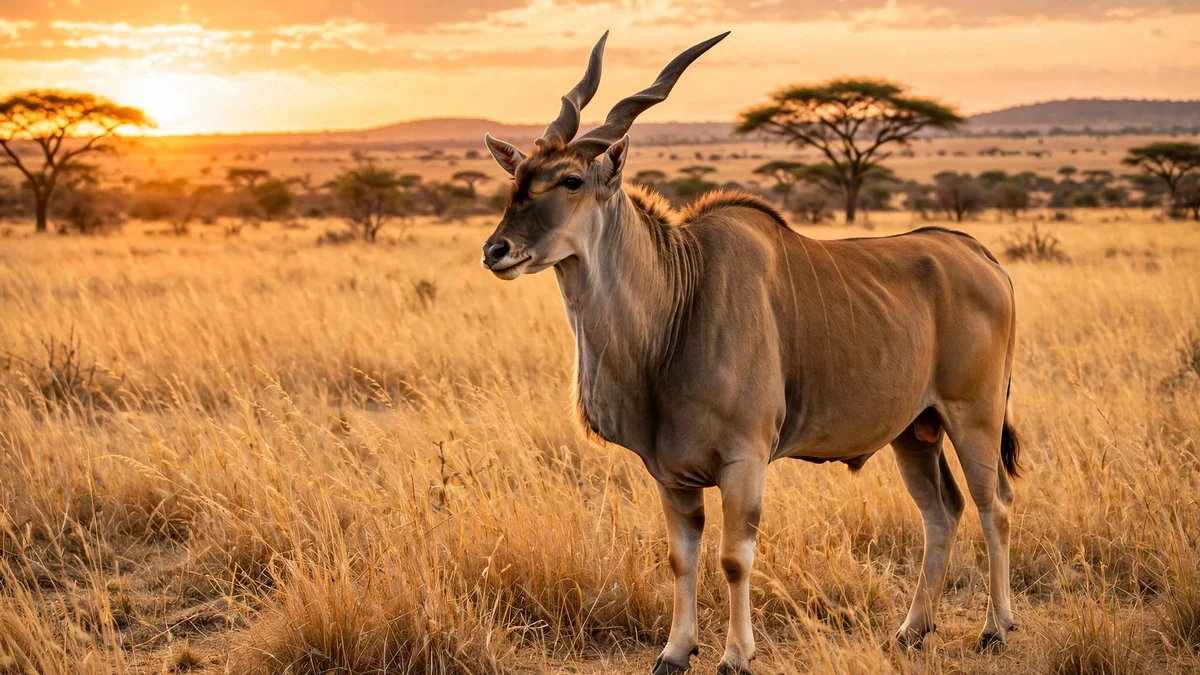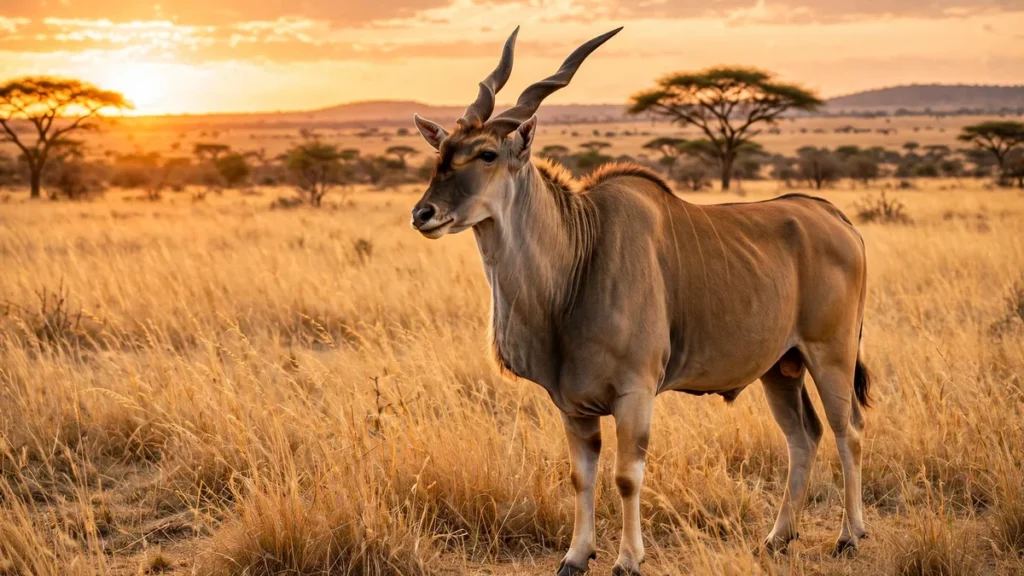
The eland species number two, the common eland and the giant eland, and they are the largest antelopes on Earth, ox-like animals of the African savanna. If you are asking how many eland species there are, the answer is two: there are two recognised eland species in the world, and every eland alive today belongs to one of them.
The eland lives in the woodlands, plains and savannas of Africa, from Senegal to South Africa, and it is a gentle giant, a spiral-horned antelope that can weigh close to a tonne. Its size, its spiral horns, its hanging dewlap and its ability to jump a fence from a standing start make it one of the most impressive animals in Africa.
Key takeaways
- There are two eland species, the common eland and the giant eland, both in the genus Taurotragus.
- Eland bulls stand 150 to 180 centimetres at the shoulder and can weigh as much as one tonne.
- Eland have straight horns with one or two screw-like spirals, carried by both males and females.
- Eland eat leaves, shoots and grasses, and they can jump up to 3 metres from a standing start.
- The common eland is listed as Least Concern, and the giant eland is listed as Vulnerable.
What makes an eland an eland
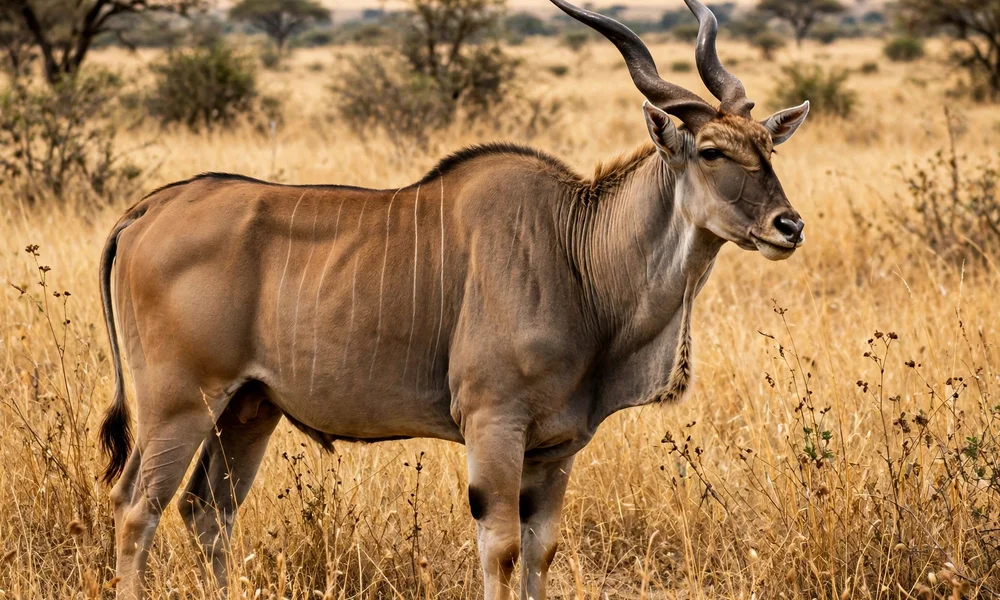
An eland is a very large ox-like antelope with a tawny or reddish-brown coat, faint white stripes on its body, a short dark mane, a dewlap hanging from its throat, and straight horns with one or two screw-like spirals, and it measures up to 340 centimetres long, stands 150 to 180 centimetres at the shoulder in the bull, and usually weighs between 400 and 1,000 kilogrammes. The female is slimmer, at 120 to 150 centimetres at the shoulder and 317 to 470 kilogrammes.
The size defines the eland: it is the largest of all antelopes, heavier than a horse and taller at the shoulder than most people, yet it can clear a fence from a standing start. Like other giraffes, the eland is a tall browser of the African savanna, but it is an antelope, not a giraffe, and it has spiral horns, not ossicones, and it runs in herds, not alone.
The eland species and their relatives
There are two eland species. The common eland lives across eastern and southern Africa, from Kenya to the Cape, and it is the one that people see on safari, in herds that sometimes number hundreds of animals. The giant eland lives in a band of West and Central African savanna, from Senegal to South Sudan, and it is larger-horned and more elusive, with a blackish neck and vivid white stripes.
The greater kudu is the eland’s closest relative, a large spiral-horned antelope with huge ears and white stripes, while the nyala is a smaller spiral-horned antelope of the southern African thickets. The bushbuck is a shy spiral-horned antelope of the forest edge, the sitatunga is a swamp antelope with long splayed hooves, and the bongo is a bright chestnut antelope of the Central African rainforest.
| Type | Animal | Where it lives | Best-known food | Length or Weight |
|---|---|---|---|---|
| Species | Common eland (Taurotragus oryx) | Plains and woodlands of eastern and southern Africa | Leaves, shoots and grasses | Up to 1,000 kg, 150 to 180 cm at shoulder |
| Close relative | Giant eland | Savannas of West and Central Africa | Leaves, shoots and grasses | Up to 1,000 kg, 150 to 180 cm at shoulder |
| Close relative | Greater kudu | Woodlands of eastern and southern Africa | Leaves, shoots and fruit | 190 to 315 kg, 120 to 150 cm at shoulder |
| Close relative | Nyala | Thickets of southern Africa | Leaves, shoots and fruit | 55 to 125 kg, 80 to 110 cm at shoulder |
| Close relative | Bushbuck | Forest edges of sub-Saharan Africa | Leaves, shoots and fruit | 24 to 80 kg, 65 to 100 cm at shoulder |
| Close relative | Sitatunga | Swamps of Central and West Africa | Reeds, sedges and grasses | 55 to 125 kg, 80 to 110 cm at shoulder |
| Close relative | Bongo | Rainforests of Central Africa | Leaves, shoots and bark | 150 to 400 kg, 110 to 130 cm at shoulder |
How eland live
Eland are creatures of the open savanna. An eland lives in herds of twenty to sixty animals, and sometimes in gatherings of hundreds on the open plains, with the Serengeti holding herds of up to 500 animals, and it moves slowly through the grass, browsing on leaves and shoots. Like other African buffalo, the eland is a large herd animal of the African plains, but it is an antelope, not a buffalo, and it is gentle and shy, and it runs away from danger, not towards it.
Leaves make up most of the diet, along with shoots, grasses and fruit, and an eland eats by browsing on trees and bushes, using its horns to break off branches too high to reach with its lips and tongue. It feeds mostly in the morning and evening, when the leaves are cool and the air is still, and it can go for long periods without drinking, taking its water from the leaves it eats.
Breeding is a year-round affair, and the bulls fight for the cows, clashing their horns and pushing with their foreheads, and the winner mates with the cows in the herd. The cow gives birth to a single calf after a pregnancy of about nine months, and the calf weighs about 30 kilogrammes and can stand within hours. The calf stays hidden in the grass for its first few weeks, and the mother returns to feed it, and the young eland joins the herd after about a month. Eland live for about 15 to 20 years in the wild.
Where eland live
The eland lives in the woodlands, plains and savannas of Africa, with the common eland across eastern and southern Africa, from Kenya to the Cape, and the giant eland in a band of West and Central Africa, from Senegal to South Sudan, and it is most common where there are open plains with trees to browse on. It is the largest antelope on Earth, and it is a symbol of the African savanna.
Open plains with trees are the key requirement. An eland needs grassland to run in and trees to browse on, with water nearby in the dry season, so it follows the rains as they move, and when the grass dries up the herds move on to greener ground, travelling hundreds of kilometres in a year.
The common eland is listed as Least Concern, with about 136,000 animals, and the giant eland is listed as Vulnerable, with far fewer animals in a shrinking range. The main pressures are hunting, the loss of habitat to farms, and disease, though eland are protected by law and many live in national parks and private reserves.
Best seasons for eland watching
There is no closed season, because eland are active all year, but the best time to look for them depends on where you go. In East Africa the best months are often June to October, when the dry season draws the herds to the remaining water and the grass is short. In southern Africa the best months are often May to September, when the winter herds gather on the open plains.
Staying safe around eland
An eland is a wild animal with long horns and great strength, and a bull can injure a person who comes too close, though eland almost never attack people. Keep your distance, never touch a calf, and never walk between a bull and his cows, because a bull that is disturbed may charge. If you see eland while on safari, stay calm, stay in the vehicle, and let them come to you, because eland that are chased may run for kilometres and never return.
Eland watching checklist
A little preparation turns a safari into a real chance of seeing an eland, so pack for heat, dust and long quiet hours.
- Binoculars, because the herds are far out on the plains and best watched from a distance.
- A camera with a zoom lens, for the spiral horns and the dewlap without getting close.
- A booked safari with a guide who knows the eland herds and the safe routes.
- A national park with open plains, where the eland gather in the dry season.
- A plan to be out in the morning, when the eland are most active and browsing.
- Patience and silence, because eland are shy animals and a noisy group will send them away.
- A field guide to antelopes, for telling a common eland from a giant eland at a glance.
Frequently asked questions
How many eland species are there?
There are two eland species, the common eland and the giant eland. They were once placed in the genus Taurotragus, and some taxonomies now place them in Tragelaphus with the kudus, but scientists recognise two species, and the giant eland’s name refers to its longer horns, not a bigger body.
How big do eland get?
Eland bulls of both species stand 150 to 180 centimetres at the shoulder and can weigh as much as one tonne, making them the largest antelopes on Earth. The females are slimmer, at 120 to 150 centimetres at the shoulder and 317 to 470 kilogrammes.
What do eland eat?
Eland eat leaves, shoots, grasses and fruit, and they use their horns to break off branches too high to reach. They can go for long periods without drinking, taking their water from the leaves they eat.
Can eland really jump fences?
Yes. Despite weighing close to a tonne, an eland can clear a fence up to 3 metres high from a standing start, and its knees make a clicking sound as it walks, a sound that carries a long way across the savanna.
How is this guide different from the American alligator species guide?
This guide covers two eland species, the largest antelopes on Earth, which live on the African savanna and eat leaves, while our American alligator species guide covers the single American alligator species, an armoured reptile of the south-eastern swamps that eats fish and turtles. The eland bull can weigh as much as one tonne and jumps fences, and the American alligator male measures 3.4 to 4.6 metres and lives in water.
Are eland endangered?
The common eland is listed as Least Concern, with about 136,000 animals, but the giant eland is listed as Vulnerable, with far fewer animals in a shrinking range. Hunting and the loss of habitat are the main threats to watch.
Conclusion
The eland species show how much gentleness one giant animal can hold: two species of spiral-horned antelope, with horns like screws, dewlaps like curtains, and lives spent between the open plain and the shady tree.
If you go looking for one, go in the dry season to the Serengeti or the Kruger, go quietly, and go with patience. Watch an eland bull stand on the plain with the sun on his back and you will understand why it has earned its place as the largest antelope on Earth, and why keeping its savannas open matters most.