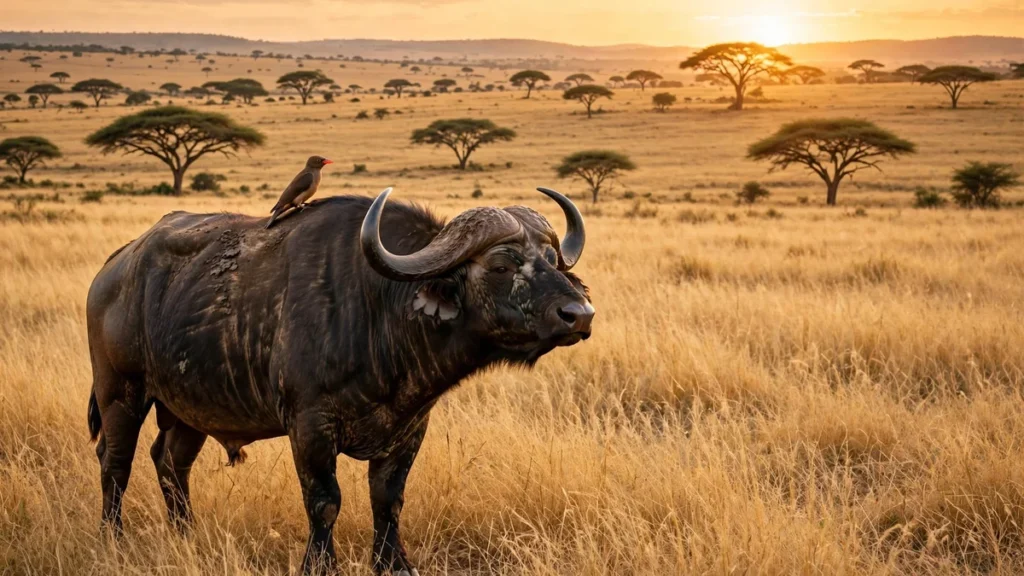
The African buffalo species is a single species, Syncerus caffer, a horned giant of the African savanna, and one of the most powerful grazers on Earth. If you are asking how many African buffalo species there are, the answer is one: there is only one African buffalo species in the world, though it is split into four subspecies, and every African buffalo alive today belongs to it.
The African buffalo belongs to the family Bovidae, the cattle family, and it lives across sub-Saharan Africa, from Senegal to South Africa, in savanna, swamp and forest. Its huge curving horns, its dark hide, its massive herds and its fearsome temper make it one of the most famous animals of the African plains.
Key takeaways
- There is only one African buffalo species, Syncerus caffer, and it is split into four subspecies: Cape, forest, Sudan and Nile buffalo.
- Adult buffalo horns meet in the middle of the forehead in a thick shield called the boss, and the horns can span more than a metre.
- African buffalo live in herds of 50 to 500 animals, and the herds can join into gatherings of more than 1,000.
- African buffalo are grazers that eat grass, drink water every day, and wallow in mud to cool down and shake off flies.
- African buffalo are listed as Least Concern, with roughly 400,000 animals left across Africa.
What makes an African buffalo an African buffalo
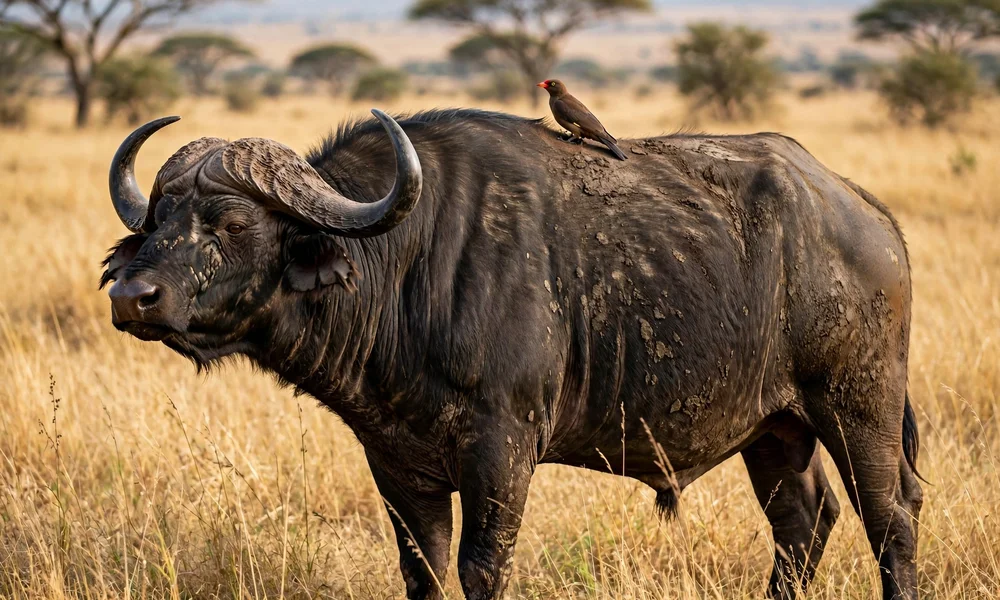
An African buffalo is a massive wild ox with dark brown or black hide, huge curving horns, a heavy head and a broad chest, and it measures roughly 2.1 to 3.4 metres long and usually weighs between 500 and 900 kilogrammes, with bulls larger than cows. The Cape buffalo of southern and eastern Africa is the largest of the four subspecies, while the forest buffalo of the Congo rainforest is the smallest, with reddish fur and smaller horns.
The horns define the African buffalo: thick horns that curve out and down and then up again, meeting in the middle of the forehead in a solid bony shield called the boss. The boss protects the skull in fights, and bulls clash their heads together in contests for dominance, the sound carrying across the plain. Like other bison, the African buffalo has a heavy shoulder hump and short strong legs, and it can charge at up to 57 kilometres per hour, faster than a lion over a short distance.
The African buffalo species and their relatives
There is one African buffalo species, Syncerus caffer, and it is split into four subspecies. The Cape buffalo lives in the savannas of southern and eastern Africa, and it is the largest and darkest of the four. The forest buffalo lives in the rainforests of Central Africa, where it is smaller and redder, and the Sudan buffalo and Nile buffalo live in the savannas of West and East Africa.
The American bison is the African buffalo’s most famous relative, a huge grazer of the North American plains with a shaggy hump, while the water buffalo is a large buffalo of Asia that wallows in rivers and swamps. The gaur is the largest wild ox in the world, living in the forests of India and Southeast Asia, and the yak is a shaggy ox of the high Himalayas. The common eland is the largest antelope in Africa, and domestic cattle descend from the wild aurochs of Eurasia.
| Type | Animal | Where it lives | Best-known food | Length or Weight |
|---|---|---|---|---|
| Species | African buffalo (Syncerus caffer) | Savanna, swamp and forest of Africa | Grass | 2.1 to 3.4 m, 500 to 900 kg |
| Close relative | American bison | Plains of North America | Grass and sedges | 2.1 to 3.5 m, 450 to 1,000 kg |
| Close relative | Water buffalo | Rivers and swamps of Asia | Grass and water plants | 2.4 to 3 m, 700 to 1,200 kg |
| Close relative | Gaur | Forests of India and Southeast Asia | Grass, leaves and bamboo | 2.5 to 3.3 m, 650 to 1,500 kg |
| Close relative | Yak | High mountains of Central Asia | Grass and herbs | 2.5 to 3.3 m, 305 to 1,000 kg |
| Close relative | Common eland | Savanna of eastern and southern Africa | Leaves, grass and fruit | 2 to 3.4 m, 400 to 940 kg |
| Close relative | Domestic cattle | Farms worldwide | Grass and hay | 1.5 to 2.5 m, 450 to 1,100 kg |
How African buffalo live
African buffalo are creatures of the open savanna. An African buffalo lives in a herd, a group of 50 to 500 animals that graze, rest and travel together, and herds join into huge gatherings of more than 1,000 animals in the wet season, when grass is plentiful. Like other lions, the buffalo’s main enemy, the herd is its defence, and a lone buffalo is far easier prey than one in a herd.
Grass makes up most of the diet, along with leaves and the occasional herb, and an African buffalo eats by grazing for hours each day, tearing grass with its tongue and broad muzzle. It drinks water every day, and it wallows in mud to cool down and to shake off biting flies, coating its hide in a layer of dried mud. Oxpeckers ride on the buffalo’s back, picking off ticks and warning the herd with sharp calls when danger is near.
Breeding happens all year round, though most calves are born in the wet season, when grass is plentiful, and after a gestation of about 11 months the cow gives birth to a single calf, weighing about 40 kilogrammes. The calf stays close to its mother for its first months, hiding in the long grass, and it joins the herd as it grows, staying with the herd for life if it is a cow, while bulls leave to join bachelor groups. African buffalo live for around 20 years in the wild, and up to 25 years or more.
Where African buffalo live
The African buffalo lives across sub-Saharan Africa, from Senegal in the west to Ethiopia in the east and South Africa in the south, and it is most common in the savannas of Kenya, Tanzania, Zambia and Botswana, where grass and water are plentiful. It is seen regularly in the Serengeti, the Okavango Delta and Kruger National Park, where huge herds graze the plains.
Grass and water are the key requirements. An African buffalo needs open grassland to graze in, and water to drink every day, so it follows the rains as they move across the savanna, and when the dry season comes the herds gather around the remaining waterholes. It depends on the grass staying plentiful, and it grazes the same plains year after year, returning to the same waterholes.
The species is listed as Least Concern, and its numbers are stable across most of its range. Roughly 400,000 African buffalo live in Africa, and the species is one of the most numerous large mammals on the continent. The main pressures are the loss of grassland to farming, disease spread from domestic cattle, and hunting, though the buffalo’s size and temper keep most hunters at bay.
Best seasons for African buffalo watching
There is no closed season, because African buffalo are active all year, but the best time to look for them depends on where you go. In the Serengeti the best months are often June to October, the dry season, when the herds gather around the waterholes. In the Okavango Delta the best months are often May to September, when the flood waters bring the herds to the islands.
Staying safe around African buffalo
An African buffalo is a wild animal with great strength and sharp horns, and it can kill a person with a single charge, and buffalo injure more hunters in Africa than any other animal. Keep your distance, never approach a buffalo herd, and never try to touch or feed a buffalo, because a buffalo that feels cornered will charge without warning. If you see buffalo, stay in your vehicle or behind a guide, and watch with binoculars, because buffalo that are disturbed may stampede and the calves may be lost.
African buffalo watching checklist
A little preparation turns a safari visit into a real chance of seeing an African buffalo, so pack for sun, dust and long quiet hours.
- Binoculars with good low-light performance, for picking a dark herd out of the grass.
- A camera with a zoom lens, because buffalo should always be watched from a distance.
- Sun cream and a hat, because the best watching is in the bright midday sun.
- A booked safari with a guide who knows the buffalo herds and the safe routes.
- A plan to be out in the morning, when the buffalo are most active and grazing.
- Patience and silence, because buffalo are wary animals and a noisy group will send them away.
- A field guide to African mammals, for telling a Cape buffalo from a forest buffalo at a glance.
Frequently asked questions
How many African buffalo species are there?
There is one African buffalo species, Syncerus caffer. It is split into four subspecies, the Cape, forest, Sudan and Nile buffalo, but they are all the same species, and the African buffalo is not closely related to the American bison, despite the shared name.
Why are African buffalo called the Black Death?
African buffalo are called the Black Death because they are one of the most dangerous animals in Africa, and they injure more hunters than any other animal. A wounded buffalo will turn and charge, and it can gore a person with its horns or trample them underfoot, and old bulls are the most dangerous of all.
Do African buffalo have any predators?
Lions are the main predators of African buffalo, and a pride will work together to bring down a calf or a weak adult. Buffalo defend themselves by forming a circle around the calves, with the bulls facing outwards, and they have been known to kill lions that come too close.
Can you keep an African buffalo as a pet?
No. An African buffalo is a wild animal that needs the savanna, eats grass by the kilogramme, and is fully protected by law in most of the countries where it lives. Buffalo in zoos need huge enclosures with grassland and water, and they are not pets.
How is this guide different from the mandrill species guide?
This guide covers the single African buffalo species, a horned grazer that lives in herds of hundreds on the African savanna, while our mandrill species guide covers the single mandrill species, a colourful monkey that lives in huge troops on the rainforest floor of Central Africa. The buffalo weighs up to 900 kilogrammes and charges at 57 kilometres per hour, and the mandrill weighs up to 35 kilogrammes and forages on the forest floor.
Are African buffalo endangered?
African buffalo are listed as Least Concern, so they are not classed as endangered. Roughly 400,000 animals live across Africa, and the species is one of the most numerous large mammals on the continent, though the loss of grassland to farming is the main threat.
Conclusion
The African buffalo species shows how much power one animal can hold: a single species of horned grazer, with a fused horn boss, herds of hundreds, and a temper that has earned it a place among the Big Five.
If you go looking for one, go in the dry season to the Serengeti or Kruger, go quietly, and go with patience. Watch a herd of African buffalo grazing the plain and you will understand why it has earned its place as the most feared grazer of Africa, and why keeping its grassland matters most.