The mandrill species is a single species, Mandrillus sphinx, a colourful monkey of the Central African rainforest, and the largest monkey in the world. If you are asking how many mandrill species there are, the answer is one: there is only one mandrill species in the world, and every mandrill alive today belongs to it.
The mandrill belongs to the family Cercopithecidae, the Old World monkeys, and it lives in the rainforests of Central Africa, from Cameroon and Equatorial Guinea to Gabon and the Congo. Its vivid blue and red face, its huge size, and its enormous troops make it one of the most spectacular monkeys on Earth.
Key takeaways
- There is only one mandrill species, Mandrillus sphinx, and it is the largest monkey in the world.
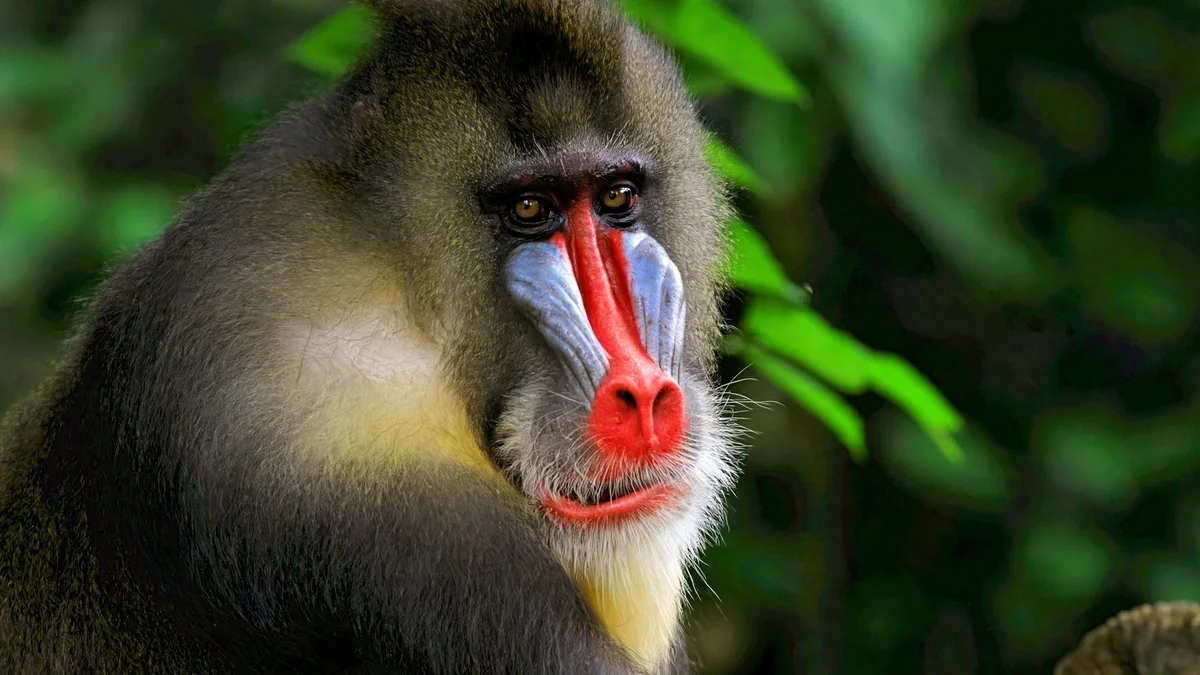
- Male mandrills have the most colourful faces of any mammal, with blue ridges, a red nose and a yellow beard.
- Mandrills live in troops of hundreds, and super-groups of more than 600 animals have been seen in Gabon.
- Mandrills spend most of their lives on the forest floor, though they climb trees to sleep and to feed.
- Mandrills are listed as Vulnerable, and hunting and the loss of rainforest are the main threats.
What makes a mandrill a mandrill
A mandrill is a large monkey with olive-brown fur, a vivid blue and red face, a yellow beard and a short stubby tail, and it measures roughly 55 to 95 centimetres long and usually weighs between 10 and 35 kilogrammes, with males far larger than females. The male is the largest monkey in the world, weighing up to 35 kilogrammes, while the female weighs about half as much and has a duller face.
The face defines the mandrill: a long muzzle with blue ridges on either side, a bright red nose and upper lip, and a yellow beard, colours that grow brighter when the male is excited or dominant. Its backside is just as colourful, with blue, red and purple skin that it shows off when it walks. Like other baboons, the mandrill has cheek pouches for storing food and long canine teeth for fighting, but it is a forest monkey, not a savanna monkey, and it lives in the thick rainforest of Central Africa.
The mandrill species and their relatives
There is one mandrill species, Mandrillus sphinx, and it is the only living member of its species. Mandrills in different parts of the rainforest form separate troops, from Cameroon to the Congo, but they are all the same species, and the troops join into huge super-groups when fruit is plentiful.
The drill is the mandrill’s closest relative, a large monkey of the same forests with a black face and a smaller range, while the baboon is a large monkey of the African savanna with a dog-like muzzle. The gelada is a grass-eating monkey of the Ethiopian highlands, the macaque is a monkey of Asia and North Africa, and the langur is a leaf-eating monkey of Asia. The colobus monkey is a black and white monkey of the African forests, and the guenon is a small colourful monkey of the African forests.

| Type | Animal | Where it lives | Best-known food | Length or Weight |
|---|---|---|---|---|
| Species | Mandrill (Mandrillus sphinx) | Rainforests of Central Africa | Fruit, seeds and insects | 55 to 95 cm, 10 to 35 kg |
| Close relative | Drill | Rainforests of Nigeria, Cameroon and Bioko | Fruit, seeds and insects | 60 to 75 cm, 12 to 25 kg |
| Close relative | Olive baboon | Savanna of sub-Saharan Africa | Fruit, grass, insects and small animals | 50 to 110 cm, 10 to 37 kg |
| Close relative | Gelada | Highlands of Ethiopia | Grass and herbs | 50 to 75 cm, 13 to 20 kg |
| Close relative | Rhesus macaque | Asia, from Afghanistan to China | Fruit, seeds, leaves and insects | 47 to 64 cm, 5 to 12 kg |
| Close relative | Colobus monkey | Forests of sub-Saharan Africa | Leaves, fruit and flowers | 45 to 70 cm, 5 to 15 kg |
| Close relative | Guenon | Forests of sub-Saharan Africa | Fruit, insects and leaves | 40 to 70 cm, 3 to 10 kg |
How mandrills live
Mandrills are creatures of the rainforest floor. A mandrill lives in a troop, a group of 20 to 50 animals that feed, rest and travel together, and troops join into huge super-groups of more than 600 animals when fruit is plentiful, the largest monkey gatherings in the world. Like other African animals, it follows the fruiting seasons, moving through the forest as different trees come into fruit.
Fruit makes up most of the diet, along with seeds, leaves, insects, fungi and the occasional small vertebrate, and a mandrill eats by foraging on the forest floor, turning over leaves for insects and cracking nuts with its powerful jaws. It stores food in its cheek pouches, carrying it to a safe place to eat, and it climbs trees to feed on fruit and to sleep at night.
Breeding happens once a year, in the dry season, when food is plentiful, and after a gestation of about six months the female gives birth to a single baby, which clings to her belly for its first weeks. The babies are born with a black face and pink skin, and their colours develop as they grow, and the young are weaned at about a year, though they stay with their mothers for several years. Mandrills live for around 20 years in the wild, and up to 40 years in captivity.
Where mandrills live
The mandrill lives in the rainforests of Central Africa, from the Sanaga river in Cameroon through Equatorial Guinea and Gabon to the Congo, and it is most common in the lowland rainforest of Gabon, where the fruiting trees are thickest. It is seen regularly in Lope National Park in Gabon, where the super-groups of hundreds of mandrills gather in the fruiting season.
Rainforest is the key requirement. A mandrill needs thick forest with fruiting trees to feed from and tall trees to sleep in, so it follows the fruit as it ripens, and when the forest is cleared the mandrill has nowhere to live. It stays mostly on the forest floor, where the fallen fruit and insects are thickest, and it climbs into the trees only to feed and sleep.
The species is listed as Vulnerable, and its numbers are falling across its range. The main pressures are hunting for bushmeat, which takes thousands of mandrills every year, and the loss of rainforest to farming and logging. Mandrills live in a small range, and they are hunted more than any other African primate, and the species is now fully protected in most of the countries where it lives.
Best seasons for mandrill watching
There is no closed season, because mandrills are active all year, but the best time to look for them depends on where you go. In Gabon the best months are often June to September, the dry season, when the super-groups gather in the fruiting trees of Lope National Park. In Cameroon the best months are often December to February, when the troops are large and easy to find near the rivers.
Staying safe around mandrills
A mandrill is a wild animal with sharp teeth and strong hands, and a large male can weigh 35 kilogrammes, though mandrills almost never attack people. Keep your distance, never approach a mandrill troop, and never try to touch or feed a mandrill, because a frightened troop may stampede and the young may be lost. If you see mandrills feeding, stay on the path and watch with binoculars, because mandrills that are disturbed may leave their feeding trees for good.
Mandrill watching checklist
A little preparation turns a rainforest visit into a real chance of seeing a mandrill, so pack for heat, humidity and long quiet hours.
- Binoculars with good low-light performance, for picking a colourful face out of the green forest.
- A camera with a long lens, because mandrills should always be watched from a distance.
- Sun cream and a hat, because the best watching is in the bright morning sun.
- A booked tour with a guide who knows the mandrill troops and the fruiting trees.
- A plan to be out in the morning, when the mandrills are most active and feeding.
- Patience and silence, because mandrills are shy animals and a noisy group will send them away.
- A field guide to monkeys, for telling a mandrill from a drill at a glance.
Frequently asked questions
How many mandrill species are there?
There is one mandrill species, Mandrillus sphinx. Its closest relative is the drill, a large monkey of the same forests with a black face, but the drill is a separate species, and no second mandrill species is recognised.
Why are male mandrills so colourful?
Male mandrills are so colourful because their faces signal their rank and health. The blue ridges, red nose and yellow beard grow brighter when the male is dominant, and females choose the brightest males, while rival males judge each other by the colour of their faces.
How big are mandrill troops?
Mandrill troops usually number 20 to 50 animals, but troops join into super-groups of more than 600 animals when fruit is plentiful, the largest monkey gatherings in the world. The super-groups were first recorded in Lope National Park in Gabon, where hundreds of mandrills feed together in the fruiting season.
Can you keep a mandrill as a pet?
No. A mandrill is a wild animal that needs rainforest, lives in troops of dozens, and is fully protected by law in most of the countries where it lives. Mandrills in zoos need huge enclosures with trees and climbing frames, and they are not pets.
How is this guide different from the American black bear species guide?
This guide covers the single mandrill species, a colourful monkey that lives in huge troops on the rainforest floor of Central Africa, while our American black bear species guide covers the single American black bear species, a forest bear that climbs trees and eats berries in North America. The mandrill weighs up to 35 kilogrammes and lives in troops of hundreds, and the bear weighs up to 300 kilogrammes and lives alone.
Are mandrills endangered?
Mandrills are listed as Vulnerable, so they are not classed as endangered, but their numbers are falling. Hunting for bushmeat is the main threat, and the loss of rainforest to farming and logging is the second.
Conclusion
The mandrill species shows how much colour one animal can hold: a single species of monkey, with a face of blue and red, troops of hundreds, and a life spent foraging on the rainforest floor of Central Africa.
If you go looking for one, go in the dry season to Lope National Park in Gabon, go quietly, and go with patience. Watch a troop of mandrills moving through the forest and you will understand why it has earned its place as the most colourful monkey on Earth, and why keeping its rainforest matters most.