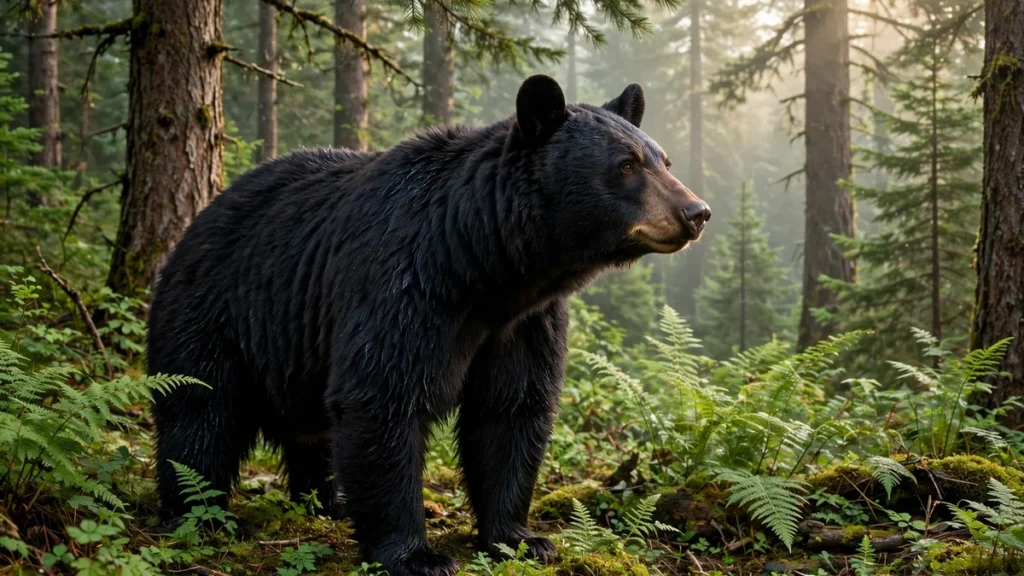
The American black bear species is a single species, Ursus americanus, a forest bear of North America, and the most common bear on the continent. If you are asking how many American black bear species there are, the answer is one: there is only one American black bear species in the world, though it is split into 16 subspecies, and every American black bear alive today belongs to it.
The American black bear belongs to the family Ursidae, the bears, and it lives in the forests of North America, from Alaska and Canada to Mexico. Its glossy fur, its brown muzzle, its tree-climbing skill and its many colour phases make it one of the most familiar bears in the world.
Key takeaways
- There is only one American black bear species, Ursus americanus, and it is split into 16 subspecies.
- American black bears are not always black, and they come in brown, cinnamon, blonde and even white colour phases.
- American black bears are expert tree climbers, and cubs climb trees to escape danger.
- American black bears are omnivores that eat mostly plants, with berries, nuts and insects making up most of the diet.
- American black bears are listed as Least Concern, with roughly 800,000 animals in North America.
What makes an American black bear an American black bear
An American black bear is a medium-sized bear with glossy fur, a brown muzzle, a straight face profile and no shoulder hump, and it measures roughly 1.2 to 2 metres long and usually weighs between 60 and 300 kilogrammes, with males larger than females. The largest males can weigh more than 400 kilogrammes, and the smallest females weigh less than 60 kilogrammes.
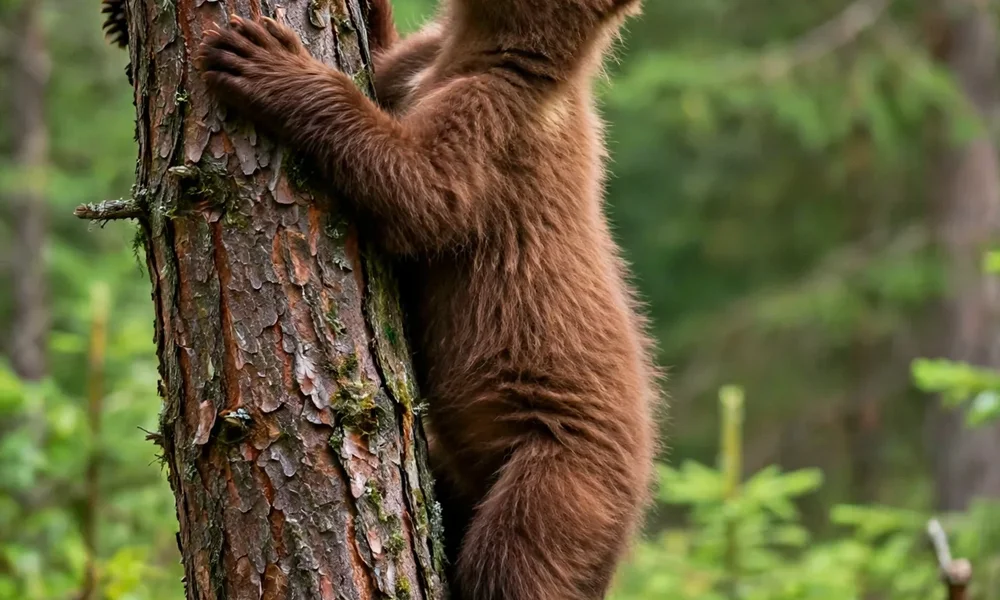
The colour defines the American black bear: not always black, but brown, cinnamon, blonde, blue-grey and even white, with the white Kermode bear, or spirit bear, of British Columbia one of the rarest colour phases in the world. Its claws are short and curved, built for climbing trees rather than digging, and it is the best climber of all the bears, able to climb a tree in seconds. Like other bears, the American black bear has a powerful sense of smell, seven times better than a bloodhound’s, and it can smell food from kilometres away.
The American black bear species and their relatives
There is one American black bear species, Ursus americanus, and it is split into 16 subspecies. The eastern black bear lives in the forests of eastern North America, the western black bear lives in the forests of the west, and the Kermode bear lives only on the central coast of British Columbia, where about one in ten bears is white.
The grizzly bear is the American black bear’s most famous relative, a huge bear of the mountains with a shoulder hump and long claws, while the polar bear is the largest land predator on Earth, a white bear of the Arctic ice. The brown bear is the grizzly bear’s Eurasian cousin, the Asiatic black bear is a black bear of the forests of Asia with a white chest mark, and the sloth bear is a shaggy bear of India that eats termites. The sun bear is the smallest bear in the world, and the spectacled bear is the only bear of South America.
| Type | Animal | Where it lives | Best-known food | Length or Weight |
|---|---|---|---|---|
| Species | American black bear (Ursus americanus) | Forests of North America | Berries, nuts and insects | 1.2 to 2 m, 60 to 300 kg |
| Close relative | Grizzly bear | Mountains of North America | Berries, roots, fish and mammals | 1.5 to 2.8 m, 100 to 600 kg |
| Close relative | Polar bear | Arctic ice and coasts | Seals, especially ringed seals | 2 to 3 m, 350 to 700 kg |
| Close relative | Brown bear | Forests and mountains of Eurasia | Berries, roots, fish and mammals | 1.4 to 2.8 m, 100 to 600 kg |
| Close relative | Asiatic black bear | Forests of Asia | Fruit, nuts, insects and honey | 1.2 to 1.9 m, 65 to 200 kg |
| Close relative | Sloth bear | Forests of India and Sri Lanka | Termites, ants and fruit | 1.4 to 1.9 m, 55 to 145 kg |
| Close relative | Sun bear | Rainforests of Southeast Asia | Insects, fruit and honey | 1 to 1.5 m, 27 to 80 kg |
How American black bears live
American black bears are creatures of the forest. An American black bear lives alone, except for a mother with cubs, roaming the forest by day and night and denning in a hollow tree or a rock cave in winter, and it can roam over a home range of up to 100 square kilometres. Like other bears, it follows the seasons, moving with the berries and nuts as they ripen.
Berries, nuts, insects and plants make up most of the diet, along with fish, small mammals, carrion and honey, and an American black bear eats by stripping berries from bushes, turning over logs for grubs, and catching salmon in the rivers. It eats about 85 per cent plant matter, and it can eat up to 20,000 calories a day in autumn, putting on fat for the winter den.
Breeding happens in summer, and after a gestation of about seven months the female gives birth to one to four cubs, usually two, in the winter den, where the cubs are born tiny and blind, weighing only 200 to 450 grammes. The cubs stay in the den for their first months, nursing on their mother’s rich milk, and they leave the den in spring, staying with their mother for about a year and a half, learning to climb, fish and find food. American black bears live for around 18 to 25 years in the wild, and up to 30 years or more.
Where American black bears live
The American black bear lives in the forests of North America, from Alaska and Canada through the United States to Mexico, and it is most common in the forests of the Rocky Mountains, the Appalachians and the Pacific coast, where berries and nuts are plentiful. It is seen regularly in the Great Smoky Mountains, Yosemite and Yellowstone, where the bears feed in the meadows and climb the trees.
Forest is the key requirement. An American black bear needs dense forest with plenty of berries, nuts and insects to eat, and hollow trees or rock caves to den in, so it follows the food as it ripens with the seasons, and when the forest is cleared the bears have nowhere to live. It depends on the autumn mast, the nuts and berries that fatten it for winter, and it roams the forest all day, looking for food.
The species is listed as Least Concern, and its numbers are stable or rising across most of its range. Roughly 800,000 American black bears live in North America, and the species is the most common bear on the continent. The main pressures are the loss of forest to development, collisions with cars, and conflict with people, when bears that learn to raid bins and campsites are killed as nuisances.
Best seasons for American black bear watching
There is no closed season, because American black bears are active from spring to autumn, but the best time to look for them depends on where you go. In the Great Smoky Mountains the best months are often May to October, when the bears feed in the meadows and climb the trees. In Alaska the best months are often July to September, when the bears catch salmon in the rivers.
Staying safe around American black bears
An American black bear is a wild animal with great strength and sharp claws, and it can hurt a person badly, though black bears almost never attack people. Keep your distance, never approach a bear with cubs, and never try to touch or feed a bear, because a bear that learns to take food from people is more likely to be killed as a nuisance. If you see a bear, stay calm, make yourself look big, make noise, and back away slowly, and never run, because a bear can outrun a person.
American black bear watching checklist
A little preparation turns a forest visit into a real chance of seeing an American black bear, so pack for sun, rain and long quiet hours.
- Binoculars with good low-light performance, for picking a dark bear out of the forest.
- A camera with a zoom lens, because bears should always be watched from a distance.
- Sun cream and a hat, because the best watching is in the bright midday sun.
- Bear spray, carried where it can be reached quickly, for safety in bear country.
- A plan to be out in the morning, when the bears are most active and feeding.
- Patience and silence, because bears are shy animals and a noisy group will send them away.
- A field guide to bears, for telling a black bear from a grizzly bear at a glance.
Frequently asked questions
How many American black bear species are there?
There is one American black bear species, Ursus americanus. It is split into 16 subspecies, including the eastern black bear, the western black bear and the white Kermode bear, but they are all the same species.
Are American black bears always black?
No. American black bears come in black, brown, cinnamon, blonde, blue-grey and even white colour phases. The colour depends on where the bear lives, with black bears most common in the east and brown and cinnamon bears most common in the west, and the white Kermode bear lives only in British Columbia.
Can American black bears climb trees?
Yes. American black bears are the best climbers of all the bears, thanks to their short curved claws and strong legs, and cubs climb trees to escape danger, while adults climb to reach fruit and nuts and to rest in the branches.
Can you keep an American black bear as a pet?
No. An American black bear is a wild animal that needs the forest, eats up to 20,000 calories a day in autumn, and is fully protected by law in most of the places where it lives. Black bears in rescue centres are there to recover from injury, and they are not pets.
How is this guide different from the elephant seal species guide?
This guide covers the single American black bear species, a forest bear that climbs trees and eats berries in North America, while our elephant seal species guide covers two elephant seal species, giant seals that dive 2,000 metres deep in the cold oceans. The bear weighs up to 300 kilogrammes and climbs trees, and the seal weighs up to 4,000 kilogrammes and dives for two hours.
Are American black bears endangered?
American black bears are listed as Least Concern, so they are not classed as endangered. Roughly 800,000 animals live in North America, and the species is the most common bear on the continent, though conflict with people is the main threat.
Conclusion
The American black bear species shows how much variety one animal can hold: a single species of forest bear, in black, brown, cinnamon, blonde and white, with cubs that climb trees and a nose that can smell food from kilometres away.
If you go looking for one, go in the summer to the Great Smoky Mountains or Yosemite, go quietly, and go with patience. Watch an American black bear climb a tree in the forest and you will understand why it has earned its place as the most familiar bear of North America, and why keeping its forest matters most.