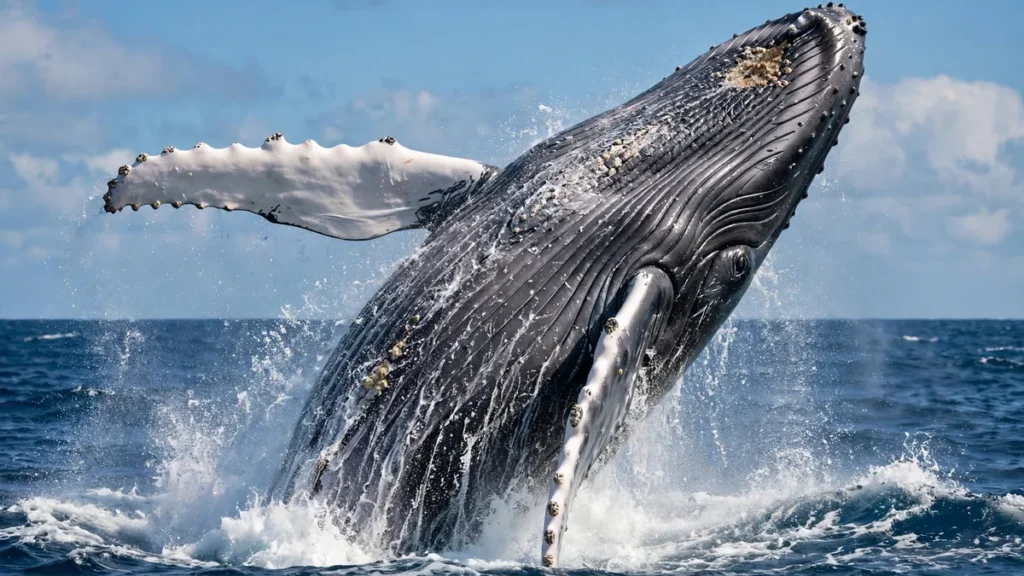
The humpback whale species is a single species, Megaptera novaeangliae, a singing whale of the open oceans, and one of the most acrobatic whales on Earth. If you are asking how many humpback whale species there are, the answer is one: there is only one humpback whale species in the world, and every humpback whale alive today belongs to it.
The humpback whale belongs to the family Balaenopteridae, the rorqual whales, and it lives in every ocean in the world, from the polar seas to the tropics. Its long pectoral fins, its knobbly head, its haunting songs and its spectacular breaches make it one of the most famous whales on Earth.
Key takeaways
- There is only one humpback whale species, Megaptera novaeangliae, and it lives in every ocean in the world.
- Humpback whales have the longest pectoral fins of any whale, up to 5 metres long, which is why their scientific name means big wing.
- Male humpback whales sing complex songs that can last for hours, and the songs change from year to year.
- Humpback whales make one of the longest migrations of any mammal, travelling up to 8,000 kilometres between feeding and breeding grounds.
- Humpback whales are listed as Least Concern, after recovering from near extinction by whaling.
What makes a humpback whale a humpback whale
A humpback whale is a large baleen whale with a knobbly head, a small hump before its dorsal fin, and enormously long pectoral fins, and it measures roughly 12 to 16 metres long and usually weighs between 25 and 40 tonnes, with females larger than males. The calf is born about 4 to 5 metres long and weighs around 900 kilogrammes.
The fins define the humpback whale: pectoral fins up to 5 metres long, the longest of any whale, with knobbly leading edges that help the whale turn sharply in the water. Its head is covered in bumps called tubercles, each with a single hair, and its tail fluke has a pattern of black and white that is different on every animal, like a fingerprint, so researchers can tell whales apart by sight. Like other whales, the humpback whale breathes air through blowholes on top of its head, and it can hold its breath for up to 45 minutes, though it usually surfaces every few minutes.
The humpback whale species and their relatives
There is one humpback whale species, Megaptera novaeangliae, and it is the only living member of its genus. Humpback whales in different oceans form separate populations, in the North Atlantic, the North Pacific and the Southern Ocean, but they are all the same species, and the whales migrate thousands of kilometres between their feeding and breeding grounds.
The blue whale is the humpback whale’s largest relative, the biggest animal that has ever lived, while the fin whale is the second largest whale in the world, a fast swimmer of the open ocean. The sei whale is a sleek whale of the deep ocean, the Bryde’s whale is a tropical whale of warm seas, and the minke whale is the smallest of the rorquals. The grey whale is a whale of the shallow coastal seas that feeds on the sea floor, and the right whale is a slow whale with no dorsal fin and a huge head.
| Type | Animal | Where it lives | Best-known food | Length or Weight |
|---|---|---|---|---|
| Species | Humpback whale (Megaptera novaeangliae) | Every ocean, polar seas to tropics | Krill and small schooling fish | 12 to 16 m, 25 to 40 tonnes |
| Close relative | Blue whale | Every ocean, deep open water | Krill | 24 to 30 m, 100 to 200 tonnes |
| Close relative | Fin whale | Every ocean, deep open water | Krill, small fish and squid | 18 to 27 m, 40 to 80 tonnes |
| Close relative | Sei whale | Deep oceans worldwide | Krill, copepods and small fish | 12 to 18 m, 20 to 30 tonnes |
| Close relative | Bryde’s whale | Tropical and warm temperate seas | Small fish, krill and squid | 12 to 16 m, 12 to 25 tonnes |
| Close relative | Minke whale | Every ocean, coastal and open water | Krill and small fish | 7 to 10 m, 5 to 10 tonnes |
| Close relative | Grey whale | Shallow coastal seas, North Pacific | Amphipods from the sea floor | 11 to 15 m, 15 to 35 tonnes |
How humpback whales live
Humpback whales are creatures of the open ocean. A humpback whale lives alone or in a small group, feeding in the cold polar seas in summer and breeding in the warm tropical seas in winter, and it migrates between the two, travelling up to 8,000 kilometres each way. Like other whales, it is a traveller, and it follows the seasons, moving north in summer and south in winter.
Krill and small schooling fish make up most of the diet, along with herring, sand eels and capelin, and a humpback whale eats up to 1.5 tonnes of food a day in the feeding season. It hunts by bubble-net feeding, blowing a ring of bubbles around a shoal of fish to trap them, then lunging through the middle with its mouth open, and several whales often hunt together, taking turns to blow the bubbles and lunge.
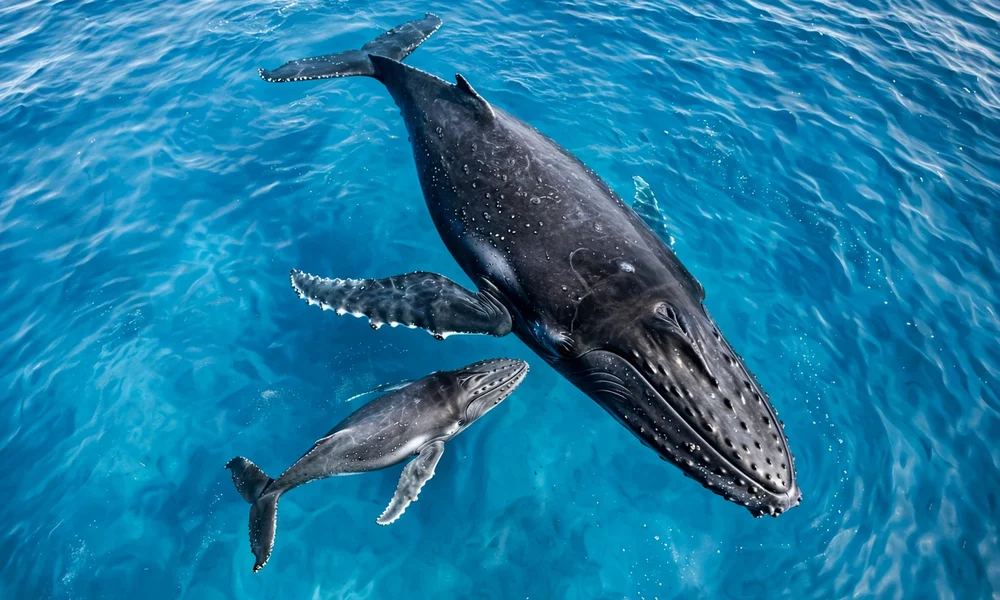
Breeding happens in the warm tropical seas in winter, and after a gestation of about 11 months the female gives birth to a single calf, usually in shallow water, where the calf can reach the surface easily. The calf is born about 4 to 5 metres long, weighing around 900 kilogrammes, and it nurses for about a year, drinking up to 400 litres of rich milk a day, and staying with its mother for a year or more. Humpback whales live for around 45 to 100 years in the wild, with some animals living to 90 years or more.
Where humpback whales live
The humpback whale lives in every ocean in the world, from the polar seas to the tropics, and it is most common in the cold feeding grounds of Alaska, Antarctica and Norway in summer, and the warm breeding grounds of Hawaii, the Caribbean and Tonga in winter. The North Pacific population migrates between Alaska and Hawaii, the North Atlantic population migrates between Norway and the Caribbean, and the Southern Ocean population migrates between Antarctica and Tonga, Australia and South America.
Cold rich water is the key requirement in summer. A humpback whale needs cold seas full of krill and small fish to feed in, and warm shallow seas to breed in, so it follows the seasons as they change, and when the seas warm the whales move towards the poles. It depends on the krill staying plentiful, and it feeds in the same grounds year after year, returning to the same bays and banks.
The species is listed as Least Concern, and its numbers have recovered strongly since whaling ended. Whalers killed hundreds of thousands of humpback whales in the twentieth century, reducing some populations to a few thousand animals, but protection since the 1960s has let them recover, and the world population is now estimated at around 84,000 mature animals. The main pressures today are entanglement in fishing gear, ship strikes, ocean noise and the loss of krill to warming seas.
Best seasons for humpback whale watching
There is no closed season, because humpback whales are active all year, but the best time to look for them depends on where you go. In Hawaii the best months are often January to March, when the whales breed in the warm shallow seas. In Alaska the best months are often June to September, when the whales feed in the cold bays, and in Tonga the best months are often July to October, when the whales come to breed.
Staying safe around humpback whales
A humpback whale is a wild animal with great strength and a tail as wide as a car, and it can hurt a person by accident, though humpback whales almost never attack people. Keep your distance, never chase a whale, and never try to touch or swim with one, because a whale that is disturbed may dive and leave its feeding ground for good. If you see whales from a boat, keep the engine slow, stay in marked channels, and watch for their backs breaking the surface.
Humpback whale watching checklist
A little preparation turns a coast visit into a real chance of seeing a humpback whale, so pack for cold wind, bright glare and long quiet hours.
- Binoculars with good low-light performance, for picking a dark back out of the water.
- A camera with a zoom lens, because whales should always be watched from a distance.
- Warm clothes and a windproof jacket, because the best watching is on cold coastal mornings.
- A polarised pair of sunglasses, for cutting the glare and seeing into the water.
- A booked boat tour with a guide who knows the whale grounds and the safe routes.
- A plan to be out in the morning, when the whales are most active and feeding.
- Patience and silence, because whales are shy animals and a noisy group will send them away.
Frequently asked questions
How many humpback whale species are there?
There is one humpback whale species, Megaptera novaeangliae. It is the only living member of its genus, and its closest relatives are the other rorqual whales, the blue, fin, sei and minke whales. No second humpback whale species is recognised.
Why do humpback whales sing?
Male humpback whales sing to attract females and to challenge other males. The songs are complex, lasting up to 20 minutes and repeated for hours, and they change from year to year, with all the males in one ocean singing the same song at the same time.
How far do humpback whales migrate?
Humpback whales migrate up to 8,000 kilometres each way between their feeding and breeding grounds, one of the longest migrations of any mammal. A whale that feeds in Alaska in summer breeds in Hawaii in winter, and a whale that feeds in Antarctica breeds in Tonga or Australia.
Can you keep a humpback whale as a pet?
No. A humpback whale is a wild animal that needs the open ocean, eats more than a tonne of krill a day, and is fully protected by law in every ocean where it lives. Whales in aquariums do not exist, and they are not pets.
How is this guide different from the harpy eagle species guide?
This guide covers the single humpback whale species, a singing whale that migrates 8,000 kilometres across the open oceans, while our harpy eagle species guide covers the single harpy eagle species, a forest eagle that hunts sloths in the rainforest canopy. The whale weighs up to 40 tonnes and sings for hours, and the eagle weighs up to 9 kilogrammes and hunts in silence.
Are humpback whales endangered?
Humpback whales are listed as Least Concern, so they are not classed as endangered. Whaling once reduced them to a few thousand animals, but protection has let them recover to around 84,000 mature animals, and entanglement in fishing gear is the main threat today.
Conclusion
The humpback whale species shows how much song and grace one animal can hold: a single species of singing whale, with fins like wings, songs that last for hours, and a life spent migrating 8,000 kilometres between the polar seas and the tropics.
If you go looking for one, go in the winter to Hawaii or Tonga, go quietly, and go with patience. Watch a humpback whale breach from the water and you will understand why it has earned its place as the singing whale of the seas, and why keeping its oceans clean matters most.