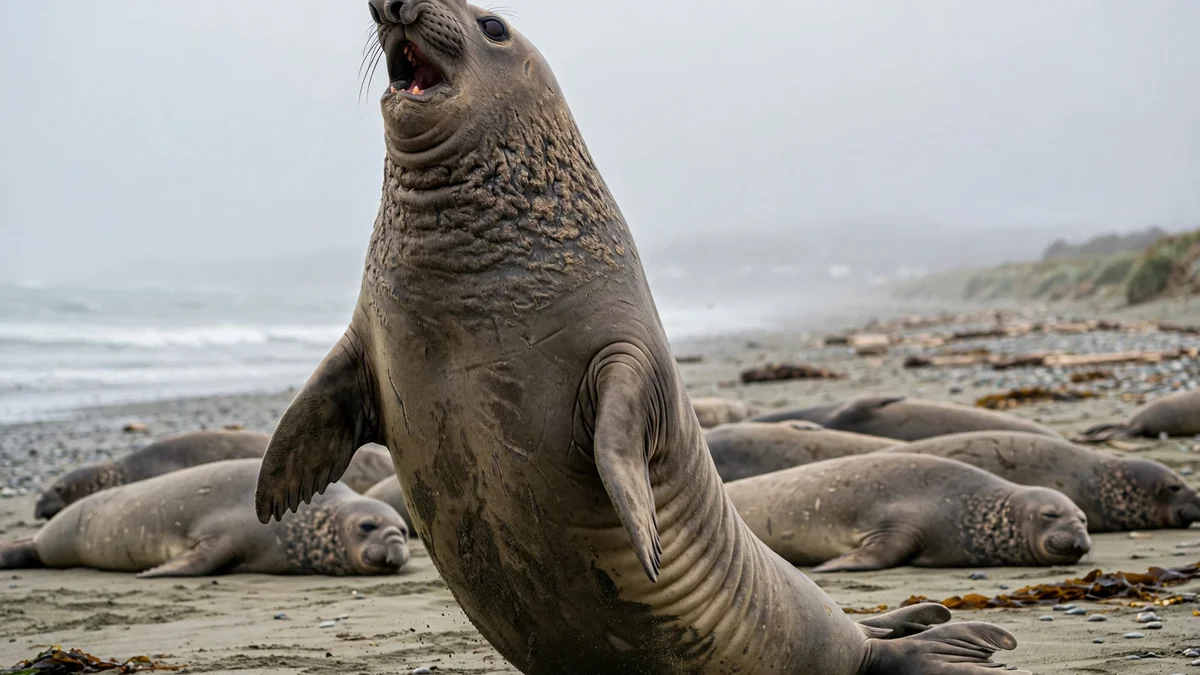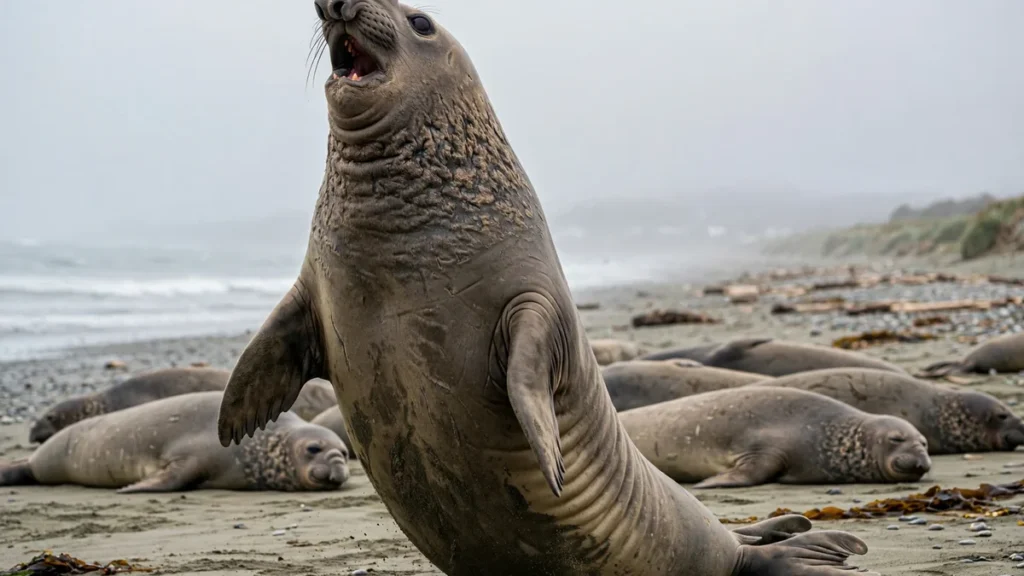
The elephant seal species number two, giant seals of the cold oceans, and they are the largest seals on Earth. If you are asking how many elephant seal species there are, the answer is two: there are two recognised elephant seal species in the world, the southern elephant seal and the northern elephant seal, and every elephant seal alive today belongs to one of them.
The elephant seal belongs to the family Phocidae, the true seals, and it lives in the cold oceans of the world, in the Southern Ocean around Antarctica and the sub-Antarctic islands, and in the North Pacific off North America. Its huge size, its trunk-like nose, and its deep dives make it one of the most remarkable seals on Earth.
Key takeaways
- There are two elephant seal species, and the southern elephant seal is the largest seal in the world.
- Male elephant seals have a trunk-like nose that they inflate to roar at rivals and attract females.
- Elephant seals are the deepest-diving seals, reaching depths of 2,000 metres and staying down for up to two hours.
- Elephant seals spend most of their lives at sea, coming ashore only to breed, moult and rest.
- Both elephant seal species are listed as Least Concern, after the northern elephant seal recovered from fewer than 100 animals.
What makes an elephant seal an elephant seal
An elephant seal is a huge seal with grey-brown skin, a blunt face, and, in the male, a long trunk-like nose, and it measures roughly 3 to 6 metres long and usually weighs between 400 and 4,000 kilogrammes, with males far larger than females. The southern elephant seal is the larger of the two, with males reaching up to 6 metres and 4,000 kilogrammes, while the northern elephant seal male reaches up to 5 metres and 2,700 kilogrammes.
The nose defines the elephant seal: a trunk that hangs over the mouth in the male, which he inflates like a balloon to make a deep roaring call that carries for kilometres across the beach. The trunk gives the animal its name, and it is used to impress females and warn off rivals, not for smelling. Like other seals, the elephant seal has no external ears and swims with its hind flippers, but it is a far deeper diver than any other seal, and it can dive to 2,000 metres and stay down for up to two hours.
The elephant seal species and their relatives
There are two elephant seal species. The southern elephant seal lives in the Southern Ocean around Antarctica and the sub-Antarctic islands, from South Georgia to Macquarie Island, and it is the largest seal in the world. The northern elephant seal lives in the North Pacific, from Alaska and British Columbia to Mexico, and it is slightly smaller, though still a giant, reaching up to 5 metres and 2,700 kilogrammes.
The walrus is the elephant seal’s most famous relative, a tusked pinniped of the Arctic that hauls out on the ice, while the grey seal is a large seal of the North Atlantic coasts. The harbour seal is a small spotted seal of the northern coasts, the Weddell seal is a seal of the Antarctic ice that dives deep under the ice, and the leopard seal is a spotted predator of the Antarctic that hunts penguins. The crabeater seal is the most numerous seal in the world, and the monk seal is a rare seal of the Mediterranean and Hawaii.
| Type | Animal | Where it lives | Best-known food | Length or Weight |
|---|---|---|---|---|
| Species | Southern elephant seal (Mirounga leonina) | Southern Ocean and sub-Antarctic islands | Squid, fish and sharks | Up to 6 m, up to 4,000 kg |
| Close relative | Northern elephant seal | North Pacific, Alaska to Mexico | Squid, fish and rays | Up to 5 m, up to 2,700 kg |
| Close relative | Walrus | Arctic coasts and ice | Clams, crabs and snails | 2.2 to 3.6 m, 800 to 2,000 kg |
| Close relative | Grey seal | North Atlantic coasts | Fish, squid and crustaceans | 1.6 to 2.5 m, 130 to 310 kg |
| Close relative | Harbour seal | Northern coasts worldwide | Fish, squid and crustaceans | 1.2 to 1.9 m, 55 to 170 kg |
| Close relative | Weddell seal | Antarctic ice and coast | Fish, squid and krill | 2.5 to 3.5 m, 400 to 600 kg |
| Close relative | Leopard seal | Antarctic pack ice | Penguins, krill and fish | 2.4 to 3.5 m, 200 to 600 kg |
How elephant seals live
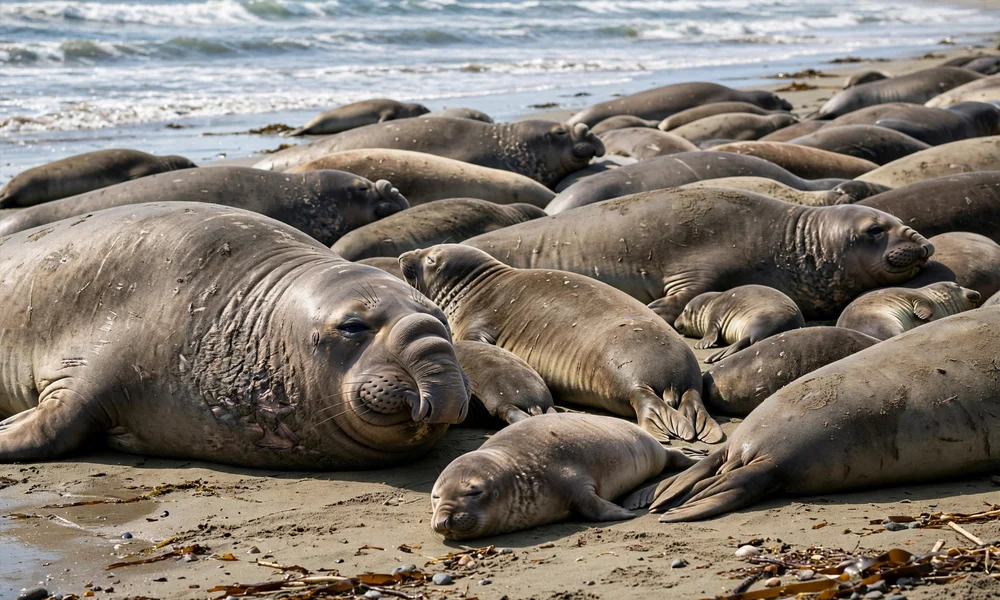
Elephant seals are creatures of the deep ocean. An elephant seal lives alone or in a colony, spending most of its life at sea, diving deep for food, and coming ashore only to breed, moult and rest, and it can spend months at sea without ever touching land. Like other walruses, it is a pinniped, but it is a far deeper diver, and it dives to depths no other seal can reach.
Squid makes up most of the diet, along with fish, sharks, rays and crustaceans, and an elephant seal eats by diving deep and catching its prey in the dark, using its whiskers to sense movement in the water. It dives for up to two hours at a time, reaching depths of 2,000 metres, and it spends about 90 per cent of its time underwater, surfacing only briefly to breathe before diving again.
Breeding happens in the southern summer for the southern elephant seal and in winter for the northern elephant seal, and the males arrive first, fighting for the best spots on the beach, where they gather harems of up to 50 females. After a gestation of about 11 months the female gives birth to a single pup, weighing about 40 kilogrammes, and she nurses it for about four weeks, feeding it milk so rich that the pup doubles its weight, then leaves it to fend for itself. The pups fast for weeks while they learn to swim, and elephant seals live for around 15 to 20 years in the wild, with females living longer than males.
Where elephant seals live
The elephant seal lives in the cold oceans of the world, in the Southern Ocean around Antarctica and the sub-Antarctic islands, and in the North Pacific off North America, and it is most common on the beaches of South Georgia, Macquarie Island and the California coast. The southern elephant seal breeds on South Georgia, Kerguelen, Heard Island and Macquarie Island, while the northern elephant seal breeds on the Channel Islands of California and the coast of Baja California.
Deep cold water is the key requirement. An elephant seal needs deep ocean to dive in, with plenty of squid and fish to eat, and a quiet beach to breed and moult on, so it follows the squid as they move with the seasons, and when the beach is disturbed the seals have nowhere to live. It depends on the squid staying plentiful, and it dives in the same waters year after year, returning to the same beaches.
Both species are listed as Least Concern, and their numbers have recovered strongly since sealing ended. Sealers hunted northern elephant seals almost to extinction in the nineteenth century, reducing them to fewer than 100 animals, but protection since the early twentieth century has let them recover to more than 170,000 animals. The southern elephant seal numbers around 650,000 animals, and the main pressures today are entanglement in fishing gear, ocean noise and the loss of squid to warming seas.
Best seasons for elephant seal watching
There is no closed season, because elephant seals are active all year, but the best time to look for them depends on where you go. In California the best months are often December to March, when the seals breed on the beaches of Año Nuevo and Piedras Blancas. In South Georgia the best months are often October to November, when the seals come ashore to breed.
Staying safe around elephant seals
An elephant seal is a wild animal with great strength and sharp teeth, and a bull can weigh as much as a car, though elephant seals almost never attack people. Keep your distance, never approach a seal colony, and never try to touch or feed a seal, because a frightened seal may stampede and crush its pups. If you see seals on a beach, stay behind the marked lines and watch with binoculars, because seals that are disturbed may leave their beach for good.
Elephant seal watching checklist
A little preparation turns a beach visit into a real chance of seeing an elephant seal, so pack for cold wind, bright glare and long quiet hours.
- Binoculars with good low-light performance, for picking a huge seal out of the colony.
- A camera with a zoom lens, because seals should always be watched from a distance.
- Warm clothes and a windproof jacket, because the best watching is on cold coastal mornings.
- A polarised pair of sunglasses, for cutting the glare and seeing into the water.
- A booked tour with a guide who knows the seal colonies and the safe routes.
- A plan to be out in the morning, when the seals are most active on the beach.
- Patience and silence, because seals are shy animals and a noisy group will send them away.
Frequently asked questions
How many elephant seal species are there?
There are two elephant seal species: the southern elephant seal and the northern elephant seal. The southern elephant seal is the larger of the two, reaching up to 6 metres and 4,000 kilogrammes, while the northern elephant seal reaches up to 5 metres and 2,700 kilogrammes.
Why do male elephant seals have trunks?
Male elephant seals have trunks to make their roars louder and deeper. The trunk works like a resonating chamber, and the male inflates it when he roars at rivals and calls to females, and the bigger the trunk, the more impressive the male.
How deep can elephant seals dive?
Elephant seals can dive to depths of 2,000 metres and stay down for up to two hours, the deepest dives of any seal. They spend about 90 per cent of their lives underwater, surfacing only briefly to breathe before diving again.
Can you keep an elephant seal as a pet?
No. An elephant seal is a wild animal that needs the deep ocean, eats squid by the kilogramme, and is fully protected by law in every ocean where it lives. Elephant seals in rescue centres are there to recover from injury, and they are not pets.
How is this guide different from the humpback whale species guide?
This guide covers two elephant seal species, giant seals that dive 2,000 metres deep in the cold oceans, while our humpback whale species guide covers the single humpback whale species, a singing whale that migrates 8,000 kilometres across the open oceans. The seal weighs up to 4,000 kilogrammes and dives for two hours, and the whale weighs up to 40 tonnes and sings for hours.
Are elephant seals endangered?
Elephant seals are listed as Least Concern, so they are not classed as endangered. The northern elephant seal was hunted to fewer than 100 animals in the nineteenth century, but protection has let it recover to more than 170,000 animals, and the southern elephant seal numbers around 650,000.
Conclusion
The elephant seal species show how much size and depth one animal can hold: two species of giant seal, with trunks like elephants, dives like submarines, and lives spent in the deep cold oceans of the world.
If you go looking for one, go in the winter to Año Nuevo in California or in the spring to South Georgia, go quietly, and go with patience. Watch a bull elephant seal roar on the beach and you will understand why it has earned its place as the largest seal on Earth, and why keeping its oceans clean matters most.