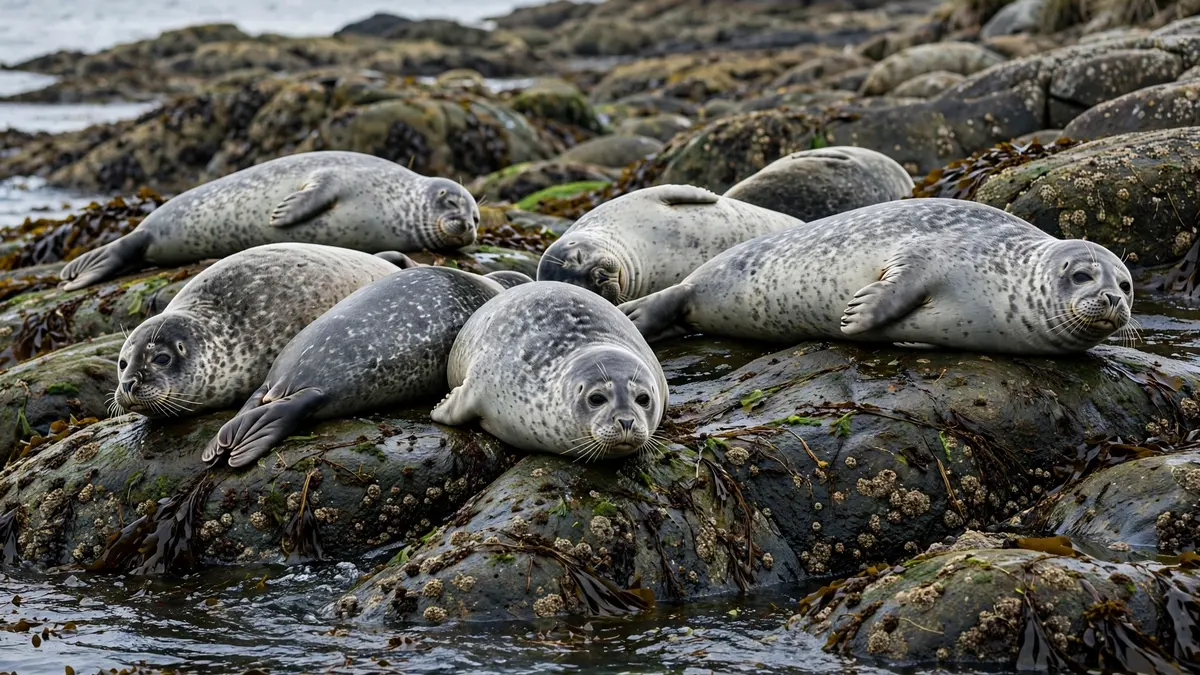
Seal species include the true seals, the sea lions and fur seals, and the walrus — marine mammals called pinnipeds, built for cold water and for resting on land. If you are wondering how many seal species there are and how they differ, the short answer is this: there are around 36 living pinniped species, split between 19 true seals, 16 eared seals and a single walrus, from the grey seals of northern Europe to the elephant seals of the Southern Ocean.
This guide covers the best-known seal species, how they dive, feed and raise pups, and where to see them.
Key takeaways
- Seal species are pinnipeds in three families: true seals, eared seals, and the walrus.
- True seals have no ear flaps and cannot turn their hind flippers forward, so they wriggle on land.
- Sea lions and fur seals have small external ears and can walk on all four flippers.
- Elephant seals are the largest and deepest-diving seals, reaching around 1,500 metres.
- Seals haul out on beaches, rocks and ice to rest, moult and raise pups, returning to the same sites yearly.
What is a seal?
A seal is a pinniped, a fin-footed marine mammal. All pinnipeds share the same design: a streamlined body, a thick layer of blubber, flippers instead of legs, and nostrils that close when they dive. They breathe air, give birth to live young and feed their pups on milk, but they spend most of their lives in the sea.
Pinnipeds evolved from land carnivores, and their closest living relatives on land are bears and the weasel family. True seals have no external ear flaps and their hind flippers point backwards, so on land they wriggle on their bellies. Eared seals have small ear flaps and can turn their hind flippers forward and walk. The walrus has a single living species, a huge whiskered animal with long tusks.
True seals: grey, harbour, harp and ringed seals
The grey seal is the largest seal of northern Europe. Males reach about 2.3 metres and weigh up to 300 kilograms, with a long, straight face that gives them the old name of horsehead seal. Grey seals live around Britain, Ireland, Iceland, Norway and eastern Canada. They eat sandeels and cod and dive to around 70 metres.
The harbour seal, also called the common seal, is smaller and rounder-faced, with a short, dog-like muzzle and a spotted coat. Harbour seals live around the coasts of the North Atlantic and the North Pacific, and they are the seals most often seen resting on sandbanks at low tide. Harbour seal pups can swim within hours of birth.
The harp seal is a seal of the Arctic pack ice. Adults have a pale grey coat with a dark, harp-shaped mark on the back, and pups are born with a white coat. Harp seals gather in huge breeding colonies on the ice off Newfoundland, Greenland and Russia. Pups are fed for only about twelve days.
The ringed seal is the smallest and most widespread seal of the Arctic, named for the pale rings on its dark coat. Ringed seals live under the sea ice, keeping breathing holes open with their claws, and they give birth in snow dens above the ice. They are the main food of the polar bear. The Baikal seal lives only in Lake Baikal in Siberia, the only seal that lives entirely in fresh water.
Elephant seals, Weddell seals and leopard seals
Elephant seals are the largest of all seal species. The southern elephant seal is the biggest, with males reaching nearly 5 metres and weighing up to 4,000 kilograms, while the northern elephant seal is only slightly smaller. Males have a large, inflatable nose like a short trunk, which gives the species its name. Elephant seals dive to around 1,500 metres and stay underwater for up to two hours.

The Weddell seal is the southernmost mammal in the world, living on the fast ice around Antarctica. Weddell seals are large, dark animals with pale blotches, and they dive to more than 600 metres, staying underwater for over an hour. They keep breathing holes open in the ice with their teeth.
The leopard seal is the hunter of the Antarctic. It is a long, slender seal, up to 3.5 metres in length, with a huge head, a wide mouth and a spotted coat like a leopard. Leopard seals eat krill, fish, squid and penguins, and they are one of the few seals that regularly hunt other seals.
Sea lions, fur seals and the walrus
Sea lions are the eared seals that most people picture when they think of a seal show. The California sea lion is the best known, a sleek, brown animal that lives along the west coast of North America from Alaska to Mexico. Males reach about 2.4 metres and weigh up to 350 kilograms, and they hunt fish and squid, often working in groups to herd shoals.
Fur seals are the other eared seals, and they differ from sea lions in their thick fur. The northern fur seal of the North Pacific has a dense underfur that once made it a target for hunters. Antarctic fur seals breed in huge colonies on South Georgia, where males fight for territories and females give birth to a single pup each year.
The walrus is the only living member of its family, and it is unlike any other seal. Walruses live in the Arctic, in the shallow waters off Alaska, Canada, Greenland and Russia, and they feed on shellfish, which they find on the sea floor with their sensitive whiskers. Their tusks, enlarged canine teeth, can reach a metre in length, and both males and females have them.
How seals dive, feed and haul out
Seals are built for diving. When a seal dives, its heart slows, blood is sent to the brain and heart first, and oxygen is stored in the blood and muscles rather than in the lungs. Their muscles hold large amounts of myoglobin, the protein that stores oxygen. A Weddell seal can stay underwater for more than an hour, and an elephant seal can dive for two hours.
Seals feed on fish, squid, krill and shellfish. Grey seals hunt fish on the sea floor, harp seals feed on small fish under the ice, and leopard seals hunt penguins at the ice edge. Seals have sensitive whiskers that detect the movements of fish, so they can hunt in the dark. They come ashore to rest, moult, give birth and mate, returning to the same sites year after year. A seal on the beach is not necessarily in trouble: a healthy seal is alert, with clear eyes and a smooth coat.
Breeding colonies and pupping seasons
Most seal species breed in colonies. Grey seals breed in autumn, where females give birth to a single white-coated pup and feed it on milk so rich that the pup can gain two kilograms a day. Harbour seals breed in summer, and their pups can swim at birth. Harp seals breed on the pack ice in late winter.
Elephant seals breed in winter, where the largest males fight for control of the beach. Sea lions breed in summer, and females find their own pup among hundreds by its voice and smell. Most seal pups are fed for only a few weeks, yet the milk is so rich that a pup can double its weight before weaning.
Where to see seals
Grey seals are best seen on the Farne Islands, the Isle of May, Skomer and the Blasket Islands, which hold thousands of animals. Harbour seals are best seen on the sandbanks of the Wash and the Moray Firth. For Arctic seals, take a boat trip in Svalbard or Greenland. Like the ocean animals of the open sea, seals are easiest to find where the water is rich in fish, and the coastal animals of rocky shores are best seen at low tide.
| Species | Family | Where it lives | Size and best-known fact |
|---|---|---|---|
| Grey seal | True seal | North Atlantic coasts | 2.3 m; white-coated pups |
| Harbour seal | True seal | North Atlantic and North Pacific | 1.9 m; pups swim at birth |
| Leopard seal | True seal | Antarctic pack ice | 3.5 m; hunts penguins |
| Southern elephant seal | True seal | Southern Ocean | 5 m; dives to 1,500 m |
| Walrus | Walrus | Arctic seas | 3.6 m; tusks to 1 m |
Threats facing seal species
Most seal species are doing well, and grey seals, harbour seals and elephant seals have all recovered from hunting. The main threats now are fishing nets, plastic, and disturbance at haul-out sites, which can separate a mother from her pup. Climate change is the biggest long-term threat, because harp seals need stable pack ice to give birth, ringed seals need snow for their dens, and walruses need ice floes to rest on. The Mediterranean monk seal, with only a few hundred animals left, is one of the most endangered marine mammals in the world.
Seal species checklist
- Learn the three families: true seals have no ear flaps, eared seals walk on land, and the walrus has tusks.
- Watch grey seals on the Farne Islands or the Isle of May in autumn.
- Look for harbour seals on sandbanks at low tide, and keep your distance.
- Visit South Georgia to see elephant seals, fur seals and Weddell seals.
- Never approach a seal pup on a beach: its mother may be nearby.
- Keep dogs on a lead near seal colonies, and never walk between a seal and the sea.
Frequently asked questions
How many seal species are there?
There are around 36 living pinniped species: 19 true seals, 16 eared seals, and a single walrus.
How is this guide different from the coastal animals and ocean animals guides?
This guide covers seals, sea lions and walruses only, species by species. The coastal animals guide covers all the animals of rocky shores and beaches, and the ocean animals guide covers the animals of the open sea. Think of this guide as the seal chapter in depth, and the other two as the wider picture.
What is the difference between a seal and a sea lion?
A true seal has no external ear flaps and cannot turn its hind flippers forward, so it wriggles on land. A sea lion has small ear flaps and can turn its hind flippers forward and walk on land.
How deep can seals dive?
Elephant seals are the deepest divers, reaching around 1,500 metres and staying underwater for up to two hours. Weddell seals dive beyond 600 metres for over an hour, and grey seals usually dive to around 70 metres.
Are seals dangerous?
Seals are wild animals and they can bite, especially if cornered or if a mother is protecting her pup. Keep your distance and never feed a seal.
What should I do if I find a seal pup on a beach?
Leave it alone and keep dogs away. A pup on a beach is often resting while its mother is out fishing. If the pup looks injured or in danger, call a local marine rescue organisation.
Conclusion
Seal species range from the grey seals of northern Europe to the elephant seals of the Southern Ocean, and from the harp seals of the Arctic ice to the walruses of the far north. Each species dives, feeds and raises its pups in its own way, but all share the same design: a body built for cold water, and a life split between the sea and the shore.
Next, pick one species and one place — grey seals on the Farne Islands in autumn, or elephant seals on a South Georgia beach — and watch them from a respectful distance, with a local guide who knows the tides.