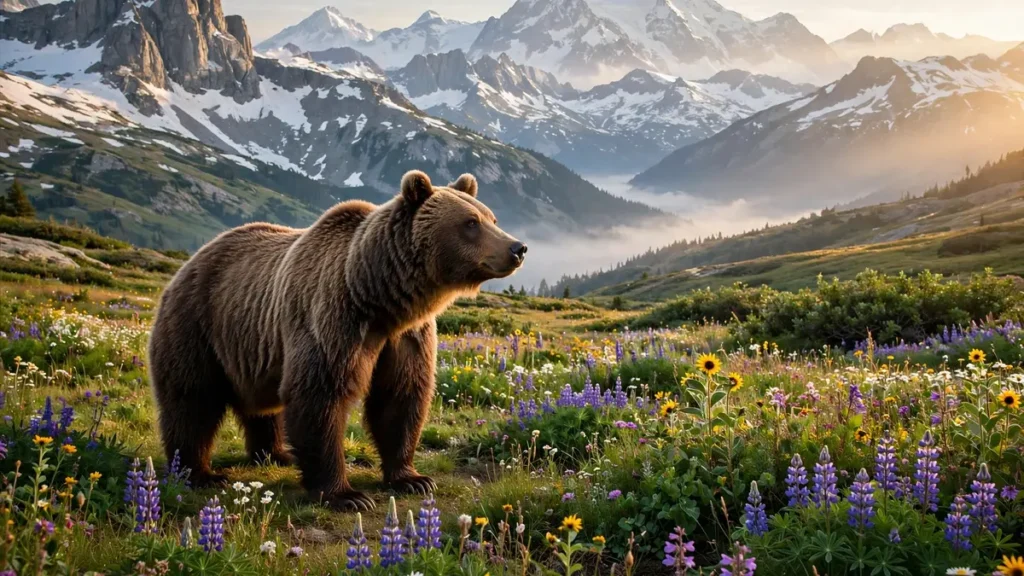
The grizzly bear species is a single species, Ursus arctos horribilis, the hump-shouldered bear of the mountains and forests of North America, and one of the most powerful land animals on Earth. If you are asking how many grizzly bear species there are, the answer is one: there is only one grizzly bear species in the world, a subspecies of the brown bear, and every grizzly bear alive today belongs to it.
The grizzly bear belongs to the family Ursidae, the bears, and it lives in the mountains, forests and tundra of Alaska, western Canada and the northwestern United States. Its brown fur tipped with silver, its huge shoulder hump and its long claws make it one of the most recognisable animals of the North American wilderness.
Key takeaways
- There is only one grizzly bear species, Ursus arctos horribilis, a subspecies of the brown bear found only in North America.
- Grizzly bears are omnivores that eat almost anything, from salmon and berries to roots, insects and carrion.
- Grizzly bears hibernate for five to seven months, living off the fat they stored in autumn without eating or drinking.
- A grizzly bear can run at up to 56 kilometres per hour, faster than any human, despite weighing up to 360 kilogrammes.
- Grizzly bears are listed as Least Concern, though their numbers are falling in the southern part of their range.
What makes a grizzly bear a grizzly bear
A grizzly bear is a large brown bear with a distinctive hump of muscle over its shoulders, a dish-shaped face, small rounded ears and very long claws, and it measures roughly 1.8 to 2.5 metres long when standing on all fours and usually weighs between 130 and 360 kilogrammes, depending on sex and season.
The hump defines the grizzly bear: a mass of muscle over the shoulders that powers the front legs for digging, and it is the easiest way to tell a grizzly from a black bear, which has no hump and a straighter face. Its claws can be up to 10 centimetres long, built for digging up roots and tearing apart logs, and its fur is tipped with silver or pale gold, which is where the name grizzly, meaning grey, comes from. Like other bears, the grizzly has a sense of smell seven times better than a bloodhound, and it can smell a dead animal from more than 30 kilometres away.
The grizzly bear species and their relatives
Ursus arctos horribilis is the only grizzly bear species, and it is a subspecies of the brown bear, Ursus arctos, which lives across the northern hemisphere. Grizzly bears in different parts of North America form separate populations, from Alaska to Wyoming, but they are all the same subspecies, and the animals move freely between mountain valleys following the food.
The Kodiak bear is the grizzly bear’s closest relative, a huge brown bear that lives only on the Kodiak Islands of Alaska and is the largest land carnivore on Earth. The Eurasian brown bear lives across Europe and Asia, the Kamchatka brown bear lives in the far east of Russia, and the Syrian brown bear lives in the mountains of the Middle East. The American black bear is a smaller bear that shares the grizzly’s forests, the polar bear is the white bear of the Arctic, and the sloth bear is a shaggy bear of India that eats termites.

| Type | Animal | Where it lives | Best-known food | Length or Weight |
|---|---|---|---|---|
| Species | Grizzly bear (Ursus arctos horribilis) | Alaska, Canada and northwest USA | Salmon, berries and roots | 1.8 to 2.5 m, 130 to 360 kg |
| Close relative | Kodiak bear | Kodiak Islands, Alaska | Salmon, berries and sedges | Up to 3 m, up to 680 kg |
| Close relative | Eurasian brown bear | Europe and Asia | Berries, roots and insects | 1.7 to 2.2 m, 100 to 350 kg |
| Close relative | Kamchatka brown bear | Far east Russia | Salmon and berries | Up to 2.4 m, up to 550 kg |
| Close relative | Syrian brown bear | Mountains of the Middle East | Fruit, nuts and insects | 1.5 to 2 m, 100 to 250 kg |
| Close relative | American black bear | North American forests | Berries, nuts and insects | 1.3 to 1.9 m, 60 to 300 kg |
| Close relative | Polar bear | Arctic sea ice | Seals | 2 to 2.5 m, 350 to 700 kg |
How grizzly bears live
Grizzly bears are creatures of the mountains and forests. A grizzly bear lives alone, wandering a home range of hundreds of square kilometres, and it comes together with others only at salmon rivers in autumn, where dozens of bears fish side by side. Like other brown bears, it follows the seasons, moving from valley to mountain as different foods ripen.
Salmon make up the most important food in autumn, along with berries, roots, grasses, insects and carrion, and a grizzly bear can eat up to 40 kilogrammes of food in a single day before hibernation. It fishes by standing in the river and snatching salmon from the water with its paws or teeth, and it digs for roots with its long claws, turns over stones for insects, and tears apart logs to reach grubs.
Breeding happens in summer, and after a gestation of about six to eight months the female gives birth to one to three cubs in the winter den, usually in January or February, while she is still asleep. The cubs are born tiny, weighing less than 500 grammes, and they stay with their mother for two to three years, learning where the salmon rivers and berry patches are. A female breeds only once every three to four years, and grizzly bears live for around 20 to 25 years in the wild, and up to 30 years in the best cases.
Where grizzly bears live
The grizzly bear lives in the mountains, forests and tundra of Alaska, western Canada and the northwestern United States, from the Arctic coast to Yellowstone National Park, and it is most common in Alaska and British Columbia, where the salmon rivers run thickest.
Wild country is the key requirement. A grizzly bear needs large areas of forest and mountain, with salmon rivers, berry patches and quiet dens, so it follows the food as it ripens with the seasons, and when the land is broken up by roads and towns the bears have nowhere to live.
The species is listed as Least Concern, but its numbers are falling in the southern part of its range. The main pressures are the loss of wild land to farming, ranching and building, conflicts with people over livestock and rubbish, and the loss of salmon runs and whitebark pine seeds, which are important autumn foods. Between 50,000 and 60,000 grizzly bears remain in North America, most of them in Alaska and Canada.
Best seasons for grizzly bear watching
There is no closed season, because grizzly bears are active from spring to autumn, but the best time to look for them depends on where you go. In Alaska the best months are often July to September, when the salmon are running and the bears gather at the rivers. In Yellowstone the best months are often May to June, when the bears come out of their dens with cubs, and September to October, when they feed on berries before hibernation.
Staying safe around grizzly bears
A grizzly bear is a wild animal with great strength and sharp claws, and it can kill a person, though attacks are rare and almost always happen when a bear is surprised or defending cubs. Keep your distance, never approach a bear, and never feed one, because a bear that learns to take human food is more likely to be killed. If you walk in bear country, make noise, carry bear spray, and store food in bear-proof containers, because a bear that is surprised at close range may charge.
Grizzly bear watching checklist
A little preparation turns a mountain visit into a real chance of seeing a grizzly bear, so pack for cold, rain and long quiet hours.
- Binoculars with good low-light performance, for picking a brown bear out of the forest at dawn.
- A camera with a long lens, because bears should always be watched from a distance.
- Bear spray, carried where you can reach it in seconds, because a surprised bear can charge fast.
- Warm clothes and waterproofs, because the best watching is in the cold mountain mornings.
- A field guide to bears, for telling a grizzly from a black bear at a glance.
- A plan to be out in autumn, when the salmon are running and the bears gather.
- Patience and silence, because bears are shy animals and a noisy group will send them away.
Frequently asked questions
How many grizzly bear species are there?
There is one grizzly bear species, Ursus arctos horribilis. It is a subspecies of the brown bear, which lives across the northern hemisphere, but the grizzly itself is found only in North America. No second grizzly bear species is recognised.
How do grizzly bears survive hibernation?
Grizzly bears survive hibernation by living off the fat they stored in autumn, without eating, drinking or passing waste for five to seven months. Their heart rate drops from about 40 beats a minute to about 8, and their body temperature falls by a few degrees, and they wake in spring thinner but alive.
How fast can a grizzly bear run?
A grizzly bear can run at up to 56 kilometres per hour, faster than any human, despite weighing up to 360 kilogrammes. It can only keep that speed for a short distance, but it runs just as fast uphill and downhill, and no person can outrun one.
Can you keep a grizzly bear as a pet?
No. A grizzly bear is a wild animal that needs hundreds of square kilometres of wild land, eats up to 40 kilogrammes of food a day, and is fully protected by law in every country where it lives. Bears in zoos need huge enclosures with trees, pools and dens, and they are not pets.
How is this guide different from the bottlenose dolphin species guide?
This guide covers the single grizzly bear species, a hump-shouldered land predator that fishes for salmon in the mountains of North America, while our bottlenose dolphin species guide covers three bottlenose dolphin species, clever marine mammals that hunt fish by echolocation in the warm coastal seas. The grizzly lives on land and eats salmon and berries, and the dolphin lives in the sea and eats fish and squid.
Are grizzly bears endangered?
Grizzly bears are listed as Least Concern, so they are not classed as endangered. Between 50,000 and 60,000 grizzly bears remain in North America, and the loss of wild land and conflicts with people are the main threats.
Conclusion
The grizzly bear species shows how much power one animal can hold: a single subspecies of brown bear, with a hump of muscle over its shoulders, claws like digging tools, and a life spent wandering the mountains of North America. It is one of the most powerful land animals on Earth, and it has lived in the wilderness of North America for hundreds of thousands of years.
If you go looking for one, go in the autumn to the salmon rivers of Alaska or Yellowstone, go quietly, and go with a guide. Watch a grizzly bear standing in the river, snatching salmon from the water, and you will understand why it has earned its place as the lord of the northern mountains, and why keeping its wild land matters most.