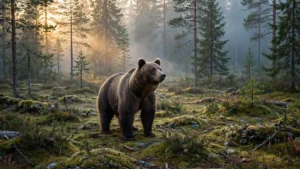
The brown bear is Europe’s largest land predator, a powerful animal that can weigh 300 kg and stand two metres tall on its hind legs. If you are wondering what a brown bear is, where it lives and what it eats, the short answer is this: it is a large, omnivorous bear of the forests of Europe, Asia and North America, it eats plants, berries, insects and meat, and it spends the winter asleep in a den.
In Norway the brown bear is the rarest of the large predators, living in small numbers in the forests of the far east. This guide covers its appearance, habitat, diet, hibernation, cubs and how to stay safe in bear country.
Key takeaways
- The brown bear is Europe’s largest land predator, weighing 100 to 300 kg in Norway.
- It is an omnivore, eating plants, berries, insects, fish and meat.
- Bears hibernate for five to seven months, living off fat stored in autumn.
- Cubs stay with their mother for one to two years and are born in the winter den.
- Norway holds only a small bear population, mainly near the Swedish and Finnish borders.
What is a brown bear?
The brown bear (Ursus arctos) is one of the largest land carnivores in the world. In Norway, males weigh 150 to 300 kg and females 100 to 200 kg, and a big bear can stand two metres tall on its hind legs. The coat is brown, from pale blonde to dark brown, and the fur is long and shaggy, with a distinctive hump of muscle over the shoulders that powers the front legs for digging.
The bear has a large head with a dish-shaped face, small round ears, and a powerful jaw with teeth built for both plants and meat. Its claws are long and curved, up to 10 cm, and they are used for digging roots, tearing apart logs for insects and defending the bear. Despite its size, the bear is fast: it can run at 50 km/h in short bursts, climb trees, and swim well.
Brown bears are found across the northern hemisphere, from the forests of Europe and Russia to Siberia, Alaska and Canada, and the grizzly bear of North America is the same species. The bears of Norway belong to the Scandinavian population, which is shared with Sweden and Finland, and the animals move freely across the borders, so the Norwegian bears are part of a much larger population.
Habitat and range
Brown bears need large areas of forest with good cover, rich food and quiet denning sites. In Norway they live mainly in the forests of the far east, in Hedmark, Trøndelag and Finnmark, close to the Swedish and Finnish borders, where the forest is continuous and the human population is low. They are also found in the mountains, where they den in rocky slopes and feed on berries in the autumn.
Each bear holds a home range that can cover hundreds of square kilometres for a male and tens to hundreds for a female, depending on the food available. The ranges overlap, and bears are not territorial in the way wolves are: they tolerate other bears in their range, though they avoid each other, and they meet mainly to mate. Young bears disperse in spring, and a young male may travel hundreds of kilometres to find his own range.
The Norwegian bear population is small, with only a few dozen animals in the country at any one time, though the number changes as bears cross the borders. The population is counted by DNA from droppings and hair, and the authorities set a target for the number of females with cubs each year. The bear is strictly protected, and hunting is allowed only under licence, with a small quota.
What brown bears eat
Brown bears are omnivores, and plants make up most of their diet. In spring they eat grass, herbs and the buds of trees, and they dig for roots and bulbs. In summer they eat berries, ants and other insects, and they tear apart rotting logs to find beetle larvae. In autumn they gorge on berries, especially bilberries, cloudberries and crowberries, building up the fat they need for hibernation, and they may eat 20 kg of berries a day.
Meat is a smaller part of the diet, but an important one. Bears eat carrion, and they kill moose calves, reindeer calves and sheep when they get the chance. They also eat fish, and in Norway they take salmon from rivers in the autumn, standing in the shallows and catching the fish with their paws. Like other omnivore animals, the bear’s diet is flexible, and it eats whatever is most abundant in the season.
Bears also raid human food when they can. They break into cabins, beehives and rubbish bins, and they are attracted to food left out in the open. A bear that learns to associate people with food becomes dangerous, and it is usually removed. Visitors to bear country should store food properly, never leave food out at night, and carry food in sealed containers.
Hibernation
Hibernation is the bear’s great survival strategy. In autumn, the bear eats as much as it can, building up a layer of fat that may double its weight, and then it digs a den, often in a hillside, under a fallen tree or in a rocky hollow, and settles in for the winter. The den is lined with grass, moss and branches, and the bear curls up inside as the snow falls, sealing the entrance.
During hibernation, the bear’s body temperature drops a few degrees, its heart rate falls from around 40 beats a minute to fewer than 10, and it breathes slowly. It does not eat, drink, urinate or defecate for five to seven months, living entirely off its fat reserves. It may wake briefly if disturbed, but it usually sleeps through the winter, emerging in spring thin and hungry.
Female bears give birth in the den, in January or February, to one to three cubs, each weighing only 300 to 500 grams. The cubs are born blind and helpless, and they nurse on their mother’s rich milk through the winter, growing fast in the warmth of the den. By the time the family leaves the den in spring, the cubs weigh several kilograms and are ready to follow their mother into the forest.
Cubs and family life
Bear cubs stay with their mother for one to two years, learning to find food, to climb, to swim and to avoid danger. The mother is fiercely protective, and she will defend her cubs against any threat, including much larger bears. Male bears may kill cubs, which is why the mother keeps her cubs close and avoids other bears, especially males, in the spring.
The cubs play constantly, wrestling, climbing and chasing each other, and play is how they learn the skills they need as adults. They eat what their mother eats, and they learn the best berry patches, the best fishing spots and the best denning sites. In their second spring, the mother drives them away, and they disperse to find their own ranges, often travelling far from where they were born.
Brown bears can live for 20 to 30 years in the wild, and females breed from four or five years old, producing a litter every two or three years. The population grows slowly, because the bears breed late and have few young, and the loss of a single breeding female can affect the population for years. That slow growth is one reason the Norwegian population is so fragile.

Bears and people
Brown bears are shy and avoid people, and attacks are very rare. Most bears run away when they hear or smell a person, and a bear that knows you are there will almost always leave. The danger comes when a bear is surprised, when it is guarding a carcass, or when a mother feels her cubs are threatened. In those cases the bear may charge, and a charge from a 200 kg animal is a serious matter.
The rules for bear country are simple. Make noise as you walk, so the bear hears you coming. Keep food sealed and stored away from your tent. Never approach a bear, and never come between a mother and her cubs. If you see a bear at a distance, back away calmly and leave the area. If a bear charges, stand your ground if it is a bluff charge, and lie face down, protecting your neck, if it makes contact. Running is the worst response, because the bear is faster than you.
In Norway, the bear is a symbol of the wild forest, and it is also a source of conflict, because it kills sheep and reindeer. The state pays compensation for livestock killed by bears, and farmers are encouraged to use guard dogs and fencing. The debate is the same as with the wolf and the lynx: how many large predators can a modern country live with, and who pays the price.
| Species | Weight | Where it lives | Main food |
|---|---|---|---|
| Brown bear | 100–300 kg | Forests of Europe, Asia, North America | Plants, berries, meat |
| Polar bear | 350–700 kg | Arctic sea ice | Seals |
| American black bear | 60–300 kg | Forests of North America | Plants, berries, insects |
| Giant panda | 70–120 kg | Mountains of China | Bamboo |
Bear safety checklist
- Make noise as you walk in bear country, so bears hear you coming.
- Store food in sealed containers, away from your tent, and never leave food out at night.
- Keep your distance from any bear you see, and never approach a mother with cubs.
- Carry bear spray where it is legal and know how to use it.
- If a bear charges, do not run — stand your ground, and lie face down if it makes contact.
- Report bear sightings to the local wildlife authorities.
Frequently asked questions
How big is a brown bear?
In Norway, males weigh 150 to 300 kg and females 100 to 200 kg, and a big bear can stand two metres tall on its hind legs. It is Europe’s largest land predator, and much larger than a wolf or a lynx.
What do brown bears eat?
Brown bears are omnivores. Plants and berries make up most of their diet, along with insects, roots and fish, and they also eat carrion and kill moose calves, reindeer calves and sheep when they get the chance.
How long do brown bears hibernate?
Bears hibernate for five to seven months, usually from October or November to April or May. During hibernation they do not eat, drink, urinate or defecate, living entirely off the fat stored in autumn.
Are brown bears dangerous?
Brown bears are shy and avoid people, and attacks are very rare. A surprised bear, a mother with cubs or a bear guarding a carcass can be dangerous, so make noise as you walk, keep your distance and never run from a bear.
Where can I see a brown bear in Norway?
Bears live mainly in the forests of the far east, near the Swedish and Finnish borders, but they are very rare and hard to see. Your best chance is a guided bear-watching trip in Sweden or Finland, where the populations are larger.
How many brown bears are there in Norway?
The population is small, with only a few dozen animals in the country at any one time, though the number changes as bears cross the borders with Sweden and Finland. The population is counted by DNA from droppings and hair.
Conclusion
The brown bear is Norway’s rarest large predator, asking for quiet forest and distance. Give it both, and it slips away unseen. Next: make noise on trails, store food properly, and never approach a mother with cubs.