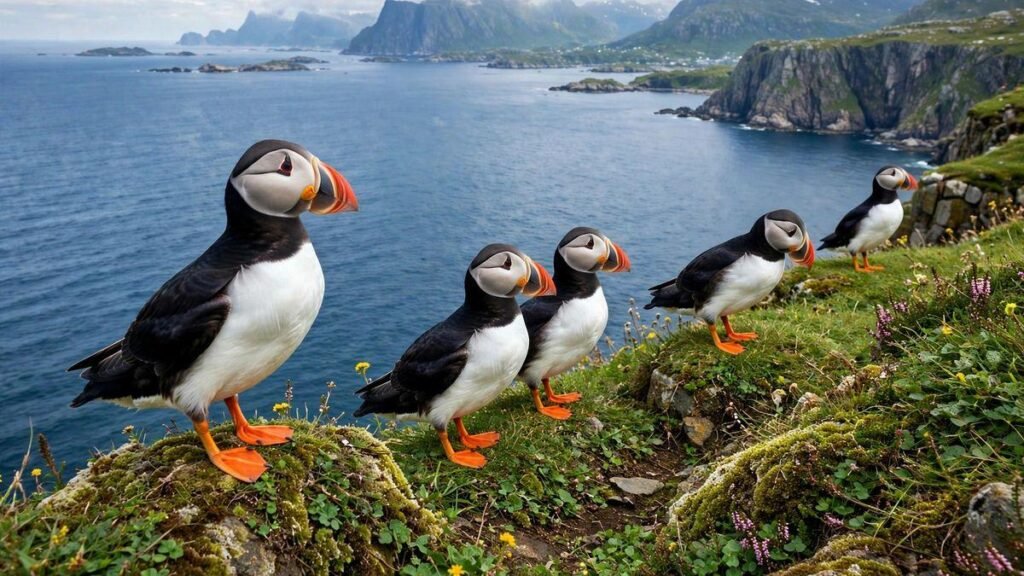
The Atlantic puffin is the clown of the sea, a small seabird with a bright, triangular beak, a black-and-white body and an upright, almost comical walk. If you are wondering what an Atlantic puffin is, where it lives and what it eats, the short answer is this: it is a seabird of the North Atlantic that breeds on northern islands, eats small fish, and spends most of its life alone at sea, coming ashore only to raise a single chick.
In Norway the puffin is one of the most loved birds, breeding in huge colonies on islands such as Røst and Runde. This guide covers its appearance, habitat, diet, breeding and the threats facing its colonies.
Key takeaways
- The Atlantic puffin is a small seabird, about 30 cm long, with a bright, colourful beak in the breeding season.
- It breeds in colonies on North Atlantic islands, including Røst and Runde in Norway.
- Puffins eat small fish, such as sandeels and herring, and carry them back to the chick in their beak.
- Each pair raises a single chick, called a puffling, in a burrow each year.
- Puffin numbers have fallen on some Norwegian colonies as fish stocks change and the sea warms.
What is an Atlantic puffin?
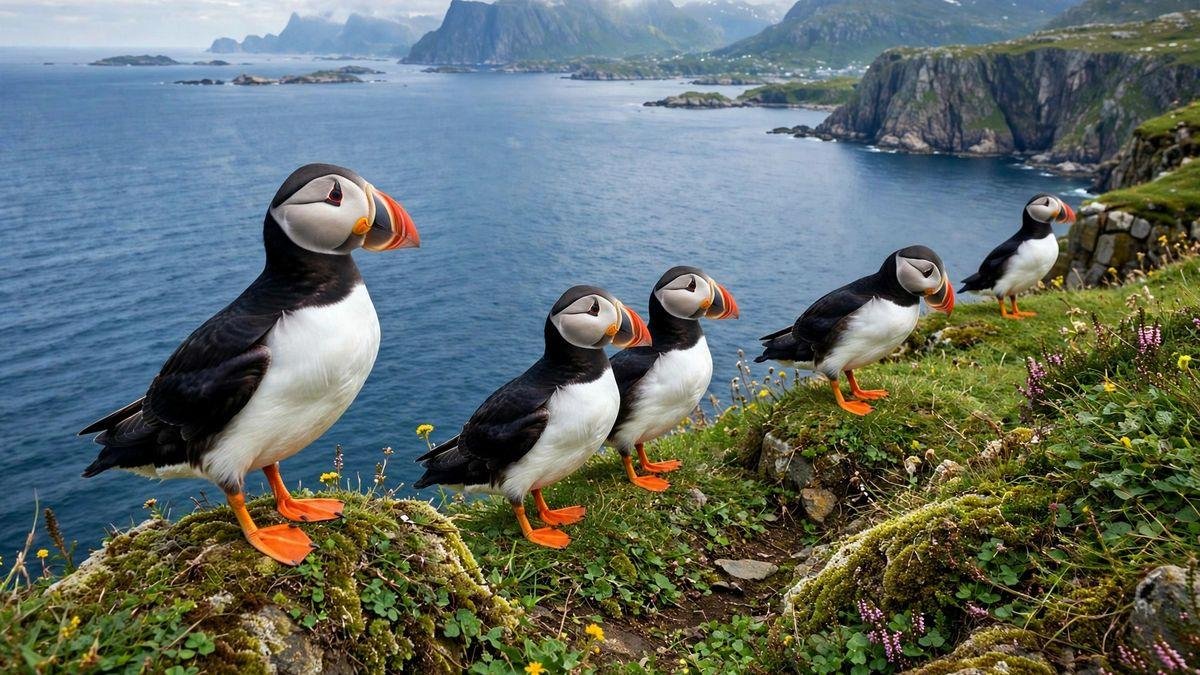
The Atlantic puffin (Fratercula arctica) is a member of the auk family, which also includes guillemots and razorbills. Adults are around 28 to 30 cm long, with a wingspan of 50 to 60 cm, and they weigh 300 to 500 grams. The body is black on top and white underneath, the cheeks are white-grey, and the beak is large, triangular and brightly coloured in red, yellow and blue-grey during the breeding season.
Outside the breeding season the beak loses its bright colours and becomes smaller and duller, and the face darkens. The puffin’s legs are bright orange, and it stands upright on land, which, with its waddling walk, gives it a comical, penguin-like look. In the air it is a fast, direct flyer, beating its short wings up to 400 times a minute, and in the water it is a superb diver, using its wings to fly underwater in pursuit of fish.
Puffins are often called the clown of the sea or the sea parrot, and they are one of the most popular birds in the North Atlantic. They are also a symbol of the Norwegian coast, and the colonies on Røst, in the Lofoten islands, are among the largest in the world, holding hundreds of thousands of pairs. Like other forest animals of the north, puffins depend on a healthy ecosystem, and their numbers are a sign of how the sea is doing.
Habitat and range
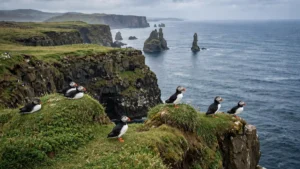
Atlantic puffins breed around the North Atlantic, from Norway, Iceland and the Faroe Islands to Britain, Ireland, Canada and the north-eastern United States. Norway holds some of the largest colonies, on Røst, Værøy, Runde, the Svalbard archipelago and the cliffs of the far north. The birds need steep, grassy slopes or rocky ground where they can dig burrows, and rich fishing grounds nearby to feed their chicks.
Outside the breeding season, puffins live alone at sea, far from land, across the North Atlantic. They spend the winter on the open ocean, resting on the water and diving for fish, and they are rarely seen from shore. In spring they return to the same colony, and often to the same burrow, year after year, and they usually pair with the same mate for life, reuniting at the burrow each spring.
Puffins are faithful to their colonies, and young birds return to breed where they were born. This loyalty makes the colonies vulnerable: if the fish around a colony fail, the birds cannot easily move elsewhere, and the colony declines. The Røst colony, once the largest in the world, has fallen sharply in recent decades, a warning of how fast a seabird population can change when the sea changes.
What puffins eat
Puffins eat small fish, mainly sandeels, herring, sprats and capelin, and they catch them by diving, using their wings to swim underwater and their feet to steer. They can dive to 60 metres or more, though most dives are shallower, and they stay underwater for up to a minute. They also eat small crustaceans, squid and marine worms, especially in winter when fish are scarce.
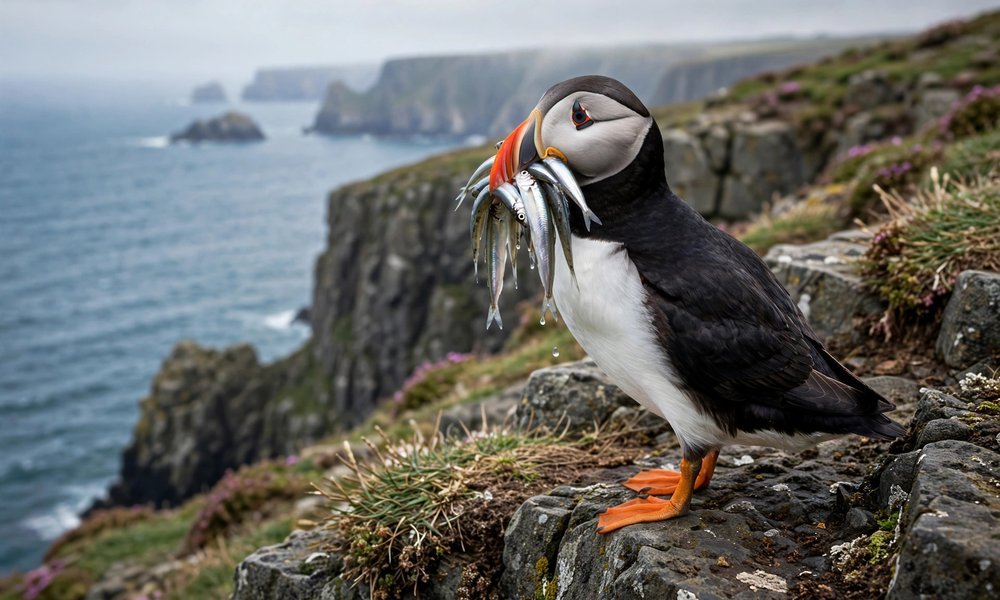
The puffin’s beak is a remarkable tool. It has a spiny tongue and a special hinge that lets the bird hold a row of fish crosswise in its beak while it catches more, so a puffin returning to its chick may carry ten or more small fish at once, lined up like a silver fan. The record is over 60 fish in a single beak, though a dozen is more usual. The chick eats the fish whole, and it grows fast on this rich diet.
Food is the key to the puffin’s year. In good years, when sandeels are abundant, most chicks survive and the colony thrives. In poor years, when the fish are scarce or too small, the chicks starve, and the colony produces almost no young. The warming sea is changing where sandeels live and when they are available, and this mismatch is one of the main reasons Norwegian puffin colonies are struggling.
Breeding and the puffling
Puffins breed from about five years old, and each pair raises a single chick a year. The pair digs a burrow in the soil, sometimes over a metre deep, or takes over a rabbit burrow or a crevice in the rocks. The burrow ends in a nesting chamber lined with grass and feathers, where the female lays a single white egg, usually in May or June.
Both parents take turns incubating the egg for about six weeks, and both feed the chick once it hatches. The chick, called a puffling, is dark and fluffy at first, and it stays in the burrow for six or seven weeks, growing fast on the fish its parents bring. The parents visit mostly at dawn and dusk, when the risk from gulls and skuas is lowest, and they carry the fish in their beaks, a sight that draws crowds to the colonies.
When the puffling is ready, it leaves the burrow at night, alone, and makes its way to the sea, where it will spend the next few years before returning to breed. Many pufflings die in their first year, from hunger, storms and predators, but those that survive may live for 20 years or more. The oldest known puffin was over 40 years old, a remarkable age for a bird of its size.
Puffins and people
Puffins have been part of life on the Norwegian coast for centuries. They were once hunted for meat, eggs and feathers, and the hunting was heavy on some islands, but it is now strictly controlled, and the birds are protected. Today the puffin is a symbol of the coast and a major draw for visitors, and the colonies on Runde and Røst bring thousands of people to the islands each summer.
Visitors can watch puffins from marked paths and viewpoints, and the best time is the evening, when the birds return from the sea with fish for their chicks. The birds are tame and allow a close approach, but they should not be disturbed at the burrow, and dogs must be kept on a lead. Flash photography is discouraged, and drones are banned near the colonies, because they frighten the birds and can cause them to abandon their nests.
The puffin is also a warning sign. Its decline on Røst and other colonies shows how the warming sea, changing fish stocks and plastic pollution are affecting the whole marine ecosystem. Conservation work focuses on protecting the colonies, reducing disturbance, and understanding the fish stocks the puffins depend on, so that the colonies can recover when the fish return.
Threats and conservation
The Atlantic puffin is listed as vulnerable in Europe, and its numbers have fallen sharply on several Norwegian colonies. The main cause is food: sandeels, the puffin’s staple, have become scarcer and smaller as the sea warms, and the chicks starve when the fish are not there. Rats and other introduced predators also take eggs and chicks on some islands, and oil spills, plastic and fishing nets kill birds at sea.
Conservation work includes protecting the breeding colonies, controlling rats and other predators, and monitoring the colonies each year to track their numbers. Researchers ring the birds and weigh the chicks, and the data shows which colonies are doing well and which are in trouble. The puffin’s future depends on the sea, and on whether the fish stocks recover, but the colonies that are protected and undisturbed have the best chance of surviving.
| Species | Length | Where it breeds | Main food |
|---|---|---|---|
| Atlantic puffin | 28–30 cm | North Atlantic islands | Sandeels and herring |
| Common guillemot | 38–45 cm | Cliffs of the North Atlantic | Small fish |
| Razorbill | 38–43 cm | Cliffs of the North Atlantic | Small fish |
| Little auk | 17–19 cm | High Arctic cliffs | Plankton and small crustaceans |
Puffin watching checklist
- Visit between May and August, when puffins are at their colonies.
- Go out in the evening, when the birds return from the sea with fish for their chicks.
- Stay on marked paths and keep back from the burrows — never block a burrow entrance.
- Bring binoculars and a camera with a long lens, and avoid flash photography.
- Keep dogs on a lead, and never fly a drone near a colony.
- Visit Runde, Røst or the Varanger coast for the best colonies in Norway.
Frequently asked questions
When is the best time to see puffins in Norway?
The puffin season runs from May to August, when the birds are at their breeding colonies. They arrive in spring, raise a single chick in a burrow, and leave for the open sea in late summer.
What do puffins eat?
Puffins eat small fish, mainly sandeels, herring and sprats, which they catch by diving and carry back to the chick in their beak. They also eat small crustaceans and squid, especially in winter.
How many fish can a puffin carry in its beak?
A puffin can carry ten or more small fish at once, held crosswise in its beak, and the record is over 60 fish. The spiny tongue and a special hinge let it hold the fish while it catches more.
Where is the best place to see puffins in Norway?
Røst in the Lofoten islands, Runde off the west coast and the Varanger peninsula in the far north are the best places. All three hold large colonies, and Runde and Røst have marked paths and viewpoints for visitors.
Are puffins endangered?
The Atlantic puffin is listed as vulnerable in Europe. Its numbers have fallen sharply on several Norwegian colonies, mainly because sandeels, its main food, have become scarcer as the sea warms.
How long do puffins live?
Puffins can live for 20 years or more, and the oldest known bird was over 40 years old. Many chicks die in their first year, but those that survive return to breed at about five years old.
Conclusion
The puffin is more than the clown of the sea: it is a measure of how the ocean is doing, and its empty burrows on Røst are a warning that the fish it depends on are changing. Protect the colonies, and the birds will return when the fish do.
The next step is to plan a summer evening on Runde or Røst, stay on the marked paths, and watch the birds come home with fish for their chicks.