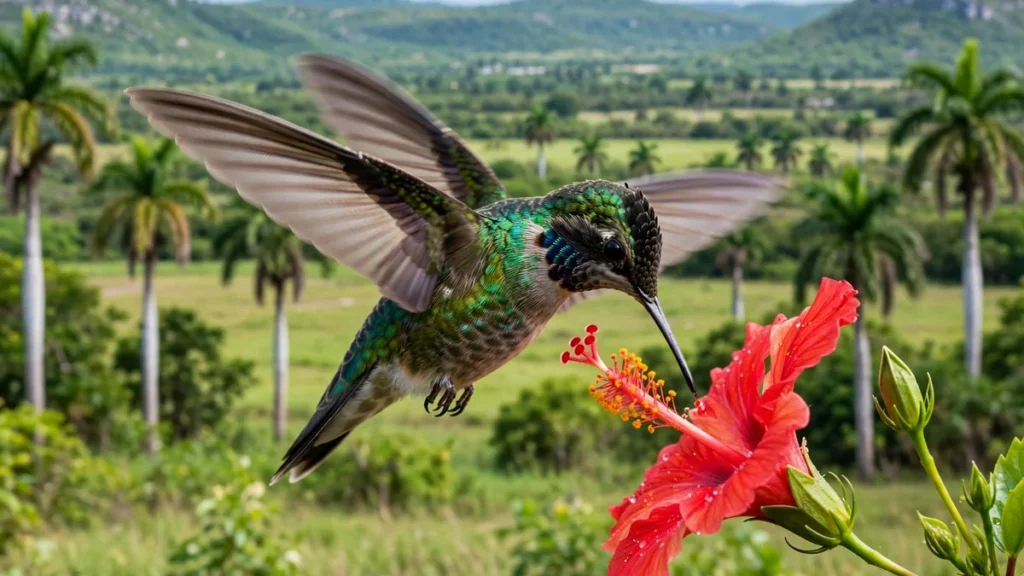
The bee hummingbird species number one, a single species called Mellisuga helenae, and it is the smallest bird in the world, a bird so tiny that an adult male weighs less than a coin and is often mistaken for a large bee. If you are asking how many bee hummingbird species there are, the answer is one: there is one recognised bee hummingbird species in the world, and every bee hummingbird alive today belongs to it.
The bee hummingbird lives only in Cuba and on the nearby Isle of Youth, and it is found nowhere else on Earth in the wild. In Cuba it is known as the zunzuncito, after the buzzing hum of its wings, and it spends its short life darting between flowers in forests, gardens and coastal scrub.
Key takeaways
- There is one bee hummingbird species, Mellisuga helenae, and it lives only in Cuba and on the Isle of Youth.
- The bee hummingbird is the smallest bird in the world, about 5 to 6 centimetres long, with males weighing about 1.6 to 2 grammes.
- Its wings beat about 80 times a second, and its heart can beat more than 1,200 times a minute in flight.
- A bee hummingbird can visit up to 1,500 flowers in a single day, feeding on nectar and small insects.
- The species is listed as Near Threatened, with an estimated 22,000 to 66,000 mature birds and a falling population.
What makes a bee hummingbird a bee hummingbird
A bee hummingbird is a bird the size of a large bee, and that is where its name comes from. Adult males measure about 5 to 5.5 centimetres long and weigh about 1.6 to 2 grammes, while females reach about 6 centimetres and up to 2.6 grammes. Its wingspan is only about 5.5 to 6 centimetres.
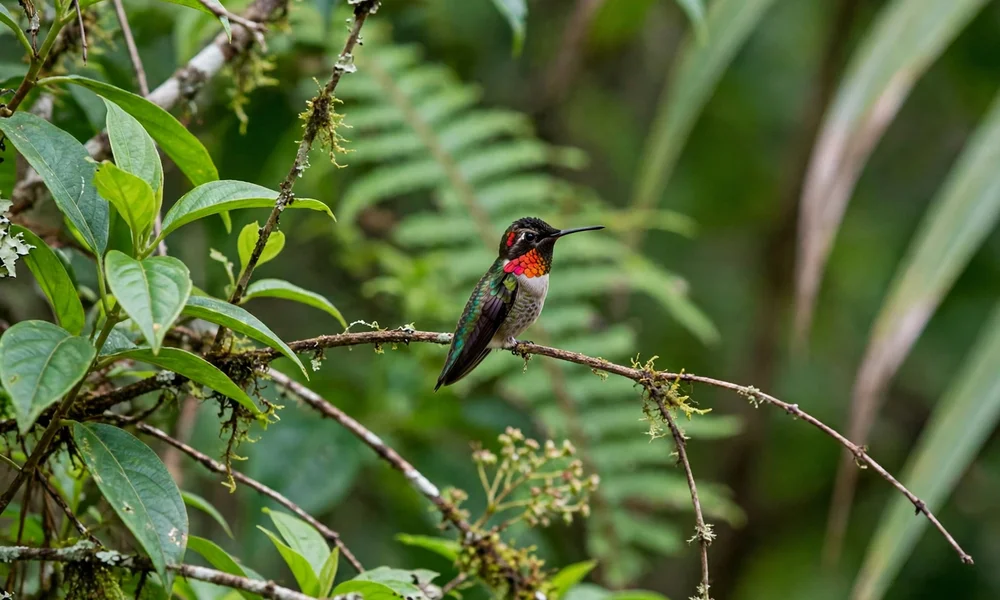
The male is the showier of the two. He is iridescent green on his back and sides, with a blue-green head and a brilliant red-pink patch on his throat, while his underparts are pale grey-white. The female is duller, green above and white below, with white tips on her outer tail feathers. Both sexes carry a slender straight black bill, made for probing deep into flowers, and a long tongue that flicks in and out to lap up nectar.
What truly sets the bee hummingbird apart is its flight. Its wings beat about 80 times a second in normal flight, rising to nearly 200 beats a second in a courtship dive, and the wings sweep in a figure-of-eight that lets the bird hover in one spot like a tiny helicopter. Its heart can beat more than 1,200 times a minute while it flies, and it breathes about 250 times a minute. Like other hummingbirds, it can also fly backwards and sideways, and reach speeds of 40 to 48 kilometres an hour.
The bee hummingbird species and their relatives
There is one bee hummingbird species. It belongs to the genus Mellisuga, which holds just two species: the bee hummingbird of Cuba and its sister species, the vervain hummingbird, which lives on Hispaniola and Jamaica. The two are the smallest members of the hummingbird family Trochilidae, which holds more than 360 species, all of them living in the Americas.
The ruby-throated hummingbird is the best-known relative in North America, which crosses the Gulf of Mexico on migration, while Anna’s hummingbird is a West Coast bird with a rose-red crown and throat. The rufous hummingbird is a fiery orange migrant, and the Cuban emerald shares the bee hummingbird’s island home. The calliope hummingbird, the smallest bird in the United States and Canada, is only a little larger than the bee hummingbird.
| Type | Animal | Where it lives | Best-known food | Length or Weight |
|---|---|---|---|---|
| Species | Bee hummingbird (Mellisuga helenae) | Cuba and the Isle of Youth | Nectar and small insects | About 5 to 6 cm long, 1.6 to 2.6 g |
| Close relative | Vervain hummingbird | Hispaniola and Jamaica | Nectar and small insects | About 6 cm long, about 2 g |
| Close relative | Ruby-throated hummingbird | North America, winters in Central America | Nectar and small insects | About 7 to 9 cm long, 2 to 6 g |
| Close relative | Anna’s hummingbird | West coast of North America | Nectar and small insects | About 10 cm long, about 4 g |
| Close relative | Rufous hummingbird | Western North America, winters in Mexico | Nectar and small insects | About 8 cm long, 3 to 4 g |
| Close relative | Cuban emerald | Cuba and the Bahamas | Nectar and small insects | About 10 cm long, about 3 g |
| Close relative | Calliope hummingbird | Western North America | Nectar and small insects | About 7 to 10 cm long, 2 to 3 g |
How bee hummingbirds live
A bee hummingbird spends most of its waking hours feeding. It may visit up to 1,500 flowers in a single day, hovering at each one to drink nectar, and it eats up to half its own body weight in food each day. Nectar is its main fuel, but it also snaps up tiny insects and spiders for protein. It is a fierce and solitary bird, and males and females hold separate territories, chasing away rivals.
When darkness falls and there are no flowers to feed from, the bee hummingbird enters torpor, a deep sleep-like state in which its body temperature and heart rate drop sharply. A bird found cold and still on its perch at night is usually not dying but shut down, and it warms up again at dawn.
Breeding runs from March to June, when the Cuban flowers are at their best. The female does all the work: she builds a tiny cup nest about 2.5 centimetres across, woven from cobweb, bark, lichen and soft plant down, on a thin branch about 3 to 5 metres up. She lays two white eggs, each about the size of a coffee bean, and sits on them for about three weeks. The chicks hatch naked and helpless, and she feeds them nectar and small insects until they leave the nest at about 18 days old. A bee hummingbird lives up to about seven years in the wild, and up to ten years in captivity.
Where bee hummingbirds live
The bee hummingbird lives only in Cuba and on the Isle of Youth, from sea level up to about 1,000 metres. It uses many kinds of wooded country: forest, pine woodland, swamp woodland, dry thorn scrub near the coast, forest edges, and village gardens. It is most common in eastern Cuba, around Holguin and Guantanamo, but it has vanished from many places where it was once widespread.
The species is listed as Near Threatened, and Cuban ornithologists rate it as Vulnerable inside Cuba itself. BirdLife International estimates 22,000 to 66,000 mature birds, and the population is falling at a moderate rate as forests are lost and degraded. It needs flowering plants through the year, so forest loss hits it directly, and it cannot simply move somewhere else, because there is nowhere else for it to go.
Best seasons for bee hummingbird watching
There is no closed season, because bee hummingbirds are active all year in Cuba’s warm climate, but the best time to look for them is the breeding season from March to June, when the males are at their brightest. The dry season, from November to April, is also the most comfortable time to travel in Cuba. Early morning is the best time of day, when the birds feed hardest after a night in torpor.
Staying safe around bee hummingbirds
A bee hummingbird is far too small to hurt a person, so the safety rules are about protecting the bird, not the watcher. Keep your distance, never touch a nest, and never try to catch a bird, because a disturbed bird may abandon its eggs or chicks. Do not offer sugar water from a feeder unless a local guide asks you to, because dirty feeders can spread disease. If you see a bee hummingbird in torpor at night, cold and still on its perch, leave it alone: it is saving energy, and handling it could kill it.
Bee hummingbird watching checklist
A little preparation turns a Cuban visit into a real chance of seeing the smallest bird in the world, so pack for heat and long quiet hours among the flowers.
- Binoculars, because the bird is only 5 to 6 centimetres long and easy to miss among the leaves.
- A camera with a fast shutter speed, for freezing the blur of wings that beat 80 times a second.
- A local guide who knows the flowering trees the birds defend.
- Light clothing and sun protection, for long mornings in the Cuban heat.
- A plan to be out at dawn, when the birds feed hardest after a night in torpor.
- Patience and silence, because a noisy group will send them away.
- A field guide to Cuban birds, for telling a bee hummingbird from a Cuban emerald at a glance.
Frequently asked questions
How many bee hummingbird species are there?
There is one bee hummingbird species, Mellisuga helenae. It lives only in Cuba and on the Isle of Youth. Its closest relative is the vervain hummingbird, which lives on Hispaniola and Jamaica.
Is the bee hummingbird really the smallest bird in the world?
Yes. The bee hummingbird is the smallest living bird species on Earth, measuring about 5 to 6 centimetres long and weighing 1.6 to 2.6 grammes. An adult male weighs less than a coin.
What do bee hummingbirds eat?
Bee hummingbirds eat mostly nectar, which they drink from flowers with their long tongues, and they also eat tiny insects and spiders for protein. A single bird can visit up to 1,500 flowers in one day, eating up to half its own body weight in food.
How fast do bee hummingbird wings beat?
A bee hummingbird beats its wings about 80 times a second in normal flight, and the rate can rise to nearly 200 beats a second during a courtship dive. The wings sweep in a figure-of-eight that lets the bird hover in one place and fly backwards.
How is this guide different from the Baltimore oriole species guide?
This guide covers the single bee hummingbird species, a 5-centimetre Cuban bird that hovers at flowers and weighs less than a coin, while our Baltimore oriole species guide covers the single Baltimore oriole species, a larger North American songbird with bright orange and black plumage that migrates between North and Central America. The bee hummingbird never leaves Cuba, and the Baltimore oriole crosses whole continents.
Are bee hummingbirds endangered?
Not yet. Bee hummingbirds are listed as Near Threatened, with an estimated 22,000 to 66,000 mature birds and a falling population, and Cuban ornithologists rate them as Vulnerable inside Cuba. The main threat is forest loss, which takes away the flowers they depend on.
Conclusion
The bee hummingbird species shows how much life can fit into a tiny package: a single species of bird, no bigger than a bee, with wings that beat 80 times a second and a daily round of 1,500 flowers across the forests and gardens of Cuba.
If you go looking for one, go to eastern Cuba in spring, at dawn, and quietly. Watch a male hover at a red flower with the sun catching his throat, and you will understand why the smallest bird in the world has earned its place in the record books, and why keeping Cuba’s forests standing matters most.














