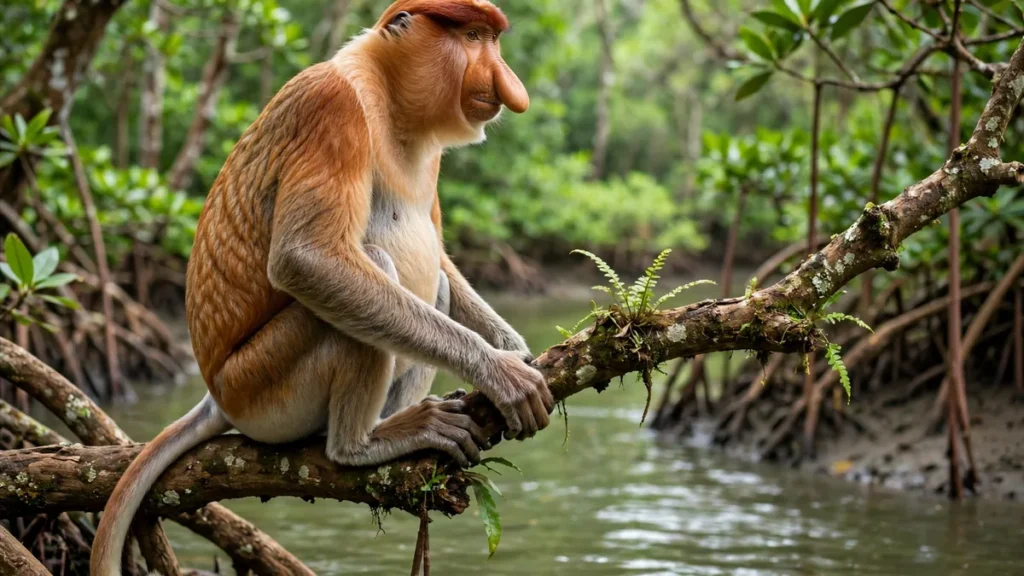
The proboscis monkey species is a single species, Nasalis larvatus, a large leaf-eating monkey that lives only on the island of Borneo. If you are asking how many proboscis monkey species there are, the answer is one, and it is one of the strangest-looking primates on Earth: the male carries a huge fleshy nose that hangs below his mouth, and it lives beside rivers and mangroves, where it swims, leaps and belly-flops into the water.
The proboscis monkey gets its name from that nose, from the Greek word for a trunk, and it is among the largest monkeys in Asia. Males can weigh more than twice as much as females, and their coats are reddish brown with pale bellies and grey arms and legs. They are famous swimmers, with partly webbed fingers and toes, and are almost never found more than about a kilometre from water.
Key takeaways
- There is one proboscis monkey species, Nasalis larvatus, and it is the only species in its genus.
- Males are about 66 to 76 centimetres long and weigh roughly 16 to 24 kilograms, while females weigh roughly 7 to 12 kilograms.
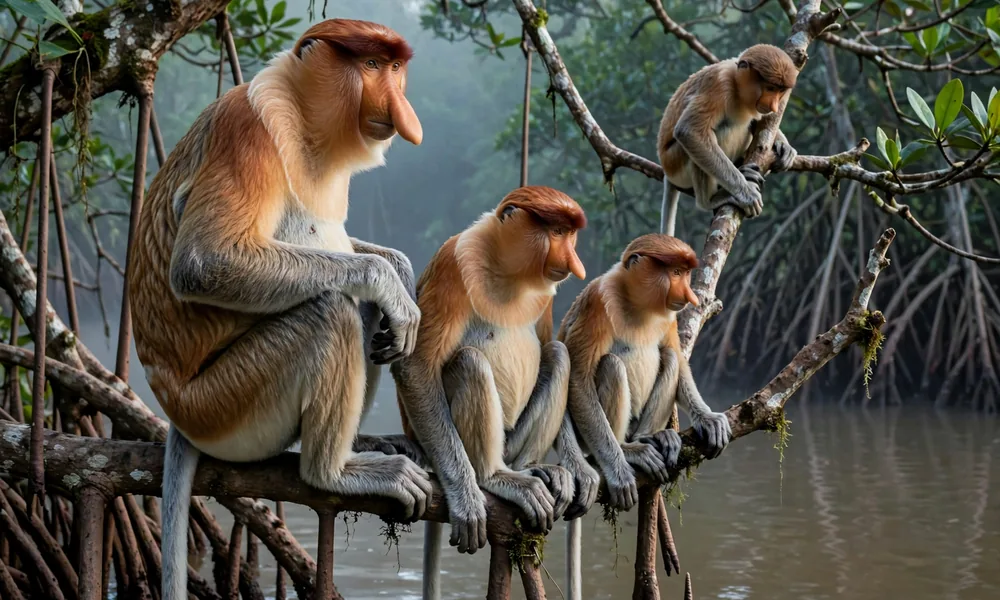
- They live in one-male groups of two to seven females and their young, and feed mostly on young leaves and unripe fruit.
- They are Endangered, with fewer than 7,000 mature animals left after losing more than half their population in about 40 years.
- They live only in Borneo, in mangrove, peat swamp and riverside forest, and they are among the best swimmers of all primates.
What makes a proboscis monkey a proboscis monkey
A male proboscis monkey is unmistakable, with a long pendulous nose that can be more than 10 centimetres long and hangs below his mouth, a dark chestnut cap and a pale, pot-bellied stomach. The nose is thought to work as an echo chamber that makes his honking call louder, impressing females and warning off rival males. Females have a smaller, snub nose, and the young have upturned noses and blue faces, which fade to grey as they grow.
The proboscis monkey has a large multi-chambered stomach, about twice the size of other leaf-eating monkeys of its kind, which lets it digest tough young leaves and unripe fruit. Its long tail is about as long as its body but is not used for gripping, and its hands and feet are partly webbed. Like the colobus monkey, another leaf-eating monkey, it spends its life in the trees and eats mostly leaves, but no other monkey looks like it.
The proboscis monkey species and its relatives
The proboscis monkey belongs to Nasalis, a genus with only one species, and to the subfamily Colobinae, the leaf-eating monkeys of Africa and Asia. Its closest relatives are the langurs and leaf monkeys of South-East Asia, such as the silvery lutung and the maroon langur, which share its leafy diet, but none of them has the proboscis nose, the pot belly or the love of water. It is an Old World monkey, a member of the family Cercopithecidae, more closely related to baboons and macaques than to the monkeys of South America.
The proboscis monkey differs from its cousins in its size, its nose and its home. It is one of the largest monkeys in Asia, and it lives only in the lowland coastal forests of Borneo, while its relatives range across much of Asia. The golden lion tamarin is not a close relative at all, since tamarins are New World monkeys, yet the two show how differently monkeys can live: one in the treetops of Brazil eating fruit and insects, the other in the swamps of Borneo eating leaves and swimming rivers.
| Type | Animal | Where it lives | Best-known food | Length or Weight |
|---|---|---|---|---|
| Genus | Proboscis monkeys (genus Nasalis) | Coastal forests of Borneo | Young leaves and unripe fruit | About 66 to 76 cm long |
| Species | Proboscis monkey (Nasalis larvatus) | Mangrove and riverside forest, Borneo | Young leaves and fruit | About 16 to 24 kg |
| Species | Silvery lutung (Trachypithecus cristatus) | Coastal forest, South-East Asia | Leaves, fruit and flowers | About 5 to 8 kg |
| Species | Maroon langur (Presbytis rubicunda) | Forests of Borneo | Leaves, fruit and seeds | About 6 to 7 kg |
| Species | Hose’s langur (Presbytis hosei) | Forests of northern Borneo | Young leaves and fruit | About 6 to 7 kg |
| Species | Dusky leaf monkey (Trachypithecus obscurus) | Forests of the Malay Peninsula | Leaves, fruit and flowers | About 6 to 9 kg |
How proboscis monkeys live
Proboscis monkeys are leaf-eaters, and young leaves make up about 38 to 66 per cent of the diet, with unripe fruit and seeds making up most of the rest, along with some flowers and the odd insect. They rarely eat ripe fruit, because their stomachs ferment it and make them ill. They feed in the morning and again in the late afternoon, and the females usually lead the search for food while the male watches over the group.
Proboscis monkeys live in organised groups of one adult male, two to seven females and their young, often about 20 animals in all, and several groups gather near the water at night to sleep. Young males leave their birth group at about two years old and join all-male bachelor groups until they are strong enough to take over a group of their own. The male defends his troop with loud honking calls and by showing his teeth.
Proboscis monkeys are diurnal and highly arboreal, but they are also the most aquatic of all monkeys. They leap from branches and hit the water with a belly flop, and swim across rivers with their partly webbed hands and feet. They even wade upright through shallow water, which is unusual for a monkey. Females give birth to a single infant after a gestation of about 166 days, and they usually breed only every other year. The baby is born with sparse blackish fur and a blue face, and the young reach breeding age at about three to five years for females and five to seven for males. They live for up to about 20 years in the wild, and over 23 years in captivity.
Where proboscis monkeys live
Proboscis monkeys live only on Borneo, in the Malaysian states of Sabah and Sarawak, in Brunei and in Indonesian Kalimantan, and nowhere else in the wild. They are creatures of the coast and the rivers, living in mangrove, peat swamp and riverside forest, and are almost never found more than about a kilometre from a waterway, or above about 350 metres. They sleep in trees beside open water, so they can drop into the river and swim away if a predator comes.
Their home is one of the most threatened landscapes in Asia. The coastal forests of Borneo have been cleared for timber, for settlements and above all for oil palm plantations, and in Sabah only about 8 to 9 per cent of the original suitable habitat remains. The population has fallen by more than half in about 40 years, and the IUCN Red List assessment of 2020 estimated fewer than 7,000 mature animals left, scattered in fragmented groups: about 6,000 in Sabah, fewer than 1,000 in Sarawak, and scattered groups of 100 to 1,000 in Kalimantan. But the proboscis monkey cannot move inland, because its whole life is tied to the rivers.
The proboscis monkey is listed as Endangered on the IUCN Red List and on CITES Appendix I, which bans commercial international trade, and it is fully protected by law in every Bornean state. Hunting adds to the losses, for meat and for the bezoar stones sometimes found in the gut, which are used in traditional medicine. Its predators are few, but real: crocodiles in the water, clouded leopards on land and reticulated pythons in the trees.
Best seasons for proboscis monkey watching
The best time to watch proboscis monkeys is the dry season, roughly from March to October, when the rivers are calmer and the animals come down to the riverside trees to feed and sleep. Early morning and late afternoon are the best hours, and a river cruise on the Kinabatangan in Sabah or a walk in Bako National Park in Sarawak is the most reliable way to see them. In the wet season the rain and high water make boat trips harder and the animals harder to find.
Staying safe around proboscis monkeys
A proboscis monkey is a wild animal and should be watched from a boat or a trail, never approached or fed. Feeding teaches monkeys to come to people, which puts them at risk from dogs, traffic and disease, and human food can make them seriously ill, because their stomachs cannot handle ripe fruit and processed food. Males can be aggressive when defending their group, so keep your distance. On the river, keep hands and feet inside the boat, because crocodiles share the same water.
Proboscis monkey watching checklist
A slow river cruise at dawn is the best way to meet Borneo’s big-nosed monkey.
- A river cruise on the Kinabatangan in Sabah or a visit to Bako National Park in Sarawak.
- An early morning or late afternoon start, when the troops feed.
- Binoculars, because the monkeys feed high in the canopy.
- A camera with a zoom lens, for close views of the male’s nose.
- Light rain gear and insect repellent, because Borneo’s rivers are humid.
- A life jacket on the boat, because crocodiles share the same rivers.
- A field guide to Bornean primates, for telling a proboscis monkey from the lutungs and langurs.
Frequently asked questions
How many proboscis monkey species are there?
There is one proboscis monkey species, Nasalis larvatus, and it is the only species in its genus. Two subspecies are recognised, but they are the same species.
Why do male proboscis monkeys have such big noses?
The male’s huge pendulous nose, which can be more than 10 centimetres long, is thought to work as an echo chamber that makes his honking call louder. A louder call impresses females and warns off rival males, so the nose is a product of sexual selection.
What does a proboscis monkey eat?
Proboscis monkeys eat mostly young leaves, which make up about 38 to 66 per cent of the diet, along with unripe fruit and seeds. They rarely eat ripe fruit, because their multi-chambered stomachs ferment it and make them ill.
Can proboscis monkeys really swim?
Yes, they are the most aquatic of all monkeys. They have partly webbed fingers and toes, leap from branches into rivers with a belly flop, and can swim up to 20 metres underwater. They also wade upright through shallow water.
How is this guide different from the pine marten guide?
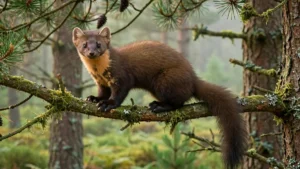
This guide covers the proboscis monkey, one species of large leaf-eating monkey that lives only in the mangrove and riverside forests of Borneo and swims rivers to escape crocodiles, while our pine marten species guide covers the pine marten, a small tree-climbing mustelid of the forests of Europe and western Asia that hunts voles and squirrels at night.
Are proboscis monkeys endangered?
Yes. The proboscis monkey is listed as Endangered on the IUCN Red List, with fewer than 7,000 mature animals left, and it is on CITES Appendix I, which bans commercial international trade. Its mangrove and riverside forest has been cleared for oil palm, timber and settlements.
Conclusion
The proboscis monkey species shows how a single animal can depend on a single place: Nasalis larvatus, one species, one island, one strip of riverside forest, and fewer than 7,000 mature animals left.
If you go looking for one, go at dawn, go by boat, and look for a troop in the trees above the river. Watch the big male raise his head and hear his call roll across the water, and you will see why this monkey has become the symbol of Borneo’s wild rivers.